How to Evaluate Alternative Steel Sheet Pile Profiles During Value Engineering?
When a client sends us two quotations for the same retaining wall and the numbers differ by thirty percent, the real question is almost never price — it is profile selection.
Value engineering for steel sheet piles is not about picking the cheapest section in a catalogue — it is about comparing every alternative profile on installed cost per square metre of wall, drivability, local availability and whole-life performance before you commit to a purchase order.
In our factory in Liaocheng, Shandong, we roll U-type, Z-type, Omega, flat web and straight web steel sheet piles, and we OEM sections for customers across the Middle East, Australia, Africa and the Americas. Every week an EPC contractor or a distributor asks us the same question: “the designer specified one section, but can you quote something equivalent — or better?” That question is where value engineering either saves real money or quietly creates a site problem. In this article I will walk you through the exact evaluation routine our technical team runs before we put an alternative profile on a quotation, so you can apply the same discipline to the steel sheet pile offers sitting on your desk.
What Does Value Engineering Actually Mean for Steel Sheet Pile Walls?
On real projects, value engineering gets misused more often than it gets used. Someone swaps a section, saves a few dollars per tonne, and inherits driving refusal, leakage or a change order that erases the saving.
A genuine value engineering exercise re-opens the design intent — retained height, soil, water, tolerance and service life — and asks which alternative steel sheet pile profile delivers that intent at the lowest installed and whole-life cost, not the lowest price per tonne.
Too many “alternatives” I see in incoming enquiries are not value engineering at all — they are substitutions driven by whatever stock a trader happens to hold. The difference matters because a steel sheet pile wall is a system: the profile, the section modulus, the interlock, the corrosion allowance and the installation method all interact. Change one variable without checking the others and the saving on paper becomes a claim on site.
The Five Gates We Run Before Quoting an Alternative Profile
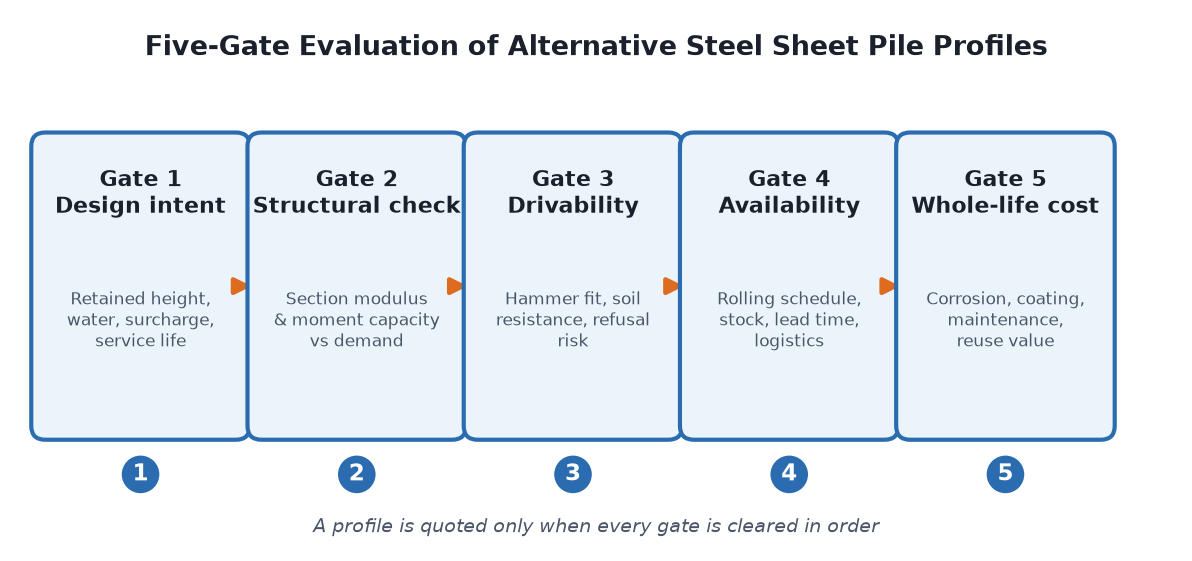
When a client asks us to quote an alternative section, our technical team refuses to answer until five gates are cleared, in order. Skipping a gate is how walls end up two centimetres out of line or a metre short of embedment. The table below is the checklist we apply internally; I encourage your engineers to copy it into their own review procedure.
| Gate | Core question | Evidence we require |
|---|---|---|
| 1. Design intent | What is the wall actually doing — retained height, water head, surcharge, service life? | Design loads, soil report, wall function sheet |
| 2. Structural equivalence | Does the alternative meet required bending moment and interlock strength? | Section modulus and moment capacity comparison |
| 3. Drivability | Can the alternative be installed with the available hammers and soil conditions? | Drivability analysis, assumed driving resistance |
| 4. Availability and lead time | Can we ship the required quantity within the programme? | Rolling schedule, stock position, port logistics |
| 5. Whole-life cost | Does the cheaper tonne cost more once corrosion, maintenance and risk are priced? | Corrosion allowance, coating plan, lifecycle estimate |
Only when all five gates pass do we price the alternative. This is also the point where we tell a client honestly that the original section was already the best choice — which, in my experience, builds more trust than forcing a swap. If you want to see how profile families differ structurally, our guide to matching sheet pile grades with project load requirements covers the strength side in detail.
Which Alternative Profiles Belong on Your Candidate List?
A useful candidate list is short and honest: two or three profile families that genuinely satisfy the design intent, not ten sections copied from a supplier’s stock list.
Compare at most three credible alternatives — typically the specified profile, one lighter or heavier sibling section, and one structurally different family — so the evaluation stays focused and the site team is not asked to handle four different interlocks.
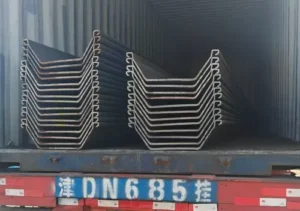
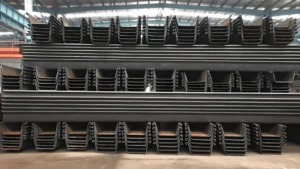
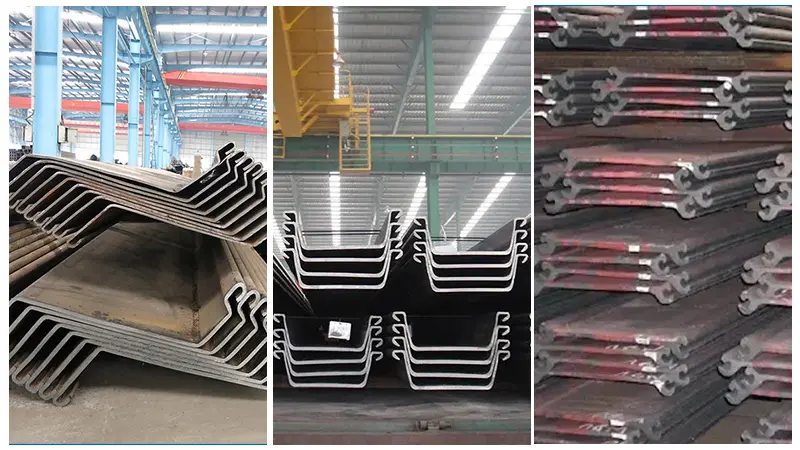
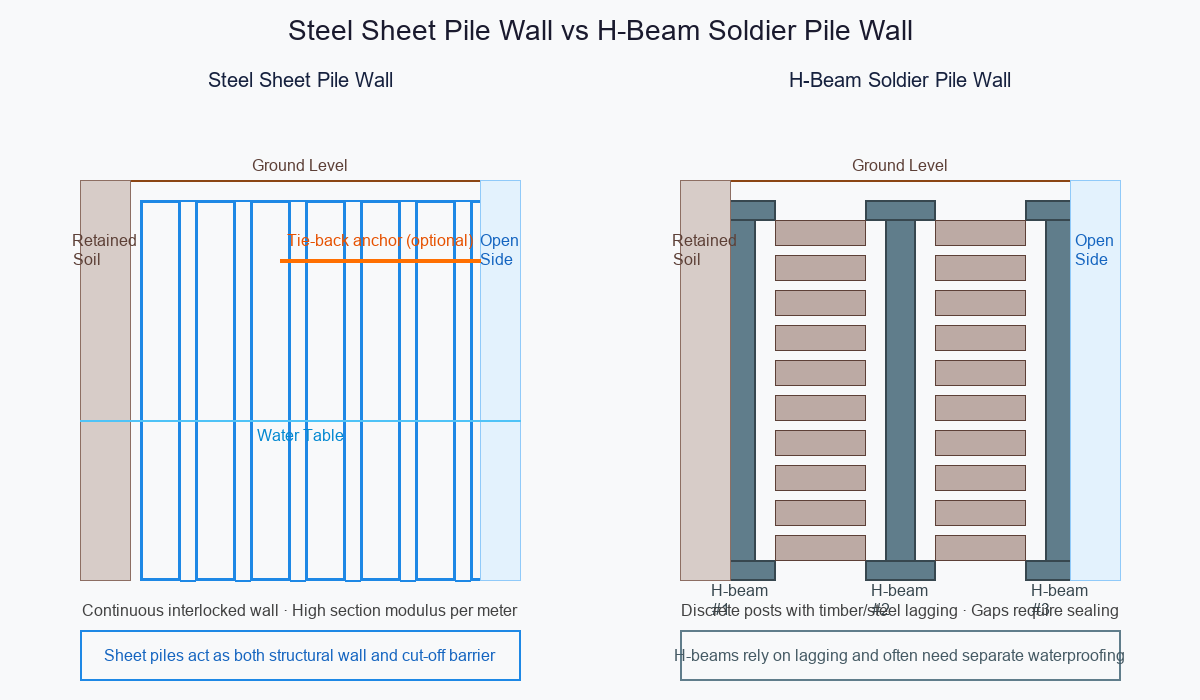
In our export business, the families that actually compete against each other are predictable. Z-type sections dominate quay walls and deep excavations because of their high modulus-to-weight ratio. U-type sections remain extremely popular in riverbank protection and general retaining work, and they are what most of our Middle East and African distributors ask for first. Omega and hat-shaped sections shine in shallow walls and slope toe protection where bending demand is modest. Flat web sections belong in circular cell structures such as cofferdams and bulkheads. Straight web sections handle the same cell-type applications where tension in the interlock governs. And for temporary pits, an H-beam and lagging system is sometimes the true “alternative profile” even though it is not a sheet pile at all — the cross-section comparison above shows why the two systems behave differently.
Matching Profile Families to Wall Functions
The table below summarises how we map wall functions to candidate families when a client invites alternatives. Treat it as a starting filter, not a design answer; the soil report and the wall height always get the final say.
| Profile family | Typical wall function | Strength profile | Watch-outs |
|---|---|---|---|
| Z-type | Quay walls, deep excavations, high walls | Highest modulus per kilo | Verify interlock tension in cells |
| U-type | Riverbank, general retaining, floodwalls | Good modulus, forgiving handling | Check crimping needs for high moment |
| Omega / hat | Shallow walls, slope toe, ditches | Efficient at low demand | Limited deep-wall track record |
| Flat web | Circular cells, cofferdams, bulkheads | Interlock tension governs | Cell geometry dominates cost |
| Straight web | Cells and tie-back structures | High interlock strength | Slower installation |
| H-beam + lagging | Temporary pits in stiff soil | Bending in flanges | Not watertight; settlement risk |
One caution from our workshop: never compare a hot-rolled section with a cold-formed section purely on modulus numbers. Yield strength tolerances, corner radius effects and interlock behaviour differ enough that the “equivalent” section may drive and seal very differently. Our manufacturing process article explains those rolling differences if you want the metallurgical background.
How Do You Normalise Price per Tonne Into Cost per Square Metre of Wall?
Price per tonne is the single most misleading number in a steel sheet pile quotation, because profiles differ enormously in mass per square metre of finished wall.
To compare profiles fairly, convert every offer into installed cost per square metre of wall face: multiply mass per square metre by price per tonne, then add the driving, handling and corrosion provisions that change with the section — the ranking often flips.
Here is a simplified example in the style we prepare for clients. The numbers are indicative only — actual pricing depends on the market week and freight — but the pattern is one I see constantly. Profile A is a heavy section quoted at a low price per tonne; Profile B is a more efficient section quoted higher per tonne but needing less steel per square metre of wall and less driving time.
A Worked Comparison in the Format We Send Clients
| Item | Profile A (heavy) | Profile B (efficient) |
|---|---|---|
| Indicative price per tonne (indexed) | 100 | 112 |
| Mass per m² of wall (indexed) | 132 | 100 |
| Steel cost per m² of wall (indexed) | 132 | 112 |
| Driving productivity (indexed) | 100 | 118 |
| Corrosion allowance area per m² | Identical | Identical |
| Installed cost per m² of wall (indexed) | ≈ 140 | ≈ 120 |
Profile B “loses” the price-per-tonne comparison and wins the wall comparison by roughly fifteen percent. Add pile length differences — which our article on wall height and section selection quantifies — and the gap widens further. This is exactly the arithmetic our cost factors guide recommends applying before any steel is ordered, and it is the same logic behind comparing quotations beyond price per ton.
What About Drivability, Availability and Lead Times?
A profile that cannot be driven through your soils with the hammers available in your market is not an alternative — it is a delay with a price tag attached.
Check drivability and availability before cost: an efficient section that refuses in dense gravel, or that needs a hammer nobody in your country can mobilise, will cost more in standby time than the tonne price ever saved.
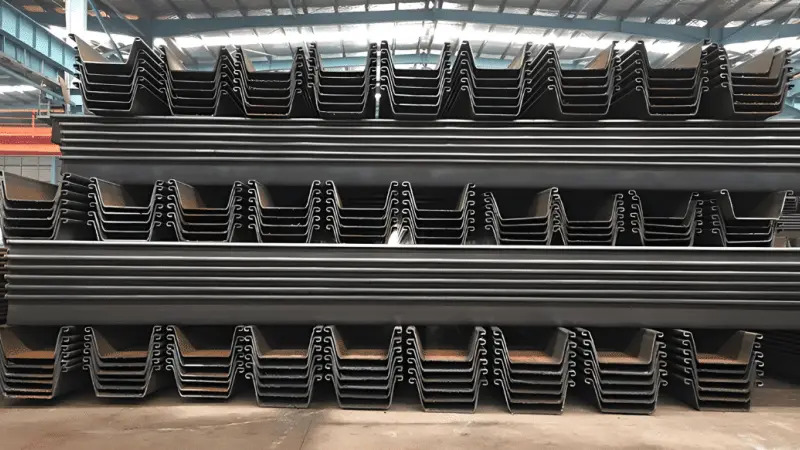
From our dispatch floor I can tell you that availability decides more value engineering outcomes than structural theory does. When a Gulf contractor asked us to evaluate an alternative Z-section against their specified U-section, the structural numbers were close. The deciding factors were entirely practical: the alternative was on the ASTM A6 rolling programme we already supply weekly, while the specified section would have meant a special campaign roll with a ten-week lead. The project moved with the alternative — not because it was cheaper on paper, but because it was physically available.
Availability Beats Theory on Real Projects
The table below lists the practical checks we complete before we even issue an alternative-profile quotation. Every one of them has killed a “savings” proposal at least once in my time here.
| Practical check | What we verify | Typical failure mode |
|---|---|---|
| Rolling schedule | Is the section on a regular campaign? | Special roll adds 6–12 weeks |
| Stock position | Can partial lots ship ahead of the programme? | Split shipments impossible |
| Local hammer fleet | Does the section suit available vibratory/impact units? | Standby while equipment is sourced |
| Corner and handling | Can cranes and press equipment handle the width? | Site congestion, slower pitch |
| Spares and re-supply | Can the same section be re-ordered mid-project? | Mixed interlocks on one wall |
That last row deserves emphasis. Mixing two different interlock families on one wall because the first lot ran out is a watertightness risk we refuse to ship for, and our hidden costs article prices exactly that kind of risk. If your project has phase-based delivery needs, involve the supplier’s split shipment planning early — availability is a supply chain question as much as a steel question.
How Do You Compare Whole-Life Performance Instead of Purchase Price?
The cheapest envelope often carries the most expensive future: a section chosen without corrosion allowance or coating planning can double its maintenance cost within a decade.
Add the future to the comparison — corrosion allowance, coating or galvanising, inspection intervals and reuse value — and evaluate profiles on whole-life cost per square metre of wall, not on the invoice you pay this quarter.
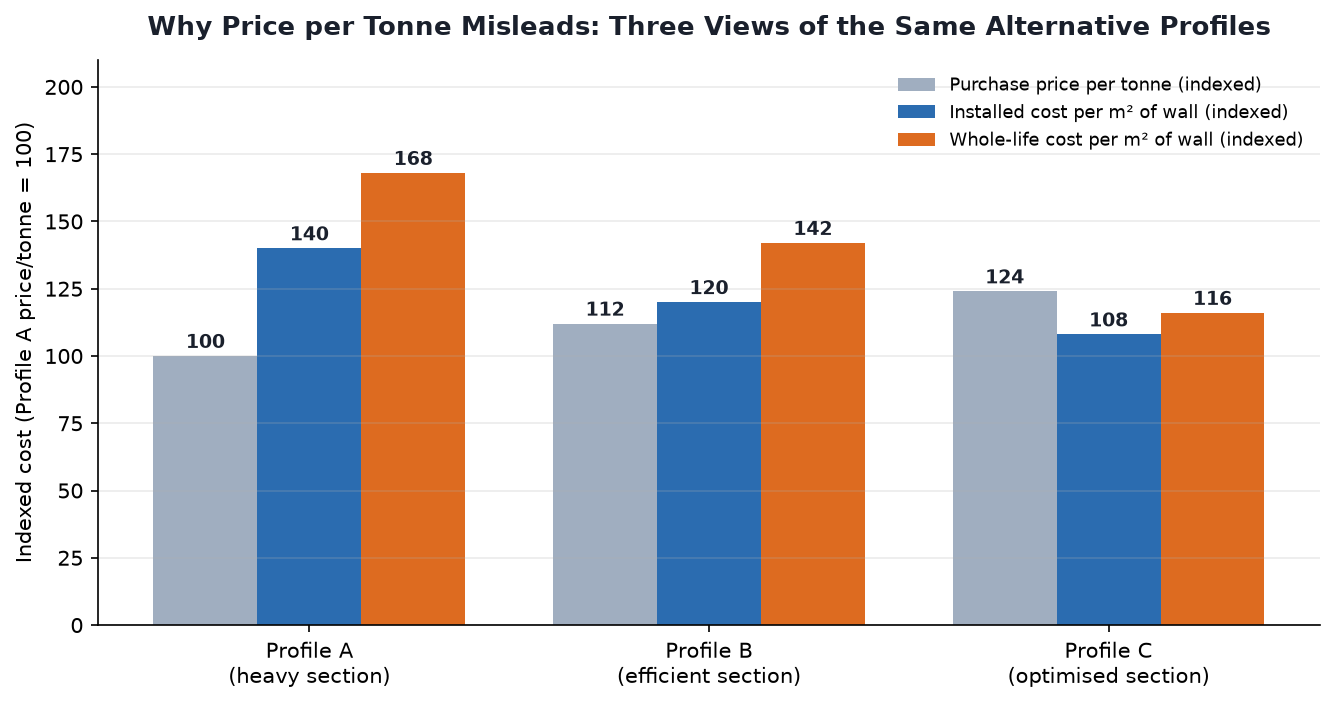
Whole-life comparison is where alternative profiles truly separate. A heavier section with generous sacrificial steel may outlast a “efficient” section in an aggressive splash zone by a wide margin, which flips the ranking again — the chart above shows the typical pattern we present to clients: purchase price per tonne tells one story, installed cost per square metre a second story, and whole-life cost a third. In marine and industrial environments, our corrosion resistance guide walks through the allowance and coating options profile by profile, and our quality standards article covers the certification documents that prove the steel you bought is the steel that arrives.
Building a Whole-Life Number the Whole Team Trusts
We keep the whole-life model deliberately simple, because an opaque spreadsheet convinces nobody. Four cost blocks, each with an owner and a source:
| Cost block | What it captures | Who owns the number |
|---|---|---|
| Supply | Steel, freight, duties, payment terms | Buyer and supplier jointly |
| Install | Driving, handling, guide frames, standby | Contractor |
| Protect | Corrosion allowance, coatings, cathodic protection | Designer |
| End of life | Extraction and reuse value, or disposal | Owner |
A profile that extracts cleanly and resells into the reuse market can justify a higher initial price — we have shipped reusable lots to Australia and the Middle East where the second user paid real money for steel that was correctly specified the first time. When you buy steel sheet piles from China, ask the supplier to state reuse assumptions explicitly, not as a marketing footnote.
My Take: Where Value Engineering Goes Wrong on Imported Projects
After years of quoting alternatives from Liaocheng, I have one observation I share with every technical client: most failed value engineering exercises were decided before the engineering started. Someone had already fallen in love with a cheaper tonne, and the evaluation became a document defending a decision rather than a test of one. The healthiest alternative-profile reviews I participate in all share three habits. First, the contractor sends us the design intent, not just the section designation — retained heights, water levels and service life, the same inputs we would need for a proper RFQ package. Second, the comparison is run per square metre of wall with installation included, which naturally surfaces the sections that are efficient in reality rather than efficient in a brochure. Third, someone owns the whole-life number, so corrosion and reuse are priced by a person, not discovered by a maintenance budget five years later. When those three habits are present, the winning profile is usually obvious within a week, and it is rarely the section anyone started with.
Conclusion
Evaluate alternative steel sheet pile profiles on installed cost per square metre of wall, drivability, availability and whole-life performance — never on price per tonne alone — and the cheapest option usually becomes obvious.