What Corrosion Resistance Solutions Keep Steel Sheet Piles Alive for Decades?
A contractor in the Middle East once called me because his port wall looked fine on paper but was losing thickness faster than expected. Corrosion can quietly eat the service life out of steel sheet piles if you do not plan for it from day one.
The best corrosion resistance solutions for steel sheet piles combine protective coatings, corrosion-resistant steel grades, cathodic protection, and regular inspection. The right mix depends on the exposure zone, soil chemistry, and the design life of the structure.
In our factory in Liaocheng, Shandong, we ship protected steel sheet piles to marine projects across Iraq, Iran, the UAE, Saudi Arabia, Bahrain, Kuwait, Pakistan, Australia, and Africa. Over the years, I have learned that corrosion protection is not a single product. It is a system. If you are also thinking about installation methods, check that guide after you finish this one. Let me walk you through how we think about it.
Why Do Steel Sheet Piles Corrode in the First Place?
Steel sheet piles look massive, but they are still steel. When steel meets water, oxygen, and salts, it starts to rust. This is the problem every marine project faces.
Steel sheet piles corrode because electrochemical reactions turn iron into iron oxides when the steel surface is exposed to moisture, oxygen, and aggressive ions like chloride.
The electrochemical story
Corrosion is an electrochemical process. At the anodic areas of the steel surface, iron atoms lose electrons and dissolve into the water as ions. At the cathodic areas, oxygen and water pick up those electrons and form hydroxide. The result is rust, which flakes off and exposes fresh steel underneath.
In seawater, the process speeds up because chloride ions break down the passive film that normally protects steel. In acidic soils or industrial runoff, low pH can accelerate attack. Even in clean fresh water, the submerged zone can suffer if dissolved oxygen levels are high and coatings are damaged.
Typical corrosion rates by environment
| Exposure environment | Typical corrosion rate (mm/year) | Risk level |
|---|---|---|
| Rural atmosphere, dry | 0.01 – 0.05 | Low |
| Urban / industrial atmosphere | 0.05 – 0.15 | Moderate |
| Marine atmosphere | 0.10 – 0.30 | High |
| Seawater immersion | 0.10 – 0.25 | High |
| Tidal and splash zone | 0.20 – 0.50 | Very high |
| Aggressive soils (acidic, sulfate) | 0.10 – 0.40 | High |
These numbers are rules of thumb. The real rate depends on temperature, oxygen, salinity, pH, and whether the wall is in the splash zone or fully submerged. That is why we always ask for the project’s environmental report before recommending a protection package.
Which Corrosion Zones Matter Most for Marine Sheet Piles?
Not every part of a marine wall corrodes at the same speed. If you treat the whole wall the same way, you either overspend or leave weak points exposed.
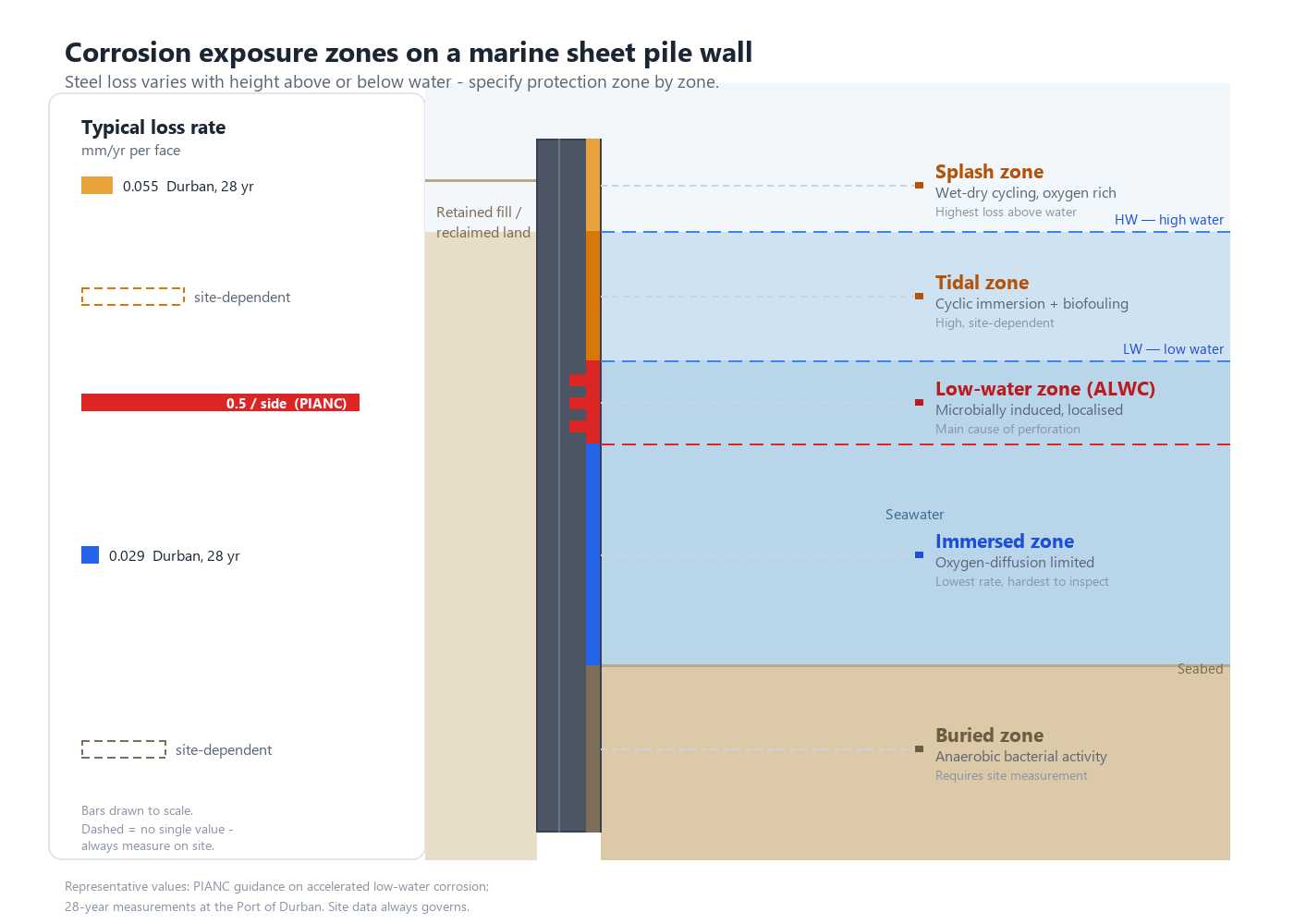
The splash zone and the tidal zone usually suffer the most corrosion because they stay wet and well-oxygenated at the same time.
Zone-by-zone breakdown
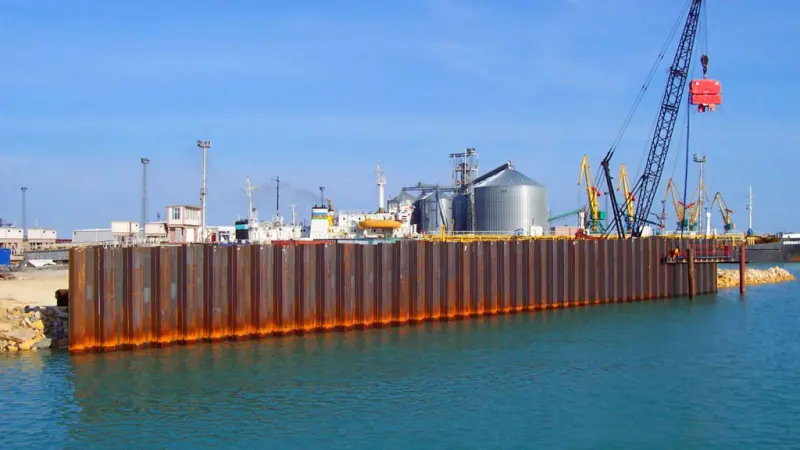
Marine sheet pile walls can be split into five main zones. Each one needs a different level of attention. This is why a harbor protection design and a retaining wall design do not share the same coating specification.
The atmospheric zone sits above the highest water level. It gets spray and humidity but dries out between wetting cycles. Corrosion here is usually slow and can be handled with a good paint system or hot-dip galvanization.
The splash zone is the killer. It is wetted by waves and spray but never fully submerged, so oxygen replenishes constantly. This zone often needs the heaviest coating, concrete encasement, or a thicker steel allowance.
The tidal zone is submerged part of the day and exposed part of the day. Like the splash zone, it has plenty of oxygen and moisture. Coating damage here is common because of wet-dry cycling and mechanical abrasion from debris.
The submerged zone is always under water. Oxygen levels are lower, but chlorides and bacteria can still cause pitting. Coatings and cathodic protection both work well here.
The soil zone is buried below the mud line. Corrosion depends on soil resistivity, pH, sulfate content, and microbial activity. In low-resistivity clays or peat, corrosion can be surprisingly aggressive.
| Corrosion zone | Main attack mode | Typical protection |
|---|---|---|
| Atmospheric | Uniform rust | Paint, galvanizing, weathering steel |
| Splash | Severe uniform + pitting | Thick coatings, concrete, extra steel |
| Tidal | Wet-dry cycling + abrasion | High-build coatings, splash-zone tapes |
| Submerged | Chloride pitting | Coatings + cathodic protection |
| Soil | Microbial + chemical | Coatings, cathodic protection, backfill control |
When we quote protected sheet piles for a quay wall or breakwater, we design the protection package zone by zone instead of using one generic coating.
What Are the Most Common Corrosion Protection Coatings?
Coatings are the first line of defense. They keep water and oxygen away from the steel surface. But not all coatings survive the life of a marine structure.
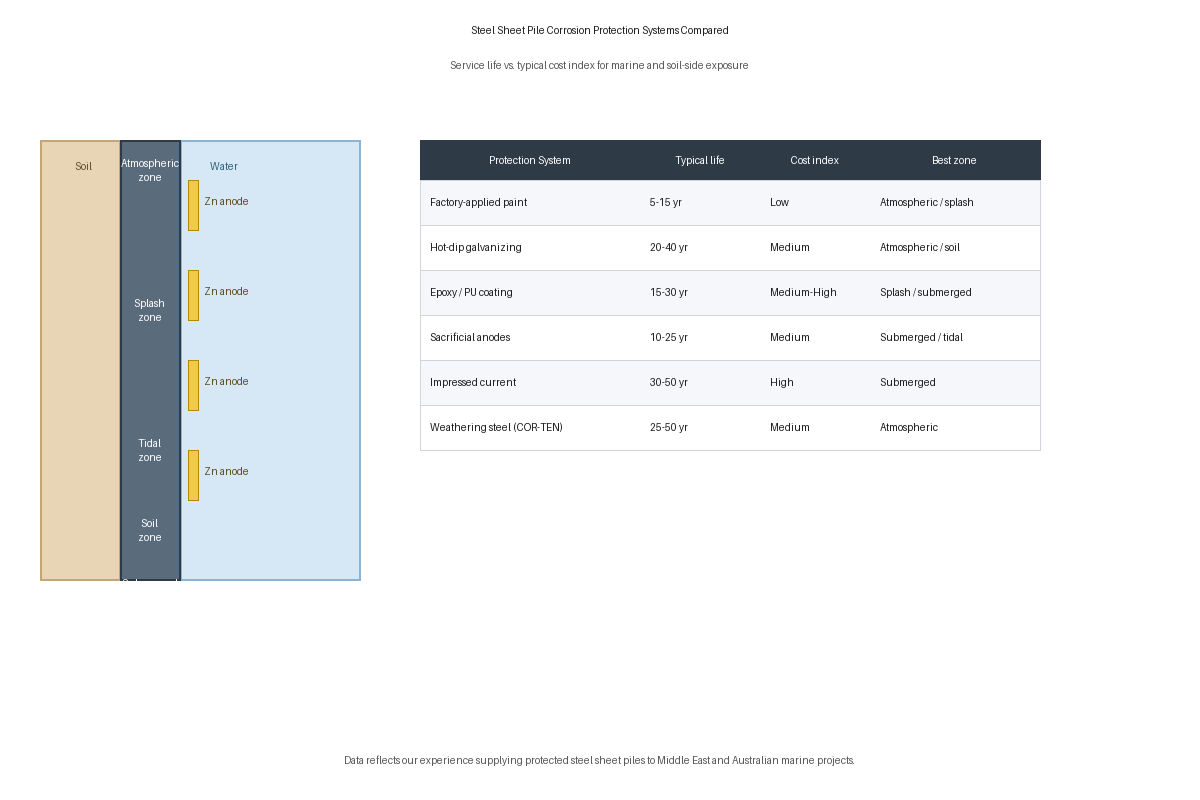
Common coatings for steel sheet piles include alkyd paints, epoxy systems, polyurethane topcoats, and splash-zone elastomeric tapes.
Coating families we see on site
Alkyd paints are cheap and easy to apply. They work for atmospheric exposure but do not last long in immersed or splash zones. I usually treat them as a touch-up or temporary solution, not a 50-year marine system.
Epoxy coatings give excellent adhesion and barrier protection. They are widely used on steel sheet piles that will be submerged or buried. The downside is that epoxies can chalk and degrade under UV, so they need a polyurethane topcoat if exposed to sunlight.
Polyurethane topcoats add color, gloss, and UV resistance. They go over epoxy primers to give a complete system. A typical marine specification is epoxy primer plus epoxy intermediate plus polyurethane topcoat, with a total dry film thickness of 300 to 500 microns.
Splash-zone tapes and elastomeric coatings are thick, rubber-like materials applied by hand or machine. They handle impact, thermal movement, and wet-dry cycling better than hard paint films. I recommend them for the splash and tidal zones of permanent walls.
| Coating system | Typical DFT | Expected life | Best zone |
|---|---|---|---|
| Alkyd paint | 80 – 120 µm | 3 – 7 years | Atmospheric |
| Epoxy primer + intermediate | 250 – 400 µm | 10 – 20 years | Submerged / soil |
| Epoxy + polyurethane topcoat | 300 – 500 µm | 15 – 25 years | Atmospheric / splash |
| Splash-zone tape / elastomer | 1 – 3 mm | 20 – 30 years | Splash / tidal |
Our mill partners can apply these coatings in the shop under controlled conditions, which gives better adhesion and fewer holidays than field application. For projects in the Middle East and Australia, we prefer shop-applied systems because site humidity and sand make field painting risky. The same care applies when we select sheet pile interlocks for water sealing in marine walls.
When Should You Specify Corrosion-Resistant Steel Grades?
Sometimes the best protection is built into the steel itself. Higher alloy grades resist corrosion better than ordinary carbon steel.
Specify corrosion-resistant steel grades such as ASTM A690 or weathering steels when the structure needs a long design life in marine or industrial atmospheres.
Grade options for aggressive environments
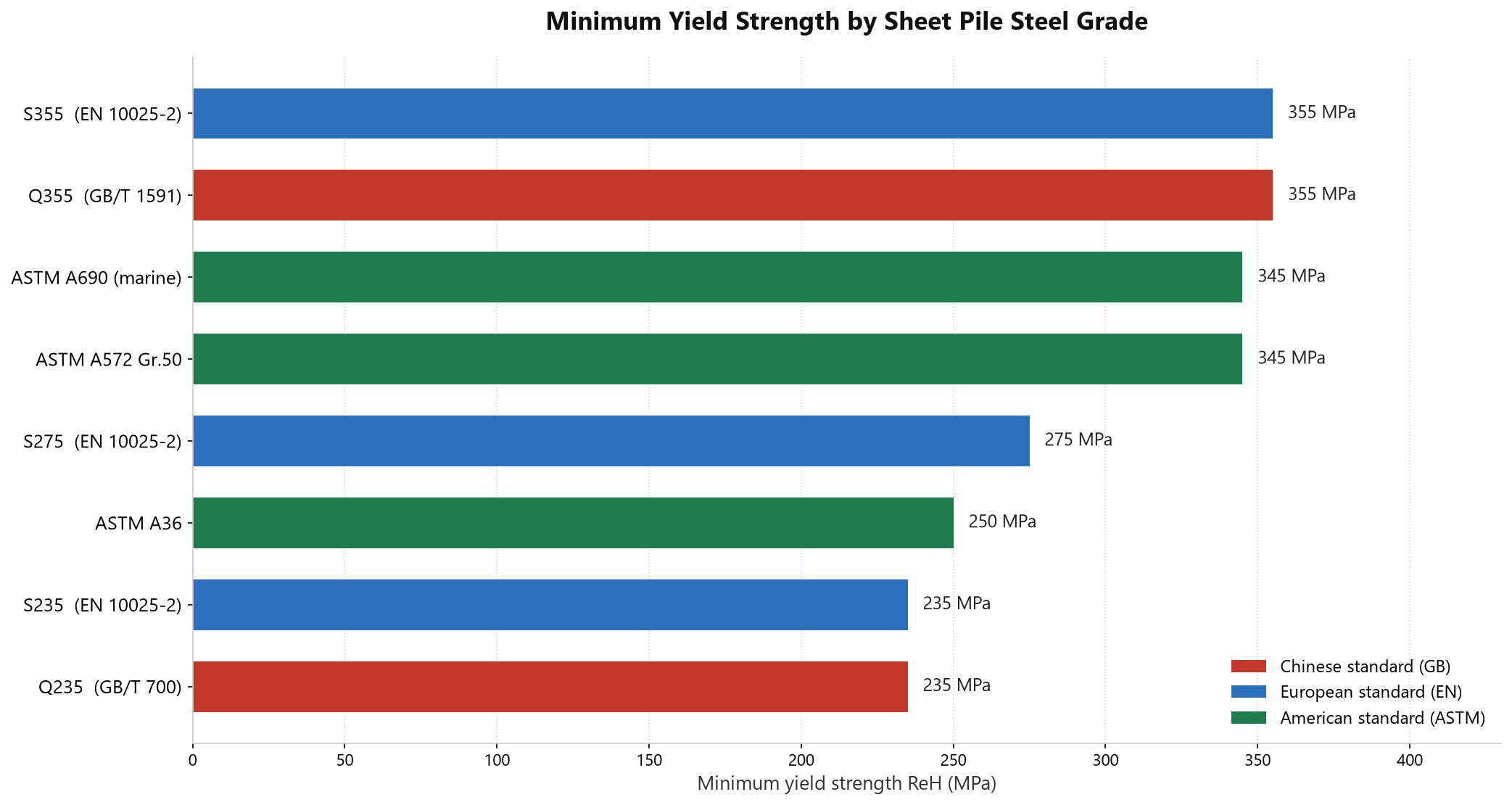
Ordinary carbon steel sheet piles such as Q235, Q355, S235, S275, and S355 meet most structural needs. But in aggressive environments, the base metal itself can be upgraded. We covered the differences between these grades in our post on common steel grades used for sheet piles.
ASTM A690 is a common choice for marine sheet piling in North America and export projects. It contains small additions of copper, nickel, and chromium that improve resistance to seawater corrosion. From my experience, A690 can reduce corrosion rates in the splash zone by roughly one-third compared to plain carbon steel.
Weathering steels, often called by trade names like COR-TEN, form a stable rust patina in atmospheric exposure. The patina slows further attack. They work well for above-water faces but are not a magic solution for submerged or splash zones.
Stainless steel clad sheet piles exist for extreme cases, but the cost is high and they are rarely used for standard civil projects. For most bulkheads and quay walls, A690 or a coated carbon grade is the practical choice.
| Steel grade | Key feature | Typical marine use |
|---|---|---|
| Q235 / S235 | Low cost, easy to weld | Low-risk atmospheric or temporary works |
| Q355 / S355 | Higher strength | General marine walls with coating |
| ASTM A690 | Enhanced marine corrosion resistance | Permanent marine walls, splash zones |
| Weathering steel | Self-protecting patina | Atmospheric face of walls |
| Stainless clad | Maximum resistance | Aggressive chemical or long-life projects |
When a client asks us for a 50-year design life in the Gulf, we usually propose A690 in the splash zone and coated Q355 or S355 elsewhere. This balances cost and durability. The choice between temporary and permanent structures also changes how much we invest in corrosion protection.
How Do Cathodic Protection Systems Work with Sheet Piles?
Coatings can be scratched or damaged during installation. Cathodic protection covers those gaps by making the steel the cathode of an electrochemical cell.
Cathodic protection stops steel sheet piles from corroding by supplying electrons from sacrificial anodes or an impressed current system.
Sacrificial anodes
Sacrificial anodes are blocks of zinc, aluminum, or magnesium alloy bolted or welded to the steel wall. These metals are more reactive than steel, so they corrode instead of the wall. They are simple, reliable, and need no power supply.
I like sacrificial anodes for remote marine sites where maintenance crews cannot visit often. The downside is that they consume themselves and must be replaced after a certain number of years. Designers calculate anode mass and spacing based on the protected steel area, current density, and design life. For bridge pier and cofferdam projects, we often pair anodes with the braced walls described in our bridge foundation guide.
Impressed current systems
Impressed current cathodic protection, or ICCP, uses an external DC power supply to force current onto the steel through inert anodes. It can protect large areas with smaller anode systems and is common for long quay walls and jetties.
ICCP needs monitoring and power, so it suits ports and industrial sites with regular maintenance. It is usually overkill for small temporary cofferdams.
| System type | Power needed | Maintenance | Typical use |
|---|---|---|---|
| Sacrificial anodes | No | Anode replacement | Jetties, small quay walls, remote sites |
| Impressed current | Yes | Electrical system monitoring | Large ports, industrial marine facilities |
Cathodic protection works best when combined with a good coating. The coating reduces the exposed steel area, which reduces the current demand and makes the system cheaper to run.
How Do You Inspect and Maintain Protected Sheet Pile Walls?
Protection is not a one-time decision. Even the best system needs inspection, especially after storms or vessel impact.
Inspect protected steel sheet pile walls visually, measure remaining thickness with ultrasonic testing, and check cathodic protection potentials at regular intervals.
Inspection routine
We recommend a baseline survey right after installation. Record coating condition, thickness readings, and anode potentials if cathodic protection is used. Then schedule follow-up surveys every two to five years, depending on exposure.
Visual inspection looks for coating damage, rust staining, anode consumption, and deformation. Ultrasonic thickness testing tells you whether corrosion is occurring under apparently sound coating. For cathodic protection, potential measurements confirm the steel is staying cathodic.
Minor coating damage can be repaired with compatible touch-up paint. Severely damaged areas may need blast cleaning and re-coating. If anodes are more than 80 percent consumed, they should be replaced before the steel starts to depolarize.
| Inspection task | Frequency | Purpose |
|---|---|---|
| Visual coating survey | Annual | Catch mechanical damage and rust stains |
| Ultrasonic thickness | Every 2 – 5 years | Measure actual section loss |
| Cathodic potential survey | Every 1 – 3 years | Confirm protection is active |
| Anode consumption check | Every 3 – 5 years | Plan replacement |
We have seen walls in the Middle East where a simple annual visual check caught barge impact damage early. A small repair kept the wall on track for its full design life. Without that check, the damaged zone could have become a corrosion hotspot. This is especially true for retaining walls that carry both soil and hydraulic loads.
My view from the field
After years of quoting and supplying steel sheet piles to marine contractors, I have one simple rule: design for the worst zone, not the average condition. The splash zone will decide your wall’s life. If you only spec a standard paint system because the submerged zone looks calm, you are asking for trouble.
I also think cathodic protection is underused on smaller projects. People see it as an extra cost, but when you add up coating repairs, section loss, and early replacement, a small sacrificial anode system often pays for itself. For permanent marine structures, we almost always propose coating plus cathodic protection.
Finally, do not forget the paperwork. A corrosion protection plan should include the environmental data, coating specification, steel grade selection, anode design, and inspection schedule. Strength matters too, so we always cross-check the section against the loads discussed in our post on structural strength and load-bearing capacity. When our clients in Australia or Saudi Arabia hand this package to their consultant, the project moves faster and approvals come easier.
Conclusion
Protecting steel sheet piles from corrosion means choosing the right coatings, steel grades, and cathodic systems for each exposure zone. Plan it early, inspect it regularly, and the wall will last.
Tags: corrosion-resistant steel sheet piles, marine sheet pile protection, cathodic protection, ASTM A690, protective coatings