What Determines the Structural Strength and Load-Bearing Capacity of Steel Sheet Piles?
When a retaining wall moves or a cofferdam leaks, the first question I ask is about strength. I have seen too many projects where the pile section was chosen by habit, not by load.
The structural strength of steel sheet piles comes from their steel grade, cross-section geometry, section modulus per meter, and embedment depth. Load-bearing capacity depends on the soil reaction, lateral earth pressure, water table, and support conditions.
If you are a contractor or engineer choosing piles for a port, riverbank, or deep excavation, you need numbers you can trust. In this article I will explain the factors that control strength and capacity, with real tables from our factory experience.
How Does Steel Grade Affect Sheet Pile Strength?
Many buyers ask me if Q235 is enough. My answer is always the same: it depends on the load.
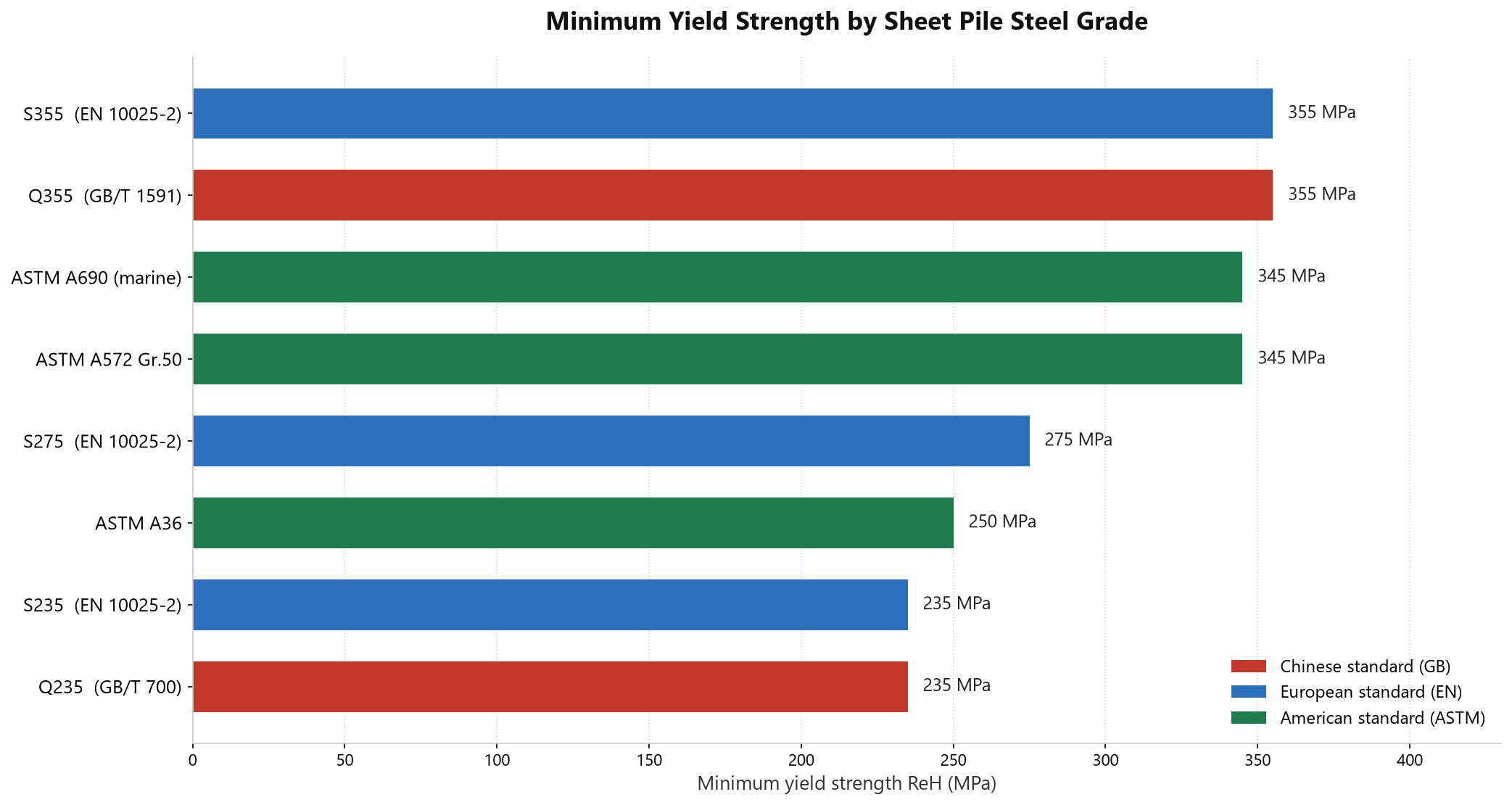
Steel grade sets the yield strength. Q235 offers about 235 MPa, Q355 gives 355 MPa, and S355 provides the European equivalent. A higher grade raises moment capacity without changing the profile shape.
Yield strength and allowable stress
In our mill practice, steel sheet piles are ordered by both section and steel grade. The grade tells us how much stress the steel can take before it starts to deform permanently. That stress limit is called yield strength. For design we do not use the full yield value. Engineers apply a safety factor, often between 1.25 and 1.5, to reach an allowable stress. If the working stress stays below that allowable value, the wall is considered safe.
I often see buyers compare unit weight only. A heavier pile is not always stronger. Two piles can weigh the same per meter but have very different section modulus because their steel is distributed differently. That is why I always ask customers for the design moment before I recommend a grade.
For marine walls we frequently move up to S355 or ASTM A572 Grade 50. For splash zones with seawater we may suggest ASTM A690 because it adds copper and nickel for corrosion resistance. The extra strength also helps when waves or berthing loads hit the wall. For ordinary land retaining walls in the Middle East, Q345 or Q355 is usually sufficient.
| Steel grade | Min yield strength (MPa) | Min tensile strength (MPa) | Typical use case |
|---|---|---|---|
| Q235 / S235 | 235 | 360–440 | Light retaining walls, temporary works, low lateral loads |
| Q345 / Q355 / S355 | 345–355 | 470–630 | Permanent retaining walls, cofferdams, port quays |
| ASTM A36 | 250 | 400–550 | General construction, North America projects |
| ASTM A572 Gr.50 | 345 | 450 | Heavy-duty walls, high bending moments |
| ASTM A690 | 345 | 483 | Marine environments, seawater corrosion zones |
Matching grade to load
A practical rule I use is this: if the required section modulus at Q235 forces you into an unusually large profile, switch to Q355 first. The stronger steel may let you keep a smaller, easier-to-drive section. That saves tonnage and driving time. However, going to a very high grade without a corresponding section size is not smart. The interlock still has to carry the shear, and the pile still has to resist local buckling.
In our factory in Liaocheng, Shandong, we keep Q235, Q355, and S355 in regular stock. We can also roll or source ASTM A572 and ASTM A690 for export orders. Every heat comes with a mill certificate, and we support third-party SGS inspection if the buyer needs it.
Why Does Cross-Section Shape Matter More Than Thickness?
I often watch buyers compare wall thickness first. Thickness is easy to see, but it is not the whole story.
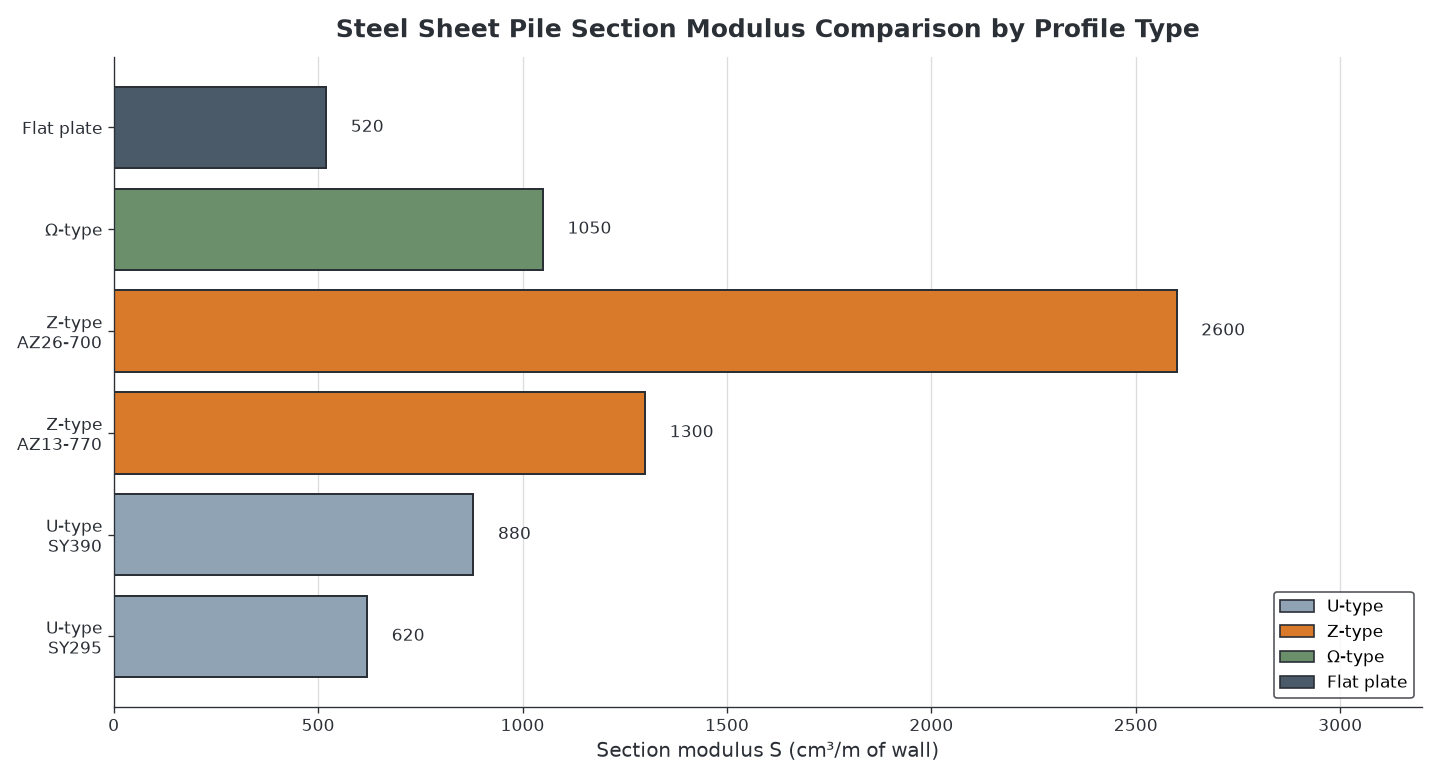
U-type piles handle general bending well, Z-type piles use material efficiently for deep walls, and flat or Ω profiles fit special cases. The real strength indicator is the section modulus per meter of wall, not the weight per meter.
Section modulus decides bending capacity
The section modulus is the number I care about most. It tells us how much bending moment a pile section can resist. A higher section modulus means a stronger wall for the same steel grade. The formula engineers use is simple: allowable moment equals allowable stress times section modulus. If you double the section modulus, you double the moment capacity.
Different profile shapes put the steel in different places. A Z-type sheet pile puts more material farther from the neutral axis. That gives a higher section modulus for the same amount of steel. That is why long, deep walls often use Z sections. A U-type sheet pile is easier to drive and handles lower loads at lower cost. Flat and Ω profiles are useful when the wall is mainly a facing or when you need a flush surface.
| Profile family | Typical section modulus range (cm³/m) | Best use | Main advantage |
|---|---|---|---|
| U-type | 500–2,400 | Riverbanks, small ports, temporary walls | Easy driving, good interlock |
| Z-type | 1,200–6,000+ | Deep retaining walls, heavy quays | High modulus per ton |
| Ω-type | 600–1,800 | Tunnels, special architectural faces | Flat face, good bending |
| Flat plate | 400–1,200 | Cellular cofferdams, combined walls | Simple geometry, easy welding |
Interlock strength is separate from section modulus
One mistake I see in some specifications is to ignore the interlock. The section modulus tells you about the single pile. The interlock tells you about the continuous wall. If the lock cannot transfer shear from one pile to the next, the wall acts like separate boards instead of one plate. For high loads or cofferdams, I recommend checking the interlock strength with the supplier. We test our interlocks for tightness and tensile capacity before shipment.
For very high retaining walls, designers sometimes use combined walls. A combined wall links king piles, often H-beams or pipes, with lighter sheet piles as infill. The king piles take the big moment, while the sheet piles close the gap. This is a common solution for deep marine structures and heavy quay walls.
What Loads Must a Steel Sheet Pile Wall Actually Carry?
A sheet pile wall is not just a fence in the ground. It feels soil, water, and traffic loads every day.
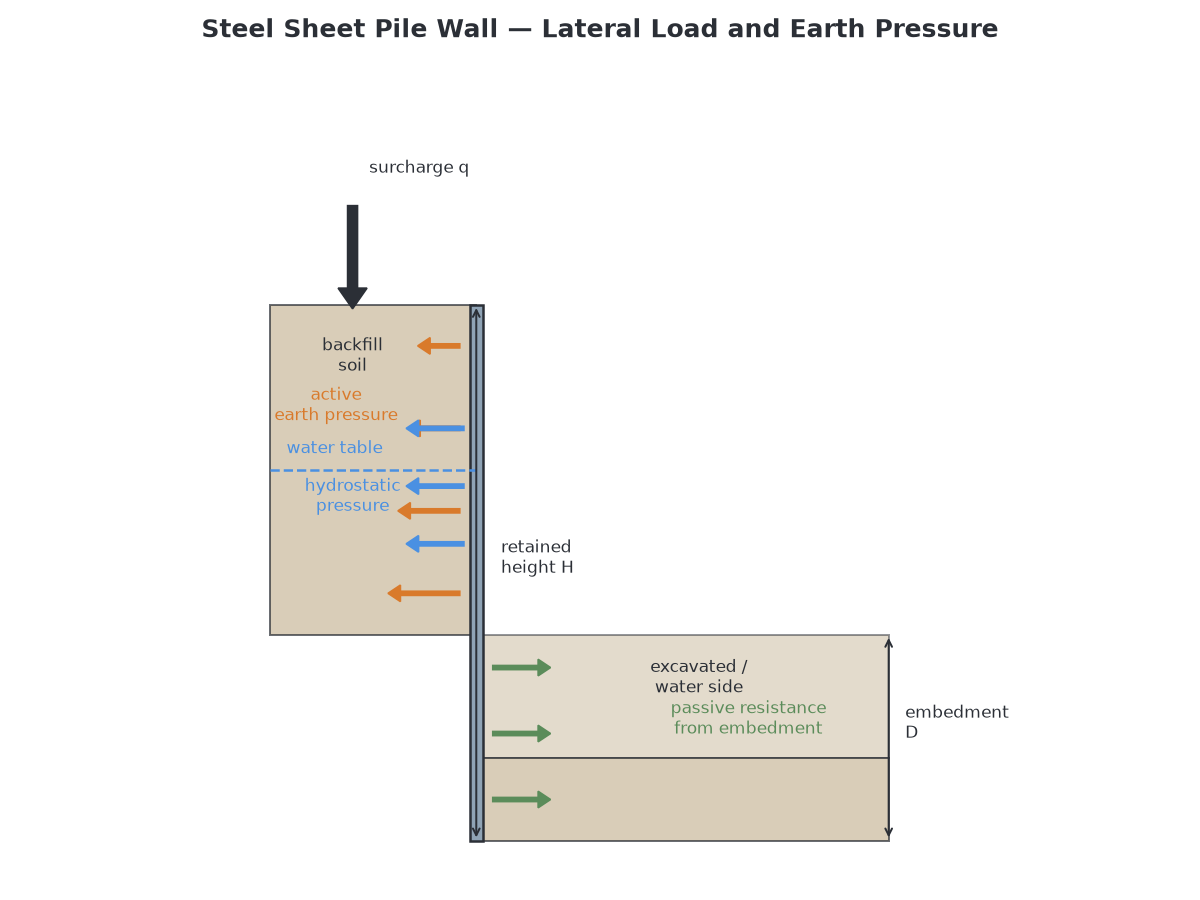
A steel sheet pile wall carries lateral earth pressure, hydrostatic pressure, surcharge loads from cranes or traffic, and wave or ice loads in marine sites. Capacity means resisting all of these at once with a safe margin.

Types of lateral load
The main load on a sheet pile wall is lateral earth pressure. When the ground level is different on each side, the soil pushes against the wall. The pressure depends on the soil type, the height of the wall, the water table, and whether the soil is allowed to move a little or not at all. Engineers classify three basic states: active pressure, where the wall can move outward; passive pressure, where the soil resists inward movement; and at-rest pressure, where the wall is not allowed to move.
Water pressure adds a straight horizontal load. If the water level is higher on one side, it pushes the wall just like it pushes a dam. I have seen walls fail because someone forgot the tide or the seasonal groundwater rise. In marine projects, wave impact and ice impact add short, high loads. In port projects, berthing and mooring forces from vessels also count.
| Load type | Source | Typical effect on design |
|---|---|---|
| Active earth pressure | Soil behind the wall | Main bending load, increases with wall height |
| Passive earth pressure | Soil in front of the toe | Resistance, needs enough embedment depth |
| Hydrostatic pressure | Water level difference | Uniform triangular or trapezoidal load |
| Surcharge | Traffic, cranes, stockpiles | Adds rectangular pressure behind the wall |
| Wave / ice / vessel | Marine environment | Short-duration impact, may govern at low tide |
How embedment creates resistance
The lower part of the sheet pile is driven below the excavation or seabed. That buried part pushes into passive soil. This is what stops the wall from rotating forward. If the embedment is too short, the toe kicks out and the wall leans. If the soil in front is weak or already disturbed, the passive resistance is lower, and you need either longer piles or anchors.
For temporary cofferdams, I often see designs with embedment equal to 0.5 to 0.8 times the retained height. For permanent quay walls, the rule can be 1.0 to 1.5 times or more, depending on the soil report. These are only starting points. A proper design uses soil mechanics calculations.
How Do Embedment Depth and Support Systems Increase Capacity?
I have watched walls move because the embedment was too short. Depth is cheap insurance.
Embedment depth creates passive resistance below the excavation. Adding anchors, struts, or deadmen reduces the free span and the bending moment in the pile.

Cantilever versus supported walls
A cantilever wall relies only on embedment for support. It is simple and fast, but the bending moment grows quickly with wall height. For heights above about 5 to 6 meters in normal soil, a cantilever wall becomes uneconomical. The pile section needed gets very heavy.
An anchored or strutted wall adds a support near the top. The support carries part of the lateral load, so the pile is loaded between two points instead of as a long cantilever. This reduces the maximum moment and allows a lighter section. I have supplied Z-type piles for deep excavation projects where two or three levels of struts made the difference between a feasible design and an impossible one.
| Support type | Max typical free height | Deflection control | Cost driver |
|---|---|---|---|
| Cantilever | 3–6 m | Largest | Heavy pile section, long embedment |
| Single anchor / tie rod | 6–12 m | Moderate | Anchor block or deadman, fewer piles |
| Multi-strut bracing | 12–20+ m | Smallest | Strut installation and removal |
| Combined wall with king piles | Very deep | Very good | King pile spacing and infill sheet piles |
Anchors and deadmen
In marine quay walls, we often see tie rods connected to a deadman anchor buried behind the wall. The tie rod pulls back on the upper part of the wall, balancing the active earth pressure. The deadman anchor must be far enough behind the wall to sit in stable soil outside the active failure wedge. If it is too close, the whole system can fail together.
For temporary excavations, internal struts are common. They do not need anchor blocks, but they get in the way of construction inside the pit. The choice between anchors and struts depends on what is happening inside the wall. We usually leave that decision to the design engineer, but we make sure the sheet pile section we supply can handle the resulting moment diagram.
My Take: Don’t Buy Sheet Piles by the Ton
After years of quoting steel sheet piles for projects in the Middle East, Australia, Africa, and beyond, I have one piece of advice: do not buy by tonnage alone. Tonnage is easy to compare, but it does not tell you if the wall will stand.
The right question is: what is the required section modulus and embedment depth for the design moment? Once I know that, I can match a grade and profile that meet the strength without wasting steel. Sometimes a lighter Z-type in S355 is cheaper and faster to drive than a heavier U-type in Q235. Sometimes the opposite is true, because the site has a tight vibratory hammer and the Z section is harder to interlock.
I also insist on real documentation. Mill certificates, chemical composition, mechanical test reports, and SGS inspection support are part of the package when we export from Shandong. If a contractor is building a cofferdam for a bridge foundation, the cost of a failed wall is far higher than the cost of the right grade. For riverbank protection jobs, choosing the right embedment and profile can add years to the service life.
We keep stock of U-type, Z-type, Ω-type, flat, and straight flange sheet piles. OEM sizes are available, and our usual lead time from Liaocheng works well for export schedules. If you send me the wall height, soil type, water level, and any surcharge, I can help you choose a section that fits the structural strength and load-bearing capacity you actually need.
Conclusion
Steel grade, section geometry, soil loads, and embedment depth together set the strength and capacity of your wall. Choose with numbers, not habit.
Tags: structural strength, load-bearing capacity, section modulus, steel grades, retaining wall design