Water and weak ground stop most excavations dead. A steel sheet pile cofferdam holds both back, so your crew works in the dry, on schedule, below the water table.
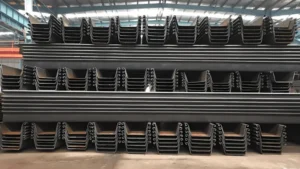
Steel sheet piles for cofferdams and deep excavations are interlocked steel sections driven into the ground to form a strong, near-watertight wall. They retain soil and water, keep the pit dry, and can be extracted and reused after the permanent works are built.
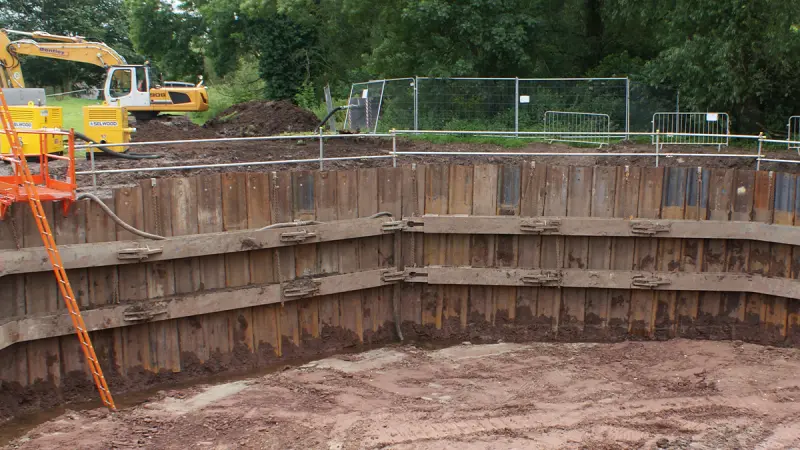
In this guide I walk through the whole system the way I discuss it with contractors: what a cofferdam actually is, how deep a wall can go unbraced, how to choose between struts and anchors, how the water is kept out, which section and steel grade to order, and what happens to the piles when the job ends. Every point comes from questions our customers ask before they confirm an order.
What Is a Cofferdam and When Do You Need One?
A cofferdam is a temporary enclosure built in water or soft ground. Choose the wrong type and you pay twice — once in steel, once in delay.
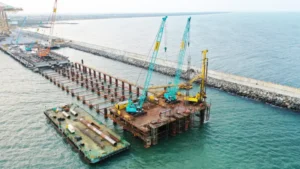
A cofferdam is a temporary watertight enclosure that lets you build in the dry. Steel sheet pile cofferdams are the default choice for bridge foundations, pump houses and waterfront works, where water depth or soft soil rules out simple earth embankments.
The word covers several very different structures, from a mound of rock fill to a braced steel box in a river. What they share is the function: they exclude water and soil long enough for the permanent works to be built inside. The cofferdam concept is old, but the modern version is almost always built from driven steel sheet piles, because steel combines low footprint with real structural strength.
The main cofferdam types compared
| Type | Suitable water depth | Footprint | Best use |
|---|---|---|---|
| Earth embankment | Shallow, slow water | Very large | Wide river sites with cheap fill available |
| Braced sheet pile | Medium | Small | Bridge piers, pump houses, foundation pits |
| Cellular (flat web) | Deep | Large | Dams, lock foundations, major river works |
| Anchored sheet pile | Medium to deep | Small | Wide dry pits and waterfront enclosures |
For most of the projects I quote, the choice comes down to a braced or an anchored sheet pile enclosure. The braced box is the workhorse for bridge piers and pump stations. When the pit is wide and the ground beside it is available, anchors remove the struts and open up the working area. We describe both arrangements in more detail on our page about steel sheet piles for temporary cofferdams.
One warning from site experience: the cofferdam is temporary, but it is not disposable engineering. More schedule is lost to cofferdam failures than to failures of the permanent structure itself. Design it with the same seriousness.
How Deep Can You Go Before the Wall Needs Support?
Every metre of extra depth multiplies the load on the wall. Cantilever walls have a hard limit — know it before your estimator prices the job.
A cantilever sheet pile wall works economically up to roughly 4 to 5 metres of excavation in firm soil. Beyond that, bending moments grow so fast that adding struts or anchors becomes cheaper than simply moving to a heavier section.
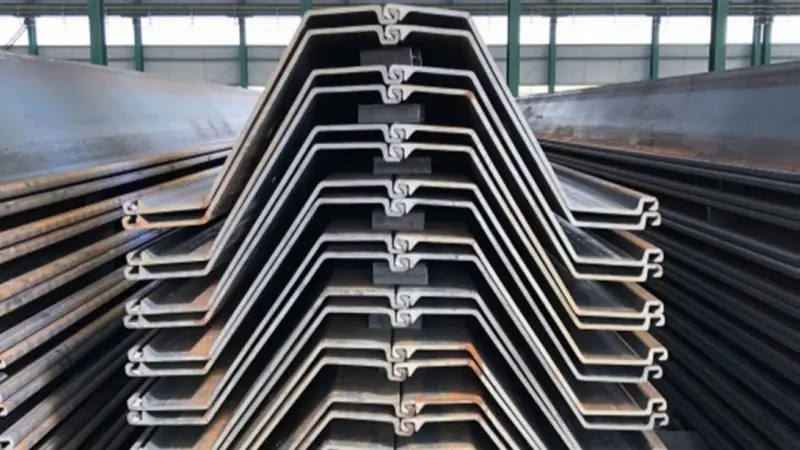
The reason is simple mechanics. A cantilever wall resists soil pressure through the passive resistance of the embedded toe alone. The embedment depth and the bending moment both grow disproportionately with excavation depth, so the section modulus demand climbs steeply. Doubling the depth does far more than double the steel.
Support options by excavation depth
| Support type | Practical depth (firm soil) | Cost driver | Typical use |
|---|---|---|---|
| Cantilever | Up to ~4–5 m | Section modulus + embedment | Shallow utility trenches, small pits |
| Single-level bracing | ~5–9 m | Struts, wales | Basement and pump house pits |
| Multi-level bracing | 9 m and deeper | Staging, strut levels | Deep excavations, cofferdams in water |
| Tie-back anchors | Depth-flexible | Anchoring rights, drilling | Wide pits with open neighbours |
These numbers are rules of thumb, not design values. The exact embedment depends on soil strength, water pressure and surcharges, and it must be calculated for your site — our article on how to calculate sheet pile embedment depth shows the working method step by step. I have seen contractors save a full strut level just by moving the excavation stage line by half a metre, so it pays to run these checks early.
Braced or Anchored: Which Support System Fits Your Site?
Struts steal your working space. Anchors steal your neighbour’s ground. The right choice depends on the pit width and what surrounds it.
Internal bracing suits narrow excavations where struts do not block the works. Ground anchors suit wide pits that must stay open — provided you have the legal right to drill and grout beneath the adjacent properties.
Why strut loads do not match the textbook
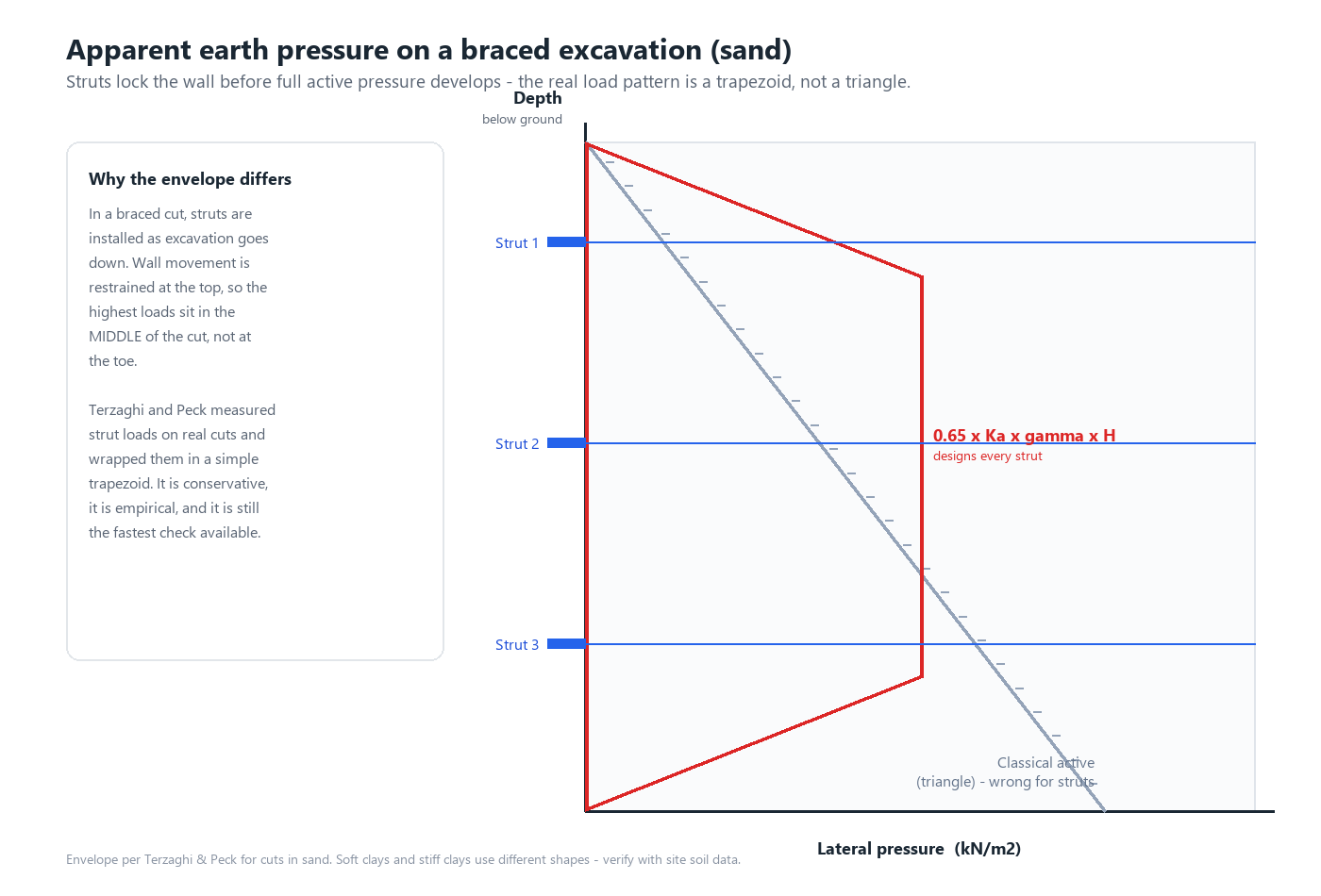
Here is the point most first-time buyers miss. In a braced cut, the struts are installed as the excavation goes down, so the top of the wall is held before it can move. Classical active pressure assumes the wall yields enough to mobilise the soil — and a well-braced wall does not yield at the top. The result is that measured strut loads peak in the middle of the cut, not at the toe.
Terzaghi and Peck turned decades of field measurements into the trapezoidal “apparent earth pressure” envelope shown above, and it is still the standard first check for braced excavations. The published FHWA geotechnical design references carry the current US guidance on applying it. The practical takeaway for a buyer is this: never let anyone size your struts from a simple triangular pressure diagram. If a quotation looks light on bracing, that is usually where the saving came from.
| Criterion | Internal bracing | Ground anchors |
|---|---|---|
| Working space inside pit | Blocked at strut levels | Fully open |
| Effect on neighbours | None outside the wall | Needs third-party ground rights |
| Speed in narrow pits | Fast | Slower (drilling + grouting) |
| Removal after use | Struts fully recoverable | Anchors usually left in place |
| Best fit | Narrow to medium pits | Wide pits, deep waterfront walls |
Whichever system you choose, the load path must be continuous: struts push into wales, wales spread the load along the wall — our explainer on waling beams in sheet pile walls covers that connection. On the anchor side, the design of the tie level itself matters just as much, and we set out the basics in how to design tie rod systems for sheet piles.
How Do You Keep the Water Out of the Excavation?
A cofferdam that leaks is a pump test, not a dam. Water control is designed in from the start, not pumped out afterwards.
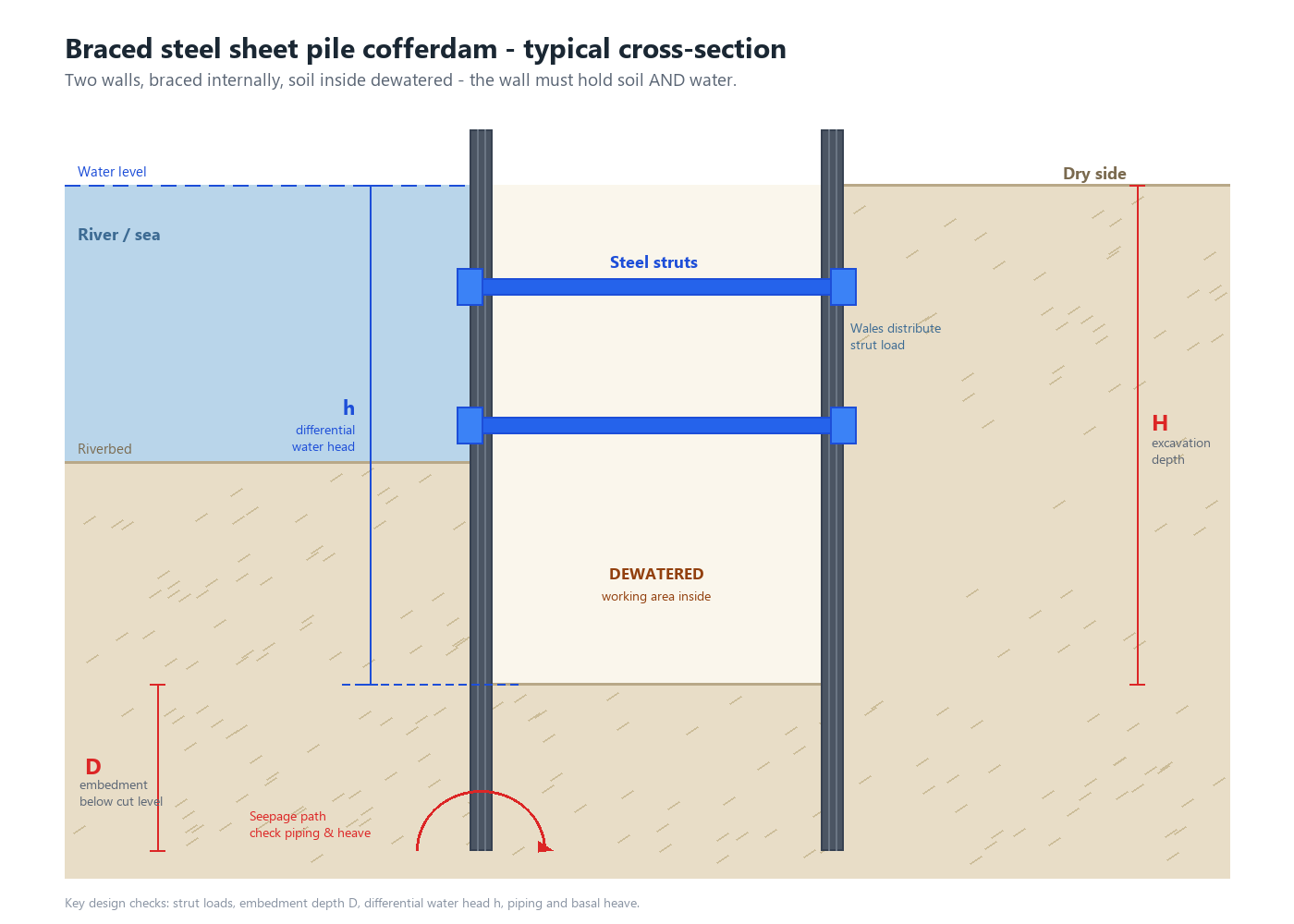
Watertightness comes from three places: tight interlocks, sufficient toe penetration into a low-permeability layer, and a dewatering system sized for the residual seepage. Sealants in the interlocks handle whatever is left.
Where the water gets in — and what stops it
| Water path | What causes it | Countermeasure |
|---|---|---|
| Interlock seepage | Loose or damaged interlocks | Factory-tight interlocks; sealant or mastic in the locks |
| Flow under the toe | Wall founded in permeable sand | Drive deeper to reach clay or rock; lengthen the seepage path |
| Piping at excavation base | High differential head, thin embedment | Check factor of safety against heave; add relief wells |
| Leakage at corners | Poor corner piece detailing | Use fabricated corner sections, not bent standard piles |
In permeable sand, the safe rule is to drive deep enough that seepage has to travel a long way around the toe, and to check piping explicitly — a quick failure at the base of a pit gives you seconds, not hours. Our practical guide on preventing leakage in sheet pile walls lists the sealing options in order of cost. For most river cofferdams I recommend threaded or welded sealant in the interlocks below water, because the price of the sealant is trivial next to the price of a flooded shift.
Which Section and Steel Grade Should You Choose?
The wrong section bends; the wrong grade rusts. Both mistakes stay invisible until the wall is in the ground, and both are expensive to fix there.
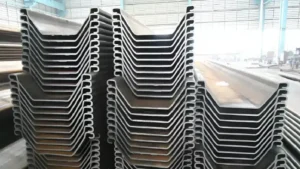
For most cofferdams and braced excavations, U-type or Z-type sections in S355 or Q355 grade give the best balance of strength, drivability and price. Match the grade to the design life and to the corrosivity of soil and water.
Common steel grades for sheet pile walls
| Grade | Min. yield strength | Standard family | Typical application |
|---|---|---|---|
| Q235B | 235 MPa | Chinese GB | Short-term temporary works in mild ground |
| Q355B | 355 MPa | Chinese GB | Standard export grade for cofferdams |
| S355GP | 355 MPa | EN 10248 | Permanent and temporary walls, European projects |
| ASTM A572 Gr.50 | 345 MPa | ASTM | North American projects and DOT work |
Grade selection is a whole topic in itself — we compare them properly in our article on the common steel grades used for sheet piles, and for projects specified to US practice, the ASTM A328/A328M sheet piling specification is the usual baseline. On the section side, the choice between profiles comes down to bending demand and driving conditions. For moderate depths and curved walls, see our U-type sheet piles; for deeper walls where you want maximum section modulus per tonne, see our Z-type sheet piles. As a factory, we roll and supply both, so the section choice stays an engineering decision rather than a stock decision.
One habit I encourage: send us the soil report before you fix the section. A half hour of review at quotation stage has saved customers entire re-driving campaigns when the section was matched to the cobble layers and dense sand they had not mentioned.
Can You Pull the Piles Out and Use Them Again?
Temporary works should not become permanent waste. Extraction and reuse is where sheet piles quietly beat every concrete alternative on cost.
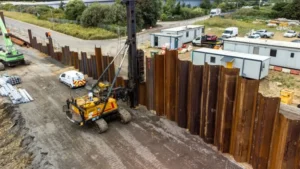
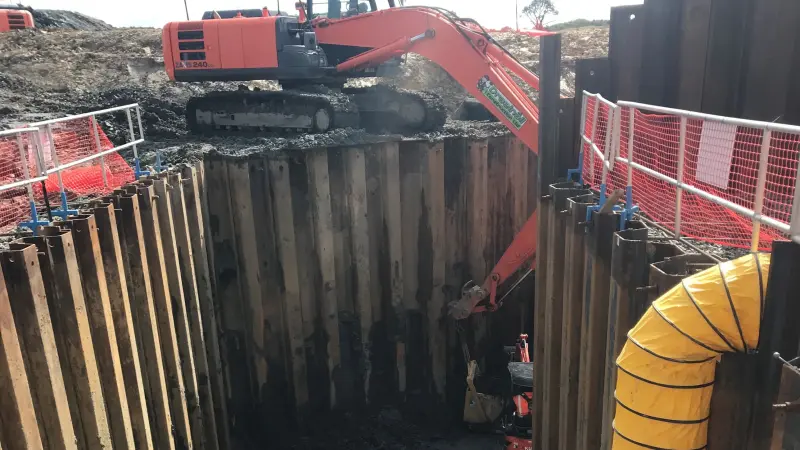
Most temporary sheet piles are extracted with a vibratory hammer after backfilling, and sound sections can be reused two or three times. Reuse can cut the effective steel cost of a cofferdam by 40 percent or more.
What limits reuse — and how to protect your second project
| Damage mode | Effect on reuse | Prevention |
|---|---|---|
| Interlock wear and twist | Looser walls, more sealing work next time | Keep alignment guides; avoid over-driving |
| Toe damage in rock or cobbles | Shortened piles, welding needed | Pre-auger or choose a heavier toe section |
| Corrosion loss | Thinner section for the next design | Measure remaining thickness before re-rating |
| Broken heads from hammers | Reduced driving life | Match hammer energy to the section |
Extraction is a whole craft of its own: the right vibratory hammer, the right breakout technique and patience with the first pile. The extraction and reuse economics matter more than the machine brochure suggests — see whether sheet piles can be reused. If your programme has several temporary pits or cofferdams, choosing the section for its second life as well as its first is the single best cost decision you can make, and our guide to selecting sheet piles for temporary works is written exactly for that case.
What I Tell Buyers Before They Order a Cofferdam Package
From my side of the business — we roll and export sheet piles from Liaocheng, Shandong, to contractors in the Middle East, Australia, Africa and the Americas — the same three questions decide almost every cofferdam project.
First, the drawings before the price. A cofferdam quoted without soil data and water levels is a guess with a delivery date. Second, plan the whole cycle, not just the driving: extraction, transport and reuse belong in the original calculation, and they change which section is “cheapest”. Third, inspect before shipment. For export orders we support SGS or a third-party inspection at the mill, because a rejected pile discovered in Iraq or Australia costs far more than an inspection booked in China.
On a riverbank protection project in Southeast Asia, our hot rolled U-type piles went in with a vibratory hammer and the wall closed tight on the first pass — the interlock tolerance did its job without a single re-drive. That is the standard I hold every cofferdam order to. If you are planning a cofferdam or a deep excavation, compare our deep excavation support systems with our temporary cofferdam packages, and then send us your drawings for a factory-direct quotation.
Conclusion
Cofferdams and deep excavations reward early engineering. Choose the right profile, brace it honestly, seal the water out — and sheet piles return their cost, project after project.