Your retaining wall decision can make or break the project budget. Pick the wrong type, and you pay twice — once in material, once in delays.
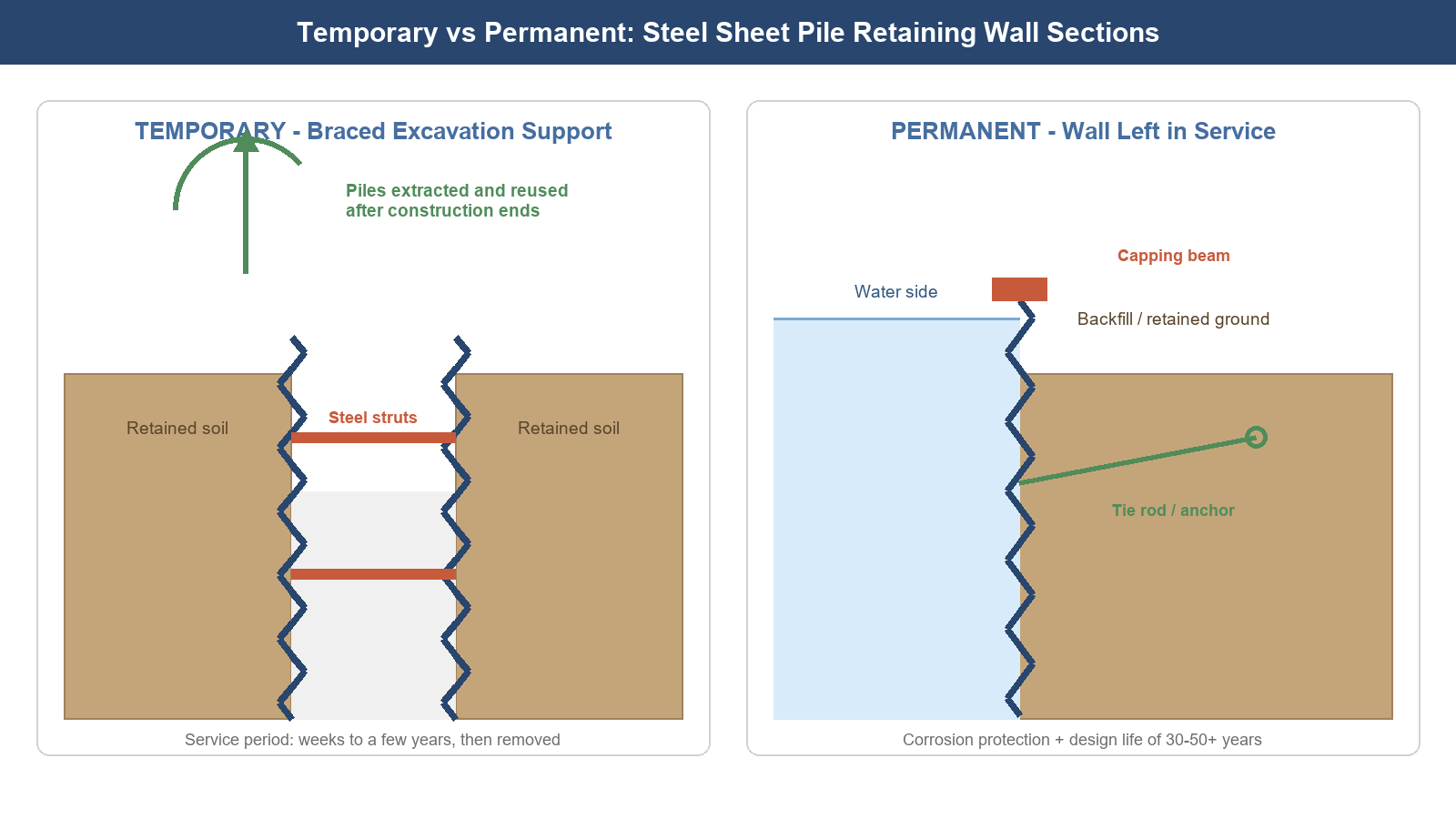
Steel sheet piles work for both temporary and permanent retaining walls. Temporary walls are driven, braced, and later extracted for reuse. Permanent walls stay in service for 30 to 50+ years with proper corrosion protection. Design life, soil, water, and budget decide the choice.
I have supplied steel sheet piles for both kinds of projects. Some walls come out of the ground after six months. Others will still be standing when my kids retire. The product looks the same on the truck. What changes is the design thinking behind it. And that thinking trips up even experienced engineers, because the two jobs share a name but not a rulebook.
In this article, I will walk you through the differences, the cost logic, and the checks I ask every customer to run before they order. I will also share what I see going wrong on real sites, and how the right decision at day one saves money at month twelve. If you are a contractor, a civil engineer, or a steel distributor quoting your own clients, this is the conversation we would have on a video call — written down.
What Is the Difference Between a Temporary and a Permanent Retaining Wall?
Many buyers mix these two up, and the mistake costs money. The difference is not the steel. It is the job the wall has to do.
A temporary retaining wall holds soil or water only during construction. It is removed or cut off after the structure is complete. A permanent retaining wall becomes part of the finished works and must carry loads for the full design life of the project, usually 30 to 50+ years.
Design Life, Exposure, and the Rules That Follow
Let me go deeper, because this difference drives everything else: the steel grade, the section modulus, the corrosion allowance, and the price.
A temporary wall lives a short life. It might work for three months on a trench job or two years on a basement dig. During that window, corrosion is almost irrelevant. Steel loses maybe 0.02 mm a year in ordinary soil. Nobody sizes the section for fifty years of rust that will never happen. This is why contractors happily reuse piles that already have scars and surface rust.
A permanent wall is a different animal. It must resist earth pressure, water pressure, and corrosion for decades. Standards such as ASTM A328/A328M define the material requirements, and Eurocode 3 Part 5 (EN 1993-5) tells designers how to add sacrificial thickness for corrosion loss over the design life. In aggressive ground or salt water, that allowance can add 2 to 4 mm per face. That means heavier sections, sometimes higher steel grades, and protective coatings from day one.
One more difference hides in the interlocks. On a temporary wall, some seepage through the interlocks is tolerable. The pit pump handles it. On a permanent wall that retains water, or that protects a dry basement, seepage becomes a serviceability problem. Designers then spec tighter interlocks, sealants, or a combi-wall with a separate water cut-off. This is exactly where the wall type decision changes the product you should buy, not just the coating on it.
The table below sums up how I explain it to first-time buyers:
| Aspect | Temporary wall | Permanent wall |
|---|---|---|
| Service period | Weeks to a few years | 30 to 50+ years |
| End of life | Extracted, cut off, or abandoned in place | Stays as part of the structure |
| Corrosion allowance | Usually none or minimal | Sacrificial thickness per EN 1993-5 |
| Typical protection | None needed | Coating, galvanizing, cathodic protection |
| Steel grade focus | Strength for driving stresses | Strength plus long-term durability |
| Cost logic | Rent or buy with reuse credit | Full purchase, treated as an asset |
Why Do Contractors Prefer Sheet Piles for Temporary Excavation Support?
On short digs, speed is money. Every extra week of excavation support eats the margin.
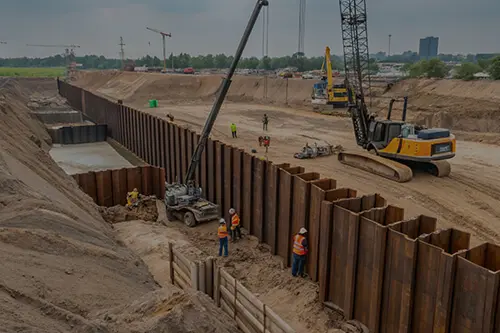
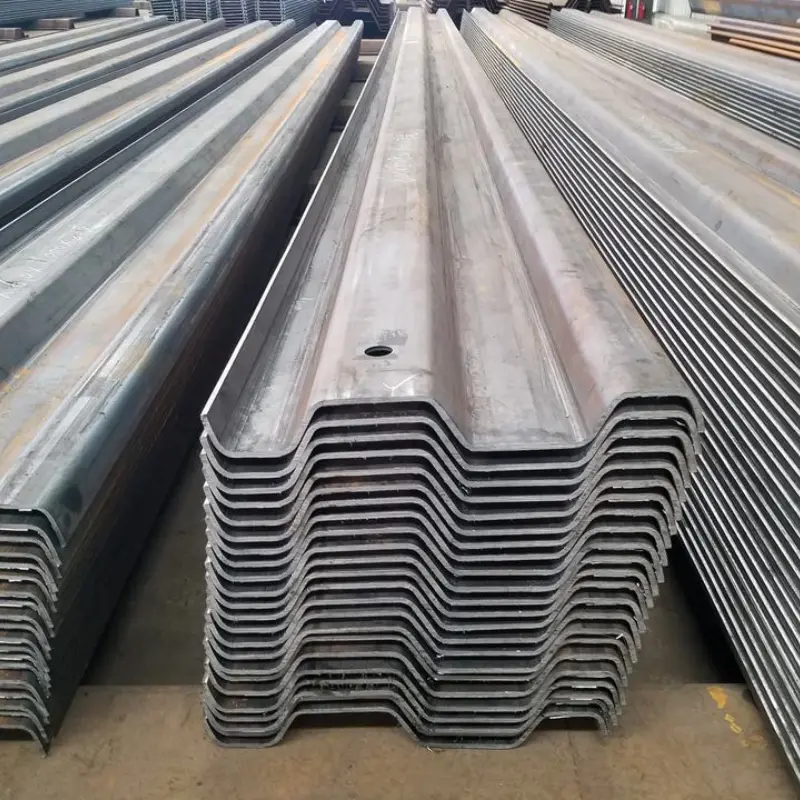
Sheet piles are fast. A crew can drive, brace, and start digging within days. When the job ends, the piles come out with a vibratory hammer and move to the next site. That reuse turns a cost into an asset, which is why temporary sheet piling dominates trench and basement work.
Extraction, Reuse, and Handover
Here is the part that surprises new buyers: the same pile can serve four or five projects.
On a shallow utility trench, contractors use light sections. The piles go in fast, sometimes with a small excavator-mounted vibratory hammer. The trench stays open for days, not months. Then the crew pulls the piles out and drives forward to the next stretch. I have seen the same batch of 3 mm light piles work pipeline jobs for eight straight years.
On deep basement work, the story is heavier but the logic holds. The wall takes real pressures, so contractors use bigger sections and internal bracing or anchors. Once the permanent basement slab and walls are built, the sheet piles lose their job. A vibratory hammer pulls them out, the site team grouts the holes left behind, and the piles go to the next job. The extraction step needs skill. If the soil grips hard, the crew can jet water along the pile or loosen it first. You can read how we handle the wet version of this in our article on cofferdams and deep excavations.
One caution from the field: temporary does not mean careless. The wall still has to hold while it stands. Most failures I hear about happen at the transition moments — when braces get removed too early, or when the crew starts backfilling before the permanent structure can take over. The steel was never the problem. The sequence was. So write the removal plan into the method statement, not into a phone call.
The economics look like this:
| Option | Upfront cost | Best for | Watch out for |
|---|---|---|---|
| Rent from piling stockist | Lowest, paid monthly | Short jobs, under 6 months | Rental fees grow on long jobs |
| Buy new, reuse internally | High first, low after | Contractors with steady pipelines | Storage and transport costs |
| Buy used piles | 30-50% below new | Low-risk temporary walls | Check interlock wear and thinning |
How Do Steel Sheet Piles Perform as Permanent Retaining Structures?
Permanent duty is where the steel has to earn its keep for decades. The section that was fine for a two-year dig may not survive fifty years of wet soil.
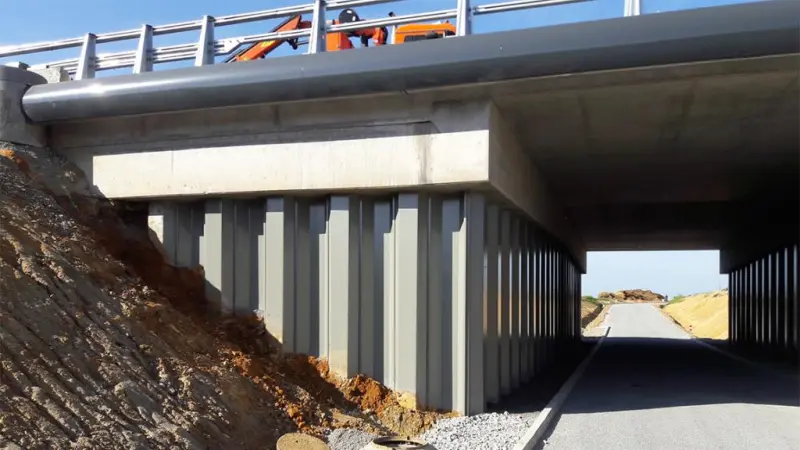
Permanent sheet pile walls serve as quay walls, flood barriers, basement walls, and bridge abutments. With the right section modulus, corrosion allowance, and protection system, they reach design lives of 30 to 50+ years even in aggressive ground and marine exposure.
Corrosion Protection and Service Life
Corrosion is the only real enemy of a permanent sheet pile wall, and it is manageable.
Steel corrodes fastest in the splash and low-water zones, where the surface is wet and dry in cycles. In fresh water soil, loss rates are low. In sea water, they rise sharply. The designer adds sacrificial thickness for each exposure zone, or the owner invests in protection. The three tools we ship most often are:
| Protection method | How it works | Typical life gain | Relative cost |
|---|---|---|---|
| Paint / epoxy coating | Barrier film on exposed zones | 15-25 years, recoatable | Low to medium |
| Hot-dip galvanizing | Zinc layer sacrifices itself first | 25-40 years in mild zones | Medium |
| Cathodic protection | Sacrificial anodes or impressed current | Extendable past 50 years | Higher, needs maintenance |
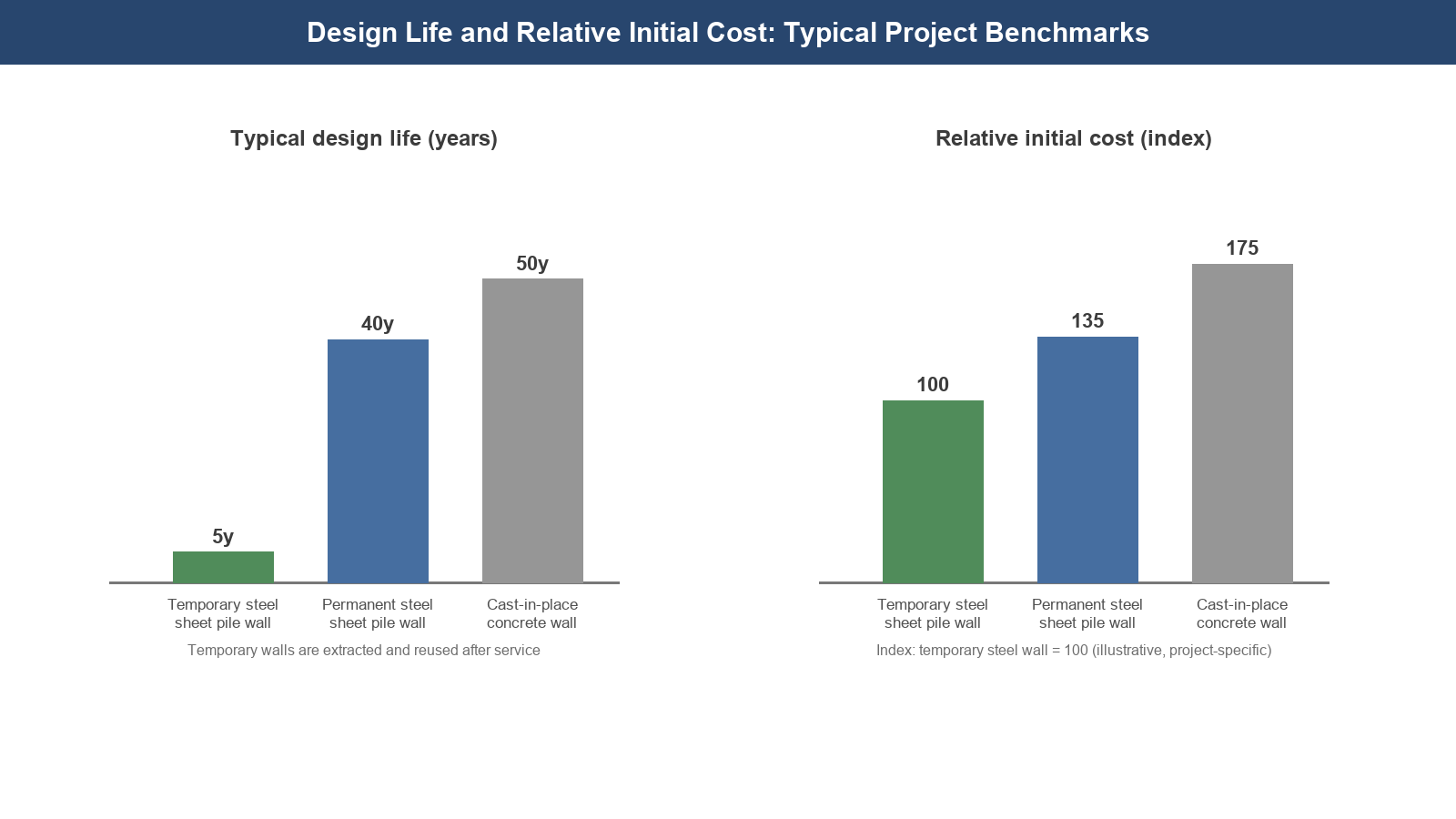
Concrete walls still win on raw design life in theory, but look at the first-cost index in my chart above. A permanent sheet pile wall usually lands well below cast-in-place concrete, and it installs in a fraction of the time because there is no formwork, no curing, and no excavation for the wall itself. For river and coastal jobs, our work on riverbank and flood control shows the pattern: sheet piles go in fast, protect immediately, and the interlock system handles water tightness. For port and quay applications, the same wall becomes the front line of marine engineering structures.
What Should You Check Before Choosing Temporary or Permanent?
Before you order a single tonne, run this filter. It takes one meeting and saves months.
Check five things: required design life, soil and water aggressivity, whether the wall can be extracted, access for piling plant, and the total cost including removal. If the wall must stay and the ground is aggressive, spec protection from day one — retrofitting later costs far more.
Soil, Water, and Removal Risks
Let me break down the checks I run with customers before quoting:
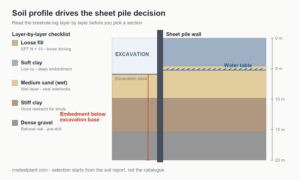
1. Ground and water chemistry. Chlorides, sulfates, and pH decide the corrosion loss rate. A soil report with chemical data is worth its price. In sulfated ground, even concrete gets attacked, so steel with coating often wins.
2. Obstructions and driving conditions. Temporary walls in loose sand drive like a dream. Permanent walls into stiff clay with boulders need the right interlock type and sometimes pre-augering. My factory ships both hot-rolled and cold-formed sections, and the choice affects drivability.
3. Can it come out? Neighboring buildings, overhead lines, or baselines of the new structure can block extraction. If the piles cannot come out, they are permanent whether you like it or not — so design them as permanent.
4. The wall above the wall. Permanent walls often carry capping beams, mooring loads, or bridge loads. Check the superstructure early. Our experience with bridge foundations and piers shows that last-minute load additions force re-design of the whole wall.
5. Total cost, not steel price. Compare the full cycle: supply, drive, brace, extract, hole grouting, transport, and reuse credit. The cheapest ton is rarely the cheapest wall.
| Check | Temporary wall | Permanent wall |
|---|---|---|
| Design life required | Project duration only | 50+ years typical |
| Corrosion data needed | Nice to have | Must have |
| Extraction planned | Yes — verify access | No — design for stay-in-place |
| Protection system | Usually none | Coating / galvanizing / anodes |
| Certification | Mill certificate | Mill cert + EN 10204 3.2 on request |
How Do You Size the Wall Without Overpaying?
Sizing errors cut both ways: too light and the wall fails, too heavy and the budget bleeds.
Match the section modulus to the real load case, not the worst case on paper. Temporary walls can use lighter sections with tight bracing spacing. Permanent walls need the modulus plus corrosion allowance. A competent designer trims 10-20% off steel weight with good bracing layout.
Where the Weight Really Goes
On temporary work, the biggest lever is strut spacing. Halve the spacing and the required modulus drops sharply. Yes, more struts cost money and slow excavation, but on deep jobs the steel saving wins. On permanent work, the biggest lever is honest corrosion data. I quote walls where the designer assumed sea-water loss rates in fresh inland soil — the wall came out two sections heavier than it needed to be.
One more practical point: for walls that straddle both worlds — say a basement wall that is temporary during the dig and permanent after — designers either double the protection or accept two life calculations. This hybrid is common in subway and underground works, where station walls stay in place for good. The saving over building two separate walls is large, and it is the main reason sheet piles beat soldier pile systems on urban stations.
My Take as a Sheet Pile Supplier
Here is my honest view after years of quoting both kinds of walls. Most buyers overthink the steel and underthink the life cycle. They compare the price per tonne between suppliers for two weeks, then spend one afternoon on the question that actually moves money: does this wall come out or stay in? Get that answer right and the whole specification falls into place — the grade, the coating, even whether a used pile makes sense.
My rule is simple. If the wall serves the project, buy or rent light and plan the extraction. If the wall serves the public for decades, spend on protection and sleep well. And if you sit on the fence, tell your supplier early — we can quote both scenarios and let the numbers decide. I would rather lose an hour to a good question than lose a customer to a bad guess. That mindset has kept our export customers in the Middle East, Australia, and Africa coming back with repeat orders, because the wall they received matched the wall they actually needed.
Conclusion
Temporary walls earn their keep through speed and reuse; permanent walls through durability and protection. Match the design to the life, and steel sheet piles win both ways.
Tags: Temporary Retaining Walls, Permanent Retaining Walls, Steel Sheet Piles, Sheet Pile Reuse, Excavation Support