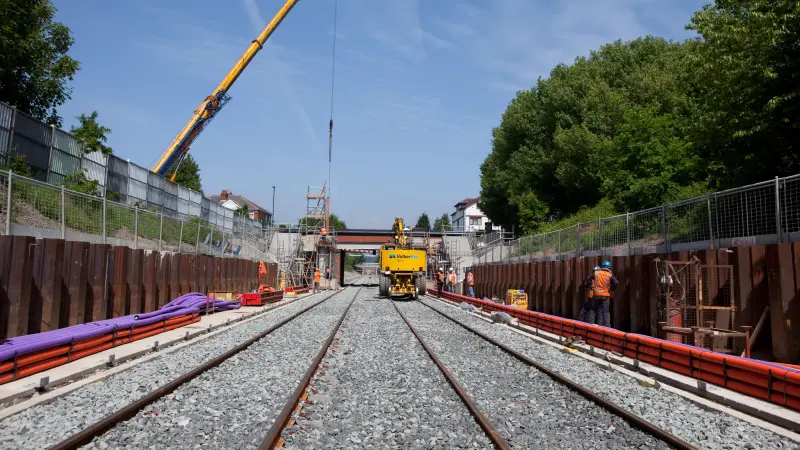
Steel sheet piles have become my go-to answer for subway and underground engineering. I have supplied them for metro stations, tunnel portals, and deep shafts across the Middle East and Australia, and the pattern is always the same: tight sites, tight schedules, and no room for wall movement.
Subway work happens under cities that cannot stop moving. Roads stay open, buildings stay occupied, and groundwater keeps pushing. I have seen contractors lose weeks to a retaining system that was wrong for the site.
Steel sheet piles are ideal for subway and underground engineering because they install fast, form an instant watertight wall, add no spoil to the excavation, and can be extracted and reused. For metro stations, shafts, and tunnel portals in soft or water-bearing ground, they often beat concrete walls on both cost and schedule.
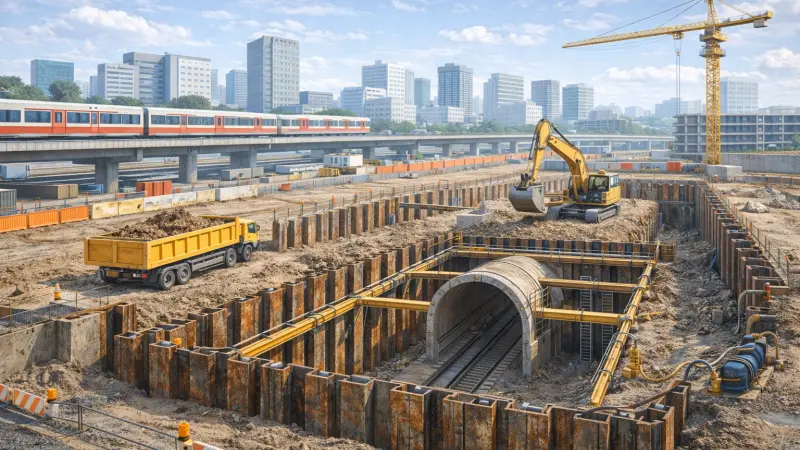
In this article, I will walk you through the way I look at underground work with sheet piles. I will cover why urban excavation is hard, which wall systems I recommend, how we control ground movement, what to do about water and corrosion, and how the numbers compare against the alternatives. Some of this comes from my own projects, and I will be honest about where sheet piles are not the right answer.
Why Is Subway Excavation Support So Difficult in Dense Urban Areas?
Urban pits fail in ways open-country sites never do. When I plan a metro station excavation, the soil is only half of the problem.
Subway excavation support is difficult because you must hold back soil and water next to live traffic and occupied buildings, control wall deflection to millimeters, and work within a narrow corridor. Any wall system you choose has to be stiff, watertight, quiet enough for the city, and fast to build.
What I actually watch for on a metro pit
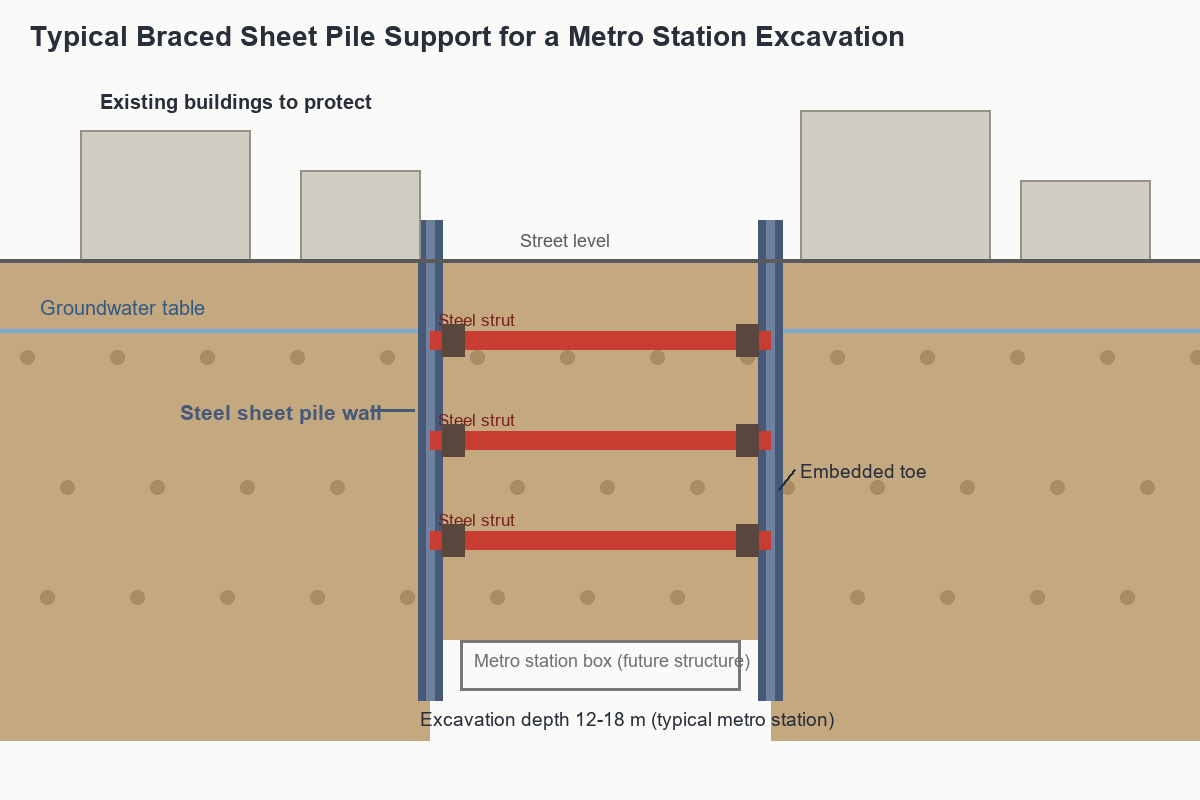
When I visit a subway site, I do not start with the steel. I start with three risks. First, settlement. If the wall moves, the street moves with it. I have watched a track slab crack because a contractor saved money on struts. Second, water. Below the water table, an open joint becomes a running sand boil within hours. Third, noise and vibration. A city will tolerate a week of pile driving; it will not tolerate three months of it.
A steel sheet pile wall answers all three risks in one step, which is why I keep recommending it. The wall is driven from street level before the pit opens, so there is no wet concrete trade working over live traffic. The interlocks give me a cut-off wall from day one. And when the station box is done, I can pull the piles out and send them to the next site, which matters because most metro alignments have station after station that needs the same temporary wall.
| Urban risk | What happens if you ignore it | How a sheet pile wall helps |
|---|---|---|
| Settlement of neighbors | Cracked roads, damaged utilities, claims | Stiff section plus tight struts limits deflection |
| Groundwater inflow | Running sand, loss of ground at the toe | Interlocked wall acts as a cut-off |
| Noise and vibration | Complaints, work stoppages, night bans | Press-in or silent piling methods available |
| Narrow work corridor | No room for slurry plant or cage lifting | Wall installs from the street, no spoil produced |
For deeper cofferdam-style pits the logic is the same, and I have written a full breakdown in our guide on using steel sheet piles for cofferdams and deep excavations. If your pit is deeper than about 18 meters, read that one before you commit, because the toe embedment starts to drive the economics at that depth.
Which Sheet Pile Wall Systems Work Best for Metro Stations and Tunnel Portals?
Not every underground job needs the same wall. Over the years I have settled on three layouts that cover most metro work.
For metro stations I normally use a single braced sheet pile wall with two to four strut levels. For shallow tunnels and portals I use cantilever walls up to about 5 meters. For deep launch shafts I wrap the shaft in a ring of sheet piles so the interlocks carry the load in ring tension.
Three layouts that cover most of my projects
The braced wall is the workhorse. I drove U-type piles for a station box once, three levels of struts, and the wall performed exactly as the design said it would. The cantilever wall is the simplest; no struts at all, so the excavator works freely, but the height is limited. The circular or polygonal shaft is my favorite for launch shafts on tunnel boring projects, because the ring shape turns earth pressure into compression in the interlocks and you need almost no internal bracing.
Which type of pile you pick matters as much as the layout. U-type piles handle the bending in braced walls very well. Z-type piles give you more section modulus per kilogram when the pit is deep. For shafts, I look at the interlock strength first, and our article on steel sheet pile interlock types and their performance advantages explains how I compare Larssen, hook, and thumb-and-finger interlocks for that job.
| Wall system | Typical use underground | Practical depth | Bracing needed |
|---|---|---|---|
| Cantilever sheet pile wall | Shallow portals, utility cuttings | 4-5 m | None |
| Braced (propped) wall | Metro station boxes, cross passages | 10-18 m | 2-4 strut levels |
| Ring shaft in sheet piles | Launch and reception shafts for TBMs | 12-25 m | Usually none, ring action |
| Double (cellular) wall | Deep dry docks, large underground basins | 15 m+ | Self-stabilizing fill |
One warning from my own experience. Do not mix wall types along one alignment just to save a little steel. I saw a contractor switch from sheet piles to a soldier pile wall halfway along a station because of stock availability. The two walls behaved differently, and the transition zone became the defect everyone argued about at handover.
How Do You Limit Ground Movement Around a Metro Pit?
Ground movement is the number that decides whether the metro owner lets you build at all. I treat it as a design output, not an accident.
To limit ground movement around a subway excavation, I increase the wall stiffness, deepen the toe embedment, pre-load the struts, and install instruments to read deflection daily. A stiffer section costs more per ton but almost always costs less per millimeter saved.
Stiffness, embedment, and reading the wall
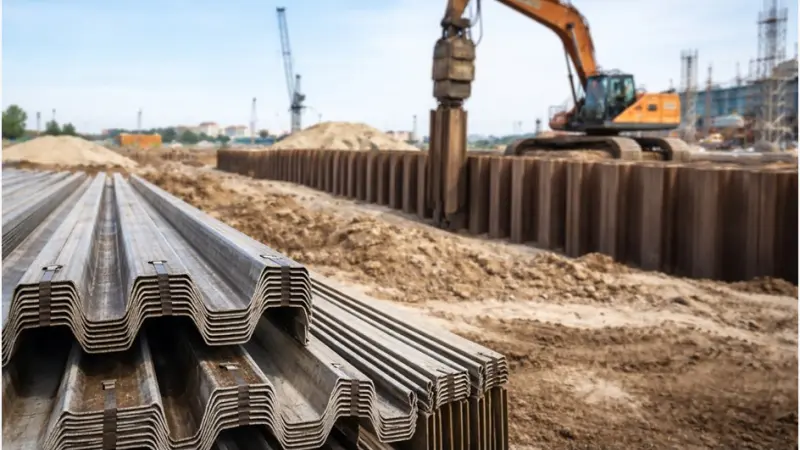
The moment of the wall goes up with the cube of the depth of the section, so a modest change in profile buys a large gain in stiffness. When the design lets me, I move up one section class rather than adding a fifth strut level, because steel is cheaper than struts and much cheaper than a settled building. The toe embedment works the same way; a deeper toe reduces the rotation at the base of the wall, which is where most of the surface settlement comes from.
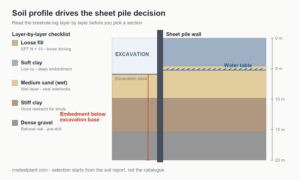
But stiffness on paper is not the whole story. What actually controls movement is the sequence: install the wall, dig to just below each strut level, install and pre-load the strut, then keep going. Contractors who dig two levels before bracing will move the ground no matter how stiff the steel is. I also insist on a proper standard penetration test program before design, because the soil profile I get from one borehole every 200 meters is not a soil profile, it is a rumor.
| Sheet pile section class | Elastic section modulus (per m of wall) | Where I use it underground |
|---|---|---|
| Light U-type (e.g. AU14) | about 1,300 cm³/m | Utility trenches, shallow portals |
| Medium U-type (e.g. AU18-AU20) | 1,800-2,400 cm³/m | Braced pits to about 12 m |
| Heavy U / Z-type (e.g. AZ26) | 3,500-5,000 cm³/m | Station boxes 12-18 m |
| High-modulus combined wall | 8,000+ cm³/m | Deep shafts beside sensitive structures |
The steel grade matters here too, and I explain the difference between Q235, Q355, and S355 in our post on common steel grades used for steel sheet piles. For most metro work I push for S355 or Q355, because the extra yield strength lets the designer use a lighter section for the same deflection limit.
What Should You Do About Groundwater and Corrosion in Underground Work?
Underground, water is not just a construction problem. It follows the wall for its whole service life, and so does corrosion.
For groundwater control I rely on the interlock cut-off, sealed with bitumen or water-swelling seals where the head is high. For corrosion I add a sacrificial thickness based on exposure zone, and I upgrade the steel grade for aggressive ground or salt water.
Keeping the pit dry and keeping the steel alive
A well-driven sheet pile wall is surprisingly watertight. The interlocks lock tight as the piles are driven, and with ballast or sealant in the joints I routinely hold back several meters of head. For a station pit below the water table, I seal every other interlock below the expected excavation base, which is cheaper than sealing all of them and covers the zone where it counts. If the site has running sand or gravel, I pair the wall with wellpoints outside the pit rather than hoping the wall alone will do it.
Corrosion is the quiet one. Buried steel corrodes slowly, but the splash and fluctuation zones around the water table corrode faster, and salty groundwater speeds everything up. My standard practice is to order the piles with a corrosion allowance on each face, typically 1.5 to 3 millimeters depending on design life, and to jump to a marine-grade steel such as that covered by ASTM A690 when the ground is aggressive. The basic product standard I work to for piling steel is ASTM A328, and for export projects I add third-party inspection on top of it.
| Exposure condition underground | Typical loss rate (per side) | What I specify |
|---|---|---|
| Natural soil above water table | Very low, often negligible | Standard grade, no allowance |
| Zone of groundwater fluctuation | About 0.02-0.04 mm/year | 1.5 mm allowance per side |
| Aggressive industrial ground | 0.03-0.06 mm/year | 3 mm allowance, higher grade |
| Salt water or tidal contact | 0.06-0.12 mm/year or more | Marine grade steel, coating, or encasement |
I always remind buyers that a temporary wall gets a shorter corrosion budget than a permanent one. If your sheet piles stay in the ground after the station opens, design them for the full life from the start, because you cannot add thickness later.
Are Steel Sheet Piles Really Cheaper and Faster Than Other Retaining Systems?
This is the question every main contractor asks me last, after the geology talk. So let me put my numbers on the table.
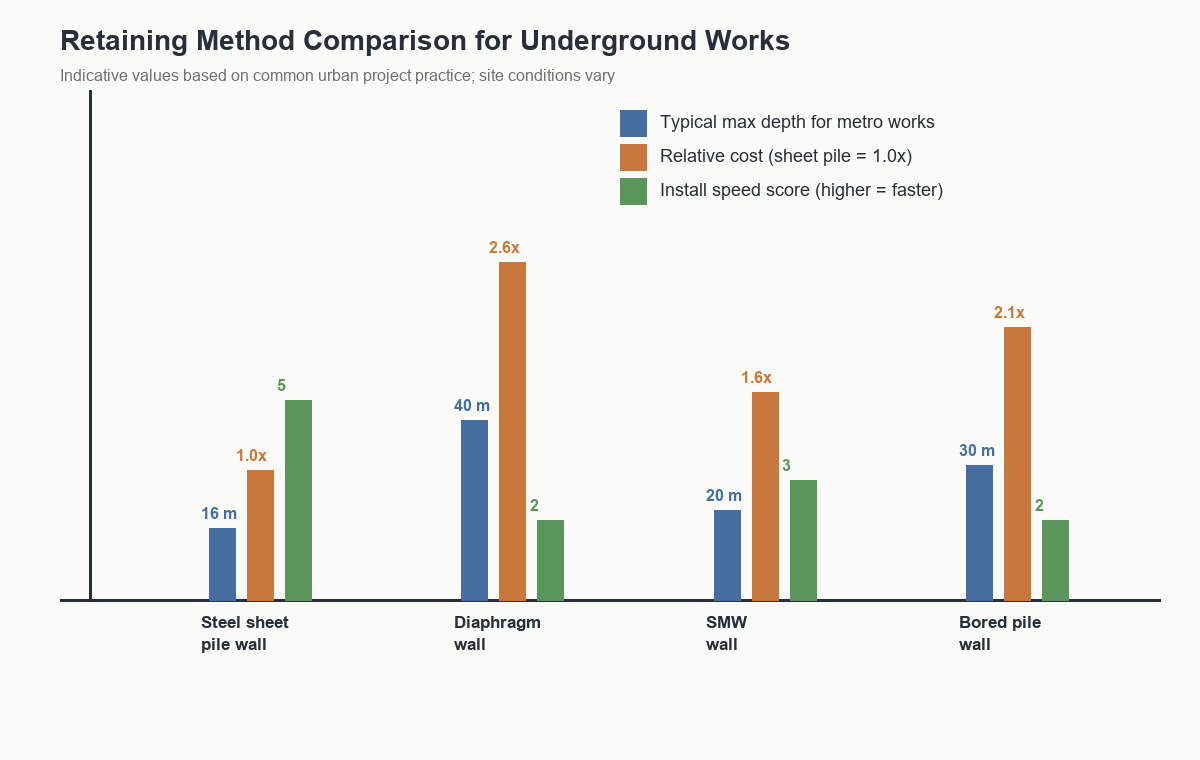
For walls up to about 16 to 18 meters, sheet piles are usually the fastest and cheapest option in metro work: one trade, no spoil, no concrete curing time, and the steel is recoverable. Diaphragm walls win above that depth and beside extremely sensitive buildings, but they cost roughly two to three times as much per square meter.
Where the money actually goes
The chart above is indicative, but it matches what I see in real quotes. A sheet pile wall needs one machine, one crew, and a few days per station wall. A diaphragm wall needs a bentonite plant, a trench cutter, rebar cages, and concrete lorries, and the guide walls alone can take longer than my whole wall. The SMW system sits in between; it is quick and watertight, but the mixing shafts are single-use, so the steel stays in the ground. With sheet piles, extraction is normal practice on temporary metro works, and the recovered piles carry real resale or reuse value into the next station.
| Cost item | Sheet pile wall | Diaphragm wall | Bored pile wall |
|---|---|---|---|
| Plant mobilization | Low, one rig | High, slurry plant + cutters | Medium, several rigs |
| Speed per 100 m of wall | 3-6 days | 3-5 weeks | 2-3 weeks |
| Spoil to haul away | Almost none | Full slurry and spoil | Full drill spoil |
| Steel recoverable | Yes, if temporary | No | No |
| Relative cost per m² | 1.0x | about 2.6x | about 2.1x |
The same speed argument works above ground too. On bridge foundation and pier construction projects I supply, the contractor chooses sheet piles for the same reason: the wall is up before the concrete trade arrives. Speed compounds, and schedule is money in metro delivery.
My Take: Where Sheet Piles Fit in the Underground Future
I will give you my honest opinion, because you should know how a supplier thinks. Sheet piles will not replace diaphragm walls for the deepest stations, and I will not pretend otherwise. But the center of gravity of metro construction is moving to places like the Gulf, South Asia, and Africa, where the ground is often soft, the water table is high, and the schedules are brutal. In those conditions, my braced or ring-shaft sheet pile wall is very hard to beat. Press-in machines are also getting quieter, which removes the last big objection in city centers. I believe more metro owners will start writing sheet pile walls into their standard station designs, the way European owners already do for cross passages and shallow cut-and-cover tunnels.
Conclusion
For subway and underground engineering, steel sheet piles give me speed, watertightness, and stiffness in one wall. Pick the system that matches your depth, control the movement, protect the steel, and the numbers will work.
Tags: steel sheet piles for subway, underground engineering, metro station excavation support, tunnel portal retaining wall, deep excavation sheet pile wall