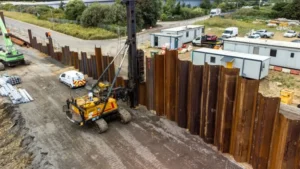
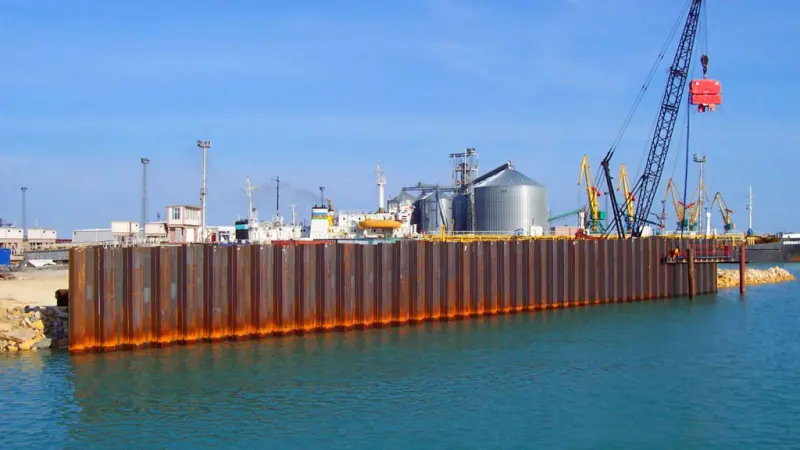
Ports and harbors are the most aggressive environment a retaining structure will ever face. A quay wall holds back saturated fill on one side while absorbing berthing energy, wave loading and cyclic tidal movement on the other — and it is expected to keep doing that for fifty years or more, usually without the luxury of taking the berth out of service. That combination of load and exposure is why port and harbor protection work is treated as its own engineering discipline rather than a variation on ordinary retaining wall design.
This guide covers the protection side of the problem: how the marine environment actually attacks the steel, how the section and grade are chosen for protection duty, how corrosion protection systems are specified, and how to verify that a wall will still be structurally sound at the end of its design life.
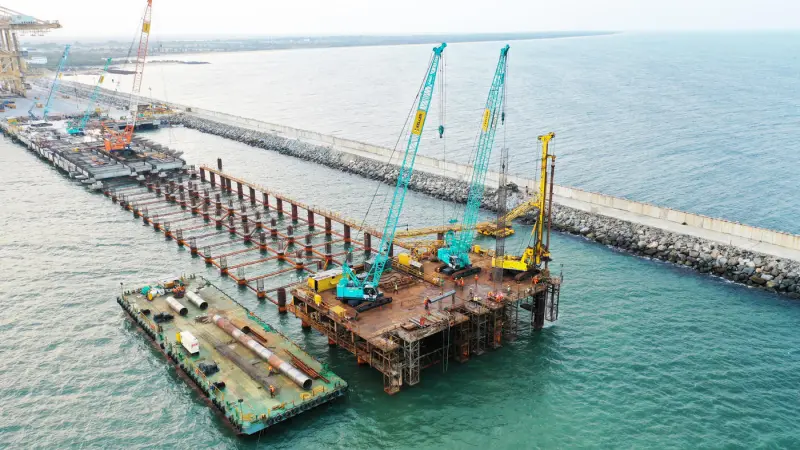
What “Protection” Means in a Port or Harbor Project
In a protection project the wall is doing more than retaining soil. Depending on the site, one sheet pile wall can be performing up to four functions at the same time:
- Shoreline and soil retention — holding back reclaimed or natural fill so the land behind the berth stays in place.
- Berthing and impact resistance — transferring fender and mooring loads into the soil without permanent deformation of the wall.
- Wave, current and scour protection — preventing erosion at the toe of the wall and undermining behind the structure.
- Environmental containment — acting as a cut-off barrier to stop contaminated groundwater migrating, or to keep dredged fill inside a reclamation area.
Getting this brief wrong early is expensive later, because each function drives a different design check. A wall specified only for soil retention frequently fails the berthing case, and a wall designed purely around berthing loads can be badly under-specified for scour. Our overview of port and harbor protection solutions sets out the standard system configurations we supply for each of these cases.
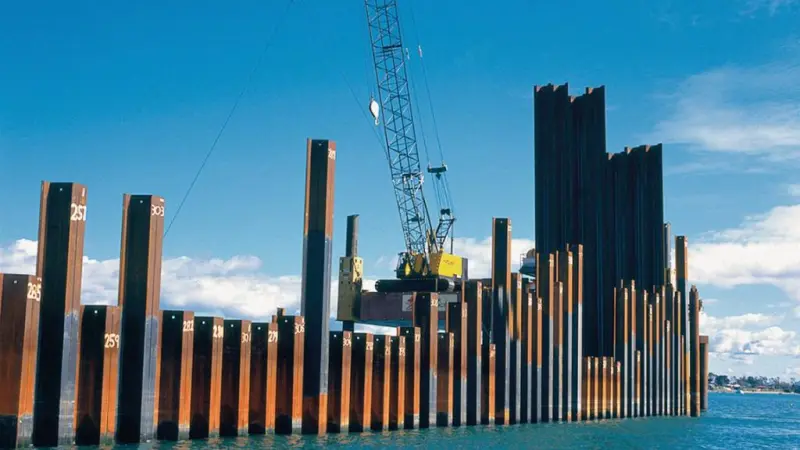
Why Marine Exposure Is Different: The Five Corrosion Zones
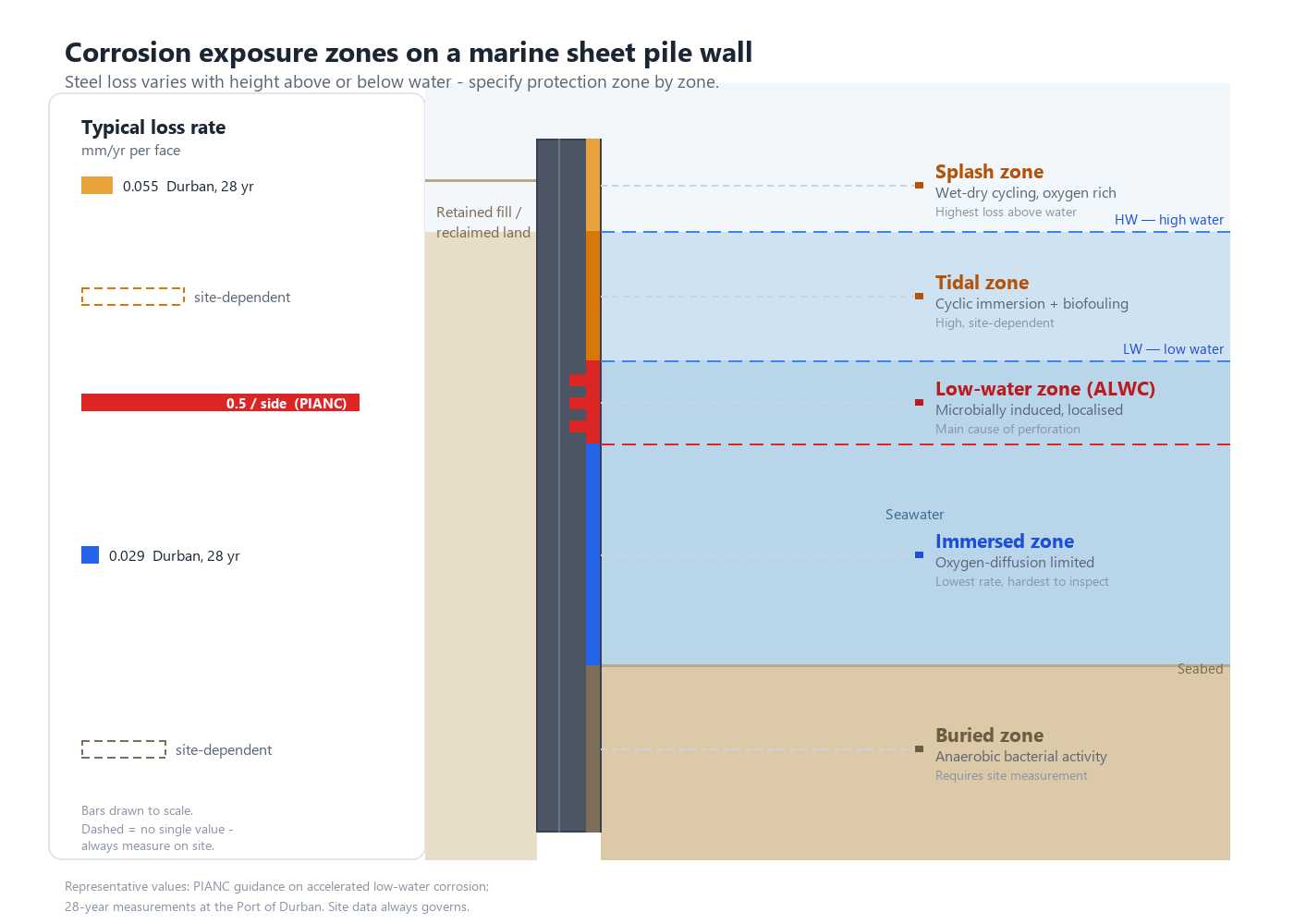
Corrosion in a marine structure is not uniform, and the most aggressive zone is not the one most people expect. The rate of steel loss depends on which part of the pile you are looking at, so the sensible approach is to divide the pile into five exposure zones and treat each one separately.
| Zone | Exposure | What drives the corrosion | Design implication |
|---|---|---|---|
| Splash zone | Wetted by spray, dried by wind and sun | Oxygen-rich wet–dry cycling | Highest loss above water; grade selection and coating matter most here |
| Tidal zone | Cyclically immersed and exposed | Oxygen reduction plus biofouling | Loss rates are high and strongly temperature- and nutrient-dependent |
| Low-water zone | Permanently wet, immediately below low tide | Microbially induced corrosion (ALWC) | Localised and unpredictable; the main cause of unexpected perforation |
| Immersed zone | Continuously submerged | Oxygen-diffusion limited | Lowest loss rate, but the hardest zone to inspect and repair |
| Buried zone | Below the seabed or inside fill | Anaerobic bacterial activity | Variable; demands site measurement rather than a blanket assumption |
The numbers matter when you are setting a corrosion allowance. A study of an existing quay wall at the Port of Durban measured an overall rate of 0.0466 mm per year after 28 years in service, with the highest loss in the splash zone (0.0545 mm/yr) and the lowest in the permanently immersed zone (0.0290 mm/yr) — see the published measurements. Localised rates can be far worse. PIANC’s guidance on accelerated low water corrosion (ALWC) reports rates averaging 0.5 mm per side per year up to the point of perforation, driven by microbiologically induced corrosion concentrated just below low water. Research by Melchers and Jeffrey links the severity of that effect to dissolved inorganic nitrogen in the water, which means two harbors at the same latitude can behave very differently — a useful reminder that published corrosion tables are a starting point, not a substitute for site data.
Selecting the Section for Protection Duty
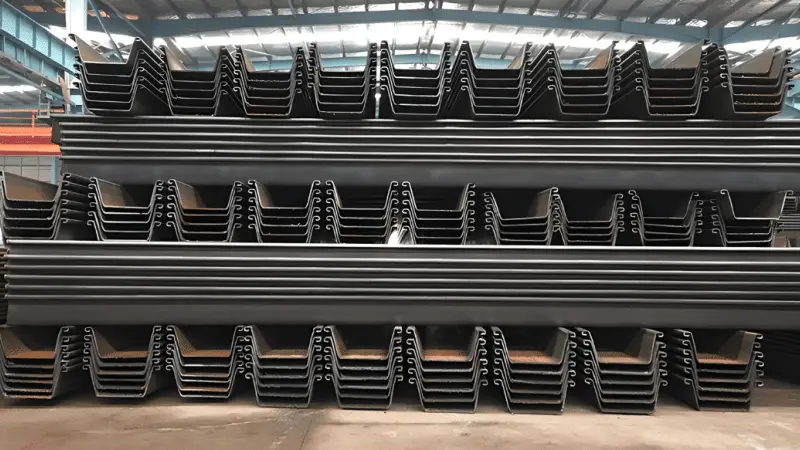
Profile selection in a port is driven by retained height, water depth and the magnitude of the horizontal load. As a working rule, the progression runs from U, to Z, to a combined wall:
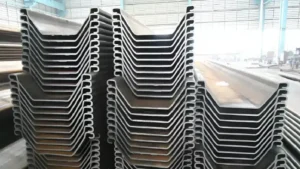
- U-type sheet piles — suitable for moderate retained heights and for walls that need to follow a curve, such as a rounded berth corner. See U-type sheet piles.
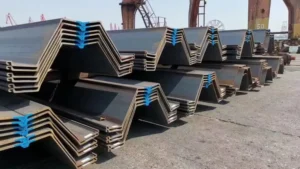
- Z-type sheet piles — the default choice for deeper quay walls. The Z profile puts material where it resists bending, so you get a higher section modulus per tonne of steel, and because the flanges sit on opposite sides of the neutral axis the section loses proportionally less capacity to corrosion. See Z-type sheet piles.
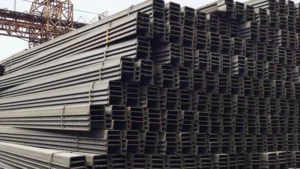
- Combined walls — once retained height and water depth push bending moments beyond what a single sheet pile can carry economically, a king pile (a steel tube or HZ section) is combined with AZ sheet pile infill panels. See combined wall systems.
This progression is essentially the same one ArcelorMittal describes for quay walls, and it holds for most protection projects regardless of which supplier you buy from. The difference between a good and a mediocre specification usually lies in the last step: proving the chosen section actually works for the specific soil, water depth and loading on your site.
Corrosion Protection Systems That Actually Work
There is no single answer to marine corrosion. The right strategy is a combination chosen to match the exposure zones identified above and kept maintainable across the design life.
1. Corrosion allowance (sacrificial thickness)
The simplest and most reliable measure is to specify a thicker section and treat the extra steel as consumable. If the assumed loss rate is 0.05 mm per year per exposed face and the design life is 50 years, the arithmetic gives 2.5 mm per face — and it is normal to add margin on top of that. This is why marine sheet piles are frequently supplied “heavy” rather than at the minimum structural section.
2. Marine steel grades
Grade selection gives you resistance that no coating can match below the waterline. ASTM A690/A690M is specified for H-piles and sheet piling in marine environments and offers roughly two to three times the splash-zone corrosion resistance of ordinary carbon steel — see the ASTM A690 specification. For a side-by-side comparison of what each grade delivers in seawater, see our article on the ASTM A690 steel grade for marine sheet piles.
3. Coatings
Coating systems protect the splash and tidal zones, where atmospheric attack is severe and where maintenance access is at least possible. Fusion-bonded epoxy and high-build epoxy systems specified to ISO 12944 durability categories are the usual approach for quay walls. The critical point is that a coating is a finite-life item: most systems will need partial renewal inside a 50-year design life, so the specification should state how that renewal will be carried out rather than quietly assuming the coating lasts forever.
4. Cathodic protection
Sacrificial anodes and impressed current systems shift the potential of the steel so that it stops acting as the anode. Cathodic protection is the only method that stays effective in the permanently immersed and low-water zones — exactly where ALWC causes perforation, and exactly where recoating is impractical. It is normally specified alongside a corrosion allowance rather than instead of one. For a zone-by-zone comparison of all four methods, see corrosion protection for steel sheet piles in seawater.
Verifying the Design
Protection projects fail most often not because the wrong material was chosen, but because the geotechnical and structural checks were incomplete. At a minimum, a marine sheet pile design should cover:
- Earth and water pressure — active, passive and at-rest pressures, with the full hydrostatic head applied on both sides.
- Berthing, mooring and wave loads — treated as service loads rather than accidental loads on a berth in continuous use.
- Embedment depth and toe stability — checked for rotational stability, basal heave and piping, not just moment equilibrium.
- Anchor and wale design — where retained height requires one or more rows of tie rods and waling beams.
- Scour assessment — particularly where the wall faces propeller wash or strong tidal currents.
The US Army Corps of Engineers manual EM 1110-2-2504, Design of Sheet Pile Walls, remains the most widely referenced starting point for these checks and includes a dedicated chapter on corrosion in retaining structures. For driven pile foundations more generally, the FHWA geotechnical publications library is the standard US reference. On the structural side, our guide to sheet pile design for wharf and dock walls works through a complete quay wall case, and how engineers calculate sheet pile wall depth for port structures covers embedment specifically.
Designing for a 50-Year Service Life
Design life is a specification, not a prediction. If a project states “50 years,” the design has to demonstrate how the wall remains serviceable for 50 years — which means assuming a defined amount of loss and planning inspection and repair around it. In practice that means:
- a stated corrosion allowance per exposed face;
- a coating or cathodic protection system with a defined inspection interval;
- a residual thickness threshold that triggers intervention;
- physical access provisions so the tidal and low-water zones can actually be inspected.
Our article on what determines the service life of steel sheet piles covers the underlying numbers in more detail.
Common Port and Harbor Protection Project Types
- New quay walls and berths — anchored or cantilever walls sized for the design vessel class.
- Quay deepening and retrofit — a new wall driven in front of an existing structure to gain draft without demolishing the berth.
- Bulkhead and seawall replacement — replacing corroded or structurally inadequate waterfront retaining systems.
- Breakwater and revetment tie-ins — tying protection walls into armoured slopes.
- Scour protection — sheet pile cut-offs at the toe to stop erosion undermining the structure.
- Reclamation containment — perimeter walls that retain fill during port expansion.
Where the brief is closer to shoreline stabilisation than to a working berth, the same systems are used in a different configuration — see steel sheet piles for coastal protection for that side of the problem.
Frequently Asked Questions
What is the design life of steel sheet piles in a port?
Typically 50 years, and often longer where a corrosion allowance, an appropriate marine grade and a protection system are specified together. The design life is achieved through a combination of section thickness, grade selection and protective measures — not by the steel alone.
Which sheet pile profile is best for a marine quay wall?
For most quay walls, Z-type sections are the default, because they deliver the highest section modulus per tonne and lose proportionally less capacity to corrosion than U profiles. Deeper berths and higher retained heights usually require a combined wall with tubular or HZ king piles.
How do you protect sheet piles from seawater corrosion?
By matching protection to the exposure zone: a corrosion allowance across the whole pile, a marine grade such as ASTM A690, a coating system for the splash and tidal zones, and cathodic protection for the immersed and low-water zones.
Are steel sheet piles suitable for permanent harbor structures?
Yes. Steel sheet pile quay walls have been in continuous service for close to a century — one of the earliest documented examples was built in the Port of Rotterdam in 1927 — and they remain one of the most cost-effective permanent solutions for waterfront retention.
Conclusion
Port and harbor protection projects reward early decisions. The profile, grade and protection strategy chosen at concept stage determine both the whole-life cost and whether the wall is still doing its job decades from now. Get those three right and verify the geotechnical design properly, and the steel itself will not be the limiting factor.
Whether you are specifying a new quay wall, retrofitting an ageing bulkhead or pricing a reclamation perimeter, we can supply the section, the grade and the protection system as a single package, with engineering support from first sizing through to delivery.
Talk to our engineering team about your project, or browse our full range of sheet pile solutions.