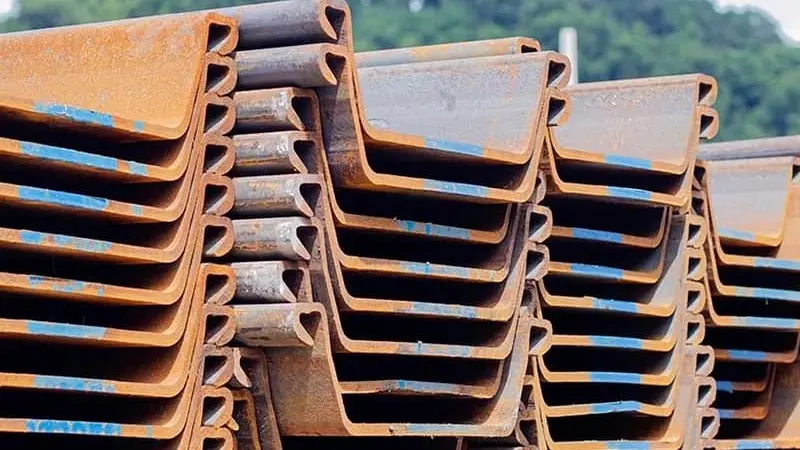
You are designing a port, a seawall, or a marine terminal. The environment is saltwater, and corrosion is a constant threat. You need a steel that can last for decades.
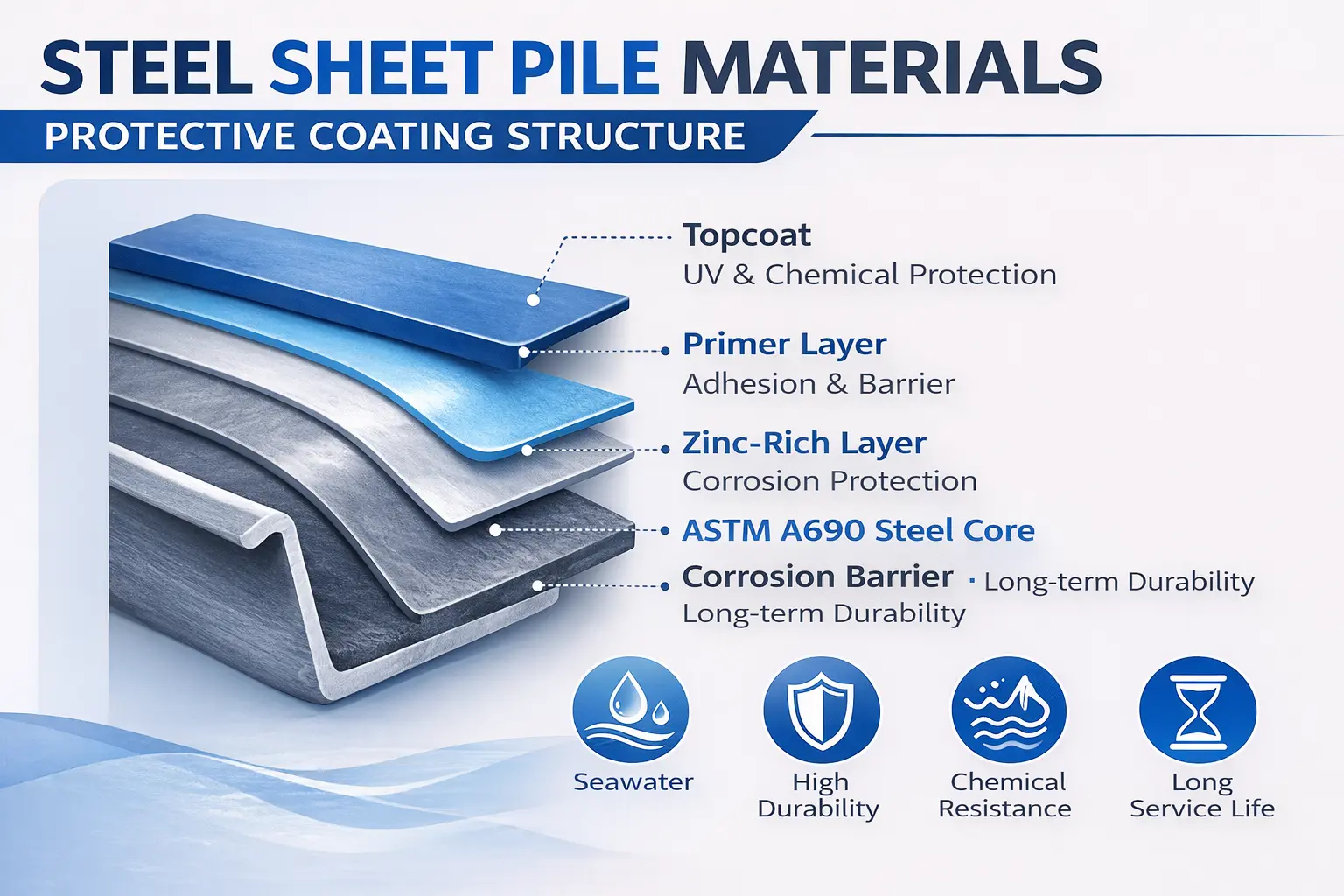
ASTM A6901 is the standard specification for high-strength low-alloy steel sheet piles with improved corrosion resistance2 in seawater. It contains copper, nickel, and phosphorus that form a protective patina, reducing corrosion by about 50% compared to standard carbon steel.
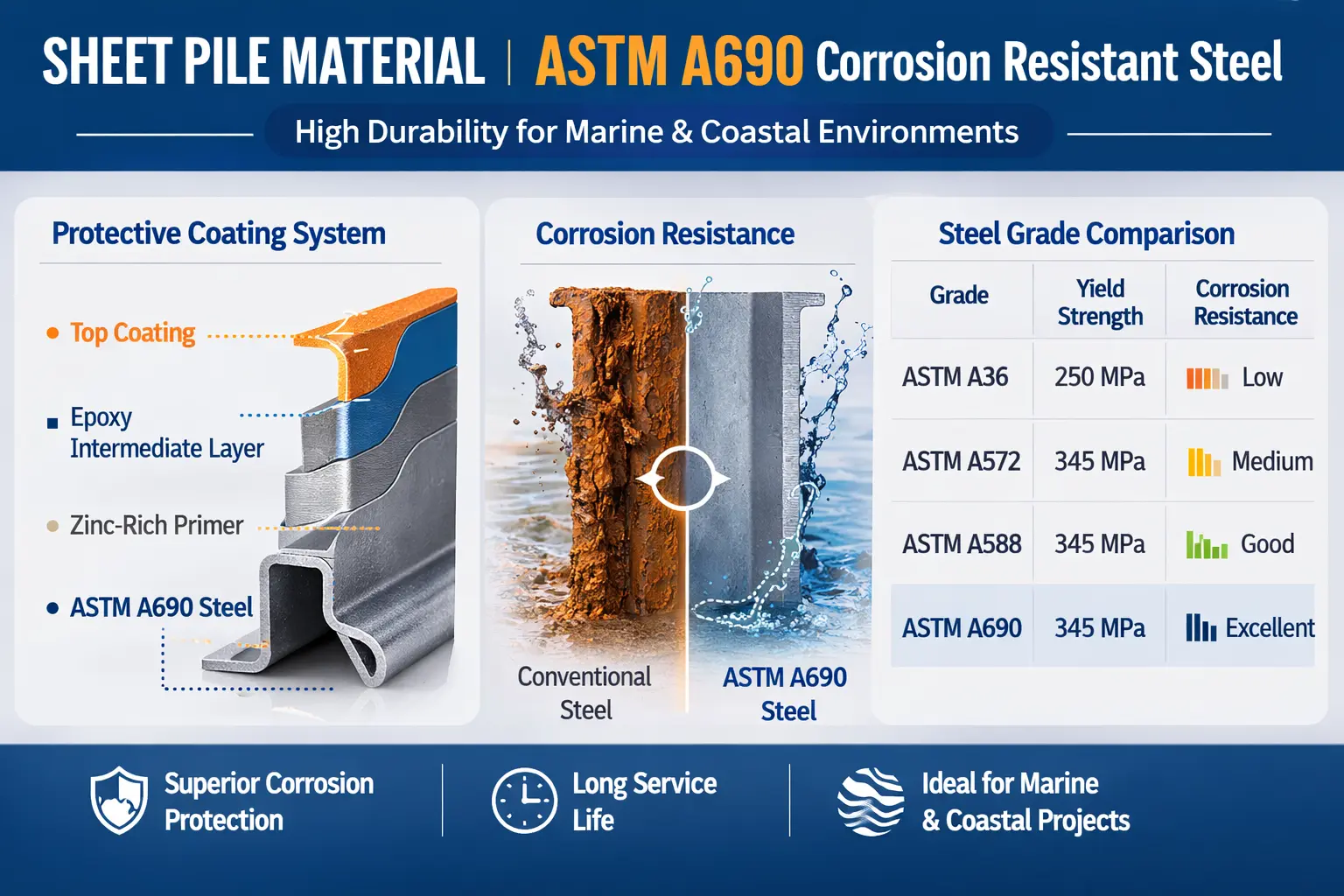
I have supplied ASTM A6901 sheet piles for ports in the Middle East, marine terminals in Africa, and coastal protection projects in Southeast Asia. The material costs more than standard carbon steel, but the long-term savings are significant. Let me explain what makes this grade special.
What grade of steel is used in sheet piles?
Sheet piles are manufactured in several steel grades. The right one depends on the environment and structural requirements.
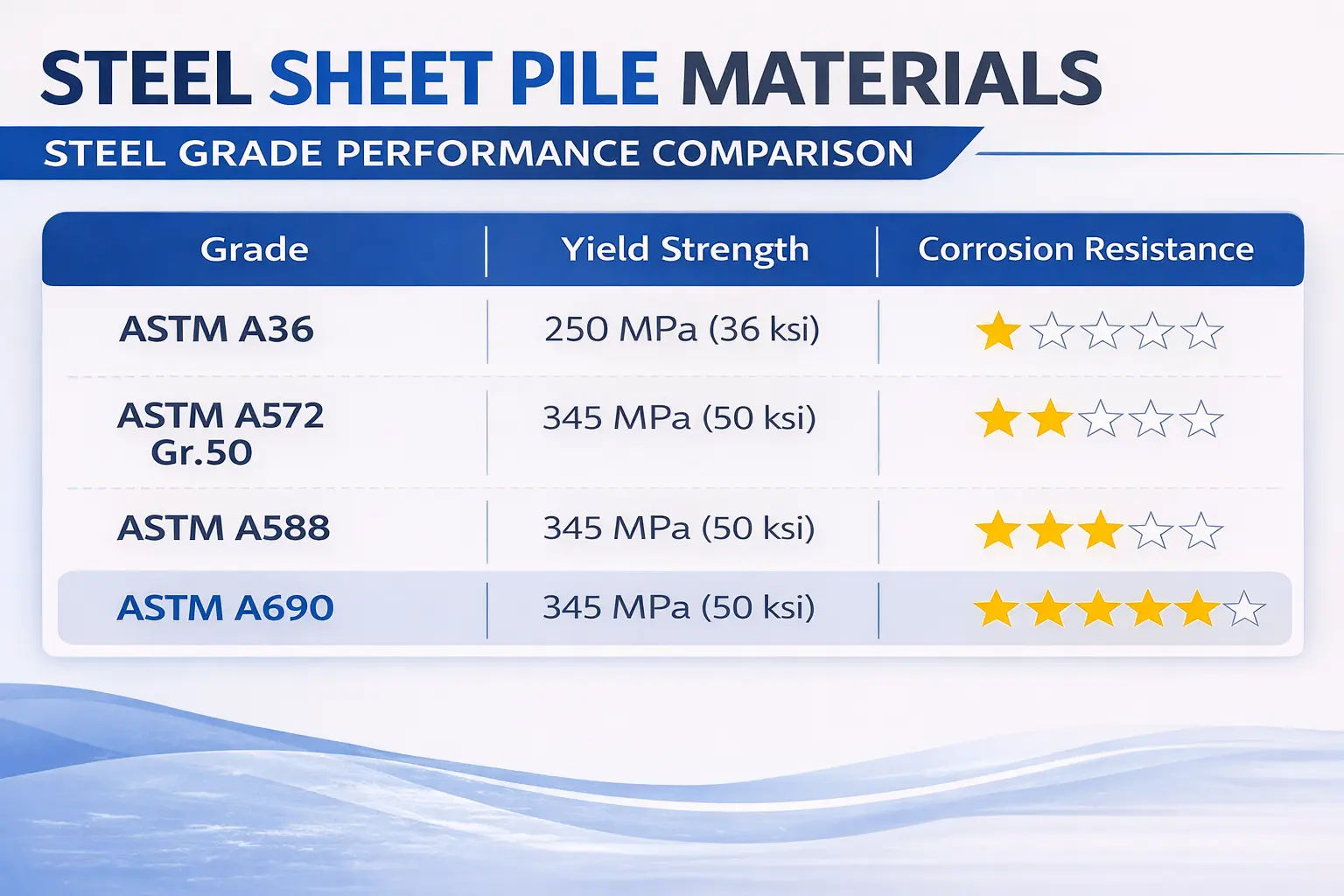
The most common sheet pile grades are ASTM A328 (standard carbon steel, 240 MPa yield), ASTM A572 Grade 50 (high-strength, 345 MPa yield), and ASTM A690 (marine grade, 345 MPa yield with corrosion resistance). For marine environments, ASTM A690 is the preferred choice.
Complete Grade Reference
Let me give you a detailed overview of the grades available.
ASTM A328 (Standard Carbon Steel)1
- Yield strength: 240 MPa (35 ksi) minimum
- Tensile strength: 410 MPa (60 ksi) minimum
- Typical use: General retaining, temporary works, freshwater applications
- Corrosion resistance2: Standard carbon steel
- Cost: Lowest
- Availability: Widely available
ASTM A572 Grade 50 (High-Strength Low-Alloy)3
- Yield strength: 345 MPa (50 ksi) minimum
- Tensile strength: 450 MPa (65 ksi) minimum
- Typical use: Deep excavations, heavy loads, where weight savings matter
- Corrosion resistance2: Slightly better than A328 due to copper content
- Cost: Moderate
- Availability: Widely available
- Yield strength: 345 MPa (50 ksi) minimum
- Tensile strength: 485 MPa (70 ksi) minimum
- Typical use: Ports, harbors, seawalls, marine terminals
- Corrosion resistance2: 50% better than carbon steel in seawater
- Cost: Higher (approximately 15-20% premium)
- Availability: Available for marine projects
Other Grades
- ASTM A857: Cold-formed light-gage sheet piles
- API 2H: Offshore platform piles
- EN 10248: European standard grades (S270GP, S355GP, S430GP)
Selection Guide
| Environment | Recommended Grade |
|---|---|
| Freshwater, temporary | A328 |
| Freshwater, permanent | A328 with coating |
| Brackish water | A572 Gr50 with protection |
| Seawater, splash zone | A690 with cathodic protection |
| Seawater, submerged | A690 or A328 with cathodic protection |
| Deep excavation, heavy loads | A572 Gr50 |
My Experience
For the riverbank project in Southeast Asia, we used A328. The water was fresh, and the wall was not in a corrosive environment. For a port project in the Middle East, we used A690. The seawater environment demanded the higher corrosion resistance.
What is the ASTM for sheet pile?
ASTM has several standards for sheet piles, covering different types and applications.
The main ASTM standards for sheet piles are ASTM A3281 for standard carbon steel sheet piles, ASTM A5722 for high-strength low-alloy sheet piles, ASTM A6903 for marine grade sheet piles, and ASTM A8574 for cold-formed light-gage sheet piles. Each standard specifies chemical composition, mechanical properties, and dimensional requirements.

Overview of ASTM Standards
Let me explain each standard and when to use it.
- Full title: Standard Specification for Steel Sheet Piling
- Covers: Carbon steel sheet piles
- Yield strength: 240 MPa (35 ksi) minimum
- Applications: General retaining walls, temporary excavations, freshwater
- Notes: The most common standard for U-shaped sheet piles
- Full title: Standard Specification for High-Strength Low-Alloy Columbium-Vanadium Structural Steel
- Covers: High-strength sheet piles (Grade 50)
- Yield strength: 345 MPa (50 ksi) minimum
- Applications: Deep excavations, heavy loads, permanent walls
- Notes: Used for both U and Z piles when higher strength is needed
- Full title: Standard Specification for High-Strength Low-Alloy Nickel, Copper, Phosphorus Steel H-Piles and Sheet Piling with Atmospheric Corrosion Resistance for Use in Marine Environments
- Covers: Marine grade sheet piles
- Yield strength: 345 MPa (50 ksi) minimum
- Applications: Ports, harbors, seawalls, marine terminals
- Notes: Specifically formulated for seawater exposure
- Full title: Standard Specification for Steel Sheet Piling, Cold Formed, Light Gage
- Covers: Cold-formed sheet piles
- Yield strength: Varies by thickness
- Applications: Temporary works, light retaining
- Notes: Not for permanent marine structures
Which Standard to Use?
For most permanent sheet pile applications, ASTM A3281 or A572 are standard. For marine environments, ASTM A6903 is the preferred choice.
My Experience
When I quote sheet piles for a project, I always ask which ASTM standard applies. For a freshwater project, A328 is typical. For a marine project, A690 is specified. The standard tells me the chemistry and mechanical properties I need to supply.
What are the grades of ASTM steel?
ASTM has a system for designating steel grades. For sheet piles, the grade indicates the strength level.
ASTM steel grades are designated by a number that typically indicates the minimum yield strength1 in ksi (thousands of pounds per square inch). For sheet piles, the common grades are ASTM A3282 (35 ksi yield), ASTM A572 Grade 503 (50 ksi yield), and ASTM A690 (50 ksi yield with marine corrosion resistance4).
Understanding ASTM Grade Designations
Let me explain what the numbers mean.
The Numbering System
ASTM standards use numbers to identify the specific standard (e.g., A3282, A572). Within a standard, grades are designated by numbers that indicate strength.
For example:
- A3282: No grade number—the standard itself defines the properties
- A572: Grade 50 means 50 ksi minimum yield
- A690: No grade number—the standard defines the properties
Common Sheet Pile Grades
| Standard | Grade | Yield (ksi) | Yield (MPa) | Notes |
|---|---|---|---|---|
| A3282 | — | 35 | 240 | Standard carbon steel |
| A572 | 50 | 50 | 345 | High-strength low-alloy |
| A572 | 55 | 55 | 380 | Less common for sheet piles |
| A690 | — | 50 | 345 | Marine grade |
| A857 | — | 33-50 | 230-345 | Cold-formed, varies by thickness |
Other ASTM Standards for Steel
ASTM has many standards for other steel products:
- A36: Carbon structural steel (plates, shapes)
- A53: Pipe, steel, black and hot-dipped
- A500: Cold-formed welded and seamless tubing
- A992: Structural steel shapes for building framing
For sheet piles specifically, A3282, A572, and A690 are the most relevant.
Why Grade Matters
The grade determines:
- How much load the pile can carry
- How deep the wall can be
- How much weight savings you can achieve
- The cost of the material
My Experience
For a deep excavation project in the Middle East, the engineer specified A572 Grade 50. The higher strength allowed a thinner section than A3282, saving 15% on steel weight. The material cost per ton was higher, but the total cost was lower.
What are the properties of marine grade steel1?
Marine grade steel (ASTM A6902) has specific properties that make it suitable for seawater environments.
ASTM A6902 marine grade steel1 has a minimum yield strength of 345 MPa (50 ksi), minimum tensile strength of 485 MPa (70 ksi), and contains copper (0.20-0.50%), nickel (0.20-0.50%), and phosphorus (0.07-0.12%). These alloying elements form a protective patina3 in seawater, reducing the corrosion rate by approximately 50% compared to standard carbon steel.
[^3] layer](https://placehold.co/600x400 "[ASTM A690](https://www.astm.org/a0690_a0690m-13ar18.html)[^2] Marine Steel Properties")](https://cnsteelplant.com/wp-content/uploads/2026/03/Comparison-Table-of-Article-Information-6.webp)
Detailed Properties of ASTM A6902
Let me give you the complete specifications.
Chemical Composition
ASTM A6902 specifies the following composition limits:
| Element | Composition (%) |
|---|---|
| Carbon (C) | 0.20 max |
| Manganese (Mn) | 0.40-1.25 |
| Phosphorus (P) | 0.07-0.12 |
| Sulfur (S) | 0.04 max |
| Silicon (Si) | 0.15-0.50 |
| Copper (Cu) | 0.20-0.50 |
| Nickel (Ni) | 0.20-0.50 |
| Chromium (Cr) | 0.50 max |
The phosphorus content is higher than in standard steel (0.04% max in A328). This, along with copper and nickel, creates the protective patina3.
Mechanical Properties
| Property | Value |
|---|---|
| Yield strength | 345 MPa (50 ksi) min |
| Tensile strength | 485 MPa (70 ksi) min |
| Elongation | 19% min in 200 mm |
| Hardness | No specified maximum |
Corrosion Resistance
In seawater immersion, ASTM A6902 corrodes at approximately 0.05 mm per year, compared to 0.10 mm per year for standard carbon steel. This 50% reduction is achieved through the formation of a dense, adherent patina that slows further corrosion.
Weldability
ASTM A6902 is weldable using standard procedures. However, because of the higher alloy content, preheating may be required for thick sections or restrained joints. The AWS D1.1 code covers welding procedures for this grade.
Toughness
A690 maintains good toughness at low temperatures. It is suitable for use in cold climates without special heat treatment.
Applications
ASTM A6902 is used for:
- Port and harbor walls
- Seawalls and bulkheads
- Marine terminals
- Offshore structures (with cathodic protection)
- Coastal protection structures
- Bridge piers in tidal zones
Comparison with Other Grades
| Property | A328 | A572 Gr50 | A690 |
|---|---|---|---|
| Yield (MPa) | 240 | 345 | 345 |
| Tensile (MPa) | 410 | 450 | 485 |
| Corrosion rate (mm/year) | 0.10 | 0.09 | 0.05 |
| Relative cost | 1.0 | 1.1 | 1.15-1.20 |
| Marine use | Poor | Fair | Excellent |
My Experience
For a port project in the Middle East, we supplied 2,000 tons of A690 sheet piles. The client chose A690 because the wall was in direct seawater contact and would not have cathodic protection. The extra cost was justified by the 50-year design life. Standard carbon steel would have needed significant corrosion allowance or cathodic protection, which was not feasible at that site.
Conclusion
ASTM A6901 is the standard for marine sheet piles, offering 50% better corrosion resistance2 than carbon steel with high strength (345 MPa yield). Use it for ports, seawalls, and any permanent structure in seawater.
-
Explore this link to understand ASTM A690’s benefits and applications in marine environments, enhancing your project durability. ↩ ↩ ↩ ↩ ↩ ↩ ↩ ↩ ↩ ↩
-
Learn about corrosion resistance in marine materials to ensure longevity and safety in your construction projects. ↩ ↩ ↩ ↩ ↩ ↩ ↩ ↩ ↩ ↩ ↩ ↩ ↩ ↩ ↩ ↩ ↩ ↩ ↩ ↩
-
Understand the role of protective patina in enhancing the durability of marine grade steel. ↩ ↩ ↩ ↩ ↩ ↩ ↩
-
Discover how marine corrosion resistance affects steel performance in coastal environments. ↩ ↩ ↩ ↩