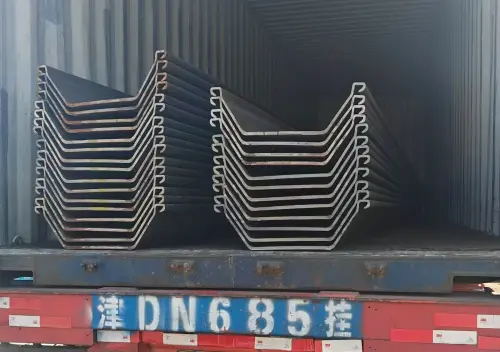
A thin steel sheet pile material submittal stalls approval, freezes the piling front, and drags the programme into liquidated damages. I have watched it happen twice.
A complete steel sheet pile material submittal includes a technical data sheet, mill test certificates traceable to heat numbers, dimensional and tolerance reports, coating data where specified, welding procedure references, third-party inspection certificates, and a declaration of conformity — every document cross-referenced to the project specification and the purchase order.
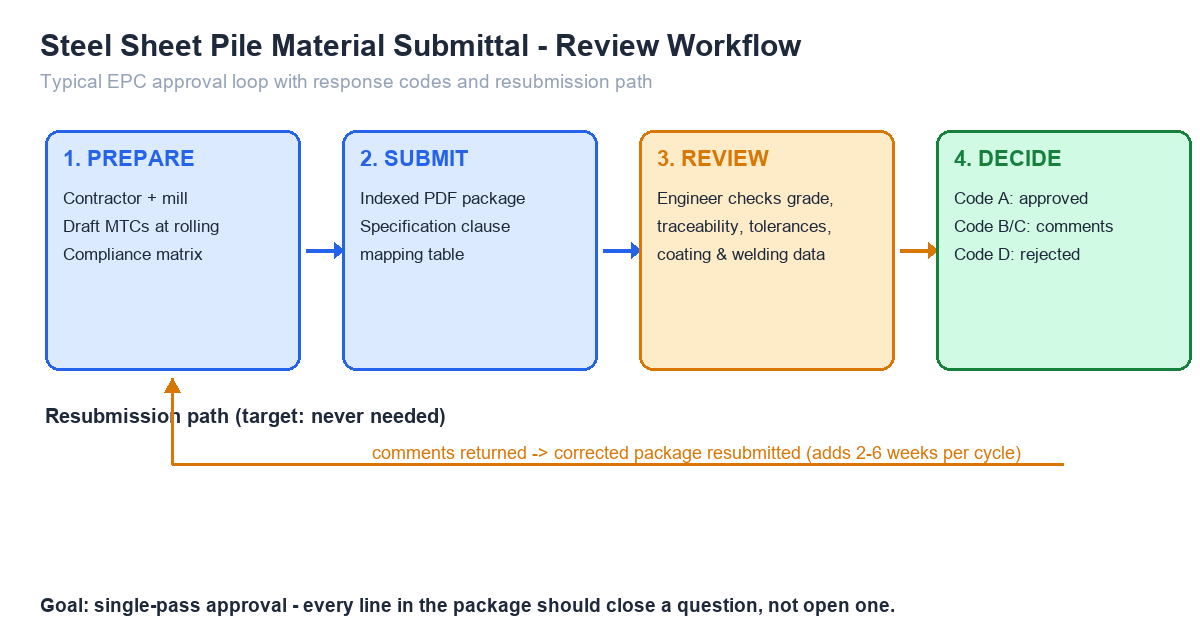
When I review a contractor's draft package for steel sheet piles destined for an EPC contract, the list looks long until you understand what the reviewing engineer is actually buying. The material submittal is the contractor's formal promise that the piles arriving at site will match the drawings, the specification, and the standards the design was certified against. My first question is always the same: what does the engineer need to see in order to say yes once, without conditions?
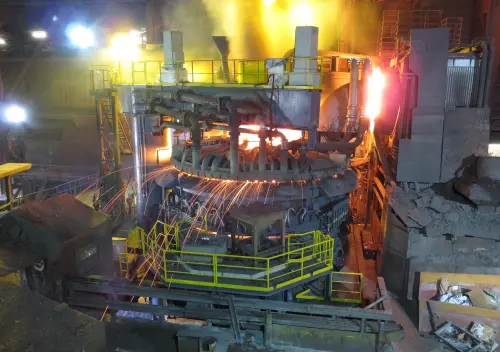
Why Do EPC Engineers Scrutinize Steel Sheet Pile Submittals So Closely?
The reviewing engineer is not checking paperwork for the pleasure of it. A sheet pile wall is a permanent, buried, often underwater structure — once the piles are driven and the backfill is placed, nobody can upgrade a steel grade or swap a profile. The submittal is the last checkpoint before that point of no return.
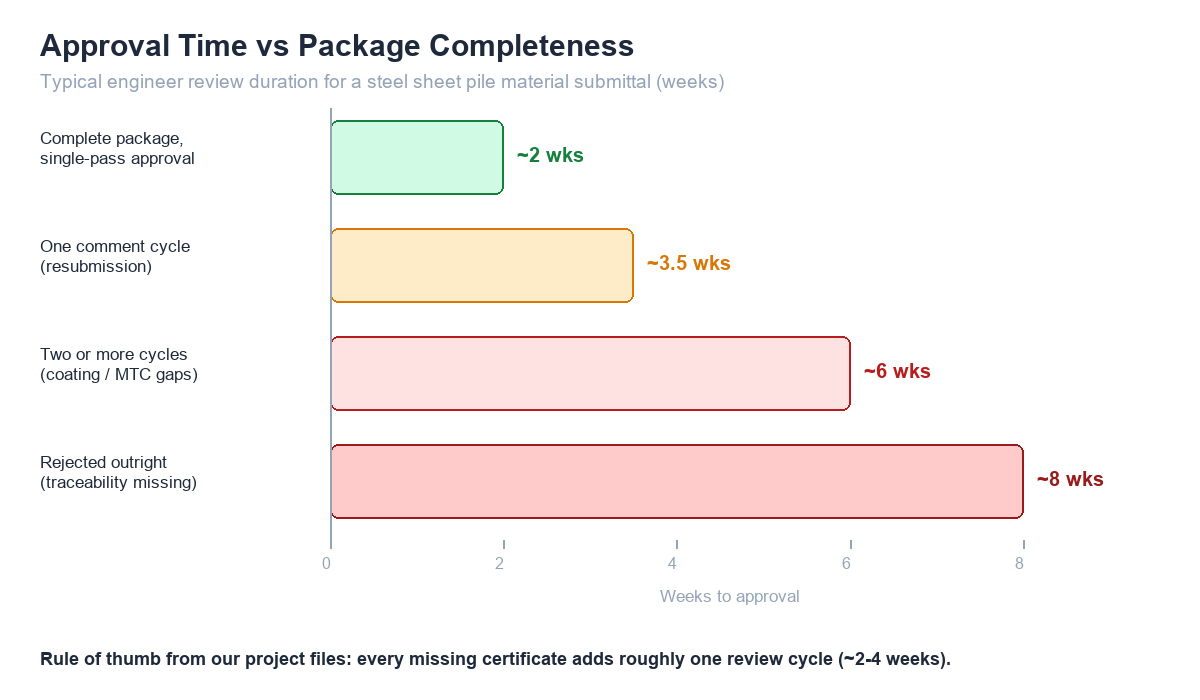
The engineer approves risk, not paper. A material submittal that proves grade, traceability, and dimensional control removes the need for intrusive site testing; a thin one invites hold points, witness testing, and weeks of correspondence that no piling program has budgeted for.
The Real Cost of a Rejected Submittal
From my side of the fence — we manufacture and export U, Z, and straight web sheet piles from Liaocheng, Shandong, mostly into wholesale channels serving EPC contractors — the pattern repeats on every continent. A package goes in missing one document: say, the coating certificate or the heat-number cross-reference. The engineer issues a coded comment, the resubmission cycle runs four to six weeks, and the piling subcontractor sits on standby rates while the crane fleet gets redeployed. On one Gulf project I heard about through a distributor, a six-week approval delay pushed pile driving into the summer heat restriction window, and the contractor lost more in standby costs than the entire value of the sheet pile supply — the kind of unbudgeted loss we catalog in our hidden cost breakdown for imported steel. The root cause, in almost every case, traces back to a package assembled in a hurry from whichever certificates happened to be on hand, rather than from the mill's current production run.
| Failure in the Submittal | What the Engineer Must Assume | Typical Programme Impact |
|---|---|---|
| MTC not traceable to heat numbers | Grade unverified; order site testing | 2–4 weeks |
| Tolerance data missing | Profile may not interlock; require trial assembly | 1–3 weeks |
| Coating certificate absent | Corrosion protection unproven; hold driving | 2–6 weeks |
| Declaration of conformity missing | No contractual proof of compliance | Approval refused outright |
| Wrong standard cited (e.g., EN instead of ASTM) | Specification mismatch; full technical review | 3–5 weeks |
The lesson I draw from these cases is that the submittal is a risk-transfer document. Every missing line transfers risk back onto the contractor, and reviewers price that risk in delay. A package built to answer the engineer's questions before they are asked is the cheapest insurance a piling program can buy — and unlike site remediation, it costs nothing but preparation time.
Which Documents Form the Core of a Steel Sheet Pile Submittal Package?
Different EPC specifications word it differently, but in practice reviewers look for the same core set of documents, arranged so each technical claim is backed by an objective certificate rather than a brochure promise.
The core package contains six elements: technical data sheets, mill test certificates, a dimensional and tolerance compliance statement, surface protection documentation, welding and connection references, and a declaration of conformity signed by the manufacturer — each item mapped line-by-line to the project specification clause it satisfies.
The Package I Assemble for Our Own Customers
When our export team supports a contractor's submittal — and we do this for most project orders, because a clean package sells the next order too — we structure it as a single indexed PDF with a compliance matrix up front. The matrix lists every requirement clause from the specification, the document that satisfies it, and the page number. Reviewers spend their first hour reading the matrix, not hunting through 80 pages of certificates, and that first impression shapes the whole review.
| Document | Reference Standard It Answers | Question It Answers for the Reviewer |
|---|---|---|
| Technical data sheet | Project specification / ASTM A328 or EN 10248 | Does the section exist with the quoted properties? |
| Mill test certificates (EN 10204 3.1) | Specification chemical + mechanical clauses | Did this heat actually meet grade? |
| Dimensional compliance statement | Tolerance clauses of the quoted standard | Will the piles interlock and drive straight? |
| Coating / corrosion data | Coating specification or corrosion allowance | How will it survive the design life? |
| Welding & connection references | AWS D1.1 or equivalent, corner-joint details | Are corner and tie-rod details weldable as drawn? |
| Declaration of conformity | Contract quality clause | Who takes contractual responsibility? |
Notice that each row answers a question the reviewer would otherwise have to raise as a comment. The standards column matters more than it looks, too: citing the wrong edition or the wrong family — quoting ASTM A328 properties in a package governed by a European specification, for instance — is one of the fastest routes to a coded rejection. That is the working test I apply before any package leaves our office: if a line item raises a question instead of closing one, it does not belong in the submittal yet. Contractors who adopt this mindset — and it really is a mindset, not a checklist — find their first-pass approval rate climbs from maybe half of packages to nearly all of them.
How Should Mill Test Certificates Be Verified Against the Specification?
The MTC is the heart of the package, and also where most rejections are born. Not because the steel is wrong — in my experience, from a mill that rolls sheet piles daily, the steel is almost never the problem — but because the certificate is read carelessly or mapped to the wrong standard.
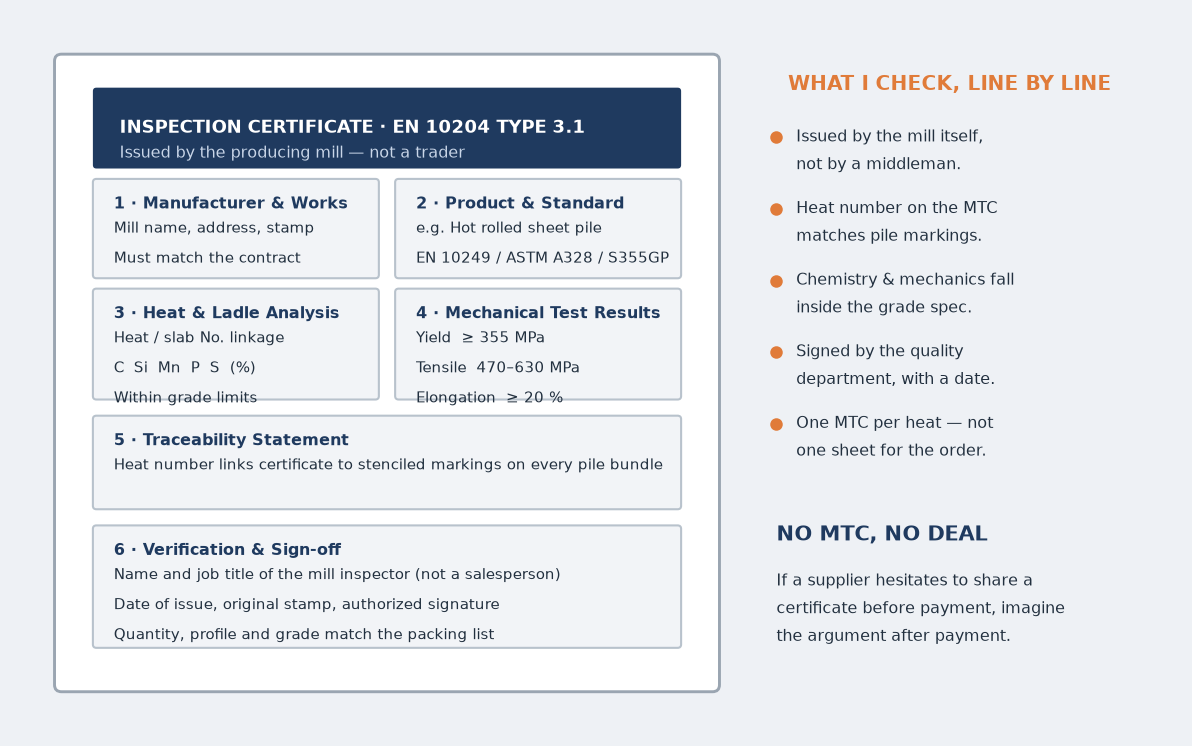
Check every MTC against three things: the heat number matches the delivery, the chemical and mechanical values meet the specified grade with margin, and the certificate type matches the contract — an EN 10204 type 3.1 certificate issued by the manufacturer's authorized inspector, or 3.2 when third-party witness is specified.
Heat Number Traceability Is the Whole Game
A certificate without a heat number is a brochure. The mill test certificate is what ties the steel to the physical bundles loaded into the container through its heat number, and it is what the site inspector will check at receiving. On our quality standards and inspection workflow I have described how each bundle leaves our plant tagged with heat number, order number, and bundle count, precisely so the contractor's submittal and the site receiving record tell the same story. When the two documents disagree, the engineer stops trusting everything else in the package, and rebuilding that trust costs weeks.
| MTC Field | What the Reviewer Checks | Red Flag I See Often |
|---|---|---|
| Heat number | Matches delivery tags and packing list | Certificate batch doesn't match shipped heats |
| Ladle chemical analysis | C, Si, Mn, P, S within grade limits | Sulfur or phosphorus sitting at the absolute ceiling |
| Yield / tensile strength | Meets grade minimum with margin | Values from a different grade's template |
| Elongation & impact (if required) | Meets spec, especially for cold regions | Impact values omitted although the spec demands them |
| Certificate type & signer | EN 10204 3.1/3.2 as specified | Photocopied stamp, unsigned, or type 2.1 used where 3.1 required |
One practical habit I recommend to every contractor: verify the MTC before the material ships, not after it lands. We issue draft certificates at the rolling stage so the contractor's engineer can pre-review them while the piles are still in our yard. That single step turns the submittal from a post-order scramble into a parallel activity, and it is why our project customers rarely see a certificate-driven rejection.
What Supporting Information Do Reviewers Expect Beyond the Certificates?
Certificates prove the steel; the rest of the package proves the system. Reviewers on infrastructure EPC contracts routinely ask how the piles will behave as an installed wall, not just as rolled sections, and the supporting documents answer that.
Expect requests for coating system data sheets with surface preparation class, welding procedures and welder qualifications for corner closures, handling and lifting method statements, tolerance statements per the governing standard, and — on many government-funded jobs — third-party inspection certificates from an agency such as SGS.
Coatings, Welding, and Third-Party Inspection Data
Coatings are the most common gap. A submittal that quotes a coating thickness without naming the surface preparation class (Sa 2½, for example), the paint system, and the applicator's qualification invites a comment. Welding matters just as much: sheet pile walls live or die at the corner and junction details, and the reviewer wants to see that whoever welds them works to a qualified welding procedure with welders certified for the position and rod class. Third-party inspection is the third recurring theme: on government-funded and lender-funded jobs, reviewers expect a certificate from an accredited agency such as SGS, which is why every project order we book includes the option of witnessed inspection before shipment. And on the document-control side, I always remind customers that packaging and marking data belong in the package too — the bundle stencils must let the site team reconcile delivery documents against the approved submittal without guesswork.
| Supporting Item | When Reviewers Demand It | Document That Satisfies It |
|---|---|---|
| Coating system data | Marine, splash zone, corrosive soils | Coating datasheet + SSPC/ISO 8501 prep class |
| Welding procedure (WPS/PQR) | Corner closures, capping beams | Qualified WPS with PQR record |
| Third-party inspection cert | Government / lender-funded projects | SGS/BV certificate referencing heat numbers |
| Handling & lifting statement | Long sections, coated piles | Method statement with lifting point details |
| Traceability & marking plan | Multi-supplier projects | Bundle stencil layout + packing list mapping |
The common thread is that every supporting document extends traceability one step further — from heat number to coating batch, from welder to weld position, from bundle stencil to packing list. A reviewer reading such a package can follow the physical product from the furnace to the wall without ever picking up the phone. That, more than any individual certificate, is what earns an unconditional approval code on the first pass.
What Mistakes Get Steel Sheet Pile Submittals Rejected Most Often?
After years of watching packages go through engineers in half a dozen countries, I can predict which failures will occur before the reviewer does. They cluster into five patterns, and all five are avoidable at zero cost.
The top rejections are: missing heat-number cross-reference, wrong standard revision cited, certificates for material other than what ships, coating data without preparation class, and no signed declaration of conformity. Every one of them is a formatting or diligence failure, never a steel failure.
Five Rejection Patterns and How to Avoid Them
The first pattern is the copy-paste specification: a package prepared for one project reused on another, with the old standard revision still cited. The second is the "last shipment's certificates" trap, where the MTCs in the package belong to an earlier order because the current heat numbers were not yet available. The third is silence on corrosion: the specification asks for a design life, the package says nothing about protection, and the reviewer has no choice but to reject and ask. The fourth is the missing quantity and dimensional reconciliation — the packing list quantities do not tie to the order, which makes the engineer wonder what else does not tie. The fifth, and in some ways most frustrating, is the unsigned or unstamped declaration of conformity, a document worth ten seconds of signature time that resets the whole review clock when absent. A related failure I see on first-time importer projects is choosing a supplier whose quality system cannot back the documents up in the first place — which is why I always steer buyers toward the factory capability checks and the broader import verification steps before the purchase order is signed, because no submittal can be stronger than the system that produced it.
My advice to contractors assembling their next RFQ-to-submittal chain is to run a mock review before submission: hand the package to someone who has not seen it, ask them to play the engineer, and let them try to reject it. Every objection they raise is a comment you have just prevented. We run this exercise internally on packages we assemble for customers, and it consistently catches two or three issues that a fresh pair of eyes spots in twenty minutes and a busy project engineer would have caught in three weeks — by correspondence.
My Take on Material Submittals After Two Decades in This Trade
If you ask me what separates contractors who never lose time to submittal rejections from those who lose weeks, it is not document templates or software — it is when the submittal is written. The winning contractors start the package at purchase order stage, request draft MTCs at rolling, and treat the submittal as a manufacturing deliverable with its own production schedule. We manufacture to order, so I see both rhythms: buyers who chase certificates after the steel is on the water, and buyers whose engineer approves the package before the ship sails. The second group pays the same freight and the same steel price, but they drive piles weeks earlier — and in infrastructure, weeks are the most expensive commodity on the project. My second conviction is that the manufacturer carries half the responsibility. When we supply submittal-ready documentation with the offer, approval stops being the contractor's problem and becomes a shared deliverable — and that is exactly how we try to work on every project order we book.
Conclusion
A complete steel sheet pile material submittal proves grade, traceability, dimensions, protection, and accountability in one indexed package. Build it early, cross-reference every clause, and the engineer's approval becomes a formality rather than a fight.
Tags: steel sheet pile material submittal, EPC contractors, mill test certificate, EN 10204, engineering approval