How Is the Steel Sheet Pile Manufacturing Process Explained Step by Step?
One weak heat of steel can crack an interlock under a port wall. That is why I always trace the full manufacturing process before I sign any supply contract.
Steel sheet piles are made by melting graded scrap in an electric arc furnace, refining the chemistry, casting blooms, reheating them, and hot rolling the section and its interlocks in one line. Mills then straighten, cut, test, and bundle every pile before export.
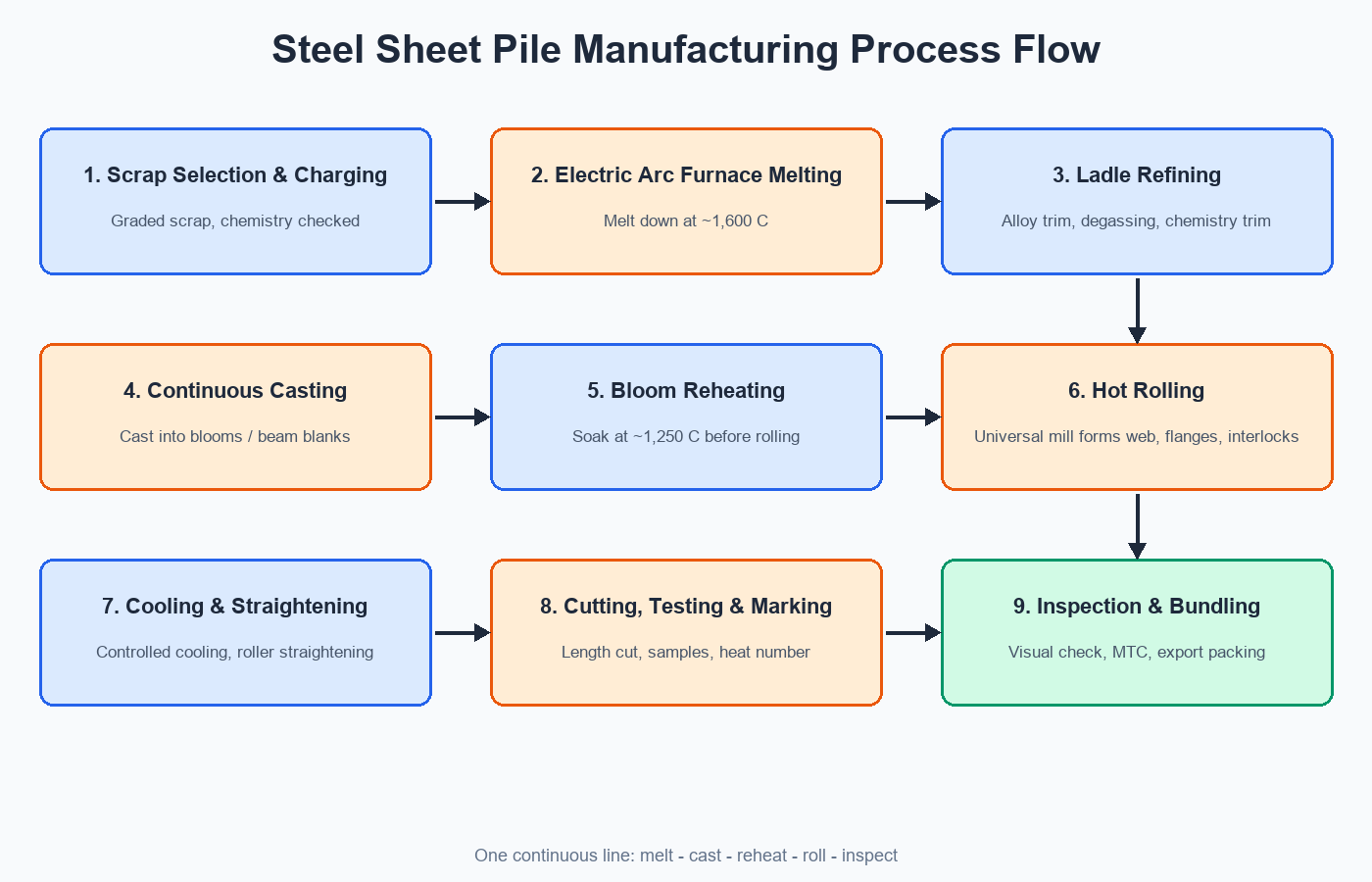
So the story is one continuous line: melt, cast, reheat, roll, inspect. I sell these products every day, and I still walk the mill floor whenever I can. In this article, I will break down each stage in plain words, share what I check on site, and show you where quality is won or lost. If you buy or specify sheet piles, this process map will help you ask sharper questions and avoid weak supply.
What Are the Main Stages of the Steel Sheet Pile Manufacturing Process?
A vague process description hides risky shortcuts. I want every buyer to see the whole chain clearly, from scrap yard to export bundle.
The main stages are scrap selection, electric arc furnace melting, ladle refining, continuous casting, bloom reheating, hot rolling, cooling and straightening, cutting with testing, and final inspection with bundling. Each stage has its own checks, and skipping any one of them weakens the pile.
The flowchart above is how I explain the process to new customers. It looks simple on paper, but each box hides a lot of engineering. Let me walk you through it.
Why the sequence matters
The order is not optional. Melt first, because casting needs liquid steel with the right chemistry. Cast next, because rolling needs a solid bloom with a clean structure. Reheat, because the rolling mill needs the metal soft enough to shape. Roll the section in one hot pass line, because the interlock and the web must stay connected as one piece. Then cool in a controlled way, straighten, cut, and test. When I visit a mill, I follow the same order and look for weak links. If a supplier cannot show me the casting date and the rolling date for a heat, I treat that as a red flag. A pile that skips controlled cooling may look fine on the truck and crack in the ground years later. The chain is only as strong as its weakest stage.
| Stage | Key Equipment | What Can Go Wrong |
|---|---|---|
| Scrap selection | Yard, sorting, radiation checks | Bad scrap brings tramp elements |
| Melting | Electric arc furnace | Overheating burns alloys out |
| Refining | Ladle furnace, degasser | Loose chemistry control |
| Casting | Continuous caster | Cracks, segregation in bloom |
| Reheating | Walking beam furnace | Wrong soak temperature |
| Rolling | Universal mill | Interlock shape drift |
| Finishing | Straightener, saws | Residual stress, poor cut |
| Inspection | Test lab, marking | Missing heat numbers |
How Is the Raw Steel Melted and Refined for Sheet Piles?
Chemistry is the soul of a sheet pile. Get it wrong, and no rolling schedule can save the product.
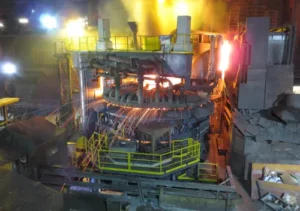
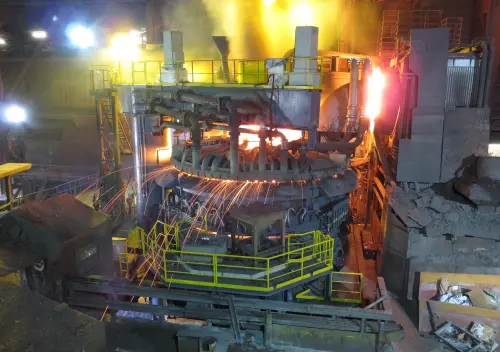
Most export sheet piles start as graded scrap melted in an electric arc furnace. The ladle furnace then trims carbon, manganese, silicon, and micro-alloys to hit the target grade, while degassing removes hydrogen and oxygen before casting.
I spend more time on this stage than customers expect. Scrap is not just scrap. Cheap scrap carries copper, tin, and nitrogen. Those elements sound small, but they change weldability and toughness. Our partner mills grade and sort scrap before charging the furnace, and they reject deliveries that fail the check.
What chemistry targets matter for buyers
The target depends on the standard. Chinese grades like Q235B and Q355B follow GB/T, European grades follow EN 10248 with S355GP, and marine projects often call for ASTM A690, which adds corrosion resistance for splash zones. I keep a small table like the one below in every offer I send. It saves long email threads later. If you want a deeper comparison of these grades, I wrote a full guide to common steel grades used for steel sheet piles that covers yield strength and welding in detail. My rule on the floor is simple: no heat leaves the ladle furnace until the lab confirms the full analysis. A heat number without a lab report means nothing to me.
| Element | Q235B (GB/T) | S355GP (EN 10248) | Why It Matters |
|---|---|---|---|
| Carbon (max) | 0.20% | 0.16% | Weldability |
| Manganese | ~1.40% | ~1.50% | Strength |
| Silicon (max) | 0.35% | 0.55% | Deoxidation |
| Sulfur (max) | 0.045% | 0.035% | Hot cracking |
| Phosphorus (max) | 0.045% | 0.035% | Cold brittleness |
| Yield (min) | 235 MPa | 355 MPa | Section design |
What Happens During Continuous Casting of Sheet Pile Blooms?
Casting decides the internal structure. You cannot inspect your way out of a badly cast bloom.
Liquid steel flows from the ladle into a continuous casting machine, where it solidifies into blooms or beam blanks. Casting speed, cooling water, and cut lengths are controlled tightly so the bloom is sound, uniform, and ready for rolling.
I like standing at the caster platform. The glow, the rhythm, the smell of hot metal. It is the point where the steel becomes a product.
Why bloom quality decides pile quality
Two defects matter most here. The first is segregation, where carbon and sulfur drift to the bloom center during solidification. The second is surface and internal cracks, often caused by wrong cooling water or a dirty mold. Mills fight both with soft reduction, electromagnetic stirring, and careful mold powder. For sheet piles, the bloom shape is also specific. Some mills cast beam blanks that are already close to the final profile, which saves passes in the mill and improves interlock consistency. Others cast square blooms and roll more passes. Both routes can work, but the mill must know what it is doing. When I audit a new mill, I ask for their casting rejection rate and their bloom cut length tolerance. Honest numbers tell me more than a glossy brochure. A clean bloom rolls into a clean pile. A tired caster hides problems that show up three stages later, at the customer’s site, during driving.
| Check at the Caster | Typical Target | Risk If Missed |
|---|---|---|
| Superheat at tundish | 20–35 C | Breakouts, coarse grains |
| Casting speed | Stable, no surges | Segregation bands |
| Mold cooling water | Tight flow control | Surface cracks |
| Soft reduction | Set per grade | Center porosity |
| Bloom cut length | ±20 mm | Yield loss, off-cuts |
Why Is Hot Rolling the Heart of Sheet Pile Production?
This is where a simple block of steel becomes a Z, a U, or a straight-web section. One wrong pass and the interlock never fits again.
Blooms are reheated to about 1,250 C and passed through a universal mill, where hot rolling forms the web, the flanges, and the clutch of the interlock in sequence. The last passes fix the profile before the steel cools below its forming range.
Rolling a sheet pile is harder than rolling a beam. The interlock clutch must form at a precise angle and width, or piles will not clutch together on site. I have watched operators adjust roll gaps by a fraction of a millimeter between heats.
How the temperature ladder shapes the result
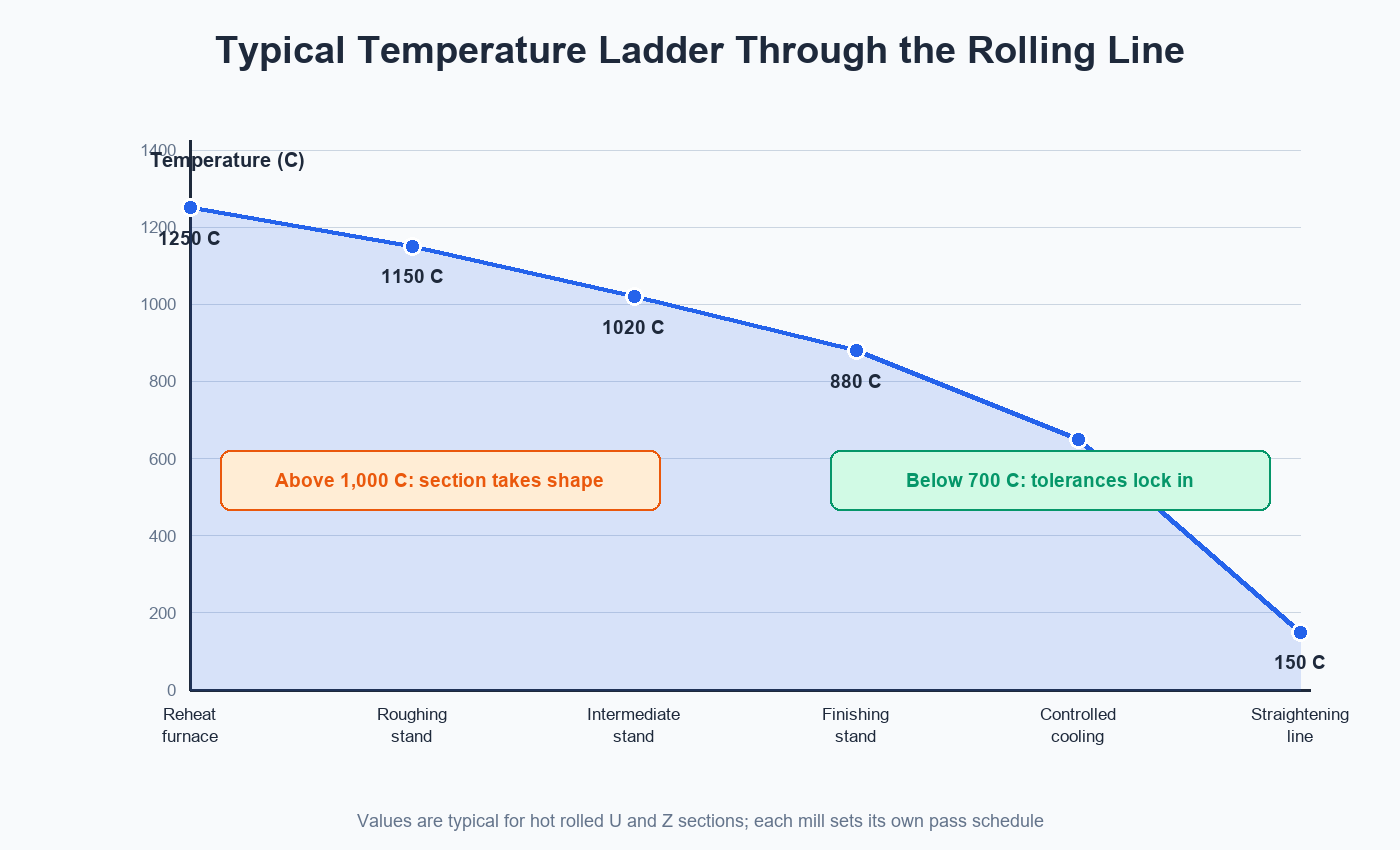
The mill runs a pass schedule that drops temperature stage by stage, like the chart I drew for this article. Above about 1,000 C, the section takes its shape and the metal flows around the rolls. Below about 700 C, the shape is locked and further work would hurt the steel. Mills stop forming inside that window. If a mill rolls too cold, you get high residual stress and a pile that wants to twist. If it rolls too hot, the surface scales badly and dimensions drift. The Z-section profile in the photo below is what a correct pass schedule produces: sharp clutch walls, even web thickness, and clean flange faces. For a closer look at how U and Z profiles differ in performance, see my article on steel sheet pile interlock types. My own check at the mill is to run a template gauge along the clutch of a hot-off-line pile. A good mill passes that check without blinking.

| Rolling Zone | Approx. Temp | Purpose |
|---|---|---|
| Reheat furnace | ~1,250 C | Uniform soak |
| Roughing stand | ~1,150 C | Break down bloom |
| Intermediate stand | ~1,020 C | Form web and flanges |
| Finishing stand | ~880 C | Form interlock clutch |
| Controlled cooling | ~650 C | Lock structure |
How Are Tolerances and Interlock Quality Controlled After Rolling?
Once the pile is cool, the clock for corrections has run out. Tolerance control has to be strict from this point on.
After rolling, piles are straightened on roller lines, measured against EN 10248 style tolerances for web thickness, height, and clutch, then checked for interlock fit with trial sections. Out-of-tolerance piles are cut back or scrapped, not shipped.
This is the stage where cheap mills cheat and good mills invest. A straightener that is out of adjustment leaves residual stress in the pile. On site, that shows up as a wall that creeps out of line during driving.
What tolerances actually get checked
The main numbers are web thickness, total height, flange width, and straightness. Interlock checks are my favorite part, because they are so physical. The mill takes a finished clutch from each heat and rotates a male section into a female section by hand or with a small winch. If the clutch binds or the gap swings, the mill adjusts or rejects. I once held up a shipment because two heats out of forty failed this trial. The customer thanked me when the wall drove clean in the Gulf. If you want the full inspection playbook, I documented it in my guide to quality standards and inspection for steel sheet piles. The temperature chart below shows why this window matters: once the steel passes through controlled cooling, tolerances are locked in, and nothing downstream can truly fix a rolled error.
| Parameter | Typical Tolerance | How It Is Measured |
|---|---|---|
| Web thickness | ±0.5 mm | Ultrasonic or micrometer |
| Section height | ±2% | Gauge and caliper |
| Flange width | ±3% | Caliper |
| Straightness | 0.2% of length | String line |
| Clutch fit | Smooth rotation | Trial section test |
What Happens Before Dispatch: Testing, Marking, and Bundling?
The last stage protects everything that came before it. A perfect pile can still fail an export project if the paperwork and packing are sloppy.
Before dispatch, each heat is tested for tensile and yield strength, every pile is stamped with its heat number, and bundles are strapped, tagged, and loaded with lifting points for safe handling at the destination port.
By this point I have usually seen the mill certificates. What I still verify in person is the marking and the packing.
What a proper export bundle looks like
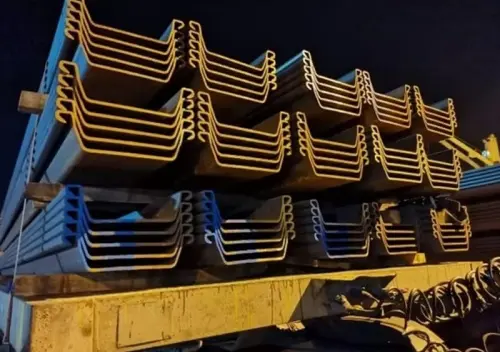
Every bundle carries a steel tag with the heat numbers, the grade, the section name, and the bundle weight. The piles inside are squared, strapped at fixed intervals, and sometimes end-capped for long sea transport. The lab tests run in parallel: tensile samples per heat, and impact tests at the grade’s required temperature. The mill test certificate then ties every number to every pile, which matters when customs or a surveyor asks questions at the port. I explained the full document chain in my article on common certifications for steel sheet pile export projects. Packing failures are silent killers. A bundle that shifts in the hold can bend clutch walls before the piles ever touch a hammer. That is why I insist on proper dunnage and photographing every loaded bundle, a process I covered in my guide to packaging, loading, and transportation of steel sheet piles. The photo below shows a finished yard load ready for the port.
| Pre-Shipment Item | Standard Practice | Buyer Action |
|---|---|---|
| Tensile test | 1 set per heat | Check MTC values |
| Impact test | At grade temperature | Confirm test temp |
| Heat number stamp | Every single pile | Spot check on arrival |
| Bundle tagging | Steel tag, fixed info | Match tag to MTC |
| Loading photos | Before and after lashing | Keep for claims |
My Take on Choosing a Mill You Can Trust
I have walked dozens of mills in ten years, and my conclusion is blunt: the manufacturing process only protects you when the mill treats every stage as a promise, not a checkbox. I now grade suppliers on three things. First, traceability. Every pile must trace back to its heat and its test report in one step. Second, interlock discipline. A mill that keeps trial sections by the roller line cares about what happens on your site. Third, honesty at the caster and the lab. If a mill shows me rejection data without being asked, I trust everything else they say. Price differences between mills are usually smaller than the cost of one stuck wall. When I quote, I would rather explain why our pile costs a little more than apologize later. That is the whole point of knowing this process: it turns a catalog choice into an engineering decision.
Conclusion
From scrap yard to export bundle, sheet pile quality is built stage by stage. Walk the process with your supplier, ask for traceability, and your wall will drive clean.
Tags: steel sheet pile manufacturing process, hot rolling steel sheet piles, sheet pile production line, steel sheet pile quality control, sheet pile mill test certificate