How Do Steel Sheet Pile Export Solutions Support Global Infrastructure Projects?
Ports erode. Coastlines retreat. Projects stall when the right steel never arrives. I have spent years solving exactly that problem for contractors across three continents, and this article is how I explain it to new buyers.
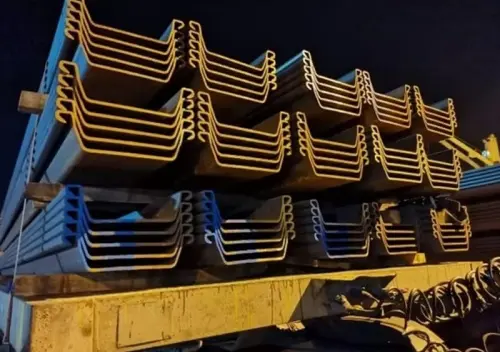
Steel sheet pile export solutions combine mill-direct production, OEM section customization, SGS-verified quality control, and container or breakbulk logistics to deliver U, Z, Ω, flat, hat, and straight-web piles from our factory in Liaocheng, Shandong, to infrastructure sites in the Middle East, Africa, Australia, and the Americas.
That one paragraph is the whole business. Everything below is the detail behind it — the projects that depend on exported piles, the supply chain that produces them, the paperwork that moves them across borders, and the quality system that lets a buyer in Baghdad or Brisbane sleep at night.
Which Global Infrastructure Projects Depend on Exported Steel Sheet Piles?
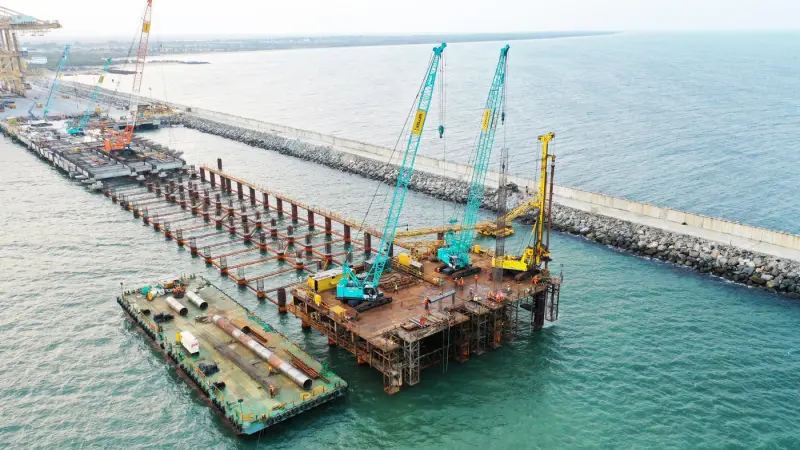
When I look at our shipment records for the past year, the same project categories keep appearing: port expansions, flood defenses, land reclamation, and foundation works. These are the arenas where a steel sheet pile wall is not just convenient but structurally and economically irreplaceable.
Roughly speaking, four project families absorb the majority of exported sheet piles: marine and port works, riverbank and flood control, deep excavation support, and permanent retaining structures. Each family pulls a different section profile, steel grade, and corrosion protection package — which is why export supply is engineering, not just shipping.
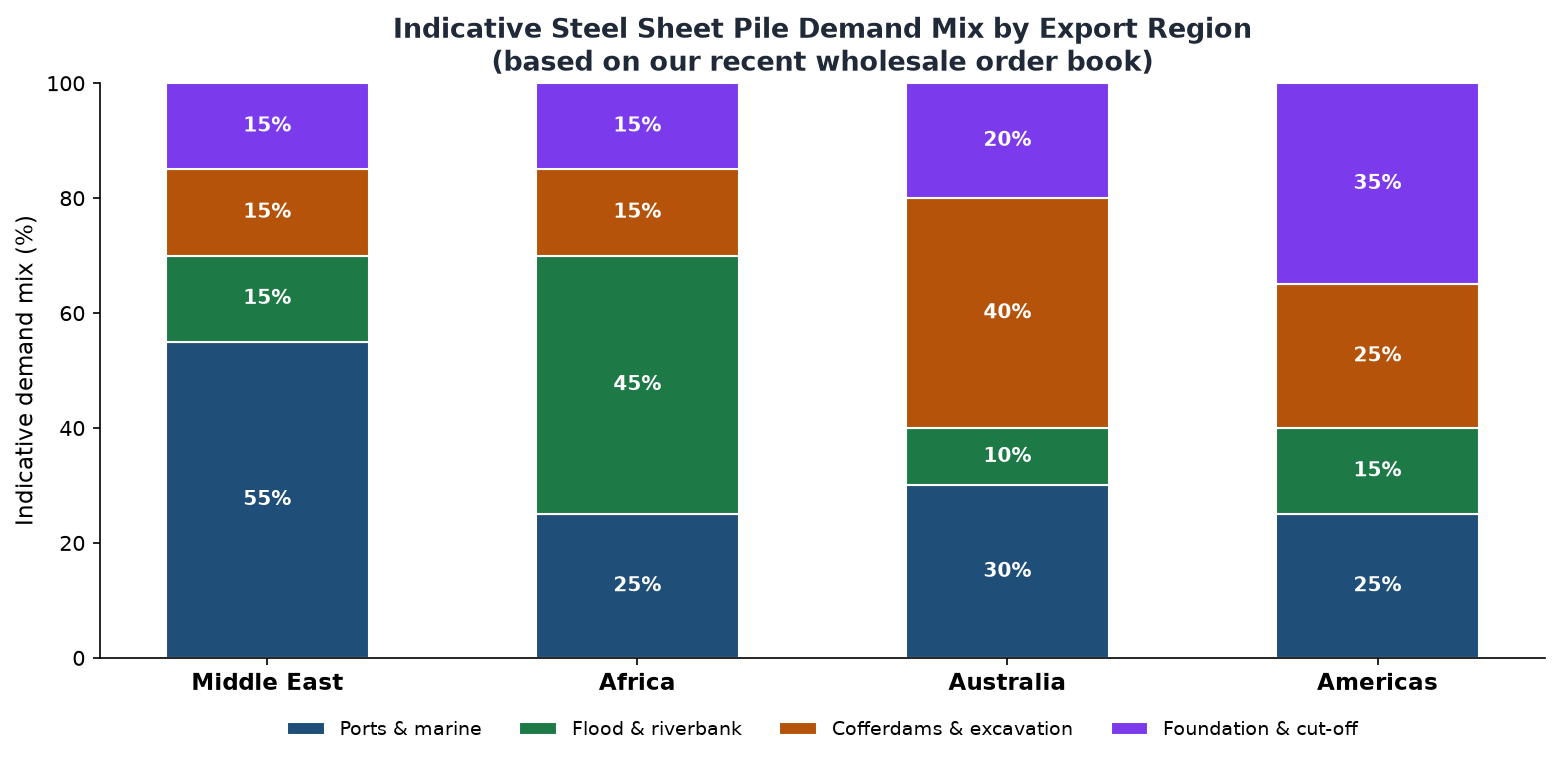
The four project families, in practice
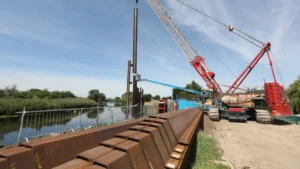
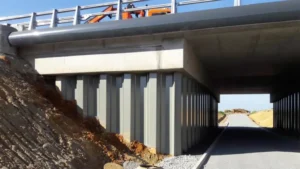
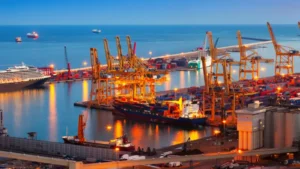
Let me make this concrete. In the Middle East, our orders cluster around port quays, breakwaters, and land reclamation in Iraq, the UAE, Saudi Arabia, and Jordan. Z-type piles in high-strength grades dominate there, because a quay wall lives or dies on its bending capacity and its corrosion allowance. Along African rivers, I see U-type piles going into river training, bank protection, and irrigation headworks — the classic combination of U-pile plus vibratory hammer that our Southeast Asian riverbank project used so successfully. In Australia, the demand leans toward temporary cofferdams for bridge and port construction, where sections must be recoverable and reusable for the next contract. In North and South America, foundation and cut-off walls for civil works keep our flat and specialty sections moving.
The table below is how I summarize the mapping for a new customer on a first call.
| Project family | Typical regions we ship to | Common sections | Typical grades | Key design driver |
|---|---|---|---|---|
| Port quays, breakwaters, reclamation | Iraq, UAE, Saudi Arabia, Jordan | Z-type, hat-type | S355GP, S430GP | Bending moment + corrosion allowance |
| Riverbank and flood control | Africa, Southeast Asia, Pakistan | U-type | Q355B/S355GP | Drivability in mixed soils |
| Cofferdams and deep excavation | Australia, Middle East, Americas | U-type, Z-type | S355GP | Extractability and reuse |
| Foundation and cut-off walls | North America, South America, Middle East | Flat, Ω, straight-web | S355GP and up | Interlock strength / tension |
Why does this mapping matter to an export buyer? Because it tells us, before the first quotation, which questions to ask. A quay wall in the Gulf needs a marine-grade solution and a serious corrosion strategy; a temporary cofferdam in Darwin mostly needs a section that comes back out of the ground cleanly and sells again. I wrote a fuller breakdown of how port and harbor protection projects select their piles, and our team keeps a similar regional playbook for every market we serve. When a buyer contacts us with a project family and a country, we are rarely starting from zero — and that accumulated project history is, honestly, a large part of what a real export solution is selling.
How Does an Export-Ready Supply Chain Turn an Inquiry Into Delivered Steel?
A buyer in Amman does not care how many rolling mills we have visited; he cares whether 400 tonnes of AZ sections arrive in Jebel Ali on schedule, with the right mill certificates. So let me walk you through the chain we actually run, end to end.
Our export pipeline runs through eight controlled stages: inquiry and drawings, section selection, OEM production or ready stock, in-house QC, SGS third-party inspection, export packing and marking, port loading by container or breakbulk, and document-supported delivery. Every stage has a named owner in our factory, and every handoff produces a written record.
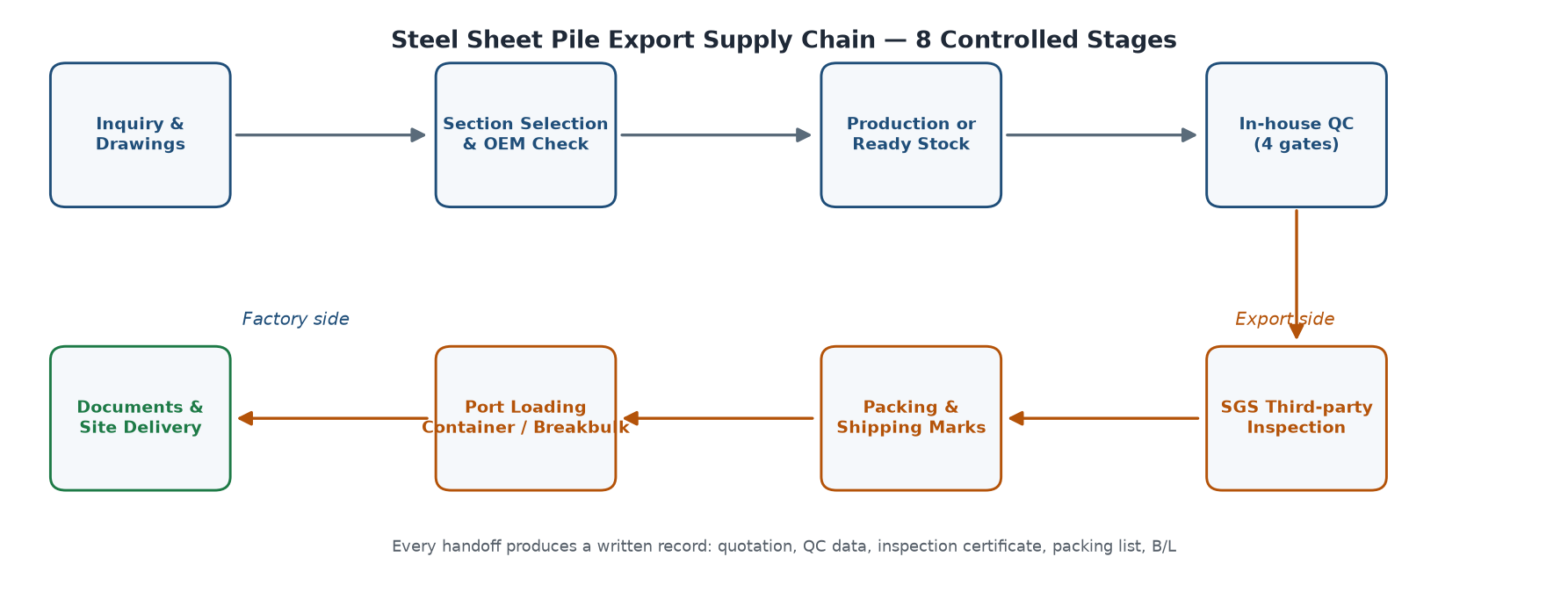
From drawings to a firm quotation
Most inquiries arrive as a bill of quantities, a drawing, or sometimes just a photo of a failed timber wall. My first job is to convert that into a section recommendation: profile, grade, length, and quantity. If the client’s engineer has specified something unusual — say, a hat section for a combined wall with tubular members, or an interlock tolerance tighter than our standard — we check our rolling schedules for OEM feasibility. Our workshop produces U, Z, Ω, flat, disc, hat, and straight-edge sections as standard, and we roll custom sections to order. If standard stock in common grades such as Q235, Q355, and S355 fits the design, we quote against yard inventory and the lead time shrinks to weeks instead of months.
Production, inspection, and the paper trail
Once the order is confirmed, production follows the same discipline I described in our quality standards and inspection article: chemical composition checks at the mill, dimensional sampling on the finishing line, interlock fit testing, and marking that matches the shipping marks we agreed in the contract. For government-funded and donor-funded projects — which is most of our Middle East and Africa volume — the client usually appoints SGS or a similar third party to witness inspection before shipment. We plan for that from day one, because arranging inspector attendance is a schedule item, not an afterthought. The Mill Test Certificates and certification package is assembled in parallel, not after production.
| Supply chain stage | What happens | Typical duration | Written output |
|---|---|---|---|
| Inquiry & drawings | Section recommendation, feasibility check | 1–3 days | Quotation + section proposal |
| OEM production / stock allocation | Rolling or yard pick per order | 2–6 weeks | Production schedule |
| In-house QC | Dimensional, chemical, interlock checks | In-line | QC records |
| Third-party inspection (SGS etc.) | Witness sampling, loading supervision | 2–5 days | Inspection certificate |
| Packing & marking | Bundling, lifting points, shipping marks | 2–4 days | Packing list |
| Port loading | Container, flat rack, or breakbulk | 1–3 days | B/L draft |
| Sailing & documents | B/L, CO, invoice, packing list courier | 2–6 weeks | Full document set |
The honest truth I tell every new distributor: the production itself is rarely the bottleneck. The schedule risk lives in the handoffs — inspector availability, vessel space, document issuance. A supplier who manages those handoffs daily, as we do for wholesale volumes, is worth more than one who simply promises a low mill price and then discovers at the port that the packing list does not match the marks.
What Do Export Logistics and Documentation Actually Involve?
I have watched buyers lose two weeks at a destination port because one shipping mark was one character off. Logistics is where export solutions earn their keep, and it deserves more attention than it usually gets in a quotation.
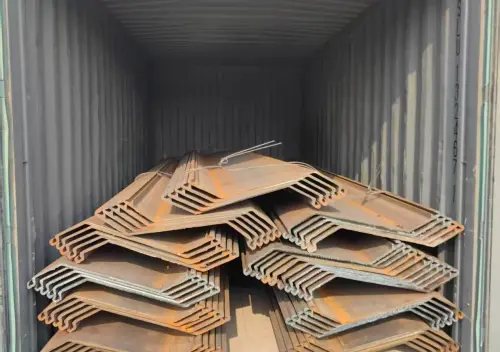
Sheet piles ship as full container loads for short sections, flat racks or open tops for lengths beyond six meters, and breakbulk or bulk vessels for tonnage above roughly a thousand tonnes. The document set — commercial invoice, packing list, bill of lading, certificate of origin, mill certificates, insurance — must match the physical cargo character for character.
Choosing the transport mode
The mode follows the length and the tonnage, not the other way around. Piles up to about 5.8 meters travel comfortably inside standard containers; anything longer goes on flat racks, where the steel overhangs and lashing becomes an engineering task of its own. For multi-thousand-tonne orders — a full quay wall, for instance — we charter space on breakbulk or bulk carriers and load bundles directly by crane, which is how most of our African river projects move. Our detailed guide to packaging, loading, and transportation covers the lifting-point welding, the dunnage, and the lashing calculations; what I want to stress here is that the packing method is chosen jointly with the unloading equipment at the destination. A port with 100-tonne mobile cranes accepts bundle sizes that a river barge jetty in landlocked Chad simply cannot.
The document chain, and where it breaks
Under Incoterms, responsibility transfers at a defined point — FOB, CFR, CIF — and the documents are the mechanical proof of that transfer. The bill of lading must describe the cargo exactly as it is manifested; the certificate of origin enables preferential duty treatment where an agreement exists; mill certificates prove the grade that the design assumed. Wood dunnage and packing timber must be ISPM 15 treated and stamped, or Australian and Middle Eastern customs will hold the cargo. I keep a checklist for each destination market precisely because the rules drift: a document format accepted in Karachi last year was rejected in Basra this spring, and we only learned through a client’s clearing agent. Distributors who buy through us inherit that checklist — this buying guide explains how a first-time importer should structure the whole transaction.
| Document | Issued by | Purpose | Common failure mode |
|---|---|---|---|
| Commercial invoice | Exporter | Customs valuation, payment | Quantity/value mismatch with B/L |
| Packing list | Exporter | Cargo verification | Marking inconsistent with bundles |
| Bill of lading | Carrier | Title document, transport contract | Wrong vessel or consignee data |
| Certificate of origin | Chamber of commerce / CCPIT | Duty preference | Missing legalization for destination |
| Mill test certificates | Steel mill | Grade and heat traceability | Heat numbers not matching stamps |
| SGS inspection certificate | Third party | Pre-shipment quality proof | Booked too late, delays sailing |
How Do Quality Assurance and Customization De-Risk an Overseas Order?
An import order is a bet placed months before the steel is touched. Quality assurance and customization are how we shrink the risk on that bet — not as slogans, but as specific, checkable steps.
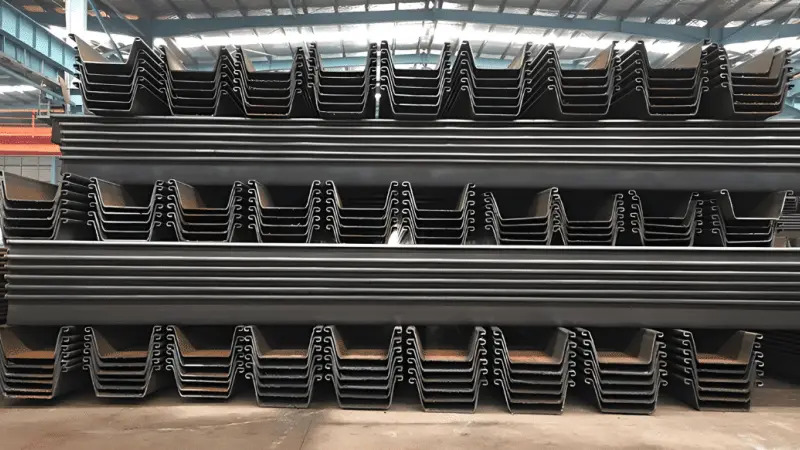
Every export order passes four QA gates — incoming chemical and mechanical verification, in-process dimensional control, pre-shipment third-party inspection, and loading supervision — while OEM customization covers non-standard sections, lengths, corner and junction pieces, and protective coatings matched to the project’s design life.
The four QA gates in detail
Gate one is the mill: every heat we buy arrives with mill certificates, and we verify chemistry against the certificate on our own spectrometer, because paper and steel do not always agree. Gate two is dimensional: we sample section height, thickness, flange width, and interlock lip geometry against EN 10248 tolerances on the finishing line, and we run physical interlock fit trials between paired sections. Gate three is the third-party inspection that I described above — SGS witnesses sampling, reviews the certificates, and issues the report that the project consultant requires before payment release. Gate four is loading supervision: the same inspector, or our own QC staff, confirms that the bundles match the marks, the lashing meets the lashing plan, and nothing damaged leaves the yard. A buyer who wants to understand how we structure a supplier evaluation for reliability can map every criterion in that article to one of these four gates; that is not an accident, it is how we operate internally.
Where customization changes the project economics
Off-the-shelf sections serve most walls, but the expensive surprises in infrastructure always hide at the interfaces. Corner pieces where a straight wall turns, junction sections where a sheet pile wall meets a tubular or H-pile combined wall, unusual lengths that avoid site cutting and welding — these are the items we fabricate or roll to order. For aggressive environments, we supply sections with increased corrosion allowance, or with coating systems applied before shipment, matched to the design-life and durability requirements of the spec. On one Gulf reclamation contract, the consultant required corner pieces in three geometries with tight tolerances; producing them at the factory, galvanized and marked per position, saved the contractor an estimated three weeks of site fabrication. That is customization doing structural work, not decorative work — and it is only possible when the export supplier controls the workshop, which is precisely our model in Liaocheng.
| QA gate | Check performed | Standard / method | Risk if skipped |
|---|---|---|---|
| Incoming material | Chemistry + mechanical retest | Mill cert vs spectrometer | Wrong grade installed |
| Dimensional control | Height, thickness, interlock lips | EN 10248 sampling | Driving refusal, leakage |
| Third-party inspection | Sampling, certificates, marking | SGS / BV witness | Payment blocked, rework |
| Loading supervision | Marks, lashing, condition | Lashing plan | Transit damage disputes |
My Take
If I could give importing engineers one piece of advice, it would be this: buy the supply chain, not the section price. I have quoted jobs where we were not the cheapest and won them anyway, because we could show the client the QC gates, the OEM corner-piece shop, the SGS relationships, and the destination-specific document checklist before he committed. When a cofferdam waits on a vessel and the monsoon season starts in three weeks, the two dollars per tonne you saved on paper will be the most expensive money you never spent. Export solutions are a risk-management product that happens to deliver steel.
Conclusion
Export-ready steel sheet pile supply combines production control, verified quality, correct logistics, and complete documentation. Choose a supplier who proves all four, and your global infrastructure project keeps its schedule.