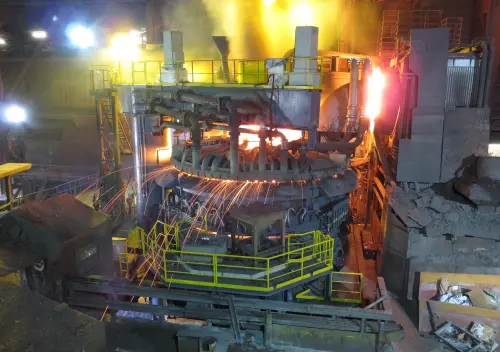
Projects demand walls that go deeper, last longer, and install faster. Contractors who ignore where steel sheet piling is heading will keep paying for last century’s inefficiencies.
The future of steel sheet piling combines high-strength grades up to S460GP, corrosion-protected fully reusable walls, BIM-driven design, automated and quieter installation rigs, and circular-economy business models. Over the next decade, expect smarter data, greener steel, and faster driving to replace guesswork on job sites worldwide.
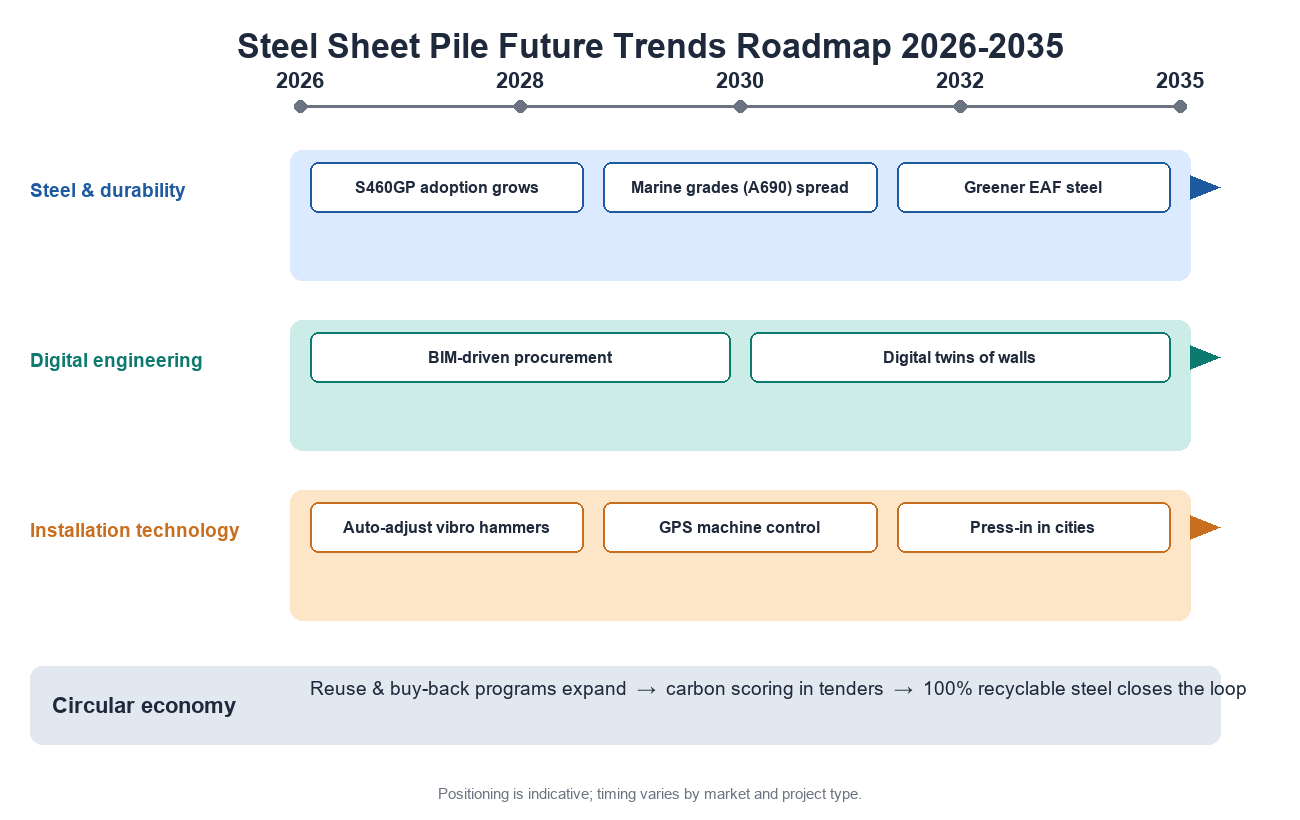
I have spent years on the supply side of this industry — quoting, rolling, and shipping steel sheet piles from our plant in Liaocheng, Shandong to contractors in the Middle East, Australia, Africa, and the Americas. When a total contractor in Iraq or a distributor in Chile asks me what will change in the next five years, I no longer answer with marketing talk. I answer with what I can already see in our order book, in our rolling mill, and on the job sites where our piles are driven. This article walks through the trends I consider real, the ones I treat with caution, and what they mean for anyone buying or designing sheet pile walls.
Why Are High-Strength and Corrosion-Resistant Steels Defining the Next Generation of Sheet Piles?
The first trend is the quietest one, because it happens inside the steel itself rather than on the job site. Section for section, sheet piles are getting stronger and more durable, which lets designers use lighter walls in the same ground conditions.
Higher yield strength means the same wall does more work. Moving from S355GP to S430GP or S460GP can reduce steel weight by 10 to 15 percent on many retaining wall projects, and modern corrosion-resistant grades extend service life in aggressive soils and marine exposure.

Which Steel Grades Will Dominate the Next Decade?
In our own rolling schedule I can track the shift precisely. Ten years ago, the overwhelming majority of our export orders asked for S355GP or Q355, and that is still the global workhorse. What has changed is the share of higher grades. European projects increasingly specify S430GP and S460GP for deep excavations and port structures, because a stronger grade lets the engineer drop one profile size, and on a 500-meter wall that saving is measured in tonnes, not kilograms. Middle East marine projects, which are a large share of our wholesale volume, increasingly ask for ASTM A690 grade or equivalent mariner-steel chemistry, because the combination of higher strength and better corrosion performance in seawater splash zones pays for itself over a design life of 50 years or more.
The table below summarizes how I explain the current grade landscape to customers who are planning multi-year project pipelines.
| Grade family | Typical min. yield | Where it wins | Trend I see |
| Q235 / S235GP | 235 MPa | Light temporary works, price-driven markets | Stable, slowly declining share |
| Q355 / S355GP | 355 MPa | Global workhorse for walls and cofferdams | Still the majority of our orders |
| S430GP / S460GP | 430–460 MPa | Deep excavations, heavy port structures | Fastest-growing share in Europe and Australia |
| ASTM A690 / marine grades | 345–450 MPa | Seawater splash zones, harbor walls | Rising with Middle East and coastal projects |
Alongside strength, durability chemistry is moving forward: improved alloy design, controlled rolling, and better mill QC mean modern piles leave the plant with more predictable corrosion resistance behavior, and buyers increasingly verify this with mill test certificates rather than trusting catalogue values. If you want the full grade-by-grade comparison, our dedicated guide to common steel grades used for steel sheet piles covers it in detail.
How Will Digital Design and BIM Transform Sheet Pile Engineering?
The second trend changes how walls are designed before a single pile is rolled. Building Information Modeling and parametric design tools are turning sheet pile engineering from a drawing exercise into a data exercise.
BIM models now carry section properties, coating specifications, and driving records for every pile in a wall. Digital design cuts clashes and rework, while digital twins of completed walls let owners monitor movement and corrosion over the full service life.
What Does a Digital Sheet Pile Workflow Look Like in Practice?
On the projects I follow most closely, the workflow now starts with a geotechnical model that feeds directly into building information modeling software. The engineer selects a section, the model checks bending moments and interlock strength automatically, and the same file drives procurement: our quotation team receives the exact section, length, grade, and quantity instead of a scanned drawing. That alone has cut quotation turnaround for our B2B customers from days to hours, and it removes a whole category of transcription mistakes.
The more interesting frontier is the digital twin of the completed wall. Ports and infrastructure owners in Europe and Australia are beginning to instrument retaining walls with inclinometers and corrosion sensors, then mirror them in software so maintenance becomes predictive rather than reactive. For a supplier like us this changes the conversation: instead of selling a pile once, we discuss life-cycle performance, monitoring, and eventual extraction and reuse. The interlock details that determine watertightness and drivability, which we cover in our guide to steel sheet pile interlock types, become data points in the model rather than assumptions.
| Digital capability | What it replaces | Benefit I see on real projects |
| BIM clash detection | 2D drawing coordination | Fewer site redesigns and change orders |
| Parametric section optimization | Manual sizing iterations | 5–10% steel savings in many walls |
| Digital twins | Periodic manual inspections | Predictive maintenance, longer service life |
| Automated quoting from models | Email and PDF back-and-forth | Hours instead of days to firm prices |
I also see design principles of steel sheet pile retaining structures being encoded into these tools, which raises the floor for less-experienced engineering teams — a genuine advantage for contractors in developing markets where senior geotechnical staff are scarce.
What Role Will Automation Play in Sheet Pile Installation?
Design may be where the money is saved, but installation is where the future becomes visible on site. The rigs, hammers, and control systems that place sheet piles are automating quickly.
GPS-guided rigs, auto-adjusting vibratory hammers, and real-time inclination monitoring are making sheet pile installation faster, straighter, and quieter. Automated pitch assistance and machine control reduce rework and bring walls within tight tolerances on the first pass.
Which Installation Technologies Are Actually Mature Today?
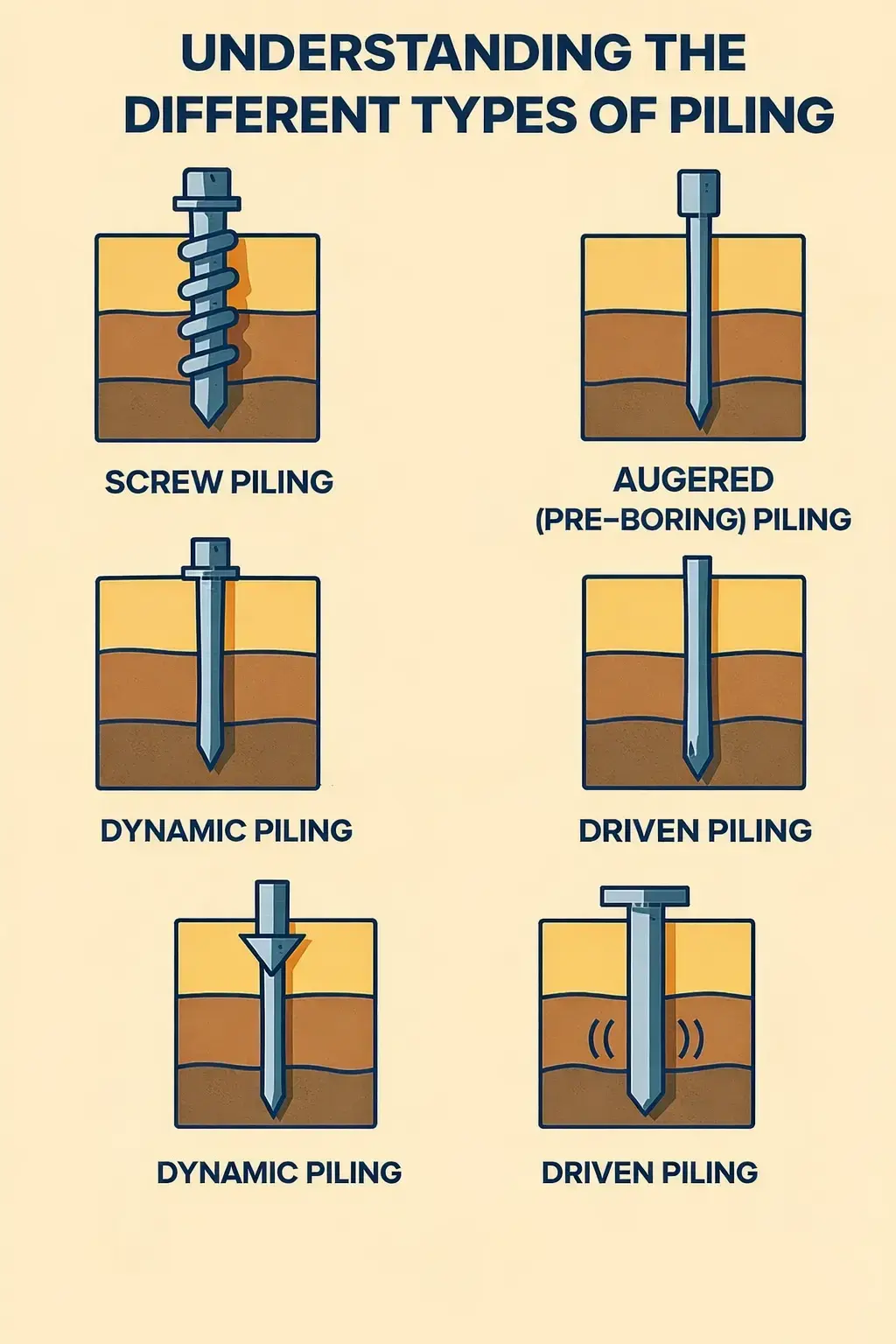
I separate the hype from the hardware by looking at what our customers actually order and what their site teams report back. Three technologies are already mainstream. First, machine-controlled vibratory drivers that adjust frequency and amplitude to the soil in real time, which our Australian customers use to drive through dense sands without refusal. Second, real-time inclination monitoring on the hammer, which gives the operator a live verticality readout and has visibly reduced the skewed-wall rework that used to plague urban sites. Third, automated pile pitching — mechanical assistants that grab, lift, and thread the next pile while the crane operator focuses on level and line, which speeds up the cycle and improves safety by keeping hands away from suspended loads.
| Technology | Status in 2026 | Impact I hear from site teams |
| Auto-adjust vibratory hammers | Mature, widely rented | Fewer refusals, less noise complaints |
| GPS/machine-control guidance | Mature on large projects | First-pass accuracy, less surveying rework |
| Live inclination monitoring | Mainstream on new rigs | Verticality issues caught early |
| Robotic/autonomous pitching rigs | Pilot stage | Watch this space, not yet standard |
| Silence/press-in methods | Growing in cities | Solves noise-sensitive urban jobs |
For contractors planning their equipment mix, our overview of steel sheet pile installation methods and the detailed step-by-step installation process explain how these technologies slot into a full driving sequence. My practical advice to wholesale customers is simple: the piles have not changed that much, but the tolerance expectations have, and it is the installation technology that lets a modern crew meet them.
Can Composite and Hybrid Sheet Piles Challenge Steel?
Every few years a new material arrives claiming to replace steel, and I always examine these claims seriously, because a supplier who ignores material science deserves to lose ground.
Composite sheet piles made from fiber-reinforced polymers resist corrosion completely and weigh far less than steel, but their stiffness limits them to light-duty walls. Hybrids that combine steel and composites are the more realistic near-term challenger.
Where Do Composite Walls Make Sense — and Where Do They Not?
Fiber-reinforced polymer sheet piles are genuine products with real installations, mostly in North America and Western Europe. They excel where corrosion dominates the life-cycle math: aggressive waterfronts, contaminated soils, and low-load flood protection where a 100-year maintenance-free wall is worth the premium. I respect that niche. But when I run the numbers my engineers run — section stiffness, bending capacity, drivability in dense ground — composites remain uncompetitive for the retaining walls and cofferdams that make up the bulk of global demand. Their elastic modulus is a fraction of steel’s, so an equivalent-stiffness composite wall is bulky, and driving them into stiff soils is a different exercise entirely.
| Property | Steel sheet piles | FRP composite piles | Hybrid steel-composite |
| Elastic modulus | ~210 GPa | 20–40 GPa | Intermediate |
| Corrosion behavior | Requires protection in aggressive sites | Essentially immune | Protected steel core |
| Drivability in dense soils | Excellent with proper equipment | Poor to moderate | Moderate |
| Typical duty range | Light to very heavy | Light walls, flood defense | Light to medium |
| Recycling at end of life | Fully recyclable | Limited | Partial |
My honest forecast is that composites will keep growing in their niche while steel keeps the structural mainstream, and that the real “hybrid” revolution is not material but systemic: steel walls protected with coatings, cathodic protection, and corrosion allowances — the approaches detailed in our corrosion article — are already delivering composite-like service lives at steel economics.
How Is the Circular Economy Redefining the Sheet Pile Life Cycle?
The last trend is the one reshaping procurement language in tenders across Europe, Australia, and increasingly the Gulf: sheet piles are no longer bought as consumables, they are bought as reusable assets.
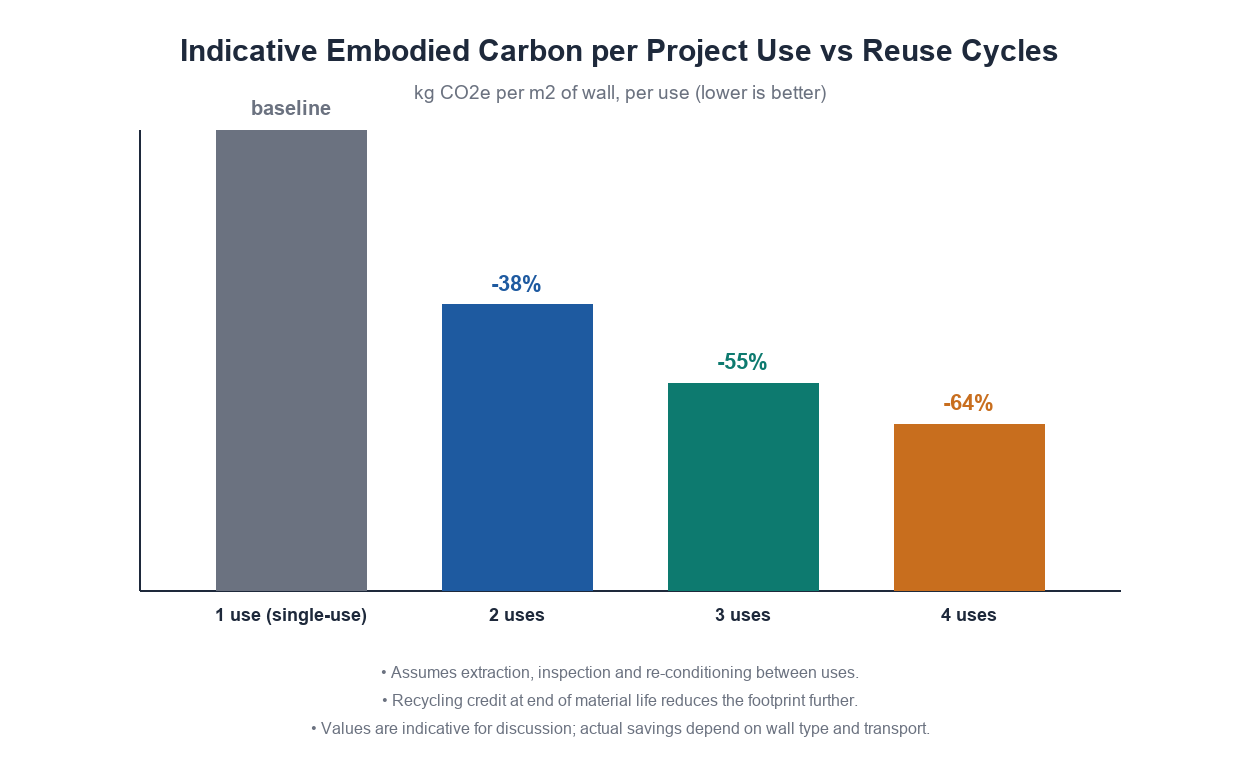
Steel sheet piles can be extracted, inspected, and re-driven several times over decades, and they are 100 percent recyclable. Reuse programs and embodied-carbon accounting are turning temporary walls from a cost line into a circular asset.
How Does Reuse Change the Economics of a Wall?
The arithmetic is powerful and simple. A steel sheet pile driven for a two-year excavation support can be extracted with the right equipment, visually and dimensionally inspected, and driven again — our repeat customers in Europe routinely run the same sections through three, four, or more project cycles. Compare that with concrete alternatives, which are demolished and downcycled at best. Steel is also endlessly recyclable without property loss: an electric-arc-furnace route running on scrap feeds our industry’s life-cycle assessment advantage, and the trend toward greener steelmaking, which we describe in our article on the steel sheet pile manufacturing process, keeps cutting the embodied carbon per tonne.
| Life-cycle stage | Traditional model | Emerging circular model |
| Procurement | Buy once, dispose after project | Buy, lease, or buy-back arrangements |
| Use | Single project life | Multiple drives across projects |
| End of first use | Scrap or landfill | Inspection, refurbishment, re-drive |
| End of material life | Downcycling at best | Full recycling into new steel |
| Carbon accounting | Rarely tracked | Embodied carbon in tender scoring |
The commercial consequence is visible in our order book: rental and buy-back style inquiries, requests for piles with straightened edges and certified reconditioning, and tenders that score embodied carbon explicitly. Combined with the durability gains described earlier, the sustainable construction case for steel sheet piles keeps strengthening, and documented service life and durability data now feeds directly into tender documents.
My Take on Where This Leaves Buyers and Suppliers
If I compress everything I see from the factory floor and the export desk into one judgment, it is this: the future of steel sheet piling is not one breakthrough but the compounding of many quiet improvements — stronger steel, better protection, digital workflows, smarter rigs, and circular business models. For wholesale buyers, that means the supplier you choose in the next five years matters more than ever, because the gap between a mill that can deliver certified S460GP with full traceability and one that cannot will show up directly in your wall performance and your tender scores. We invest accordingly — in rolling precision, in quality standards and inspection, and in the documentation that buying steel sheet piles from China requires today. The contractors who partner with suppliers moving in the same direction will be the ones who win the deep, difficult, carbon-scored projects of the 2030s.
Conclusion
Steel sheet piling’s future is stronger steel, digital design, automated installation, and circular reuse. Choose suppliers investing in all four, and your walls — and margins — will thank you.
Tags: Steel Sheet Pile Future Trends, Steel Sheet Pile Engineering, Digital Construction, High Strength Steel, Circular Economy