Steel Sheet Piles vs Soldier Piles: Which Option Wins on Cost and Performance?
Choosing between steel sheet piles and soldier piles can decide your whole budget. I have supplied both systems for years, and the right answer always depends on water, soil, and schedule.
Steel sheet piles form a continuous interlocked wall with built-in waterproofing and high reuse value, while soldier piles are spaced steel beams with lagging between them. Soldier piles often cost less in dry ground, but sheet piles usually win once water, depth, or reuse enters the project.
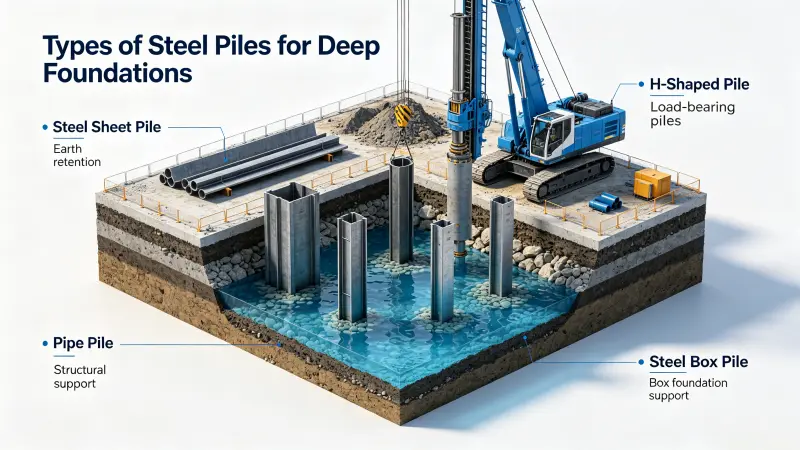
In this article, I will compare these two systems on real project terms: material cost, installation speed, waterproofing, performance under load, and residual value. I will also share what our clients in the Middle East, Australia, and Africa have learned after using both systems. By the end, you should be able to look at your site report and know which wall type to price first.
What Is the Real Difference Between Steel Sheet Piles and Soldier Piles?
Many buyers treat these two systems as interchangeable, and that mistake costs money. I want to clear this up before we talk about numbers.
A steel sheet pile wall is a continuous barrier of interlocked profiles, while a soldier pile wall is a row of spaced steel beams that carry load, with timber, steel, or shotcrete panels holding the soil between them.
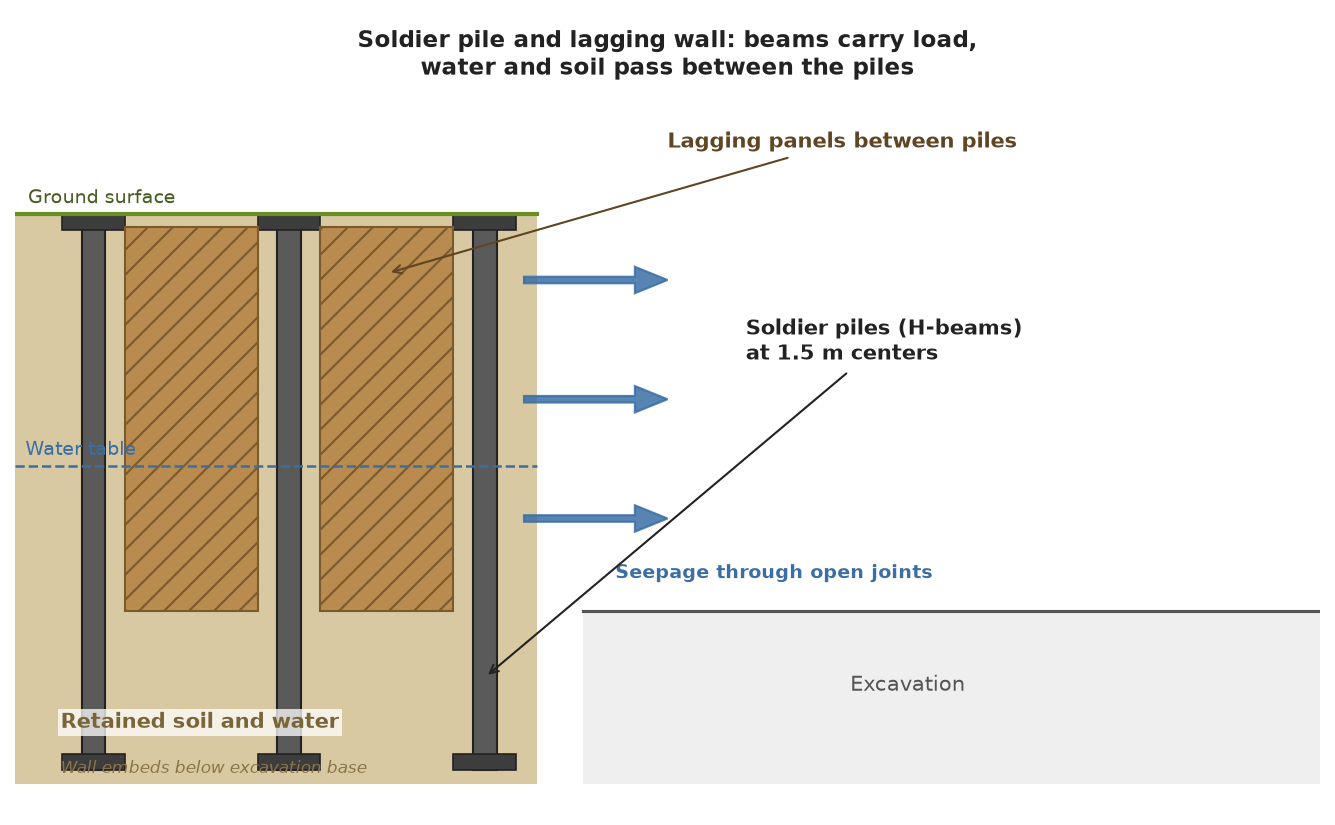
How a soldier pile and lagging wall is built
A soldier pile and lagging wall starts with wide-flange steel beams driven or placed in pre-bored holes at regular spacing, commonly every 1.8 to 3 meters. As the excavation goes down, the crew installs lagging panels between the flanges, one row at a time. The beams carry almost all the bending load. The lagging only stops the soil between beams from raveling out.
This system is popular for temporary cuts in stiff clay and dense sand above the water table. It is also forgiving on variable ground. If the crew hits a boulder or shallow rock, they can pre-drill that single hole and keep moving. I have seen this flexibility save schedules on rocky sites in Africa where driving a continuous sheet pile wall would have slowed down badly.
The weakness is water. The gaps between beams are open paths. Once the water table rises, water flows through the lagging joints and the wall starts to lose soil behind it. That is when a soldier pile wall stops being a cheap option and becomes a repair project.
How a steel sheet pile wall is built
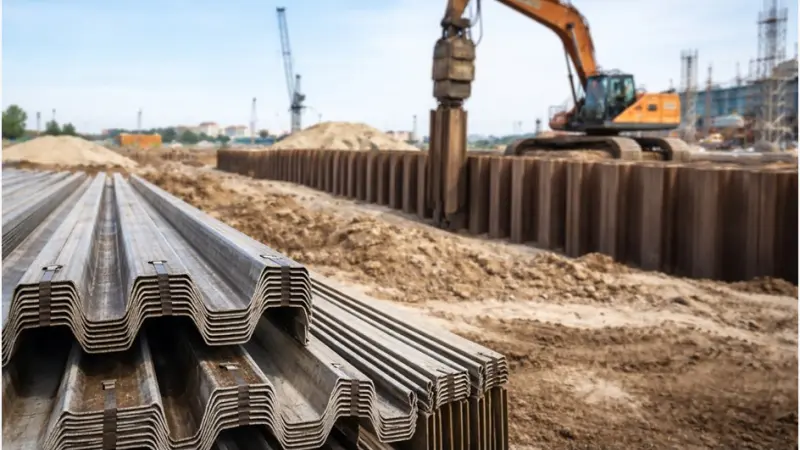
A steel sheet pile wall works the opposite way. Every pile has rolled interlocks on both edges, so each new pile threads into the last one. The finished wall is a continuous steel membrane from one end to the other. It resists soil pressure and water pressure at the same time, without lagging, membranes, or a second trade.
| Feature | Steel Sheet Pile Wall | Soldier Pile and Lagging Wall |
|---|---|---|
| Wall form | Continuous interlocked steel membrane | Spaced beams with lagging panels |
| Structural element | Every pile contributes | Only the beams carry moment |
| Waterproofing | Built into the interlocks | Open joints, needs extra sealing |
| Best ground | Soft to medium soils, water-bearing layers | Stiff clay, dense sand, rock near surface |
| Load transfer | Distributed along the full wall | Concentrated at each beam |
| Obstruction handling | Difficult once driving starts | Easy: pre-drill single holes |
In my own experience, the table above is the mental model I want every client to carry. The systems are not competitors in the strict sense. They are tools for different problems. When a project needs both structure and water control, the sheet pile wall is usually the only honest answer. When the project is a dry, shallow, temporary cut, the soldier pile wall deserves a fair look because it uses less steel.
Which System Costs Less Over the Full Project Life?
This is the question I get most often from contractors and steel distributors. The honest answer is that first cost and total cost tell two different stories.
Soldier piles often have a lower material bill because they use fewer tons of steel, but sheet piles can end up cheaper in total once you add lagging, waterproofing, faster installation, and the money you recover by extracting and reselling the piles.
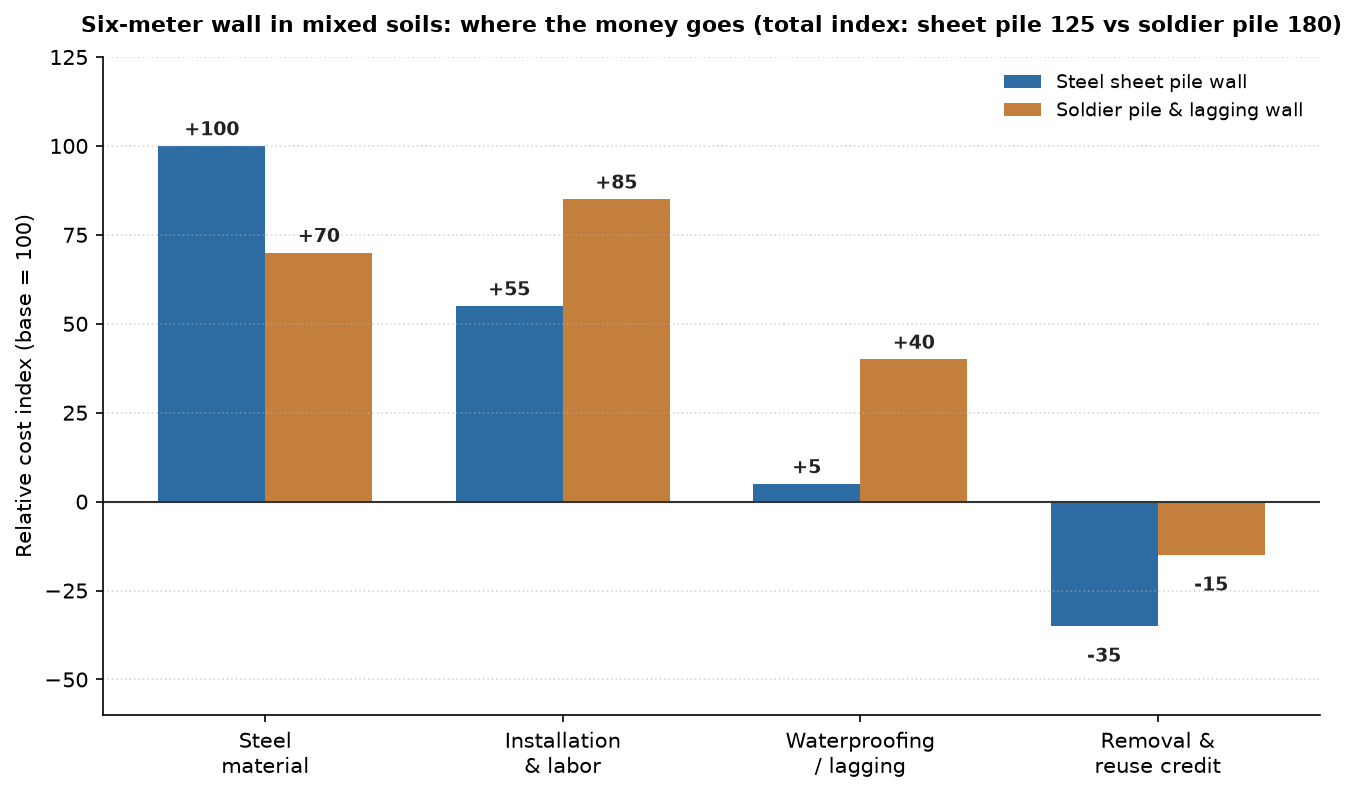
Where the money actually goes
I like to break the cost into four buckets: steel material, installation and labor, waterproofing and lagging, and what you get back at removal. On a typical six-meter wall in dry ground, the soldier pile wall buys roughly 30 percent less steel. That is a real advantage, and I never pretend otherwise. But then the picture changes. The lagging costs money and labor hours. The staged excavation slows the crew. If the wall must hold back any water, the sealing works can erase the steel saving entirely.
The chart above shows our internal index for a six-meter wall in mixed soils. The soldier pile wall starts cheaper on steel but carries heavy lagging and labor costs. The sheet pile wall carries more steel but almost no waterproofing line and finishes with a strong reuse credit. If you want the structural side of that calculation, our article on load-bearing capacity of steel sheet piles walks through it.
| Cost item | Steel Sheet Pile Wall | Soldier Pile Wall |
|---|---|---|
| Steel material per meter | Higher: continuous wall | Lower: beams only |
| Lagging or sealing | Not needed | Required, plus labor |
| Installation stages | One pass with a hammer | Drilling, setting, staged lagging |
| Dewatering needs | Usually minimal | Often significant below water table |
| Removal and reuse credit | High: piles extract cleanly | Beams extract, lagging is lost |
| Total cost, dry shallow cut | Competitive | Often lower |
| Total cost, below water table | Usually lower | Often higher after sealing |
Reuse and residual value
Here is the part most first-time buyers miss. Temporary steel sheet piles can be extracted with a vibratory hammer and resold or reused on the next project. On temporary works, that credit can reach 30 to 60 percent of the material cost. Soldier pile beams can also be pulled, but the lagging is buried or disposed of, and the wall often needs grouting around the beam holes before extraction.
One of our Australian clients runs a rotation where the same Z-type piles have served three different projects. Their effective steel cost per project has dropped to less than half of the first purchase price. No soldier pile scheme we have supplied has matched that number, because the consumable lagging keeps resetting the account.
How Do Installation Speed and Site Logistics Compare?
Schedule pressure is where I see the biggest gap between the two systems. Clients consistently underestimate what lagging installation does to a program.
A sheet pile wall goes up in one continuous driving pass and is usually finished 20 to 40 percent faster than a soldier pile wall, which needs separate steps for beams, staged lagging, and sealing as the excavation deepens.
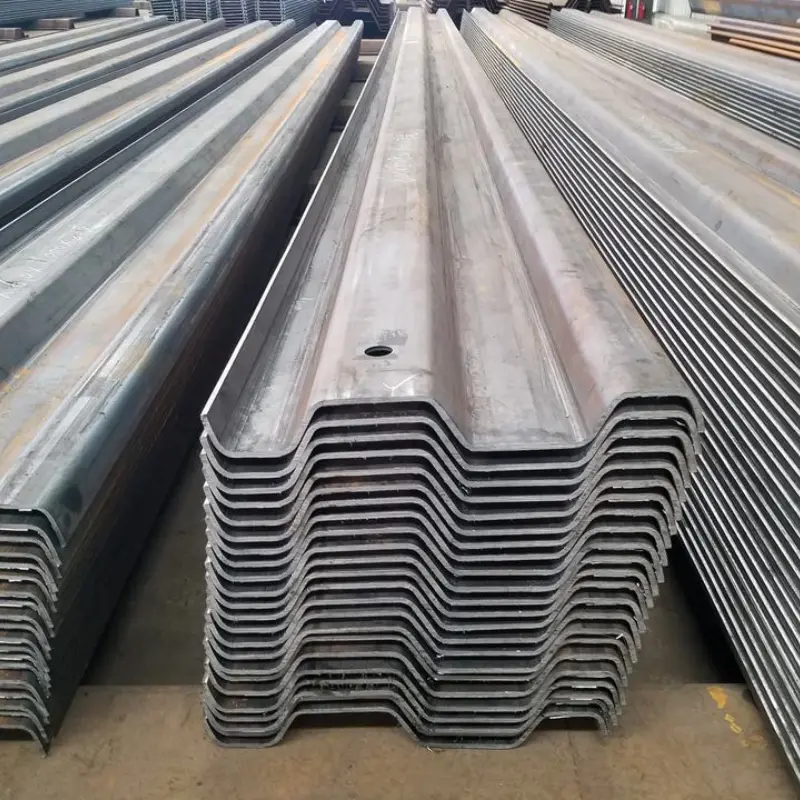
Sheet pile installation on site
A trained crew with an excavator-mounted vibratory hammer can thread and drive sheet piles almost without stopping. Pile number thirty starts the same minute pile number twenty-nine reaches depth. There is no lagging to stock, no follow-up trade waiting at the edge of the pit. On open sites, this makes sheet piles the fastest conventional wall we supply. For a full walkthrough of the equipment and methods, see our article on steel sheet pile installation methods.
The one warning I always give: in very dense gravel or rock, sheet pile driving slows down and refusal becomes a risk. We covered those situations in our post about common construction challenges and solutions. If your boreholes show refusal layers, tell us before you order. Sometimes the honest advice is that a soldier pile scheme with pre-drilling will protect your schedule better.
Soldier pile installation on site
A soldier pile wall is a sequence of separate operations. First the beams go in, by driving or by drilling and grouting. Then excavation starts, and lagging follows the dig, row by row, with workers in the trench placing each panel. Each stage adds mob and demob time and a safety inspection. If water appears, add dewatering wells and sealing works on top.
| Installation factor | Steel Sheet Piles | Soldier Piles |
|---|---|---|
| Primary operation | Single continuous driving pass | Drive or drill beams, then staged lagging |
| Typical daily output | 20 to 40 piles per shift | 8 to 15 beams per shift, lagging behind the dig |
| Trades on site | Piling crew only | Piling crew plus lagging and sealing crews |
| Excavation staging | Wall complete before dig | Lagging installed during dig |
| Suitability for tight urban sites | Excellent: narrow footprint | Good, but lagging storage needs space |
| Schedule risk in hard ground | Higher: refusal during driving | Lower: pre-drill problem holes |
On tight city projects, both systems can work, but I lean toward sheet piles when the client needs speed and a small footprint. We wrote more about this in our article on why sheet piles suit confined construction sites.
When Should You Choose Steel Sheet Piles Instead of Soldier Piles?
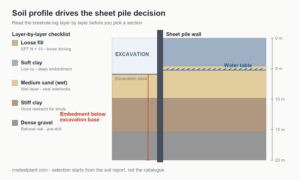
Every project eventually forces a decision. I use a simple filter with my clients: water first, depth second, ground third, and money last.
Choose steel sheet piles when the wall must cut off water, reach beyond about six meters, or be extracted and reused. Choose soldier piles for dry, shallow, temporary cuts in stiff ground where rock or boulders make driving difficult.
Choose sheet piles in these cases
Water is the first filter. Any wall that stands below the water table, along a river, or at a port should be a sheet pile wall. The interlocks do the sealing work that lagging cannot. Depth is the second filter. A continuous sheet pile wall distributes moment along its full length, so it stays economical at depths where a soldier pile wall would need very heavy beams at close spacing. Our cofferdam and deep excavation guide shows these cases in detail.
The third filter is temporary works. If the wall will be pulled out after use, sheet piles hold their value far better than any alternative. Add permanent walls into the same category: for a permanent retaining structure exposed to water, corrosion protection and clean interlocks matter, and we cover service life in our durability article.
Choose soldier piles in these cases
Now the fair side of the story. Soldier piles are excellent when the cut is shallow, the ground is stiff, and there is no water to fight. They are also the pragmatic choice when boreholes show boulders or shallow bedrock, because each beam position can be pre-drilled independently. A continuous wall cannot dodge an obstacle halfway through a drive.
| Decision factor | Better choice | Why |
|---|---|---|
| Below water table | Sheet piles | Interlocks seal; lagging leaks |
| Cut depth over 6 m | Sheet piles | Distributed moment, lighter steel per meter |
| Boulders or shallow rock | Soldier piles | Pre-drill each position independently |
| Dry temporary cut under 6 m | Either, price both | Soldier piles often cheaper in steel |
| Temporary works with resale | Sheet piles | Clean extraction, high reuse credit |
| Very tight urban footprint | Sheet piles | One pass, less staging space |
My rule of thumb after many projects: if two of the first three filters point to water, depth, or reuse, price the sheet pile wall first. If all three point to dry, shallow, obstructed ground, price the soldier pile scheme first. The systems are tools, and a good contractor carries both tools in the truck.
My Take
After years of quoting both systems, my view is that buyers overweight the steel price and underweight everything around it. The lagging invoice, the dewatering rig, the extra weeks of staged excavation, and the lost residual value of soldier pile walls rarely appear in the first comparison, but they decide the real cost.
At our factory in Liaocheng, we push clients toward a total-cost conversation before they commit. If you send us your wall height, soil report, and water table level, we will price the right profile, not just the cheapest ton. We support OEM sections, flexible MOQ, and SGS inspection before shipment, and we export to contractors and distributors across Iraq, the UAE, Saudi Arabia, Pakistan, Australia, and Africa. When the ground is right for soldier piles, I say so. When sheet piles will protect the budget, I show the math. That honesty is why our clients come back with their next project instead of their next complaint.
Conclusion
Steel sheet piles and soldier piles solve different problems. Match the wall to your water, depth, ground, and reuse plans, and the cost difference will usually take care of itself.
Tags: steel sheet piles vs soldier piles, soldier pile wall, sheet pile cost comparison, excavation support systems, retaining wall selection