What Are the Common Challenges in Steel Sheet Pile Construction and How Do You Solve Them?
Most sheet pile walls do not fail in the steel. They fail in the surprises nobody planned for: hard ground, loose interlocks, leaking clutches, angry neighbors, and walls that move.
The most common steel sheet pile construction challenges are driving refusal in hard ground, interlock damage and declutching, water leaks through clutches, noise and vibration limits near sensitive sites, and wall movement beyond tolerance — each has a proven field fix.
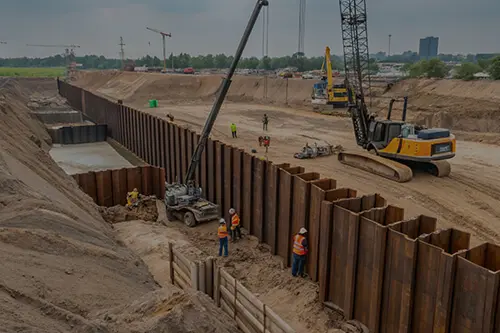
If you run a piling crew, review subcontractor claims, or buy steel sheet piles for projects across the Middle East, Australia, or Africa, this article is for you. I work for a sheet pile factory in Liaocheng, Shandong, and I have listened to hundreds of installation stories from our customers. The same five problems come back again and again, on port quays, on river embankments, and in deep urban basements. Below I describe each one the way it shows up in steel sheet pile construction, what causes it, and the fixes I have watched work.
Why Do Sheet Piles Hit Refusal in Difficult Ground?
Refusal always arrives at the worst moment. The fix starts with diagnosis, not with a bigger hammer.
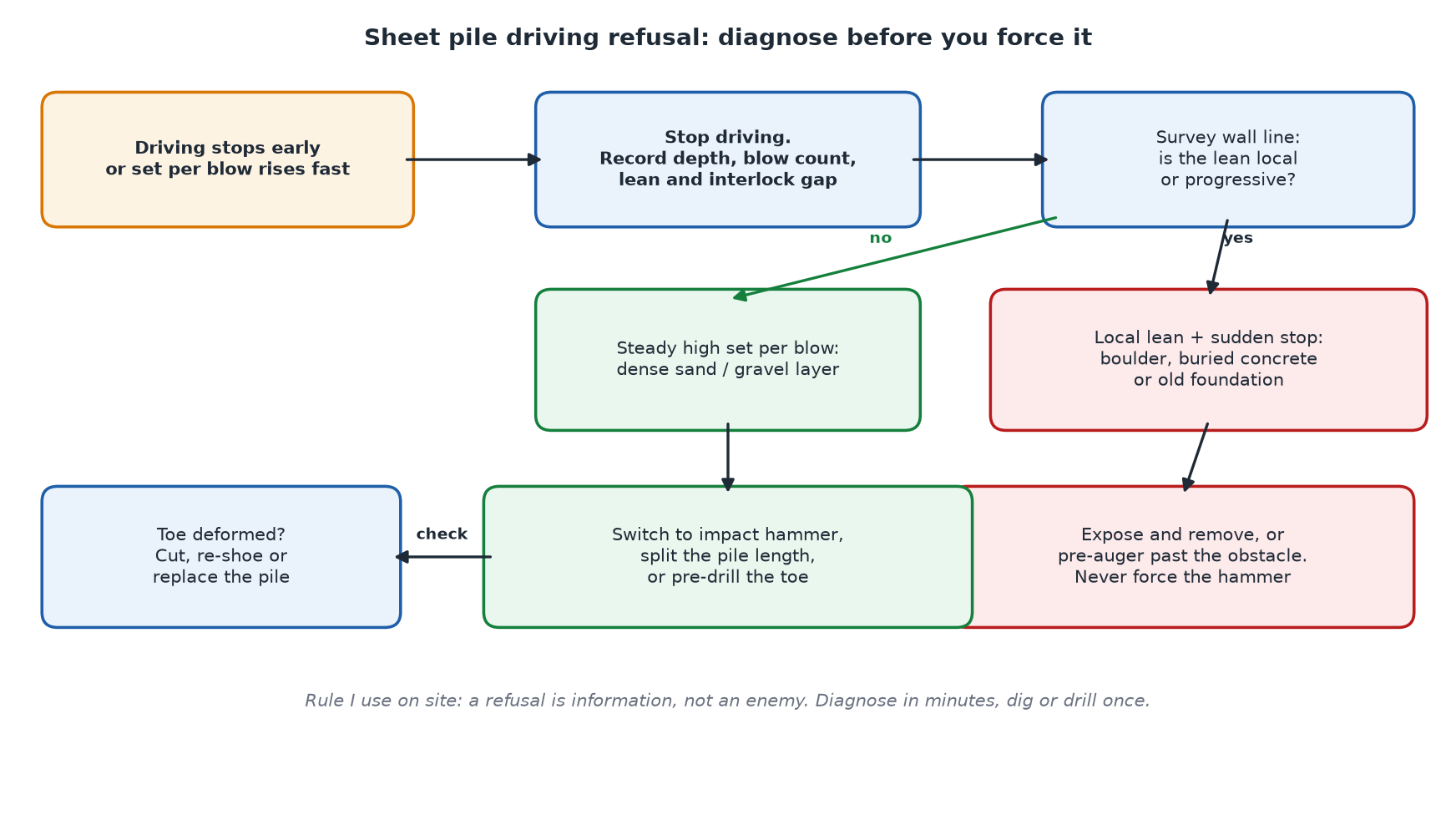
Refusal happens when the pile toe meets boulders, buried concrete, or dense sand and gravel. Stop driving, read the blow count and the lean, then remove the obstacle, pre-auger, split the pile length, or switch to impact energy.
Diagnosing the Stop Before Forcing It
I tell every crew the same thing: a refusal is information. When a pile stops early, the first move is to record the depth, the set per blow, the lean of the pile, and the gap at the interlock. A sudden stop with a local lean almost always means a boulder, an old foundation, or buried concrete. A steady rise in set per blow over several meters usually means a dense sand or gravel layer. These two cases need opposite responses, so guessing wrong gets expensive fast.
For obstructions, the honest options are to expose and remove them by excavation, or to pre-auger past them. Forcing the hammer is not an option. I have seen pile toes folded like paper and hammers cracked because someone tried to outmuscle a concrete slab. On one project in the Gulf, a hidden layer of cementitious fill stopped pile four at two meters. The crew wanted to keep driving. Instead, they dug it out in an afternoon, and the wall went in clean.
For genuinely dense layers, the answer is energy, not excavation. Switching from vibratory to impact driving, splitting the pile into two shorter sections, or pre-drilling the toe all work. Our earlier comparison of steel sheet pile installation methods: vibratory vs impact driving explains when each method earns its cost. The pre-installation checklist we share with customers also flags obstruction risk before mobilization, which is where this problem should be solved.
| Refusal Sign | Likely Cause | First Response |
|---|---|---|
| Sudden stop, local lean | Boulder or buried concrete | Expose, remove, or pre-auger |
| Rising set per blow | Dense sand or gravel | Impact hammer, split length |
| Hammer stalls, no set | Cobbles or cemented layer | Trial pits, toe pre-drilling |
| Toe deformed on extraction | Hard driving without shoe | Cut, re-shoe, or replace pile |
Why the Toe Deserves Respect
The pile toe takes every blow you deliver. A damaged toe does not just slow the current pile; it can tear the interlock of the neighbor and start a lean that spreads down the wall. A cast or welded driving shoe costs little compared with a week of standby rig time. I ask customers to order a small percentage of spare piles whenever the soil report mentions cobbles or fill. Steel is cheap. Standby cranes are not.
How Do Interlock Problems Start and How Do You Stop Them?
Interlocks fail quietly. By the time you see the gap, the damage is already three piles old.
Interlock problems come from dirty clutches, off-center blows, hard corners, and driving too fast in soft soil. Clean every clutch, guide the first piles carefully, and control the hammer alignment to keep the wall engaged.
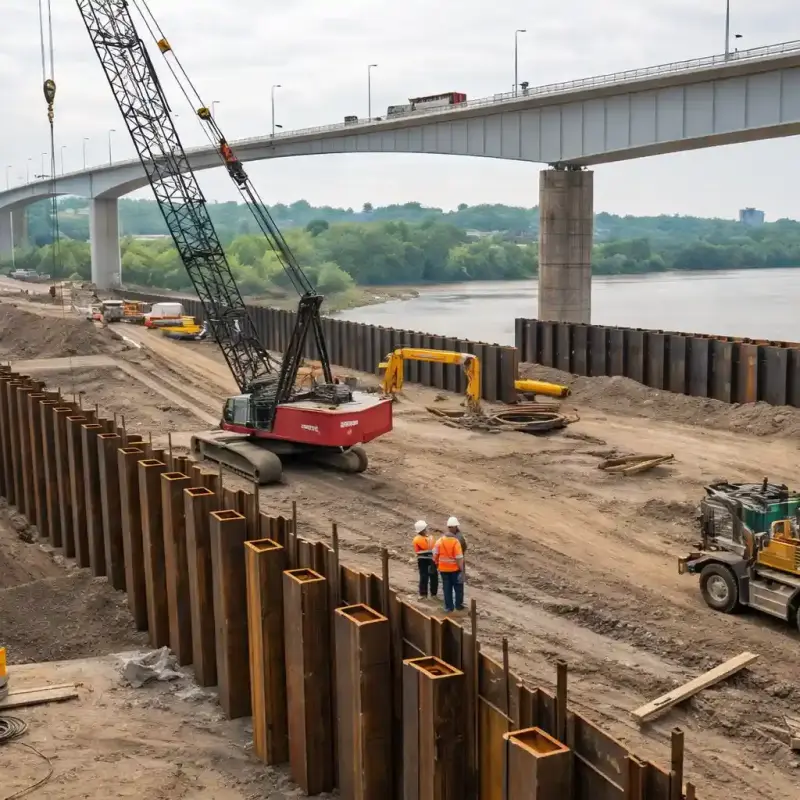
The Four Ways a Clutch Fails
A sheet pile wall is only as good as its weakest clutch, and I see four classic failure paths. First, dirt: clay packed inside a clutch bakes hard in the sun and turns the next pile into a plow. Second, mechanical damage: lifting chains and toe impact flatten the interlock lips before the pile even stands up. Third, off-center blows: a hammer that is not centered on the pile head prys the clutch open with every stroke. Fourth, over-driving in soft soil, where the pile runs ahead of control and rips itself out of engagement.
Each failure has a simple prevention. Clean and lightly lubricate clutches during handling, especially in sticky clay. Use proper lifting points, not chains through the clutches. Check hammer centering and leader alignment every panel. And in soft soils, drive with restraint and monitor the interlock engagement as you go. Our guide on steel sheet pile interlock types and their performance advantages explains which clutch systems tolerate abuse best, and our step-by-step installation process shows where each check belongs in the sequence.
| Interlock Problem | Root Cause | Prevention |
|---|---|---|
| Clutch jams during driving | Clay or debris inside | Clean, lubricate before pitching |
| Flattened interlock lips | Wrong lifting method, toe impact | Proper lifting points, driving shoes |
| Clutch opens while driving | Off-center blows, hard corners | Center the hammer, corner templates |
| Wall walks off line | Uncontrolled panel start | Panel driving with reference piles |
Corners and Panels
Corners deserve special respect. A badly cut corner piece forces the next piles to twist, and a twist becomes a gap. I ask for corner geometry on the workshop drawing, not on site. Panels driven between two carefully placed reference piles stay straighter than one-by-one pitching, especially on long walls. These habits cost minutes. Repitching a wandering wall costs days.
Why Do Sheet Pile Walls Leak and How Do You Seal Them?
Some weeping is normal. A water jet through a clutch is not. Know the difference before you pump.
Leaks come from open clutches, pile-toe gaps, and high hydraulic gradients during dewatering. Seal clutches before driving, control the pumping rate, and use toe sealing or relief wells where gradients are high.
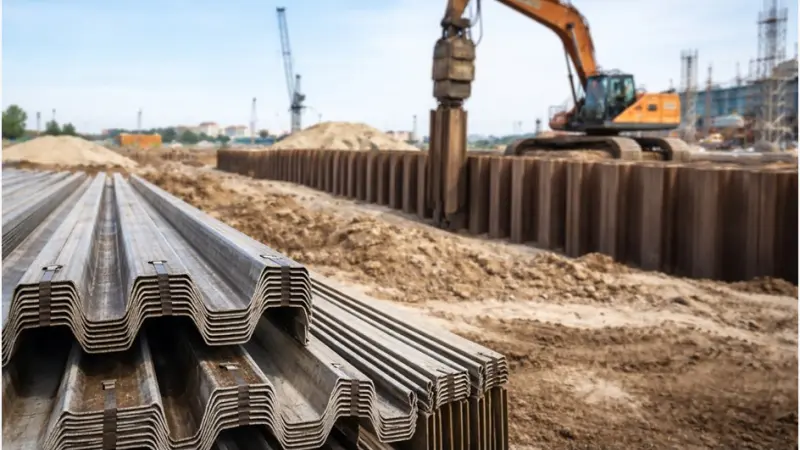
Where the Water Gets In
Water finds three paths through a sheet pile wall. The clutches are the obvious one, especially where a clutch was damaged or driven in tension. The pile toe is the sneaky one: below the excavation base, water can travel under the wall and up behind it, appearing far from the real hole. And the third path is the ground itself, when the hydraulic gradient across the wall gets high enough to boil the excavation base.
Prevention starts before driving. Interlock seals, from simple bituminous products to factory-applied sealants, are cheap insurance for walls that must stay dry. I recommend them for cofferdams and deep excavations below the water table as standard practice, and crews who build riverbank and flood control walls treat them the same way. During pumping, the rate matters as much as the volume. Dewatering too fast raises the gradient and can pull fines through the clutches, which turns a small weep into a channel. Slow, staged pumping with dewatering points placed away from suspect clutches keeps the wall honest.
| Leak Symptom | Probable Path | Fix |
|---|---|---|
| Clear weeping at clutch | Open or damaged clutch | Seal from inside, re-drive if open |
| Sandy water, growing flow | Fines migrating through clutch | Filter and seal, slow the pumping |
| Boiling at pit base | High gradient, shallow embedment | Deepen embedment, relief wells |
| Flow far below toe | Under-seepage path | Toe grouting, longer piles |
When Sealing Is Not Enough
If seepage keeps growing after you slow the pumping, the wall is telling you the embedment is too shallow or a clutch has fully opened. That is a redesign conversation, not a pumping conversation. Relief wells, a deeper toe, or external bentonite sealing in front of the suspect clutch are the standard answers. The worst response is to pretend the pit will dry on its own. It will not.
How Do You Deal With Noise and Vibration Limits on Confined Sites?
The neighbor with a decibel meter can stop your project faster than any boulder.
Noise and vibration limits are set by permits and nearby structures, not by the hammer you own. Choose vibratory or press-in methods near sensitive sites, monitor peak particle velocity, and agree thresholds with the engineer before day one.
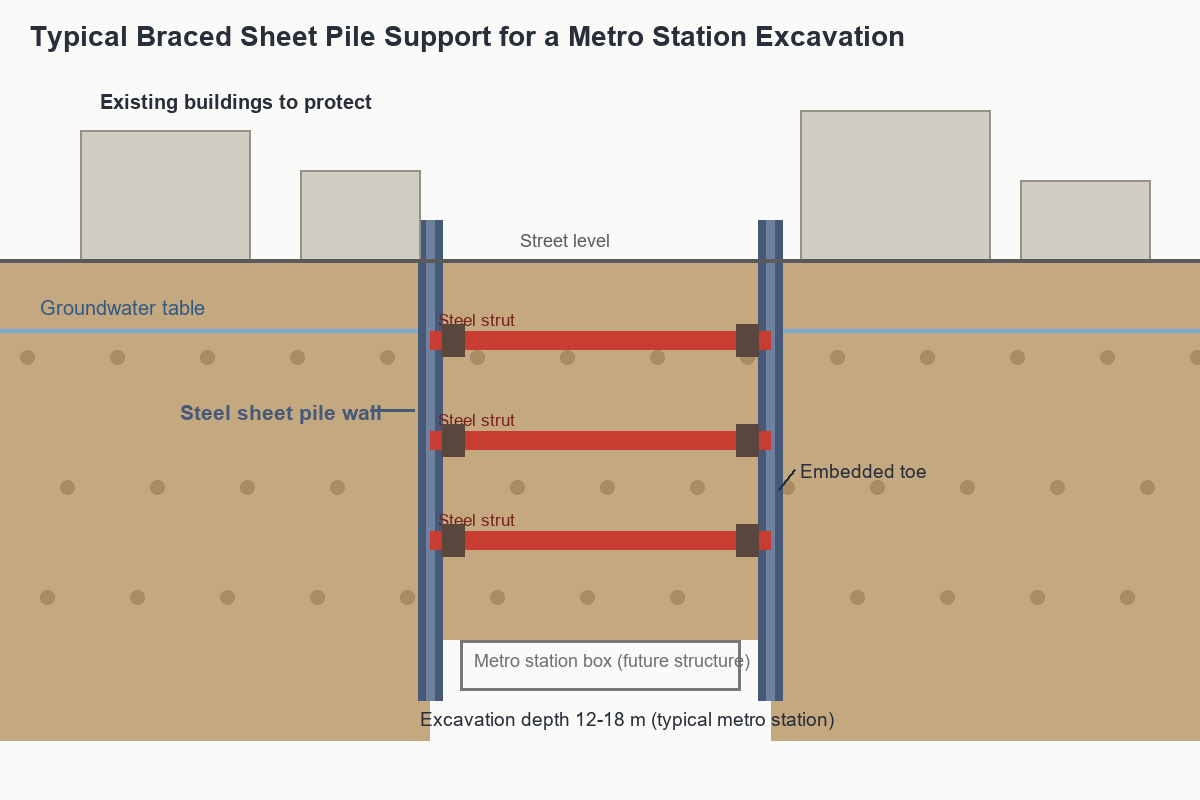
Permits First, Hammer Second
In cities, the driving method is often chosen by the permit office before the soil report gets a vote. I ask customers to secure the noise and vibration permits first, then select the equipment. A vibratory hammer is my default: it is faster, quieter, and gentler on the ground than impact driving in most soils. But vibration has its own limits, and near hospitals, metro tunnels, or old masonry, even vibratory driving can exceed them. That is where press-in and silent piling rigs earn their slow production rates.
Monitoring is the other half of the answer. Place peak particle velocity sensors on the nearest sensitive structure before the first blow, and agree in writing what happens when a threshold is exceeded. On a subway and underground engineering project, those numbers and that agreement are what kept a mid-city site working through a full excavation. Without them, one complaint letter can freeze a site for weeks.
| Constraint | Preferred Method | Backup Plan |
|---|---|---|
| Night noise curfew | Vibratory hammer | Daytime windows, acoustic screens |
| Old masonry nearby | Press-in rig | Pre-augering, vibration monitoring |
| Metro tunnel below | Press-in rig, low PPV limit | Real-time monitoring, stop rules |
| Open port or industrial site | Vibratory or impact | Standard monitoring only |
The Complaint Economy
I call this the complaint economy because the math is not about physics. A quieter method that costs three more days on the schedule can be cheaper than two days of stoppage after the first complaint. When I quote export projects, I ask about neighbors the same way I ask about soil. It sounds soft. It saves real money.
What Makes a Sheet Pile Wall Move More Than the Design Allows?
Walls rarely fall over. They lean, bulge, and creep until someone measures them.
Excessive wall movement comes from over-excavation, missing or late struts, soft clay creep, and shallow embedment. Brace before you dig, monitor deflection against thresholds, and stop work the moment the wall moves faster than the plan allows.
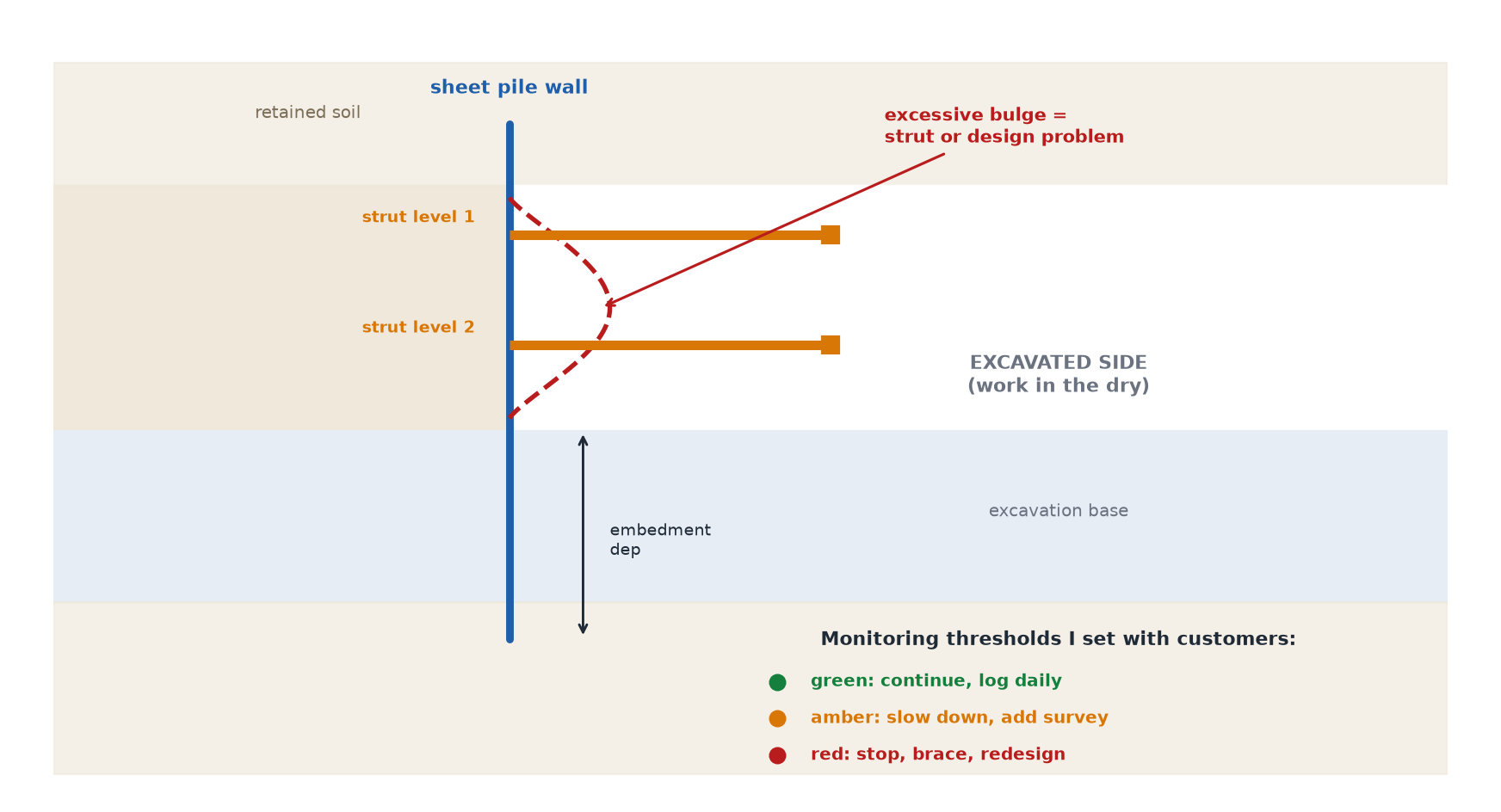
The Sequence Is the Structure
A sheet pile wall in a braced excavation is not a standalone structure. It is a system of wall, walers, struts, and soil, and the system only works in the right order. The most damaging mistake I see is excavating ahead of the bracing: the crew digs to full depth “just to see”, the wall bulges, and the damage is permanent. Brace as you dig, level by level, and never remove a strut before the permanent works can replace it.
Soft clay adds its own patience tax. Clay keeps moving after excavation, sometimes for weeks, so the wall needs staged digging and movement monitoring, not just a design check on day one. I set three color thresholds with customers: green means continue and log daily, amber means slow down and survey more often, red means stop, brace, and call the designer. Every project I have seen get into trouble skipped the amber stage. The crew ignored small numbers until they were big numbers. For permanent walls, movement tolerances are tighter and the design life longer, which is why our notes on temporary vs permanent steel sheet pile structures matter before the section is chosen.
| Movement Signal | Likely Cause | Action |
|---|---|---|
| Steady creep in soft clay | Normal consolidation | Monitor, keep staged digging |
| Bulge below last strut | Over-excavation | Install missing brace, backfill if needed |
| Sudden jump in deflection | Strut failure or overload | Stop work, redesign bracing |
| Ground cracks behind wall | Overall instability | Evacuate, redesign embedment |
My Take: Most Sheet Pile Problems Are Found With a Notebook, Not a Crane
After years of listening to installation stories from our export customers, I believe the difference between a smooth job and a painful one is rarely the steel. It is whether somebody wrote things down. The best foremen I know keep a one-page daily log: blow counts, leans, clutch condition, pump rates, and sensor readings. When a dispute or a claim appears, that notebook is worth more than any opinion.
I also believe suppliers should be part of the loop earlier. When a contractor sends us the soil report and the wall drawings before ordering, we can suggest a heavier toe, interlock seals, or a corrosion allowance where chloride levels demand it, drawing on what we learned supplying steel sheet piles for port and harbor protection projects and on our guide to common steel grades used for steel sheet piles — and these conversations happen while changes are still cheap. A wholesale supply relationship should work like that: not just tons and prices, but the experience of hundreds of sites behind every order. The steel is the easy part. Knowing which problems are coming is the service.
Conclusion
Refusal, interlock damage, leaks, noise limits, and wall movement are the five classic sheet pile challenges. Diagnose early, brace in sequence, and document everything on site.
Tags: steel sheet pile construction challenges, sheet pile driving refusal, interlock damage, sheet pile wall leaks, construction vibration control