How Do You Evaluate a Reliable Steel Sheet Pile Supplier?
One bad batch of sheet piles can freeze a project for months. I have watched it happen. Here is the checklist I give every serious buyer.
A reliable steel sheet pile supplier proves three things: real production capability, verifiable mill documents, and stable export experience. Audit the factory, check every mill test certificate, run a trial order with third-party inspection, then scale up. Price sets your margin; process protects your schedule.
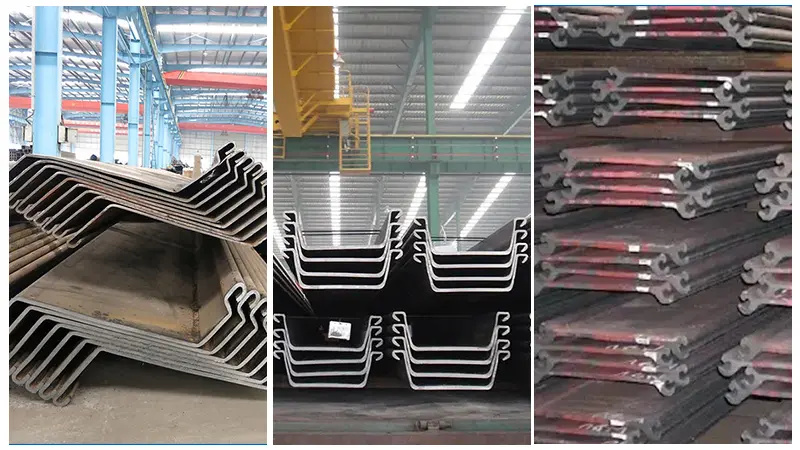
I run export sales for a steel sheet pile factory in Liaocheng, Shandong, and I talk with contractors, civil engineering companies, and steel distributors every week. Many of them have been burned before. They paid a deposit to a middleman with a nice website, and the goods arrived late, off-grade, or not at all. So in this article I will share the exact evaluation process I recommend, the same one our best customers use on us. It works whether you buy U-type, Z-type, or special profiles.
What Production Capability Should a Real Steel Sheet Pile Supplier Have?
A glossy catalog costs nothing. A rolling mill, a stock yard, and a real production schedule are much harder to fake.
Check for in-house rolling or a binding mill partnership, profile range from U and Z to straight-web and hat sections, monthly output, and current stock depth. A real factory answers capacity questions with schedules and photos, not slogans.
Dive Deeper: Owned Mill, Trading Company, or Hybrid — What Changes for You?
The first thing I ask a buyer to figure out is who they are actually talking to. There are three kinds of sellers in this market, and each one carries a different kind of risk.
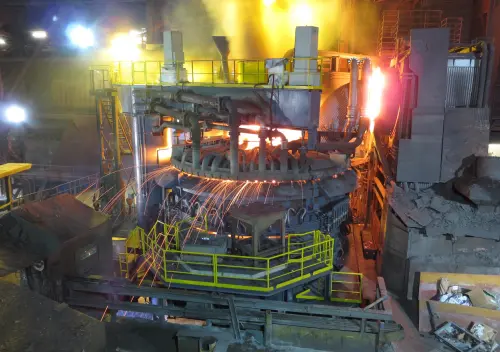
An owned-mill supplier controls the rolling line. When your order enters the schedule, the mill rolls it. If a heat fails testing, the mill re-rolls. Communication is short: you talk to the people who make the product. A pure trading company owns no machines. Sometimes that is fine, because good traders aggregate stock and handle documents well. But the trader cannot promise a rolling date, cannot fix a chemistry problem at the source, and often buys from whichever mill is cheapest that week. Quality then depends on the trader’s discipline, not on any factory system. A hybrid supplier, like us, cooperates long-term with several certified mills while running our own stock, OEM customization, and SGS inspection support in Liaocheng. This model gives buyers both mill capacity and a single accountable contact.
Here is how the three models compare in daily practice:
| Aspect | Owned-Mill Supplier | Trading Company | Hybrid (Mill + Stock Yard) |
|---|---|---|---|
| Rolling schedule control | Direct and fixed | Indirect, depends on third mill | Fixed through long-term mill contracts |
| Price level | Lowest for standard sections | Varies, adds a margin | Competitive, small service margin |
| Quality accountability | Mill quality department | Whoever sold them the goods | Single contact, mill + inspection team |
| Special profiles / OEM | Possible, needs minimum tonnage | Rarely arranged properly | Available with custom profiles and steel grades |
| Risk when a heat fails | Re-rolled quickly | Delay passed on to you | Re-rolled or replaced from stock |
Questions That Expose a Fake Factory in Ten Minutes
You do not need to fly to China to test this. Ask four questions on a video call: Which mill will roll my section? What is the current rolling schedule for my profile? Can I see the stock yard live? Who signs the mill test certificate? A real supplier answers with dates, yard photos, and a named quality engineer. A middleman answers with excuses, or shows you a borrowed workshop. I once hosted a client’s video tour where he asked to zoom in on the pile markings. The markings carried a heat number that matched the certificate we had sent. He told me that single detail closed the deal, because his previous supplier could never produce that match.
Which Certificates and Test Documents Prove Supplier Quality?
Paper is cheaper than steel, so fake paper is tempting. Real documents follow strict rules, and you can learn the rules in one evening.
Demand a mill test certificate per heat, issued by the mill to EN 10204 type 3.1, plus ISO 9001 certification and third-party inspection reports. Verify heat numbers against the markings stamped on the piles themselves.
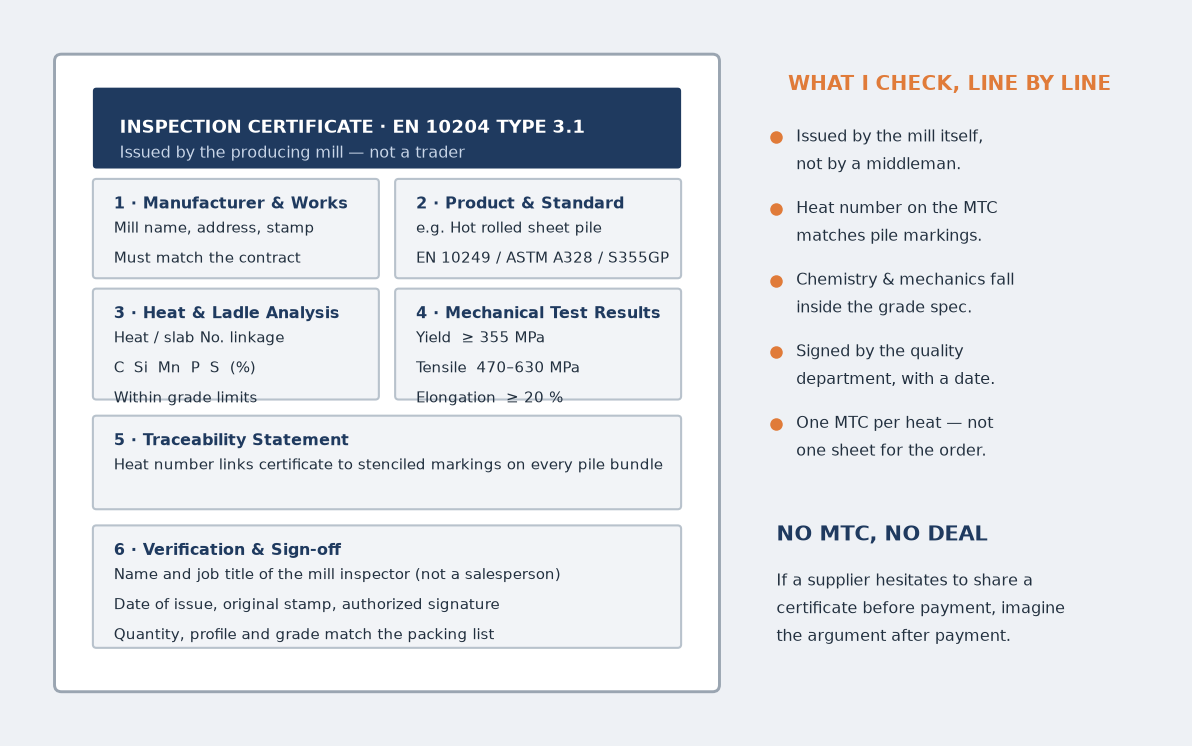
Dive Deeper: Reading a Mill Test Certificate Like an Auditor
A mill test certificate, or MTC, is the birth certificate of your steel. Every heat of steel gets one, and it records the ladle chemistry and the mechanical test results for that exact melt. The full document flow for export orders, from MTC to bill of lading, is covered in our guide to steel sheet pile certifications. Here I want to teach you how to audit one.
Start with the issuer. A type 3.1 certificate must be stamped by the producing mill’s quality department, with a named inspector and a date. If the certificate comes from a trading company’s letterhead, you have learned something important. Next, find the heat number and trace it. Every bundle of sheet piles leaves the mill with stenciled markings: profile, grade, heat number, and bundle weight. Your MTC heat numbers must match those markings exactly. Then check the numbers themselves against the grade. For S355GP steel, for example, yield must reach at least 355 MPa, and the carbon, manganese, phosphorus, and sulfur values must sit inside the grade window. The chart below shows what I check line by line.
| Document | What It Proves | What It Does Not Prove |
|---|---|---|
| MTC EN 10204 3.1 | Chemistry and mechanics of your heat | Interlock tolerance or straightness |
| ISO 9001 certificate | The mill runs a quality management system | Your specific order was controlled |
| Third-party report (SGS / BV) | Goods checked before shipment | Anything after the container is sealed |
| CE marking (where applicable) | Compliance for the EU market | Suitability for your soil conditions |
Notice the pattern: each document covers a slice of the risk, and none of them covers everything. That is why auditors stack them. One more warning: some suppliers send one beautiful MTC and reuse it for every shipment. Ask for one certificate per heat, and compare the values across heats. Real heats vary slightly. Photocopied perfection is a red flag, not a comfort.
How Do You Verify a Supplier Before You Send Money?
Trust is expensive to rebuild. Verification is cheap. Do the cheap thing first, every time.
Vet a supplier in five steps: request a technical dossier, screen the documents, audit the factory on-site or by live video, place a trial order with third-party inspection, then scale volumes gradually. Never wire a full container payment before step four is complete.
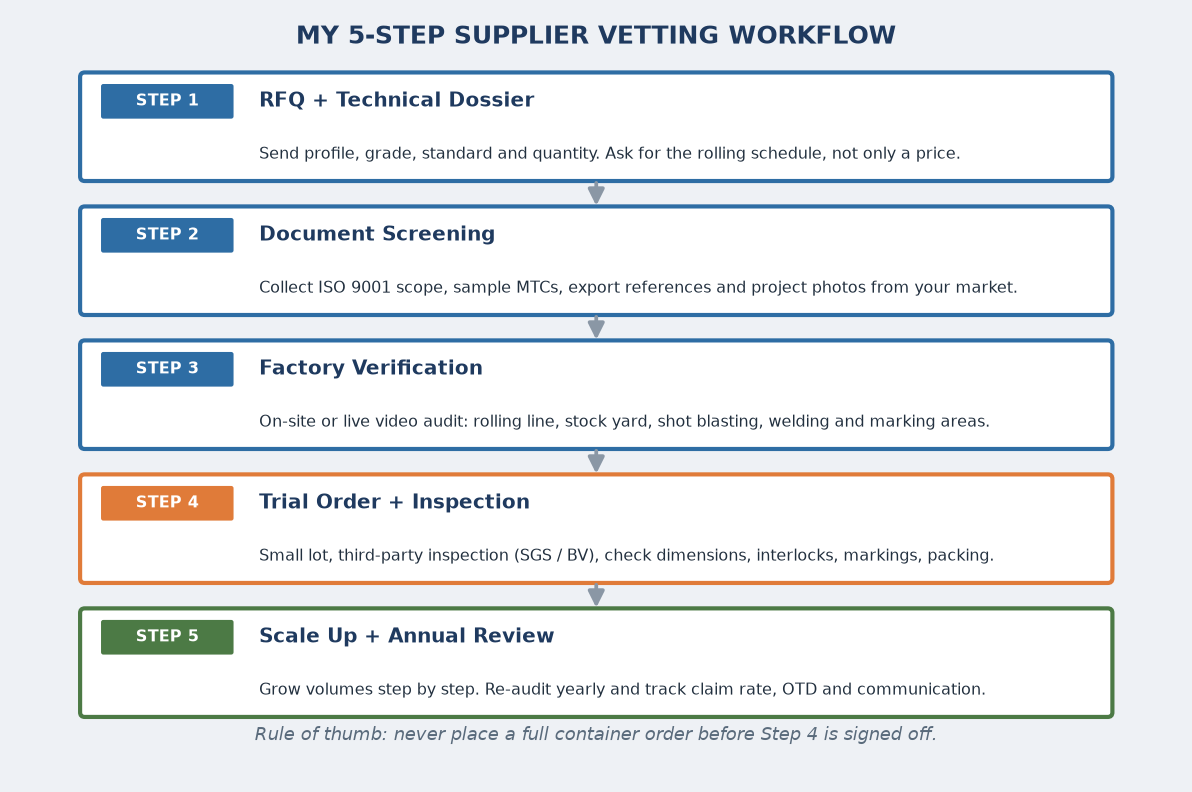
Dive Deeper: My Five-Step Vetting Process in Detail
I wrote the workflow graphic above for buyers, but honestly, I use the same steps when our factory picks a new mill partner. Good verification is symmetrical. Here is what each step involves and where buyers usually go wrong.
Step one is the request for quotation. Send profile, grade, standard, quantity, and destination port in one message. Vague inquiries get vague answers, and you learn nothing. Step two is document screening: collect sample MTCs, the ISO 9001 certificate, and export references from your market. A Middle East contractor should ask for refinery or port references, not a photo of a farmhouse wall. Step three is the factory audit. If travel is not possible, demand a live video walk through the rolling line, stock yard, and marking area, with no notice. Step four is the trial order, small but real, with third-party inspection booked before shipment. Check dimensions, interlock fit, straightness, markings, and packing photos. Step five is scaling with an annual review. The whole path mirrors the process in our complete guide on how to buy steel sheet piles from China.
| Red Flag | Why It Matters | Healthy Signal Instead |
|---|---|---|
| Price far below every other quote | Usually off-spec steel or missing heats | Quote within market band, breakdown offered |
| No named quality contact | Nobody owns your problem | Named engineer signs the MTC |
| Refuses live factory video | There may be no factory | Proud to walk you through the yard |
| Payment 100% upfront | All risk moves to you | Staged terms, e.g. 30% deposit, 70% after inspection |
| One MTC for the whole order | Certificates are per heat | One MTC per heat, matching stencil marks |
Most failed imports I have seen share one root cause: the buyer skipped the trial order to save six weeks. The audit trail in steps one to four costs almost nothing compared to a stuck vessel full of off-grade steel.
What Role Do Price, Logistics, and After-Sales Support Play?
A good supplier is not the cheapest quote. A good supplier is the one whose total landed cost and total risk are lowest.
Compare quotes on Incoterms, packing, and delivery time, not just unit price. Confirm container loading plans, export documents, and how the supplier handles claims. The cheapest ton often becomes the most expensive delay.
Dive Deeper: Comparing Quotes Without Falling for the Cheapest
When three quotes land on your desk, the spread between them can reach 15 percent. Before you celebrate the lowest one, line them up on the same basis. First check the Incoterms, because FOB and CIF prices are not comparable until freight and insurance are added. Our breakdown of steel sheet pile cost factors explains how freight, section weight, and steel index moves shape the final number. Then check what the price includes: shot blasting or corrosion coating, lifting holes, bundle packing, and documents. A quote that excludes packing is not cheaper; it is just less finished.
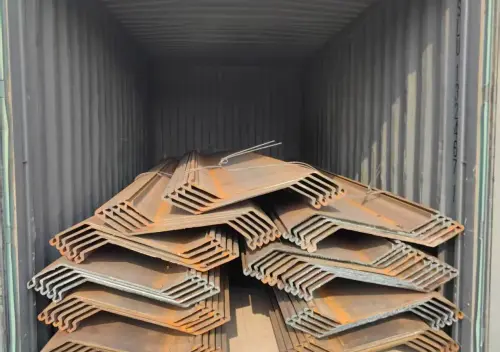
Logistics deserve the same scrutiny. Ask for the loading plan: which container sizes, how many bundles per unit, what dunnage protects the interlocks. An experienced exporter loads more tons per container and delivers bundles that open without a fight at the site. If your project drives the piles with vibratory hammers, damaged interlocks will slow driving, raise noise and cost, and quietly shorten the service life of the wall, as covered in our overview of pile driving equipment. Finally, ask how the supplier handles claims. The answer tells you who they become after the money arrives.
| Cost Element | Visible in Quote | Often Hidden |
|---|---|---|
| Unit price per ton | Yes | Steel index adjustment clauses |
| Freight and insurance | If CIF / CFR | Port congestion surcharges |
| Packing and lifting | Sometimes | Re-bundling fees at transshipment |
| Inspection | If third-party ordered | Retest fees if a heat fails |
| After-sales response | Never | Delay cost of slow claim handling |
After-sales is where suppliers separate quietly. When a client in Iraq once reported two bundles with bent interlocks, we replaced the tonnage on the next vessel and shared the mill’s rework report. That shipment cost us money. The client has reordered for four years straight. Support is not a cost line; it is the cheapest marketing a factory can buy.
My Take: Buy From Process, Not From Promises
Here is my honest view from the factory side. After years of export orders, I can predict which buyers will have smooth projects before the first container ships. They are the ones who treat evaluation as a process with checkpoints, not as a hunt for the lowest number.
The pattern that works is boring and repeatable. Clear specifications in one message. Documents verified against the steel itself, heat number by heat number. A factory seen live, even through a phone screen. A trial order inspected by a third party before the balance is paid. Volumes that grow with trust. None of these steps requires an expert; they require patience. The buyers who skip steps do not usually save time, they borrow trouble at a high interest rate. I would also say this: a confident supplier should welcome your checklist. When a client audits us carefully and we pass, that client stops shopping around. Long partnerships in this industry are built on one clean, inspected, on-time trial container. Everything after that is just repetition at a larger scale.
Conclusion
Evaluate a steel sheet pile supplier on production capability, verifiable certificates, a disciplined vetting process, and total landed cost. Do this in order, and the reliable suppliers will identify themselves.