What Equipment Do You Need to Drive Steel Sheet Piles? A Machinery Overview
Buying the wrong rig can stop your project for weeks. I have watched it happen on port and bridge jobs. Here is the equipment that actually works on site.
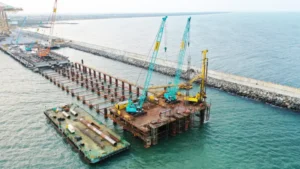
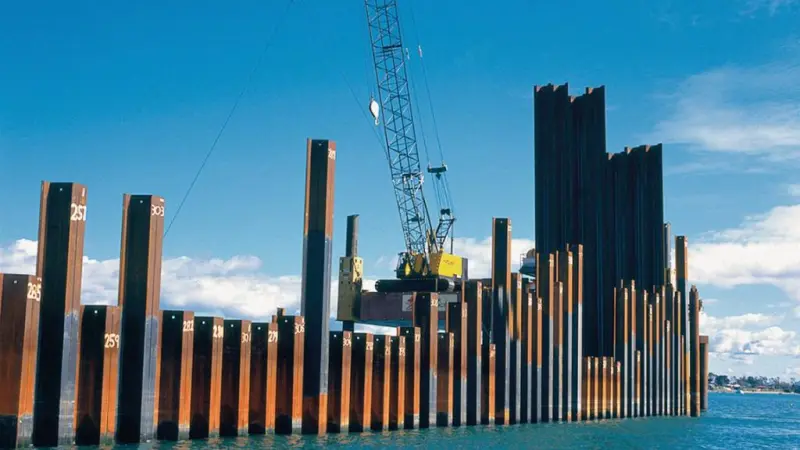
The main types of steel sheet pile driving equipment are vibratory hammers, impact hammers, hydraulic press systems, and excavator-mounted rigs. Most contractors drive sheet piles with a vibratory hammer hung from a crawler crane and fed by a hydraulic power pack.
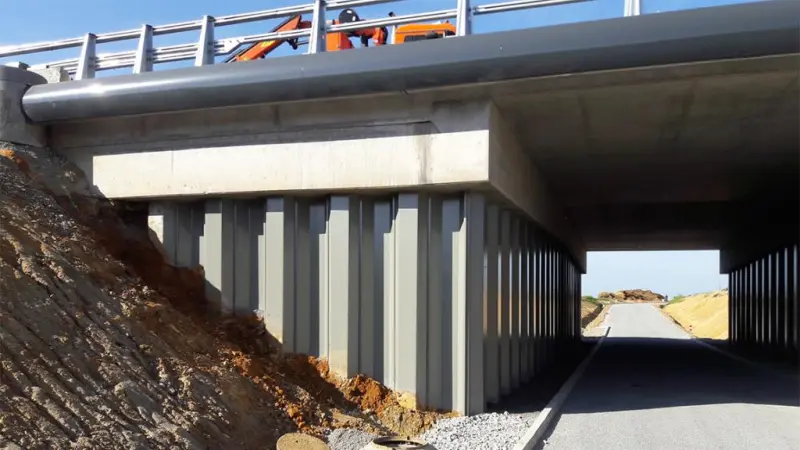
I have supplied steel sheet pile driving equipment specs to contractors on three continents, and I still see the same mistake. Teams pick a hammer by price, not by soil. Then the pile refuses at half depth, or the noise stops the job on day two. The machine was never the problem. The match was. In this guide, I break down every machine family you will meet on a sheet piling site. I explain how each one works, where it performs best, and how I match gear to ground conditions for buyers in the Middle East, Australia, and Africa.
What Are the Main Types of Steel Sheet Pile Driving Equipment?
You will meet four machine families on any sheet piling job, and each one moves piles with a different force. Pick the wrong family, and your production rate drops fast.
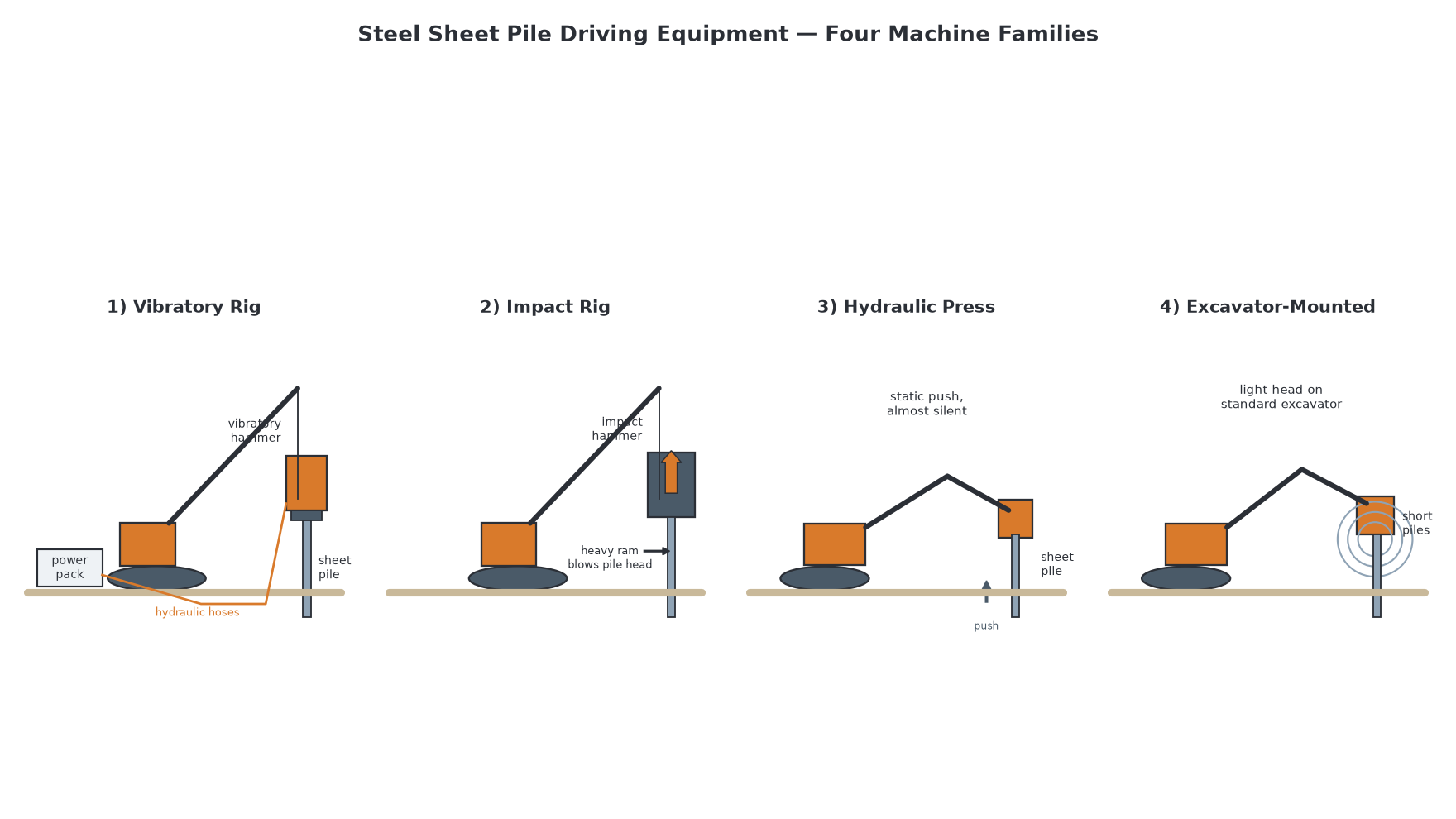
Sheet piling crews use four main machine types: vibratory hammers, impact hammers, hydraulic presses, and excavator-mounted rigs. Each type pushes piles into the ground with a different force, so each one fits different soils, sites, and noise limits.
Breaking Down the Four Equipment Families
Let me walk through each family the way I explain it to first-time buyers.
Vibratory hammers are the workhorse of the industry. A vibratory hammer spins a pair of eccentric weights inside the hammer body. That spin creates a vertical vibration wave. The wave liquefies the soil around the pile toe for a moment, so the pile slides down under its own weight plus the hammer’s amplified force. In sand and soft clay, this is the fastest method you can buy. When clients ask me about U-type and Z-type sheet piles, I usually pair them with a vibratory hammer first.
Impact hammers work like a pile-driving hammer in the classic sense. A heavy ram lifts up and drops onto the pile head, again and again. Each blow drives the pile a little deeper. Impact driving suits stiff clays, dense gravels, and ground with obstructions. It is louder, and it sends more vibration into neighbors, but it wins where vibration alone cannot move the pile. Our vibratory vs impact driving comparison covers this choice in detail.
Hydraulic press systems grip the pile head with hydraulic clamps and push it into the ground with static force. No vibration, very little noise. This is the method you want beside hospitals, schools, or live railways. Press systems cost more to mobilize, and they need reaction force, which usually comes from gripping already-driven piles.
Excavator-mounted rigs bolt a small vibratory head or press module onto a standard 20-to-30-ton excavator. They are cheap to move and fast to set up. They suit short walls, small cofferdams, and repair jobs. They lack the force of a full crane-hung rig, so I only recommend them for light sections in soft ground.
Do not forget the supporting cast. Long walls on open sites often use a leader rig or a gantry frame to hold piles truly vertical before driving starts. Extraction needs a bigger crane than driving, because soil suction adds huge resistance when you pull a pile out. And every rig needs a trained banksman, spare clamp jaws, and extra hoses on site. I have seen whole crews sit idle for two days over a failed hose that cost less than a hundred dollars. Plan the small parts, and the big machine keeps earning.
| Equipment Type | Driving Force | Best Soil | Noise Level | Typical Use |
|---|---|---|---|---|
| Vibratory hammer | Vertical vibration | Sand, soft to firm clay | Medium | Quay walls, cofferdams |
| Impact hammer | Repeated blows | Stiff clay, dense gravel | High | Hard ground, long piles |
| Hydraulic press | Static push | Most soils above rock | Very low | Urban sites, sensitive zones |
| Excavator-mounted | Light vibration or press | Soft soil, short piles | Medium | Small walls, repairs |
How Does a Vibratory Hammer Work, and When Does It Perform Best?
Vibratory hammers look simple from a distance. In truth, the whole setup has to work together, or the hammer will underperform no matter what you paid for it.
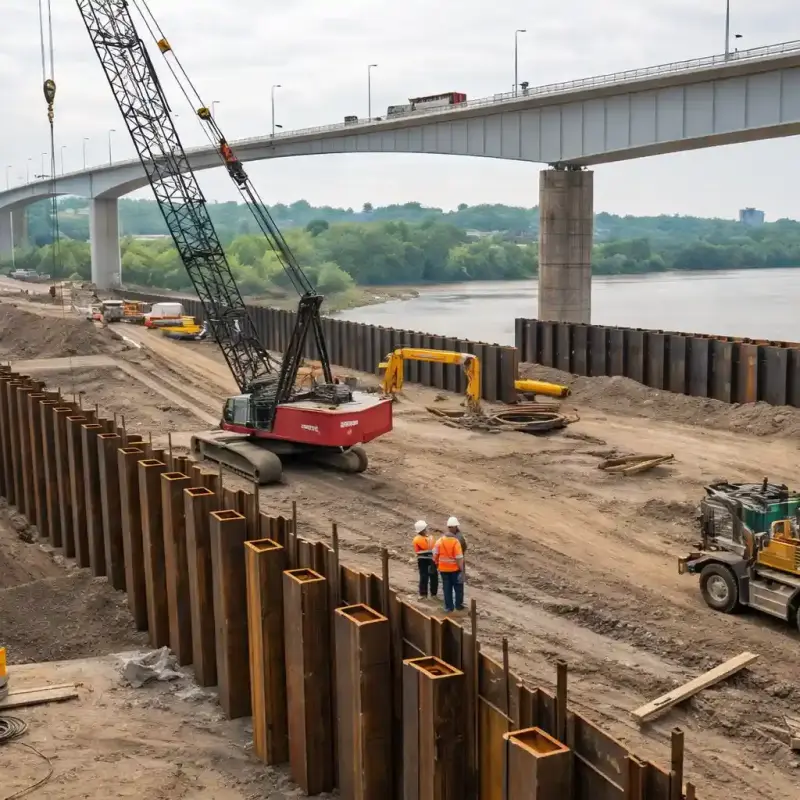
A vibratory hammer uses rotating eccentric weights to shake the sheet pile at high frequency. The shaking reduces soil friction at the pile face, so gravity and clamp force pull the pile down fast. It performs best in loose to medium sand and soft clay.
Inside the Vibratory Hammer Setup
A complete vibratory setup has five parts, and each part matters.
First is the hammer body. It holds the eccentric pairs and the suspension. Hammer size is rated in eccentric moment and line pull. For a 600 mm wide Z-type pile, I normally see 40 to 60 kW hammers on export jobs. Bigger is not always better, because an oversized hammer can damage the interlock if the operator runs it dry.
Second is the hydraulic clamp. The clamp grips the pile head. Without a solid grip, vibration never transfers into the pile. I always tell buyers to buy clamps matched to their pile section, not generic ones.
Third is the power pack. It is a diesel engine driving hydraulic pumps. The hoses run from the pack to the hammer. Power pack size decides hammer speed. A small pack starves a big hammer.
Fourth is the carrier, usually a crawler crane hung on the crane line with a quick coupler. The crane needs enough line pull to extract piles later, because extraction is often harder than driving.
Fifth is the suspension and hose package, including the elastomeric suspension that keeps vibration out of the crane boom.
| Setup Component | What It Does | Common Failure Point |
|---|---|---|
| Hammer body | Creates vibration | Worn bearings, low amplitude |
| Hydraulic clamp | Grips pile head | Jaw wear, low clamp pressure |
| Power pack | Feeds hydraulic flow | Clogged filters, overheating |
| Carrier crane | Lifts and positions | Low line pull for extraction |
| Suspension | Isolates crane boom | Cracked rubber elements |
When the setup is right, a vibratory hammer can drive a 12-meter pile in a few minutes in loose sand. That speed is why I recommend this method first for port and river work. Just remember that installation accuracy still depends on the operator and the setup, not only on the machine.
Frequency choice matters more than most buyers expect. Standard vibratory hammers run at mid frequency and move the most soil per cycle. High-frequency hammers shake faster with a smaller amplitude. They transfer less vibration into the ground, so they suit city centers and old structures nearby. The trade is slower penetration in dense layers. I once supplied piles for a waterfront job next to an old masonry warehouse. The contractor chose a high-frequency head, and the surveyor recorded almost no movement in the warehouse walls. That single decision saved the project from a compensation claim worth more than the entire piling package.
When Should You Choose an Impact Hammer or a Hydraulic Press?
Vibration does not always win. Some ground refuses it, and some sites forbid it. That is when the other two families take over.
Choose an impact hammer when piles must reach dense soil or rock layers that vibration cannot penetrate. Choose a hydraulic press when the site sits next to hospitals, homes, or railways, because pressing creates almost no noise and vibration.
Comparing Driving Force Against Site Limits
I keep one rule of thumb: let the ground choose the force, and let the neighbors choose the noise.
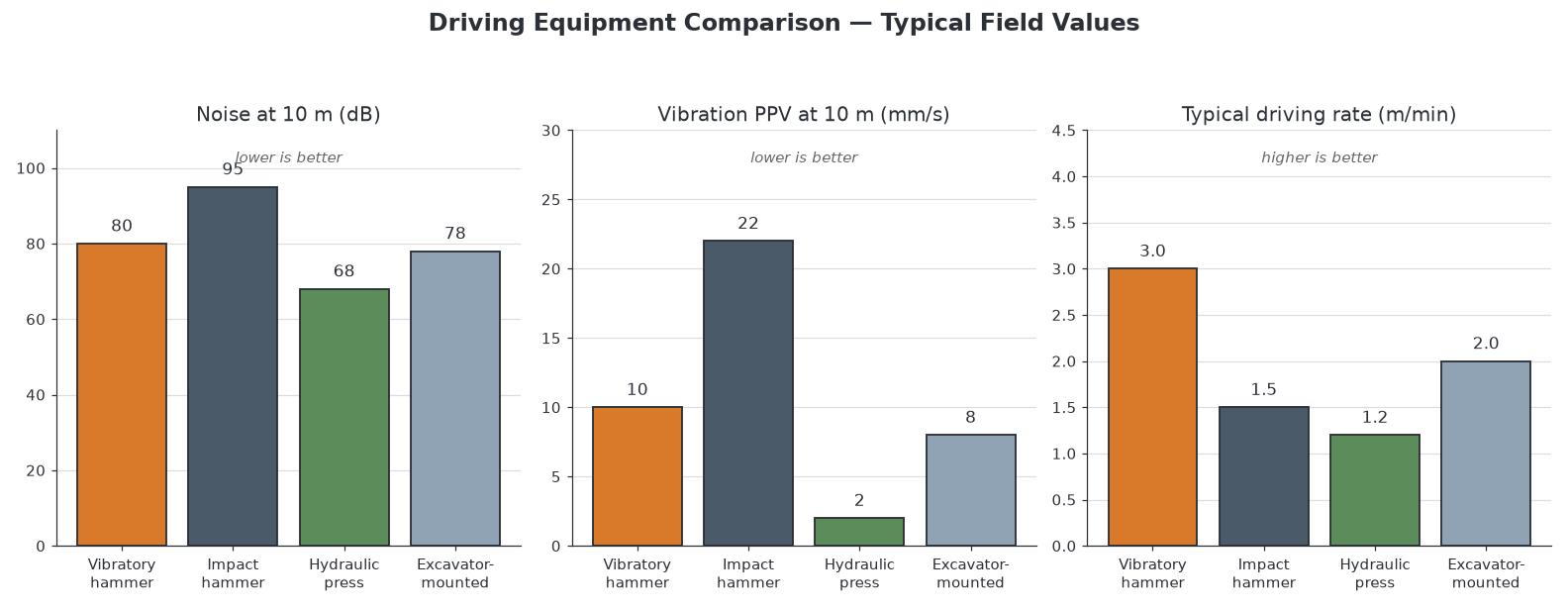
Impact hammers deliver energy per blow, measured in kilojoules. A common open diesel or hydraulic impact hammer for sheet piles delivers 10 to 40 kJ. That energy punches through stiff clay layers, dense sand, and light obstructions. The cost is noise and vibration. Impact driving near sensitive structures needs a vibration and noise monitoring plan. On one Middle East project, my client switched from impact to press driving after a nearby hotel complained on day one. The pile rate dropped by half, but the job kept its permit.
Hydraulic presses push with static force instead of striking. Modern press systems clamp the top of the pile, push it down, then walk to the next pile using already-installed piles as reaction. Near-silent operation makes them the only real choice for city-center walls. The trade-offs are real, though. Presses struggle in very dense ground. They also need a starting pit or corner piles to grip for the first installation. For temporary vs permanent walls, extraction noise matters too, and presses extract almost as quietly as they install.
| Factor | Impact Hammer | Hydraulic Press |
|---|---|---|
| Penetration power | Very high | Medium |
| Noise at 10 m | 90 to 100 dB | 60 to 70 dB |
| Vibration effect | High | Almost none |
| Mobilization cost | Low to medium | High |
| Best site | Open, hard ground | Urban, sensitive zones |
How Do You Match the Driving Equipment to Your Project?
Now that you know the machine families, the final question is the one that costs or saves you the most money. Matching gear to ground is a skill, but it follows a process.
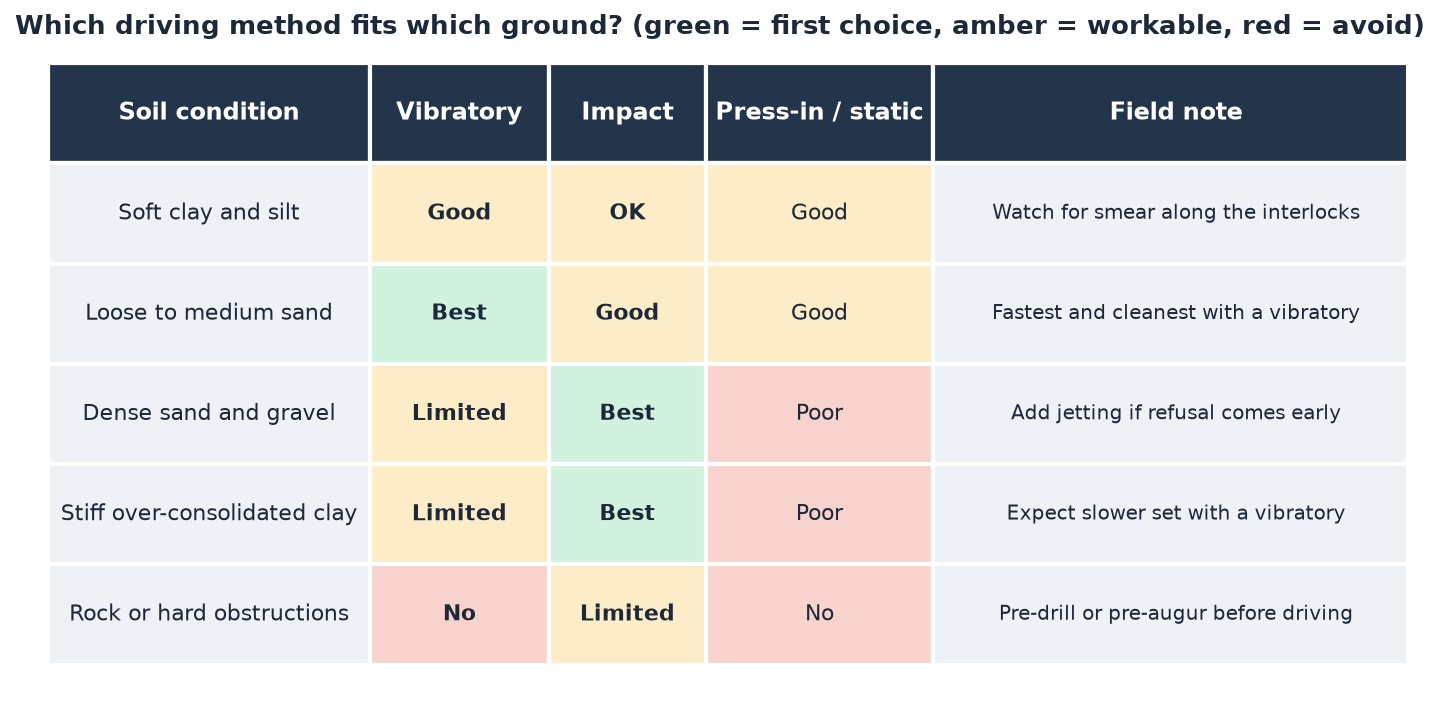
Start with the soil report, then the site constraints, then the pile section. Loose sand points to a vibratory hammer. Dense layers point to impact driving. Tight urban sites point to a press. The pile section and wall length decide the hammer size you need.
A Simple Selection Process I Use With Buyers
I run the same four checks with every export customer before we quote a hammer recommendation.
Check one: soil. Read the borehole log. If the top 10 meters are loose sand or soft clay, a vibratory hammer will fly. If there is a dense sand or gravel layer within the pile depth, plan for impact follow-up. If rock sits at toe level, no hammer will help. You need pre-drilling or a different wall system. Our guide on key considerations before installation walks through the full site review.
Check two: site constraints. Measure the distance to the nearest building, road, or railway. Many countries set vibration limits in millimeters per second at the nearest structure. If the limit is tight, a press beats every hammer.
Check three: pile section and depth. Heavier sections need more energy. A light excavator-mounted head cannot install a 700 mm Z-pile 15 meters deep. Match hammer size to the steel grade and section you plan to drive.
Check four: program and budget. Vibratory driving moves fast and rents cheap. Press driving moves slower and mobilizes expensive, but it keeps the neighbors happy. On long walls, that speed difference decides your crane days and your total cost.
| Ground Condition | First Choice | Backup Option |
|---|---|---|
| Loose sand, soft clay | Vibratory hammer | Excavator-mounted head |
| Medium dense sand | Large vibratory hammer | Impact follow-up |
| Stiff clay, gravel | Impact hammer | Large vibratory + jetting |
| Urban sensitive zone | Hydraulic press | Silent vibratory + monitoring |
| Rock at toe | Pre-drilling + vibratory | Change wall system |
Run these checks before you rent, not after the first pile sticks at five meters. Every contractor I know who skipped this step paid for it twice, once in standby crane time and once in a changed method statement.
One more point on cost. Rent the hammer, buy the piles. Equipment rental markets are deep in every region we ship to, but pile sections are project-specific and lead time matters. When you order from us, we confirm the section, grade, and interlock fit before fabrication, so the hammer you rent locally will grip and drive our piles without surprises. That simple coordination step, done at the order stage, removes the most common delay I see on import projects.
My Take: What I Tell Buyers Every Week
From my desk at the factory in Liaocheng, I quote sheet piles for ports, bridges, and basements across the Middle East, Australia, and Africa every week. Here is what I keep seeing. Buyers obsess over hammer brand names, but the real win is in the boring details. Ask your supplier for the actual section modulus and interlock strength of the piles, then size the equipment to that data, not to habit. Ask whether your piles come hot rolled or cold formed, because driving behavior differs between them. And ask for SGS inspection support before shipment, so the pile that meets your hammer on site is the pile you paid for. We supply U, Z, Omega, and custom sections as wholesale OEM orders, and the contractors who send us their soil reports always end up with the smoother installation. Equipment does not fail alone. It fails when it is mismatched to the pile and the ground.
Conclusion
Match the machine to the soil, the site, and the pile section. Do that, and your sheet piling job runs fast, quiet, and on budget.