Your supplier quotes USD 700 per tonne. By the time the wall is driven, the real cost is nearly double. Nothing dishonest happened. The budget stopped at the material price.
A steel sheet pile budget needs nine layers beyond the ex-works price: export packing, inland haul, ocean freight, insurance and duty, site handling and storage, installation plant, cut-off waste and splicing, corrosion allowance, and finance or inspection charges. Together they add 40 to 60 percent to the invoice.
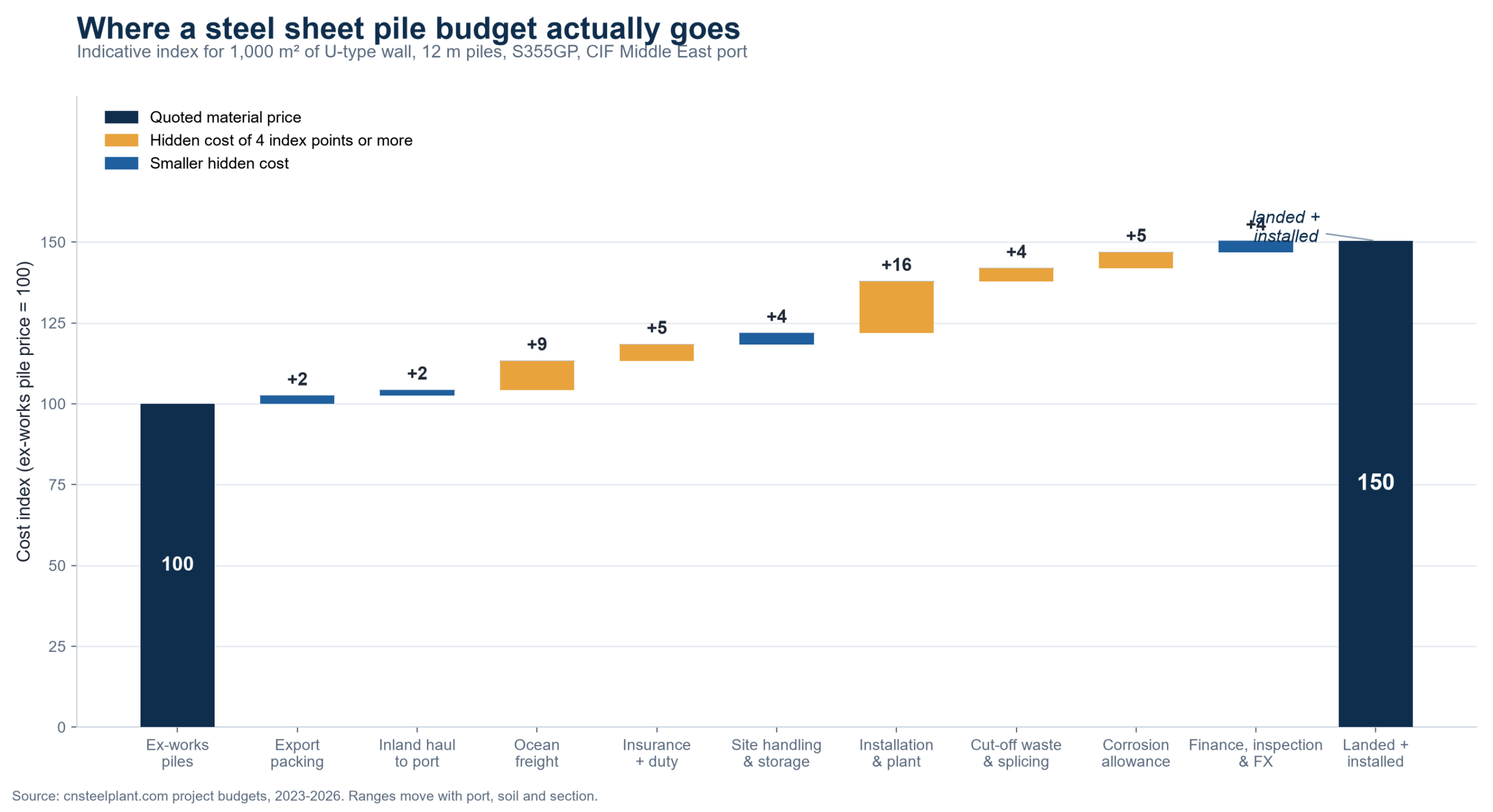
I quote sheet piles every week from our mill in Liaocheng. I also get the phone calls six months later, when a contractor tells me the wall is over budget and asks where the money went. The pattern is always the same. The piles were priced correctly. Everything around the piles was never priced at all.
This article walks through the cost layers I see most often, in the order they hit a project. At the end you will have a checklist you can paste into your own budget sheet, and a way to compare bids on the same basis instead of on the tonne price.
Why Does the Price per Tonne Tell You So Little?
A tonne price compares weight, not wall. Two suppliers can quote the same number and deliver walls that differ by 30 percent in steel.
Price per tonne ignores section modulus, steel grade, coverage width and cut-off length. Convert every quote to cost per square metre of finished wall before you compare anything, then add the layers below.
Most buyers start with a simple question: how much do steel sheet piles cost per tonne? It is the easiest number to collect and the hardest number to use. A U-type pile at 6.0 mm wall thickness and a Z-type at 8.0 mm can carry the same bending moment per metre of wall, but they weigh different amounts. If you pay by weight, you are paying for steel you may not need, or you are buying too little steel and paying for it later in repairs.
When people ask me about steel sheet pile project cost, I tell them to forget the tonne for one afternoon and build a per-square-metre number instead. It takes two hours and it changes every conversation that follows.
Three ways to express the same quote
| Basis | What it measures | Where it misleads |
|---|---|---|
| USD per tonne | Weight of steel supplied | Ignores coverage width and section efficiency |
| USD per m² of pile surface | Area of steel delivered | Still ignores cut-offs, waste and installation |
| USD per m² of finished wall | The actual retaining function | Requires design data, but is the only fair comparison |
I have seen a 12 percent “cheaper” tonne price turn into a 9 percent more expensive wall, because the cheaper profile covered 1,050 mm per pair instead of 1,200 mm. More pairs, more driving, more interlocks, more time. If you want the full method, I wrote about the cost drivers behind steel sheet pile projects and about comparing quotations beyond price per ton in earlier notes.
What Do Freight and Port Charges Really Add?
Ocean freight is the line item buyers underestimate most, because it moves with fuel, war risk and port congestion, not with steel.
Freight, inland haul, insurance and duty usually add 12 to 18 percent to an FOB price for Middle East and South Asian destinations, and more when piles exceed 12 metres and leave the container envelope.
Pile length decides the shipping method, and the shipping method decides the cost. A 40-foot container has about 12.03 m of internal length. A 12 m pile fits, but only with careful loading and no room for error. A 15 m pile does not fit at all. It goes on a flat rack, in a breakbulk hold, or on a deck cargo ship, and the rate per tonne roughly doubles.
Comparing the three realistic shipping options
| Option | Practical pile length | Relative freight cost | Main risk |
|---|---|---|---|
| 40 ft container | Up to 12 m | Lowest | Tight loading, bundle damage, limited weight per box |
| Flat rack | 12 to 18 m | Medium to high | Out-of-gauge surcharges, stack damage on deck |
| Breakbulk vessel | 18 m and above | Highest per shipment, lowest per tonne at volume | Port schedule, weather delays, stevedoring quality |
Two smaller items sit next to freight and are almost always forgotten. The first is demurrage and port storage at destination, which can run from USD 80 to USD 300 per container per day once free time expires. The second is the Incoterm itself. On CIF terms the seller arranges freight but the buyer still carries discharge, inland haul and import clearance. On DAP the seller carries more, and the price should show it. If you compare a CIF quote with a DAP quote without adjusting, you are not comparing the same thing.
How Much Do Handling and Storage Cost Before Driving Starts?
Piles arrive as heavy bundles of long steel. Moving them twice costs money, and moving them badly costs more.
Plan for 3 to 6 percent of material value for discharge, double handling, dunnage, edge protection and secure storage. On sites without hard standing, add the cost of re-grading or laying a temporary pad.
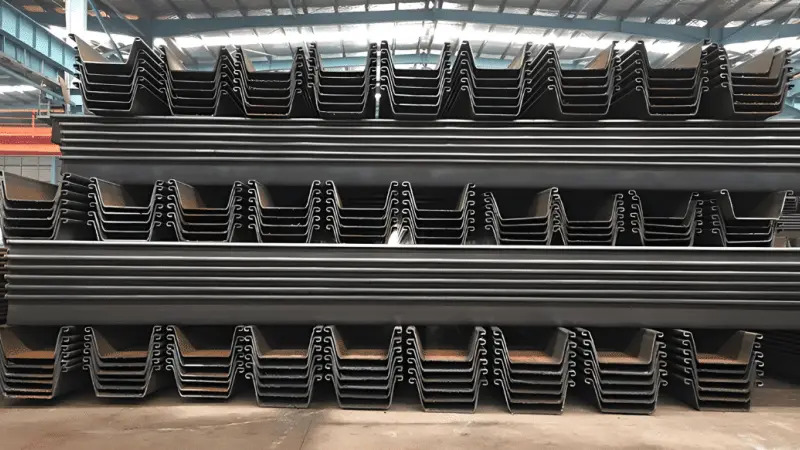
Unloading looks trivial until the crane is a rented 50-tonner on standby and the bundles are 12 m long. I always ask three questions before a shipment leaves: what lifts the bundles, where do they sit, and how many times will they move before the hammer touches them.
The handling costs that never appear in a quote
| Item | Typical allowance | Why it appears |
|---|---|---|
| Crane or forklift hire | 0.8 to 2.0% of material | Discharge and placing bundles at the pitch point |
| Dunnage and edge protection | 0.2 to 0.5% | Prevents interlock deformation in storage |
| Double handling | 0.5 to 1.5% | Bundles moved from laydown area to the wall line |
| Temporary hard standing | 0.5 to 2.0% | Soft ground cannot carry bundle point loads |
| Security and re-stacking | 0.3 to 1.0% | Long programmes, open sites, theft of short lengths |
Deformed interlocks are the expensive failure here. A bundle dropped flat, or stacked without timber bearers, can close up the clutch along several metres. That section becomes a cutting job, and cutting costs both the steel and the time. The weight of the pile matters too, because heavier sections need bigger lifts and better ground; I covered that in my note on how sheet pile weight affects installation and cost.
What Does Installation Plant and Method Add to the Budget?
Installation is the largest hidden layer. On most walls it adds more than freight and duty combined.
Budget 15 to 25 percent of material value for piling plant, crane, guide frame, labour and supervision. Add pre-augering, splicing or extraction as separate lines, because they are priced separately on site.
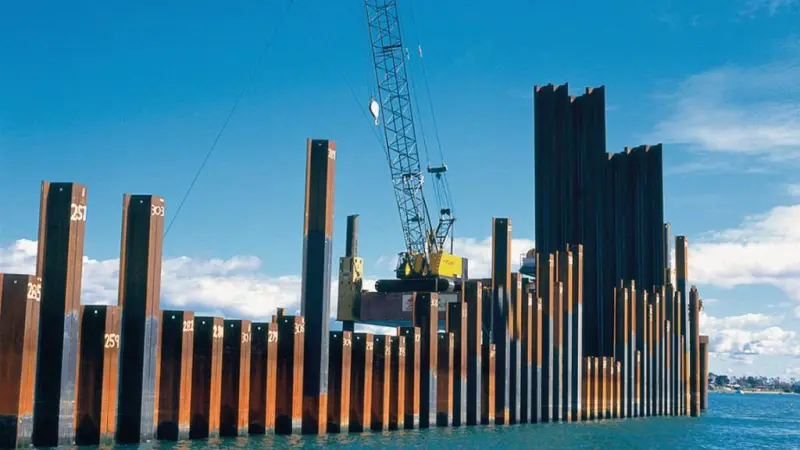
A vibratory hammer on a 50-tonne crawler is not a cheap neighbour. Day rates for rig and operator commonly sit between USD 2,500 and USD 6,000 depending on the market, and standby is charged the same as working. This is why a two-week delay caused by late piles costs more than the freight saved by choosing a slower supplier.
Where installation money actually goes
| Cost driver | Typical effect | How to control it |
|---|---|---|
| Pile length and weight | Higher crane class, slower pitching | Optimise section, not just thickness |
| Soil condition | Pre-augering in dense sand or gravel | Use soil investigation data at tender stage |
| Verticality tolerance | Slower driving, more re-pitching | Specify realistic tolerance, use a guide frame |
| Splicing | Welding, inspection, cooling time | Order full length where freight allows |
| Cut-off allowance | 3 to 8 percent of pile length wasted | Set cut-off level before ordering |
| Extraction | Crane time, vibration, possible damage | Decide temporary versus permanent early |
The number I see underestimated most often is cut-off. Piles are ordered to a nominal length, driven to refusal or design set, then cut to a level line. On a wall with variable bedrock, that waste can reach 8 percent of the order. It is real money, and it is invisible in a tonne price. Contractors who plan the sequence properly recover part of this through shorter driving cycles; the labour side of that argument is covered in my article on how sheet piles reduce construction time and labour costs.
Where Does Corrosion Allowance Fit in the Budget?
Corrosion is not a maintenance topic. It is a purchasing decision made at the tonnage stage.
Allow 4 to 8 percent of material cost for corrosion protection: extra wall thickness, a coating system, or cathodic protection. In the splash zone the allowance is not optional, because metal loss there can exceed 0.1 mm per year.
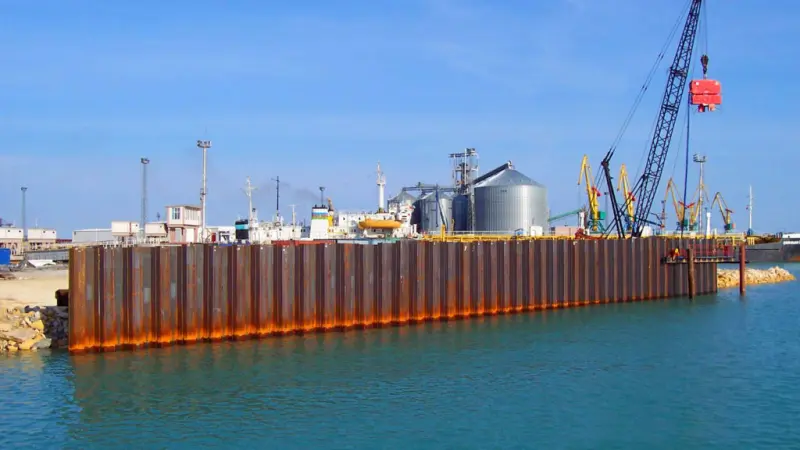
Buyers often ask for the cheapest section that passes the design check, then discover the design life was based on a corrosion allowance that nobody ordered. Adding 1.5 mm to a 10 mm pile costs roughly 15 percent more steel. Replacing a wall in year 18 costs everything again, plus demolition and downtime.
Protection options and what they cost
| Approach | Relative cost | Design life effect | Best fit | |||||
|---|---|---|---|---|---|---|---|---|
| Plain carbon steel, no allowance | Lowest | 15 to 25 years in aggressive soil | Temporary works, short schemes | |||||
| Extra thickness allowance | +8 to 15% material | Adds 10 to 25 years | Permanent walls, unknown water table | |||||
| Coating system | +3 to 8% | Protects the zone above ground and splash | Visible faces, aesthetic requirements | |||||
| ASTM A690 weathering steel | +10 to 20% | Roughly doubles splash zone life | Marine bulkheads, harbour walls | Cathodic protection | +5 to 12% plus power or anodes | Extends immersed zone life significantly | Permanent marine structures |
I usually recommend deciding the exposure zone first, then the protection. A wall that sits in dry fill does not need the same specification as a wall that breathes salt spray twice a day. Our mill supplies both plain and A690 grades, and I would rather lose a small upgrade than see a client replace a wall in 15 years. More detail sits in my notes on corrosion resistance solutions for steel sheet piles and on ASTM A690 for marine piles.
Which Finance, Inspection and Compliance Costs Hide in the Fine Print?
These lines are small individually and painful in total. They are also the easiest to remove with better paperwork.
Set aside 3 to 6 percent of order value for letter of credit charges, third party inspection, testing, import duty, brokerage, insurance and the cost of payment terms. Retention and delayed payment can double that figure.
Most of these costs scale with the invoice value, so they never appear in a per-tonne comparison. A buyer who negotiates 2 percent off the steel and pays 1.5 percent in LC charges and 1 percent in inspection has gained nothing.
The fine print, line by line
| Line item | Typical range | Notes |
|---|---|---|
| Letter of credit opening and amendment | 0.3 to 1.5% of value | Amendments are charged again |
| Third party inspection, SGS or BV | 0.6 to 1.5%, minimum fee applies | Usually per lot, not per tonne |
| Material test certificates, EN 10204 3.1 | Included to 0.4% | 3.1 costs more than 2.2 and is often required |
| Marine insurance | 0.3 to 0.6% of CIF plus 10% | Check the clause set, not just the rate |
| Import duty and VAT | 0 to 15% depending on market | Confirm HS code before pricing |
| Customs brokerage and port dues | 0.3 to 1.0% | Varies heavily by port |
| Retention or delayed payment | 5 to 10% held, cost of capital 8 to 12% per year | The most expensive line nobody budgets |
The certificate question deserves its own paragraph. Many public and EPC projects require EN 10204 3.1 certificates, which mean the mill tests the actual cast. That is a real cost, and it must be in the price from the start. Asking for it after the order is placed is how delivery schedules slip. Our own quality standards and inspection workflow is built around that rule.
How Do You Budget for the Whole Life, Not Just Year One?
A budget that ends at installation is only half a budget. The other half arrives quietly, in maintenance and replacement.
Compare bids on whole-life cost over the design life, not on award price. A section that is 19 index points cheaper at award can be 120 points more expensive by year 25 once replacement is counted.
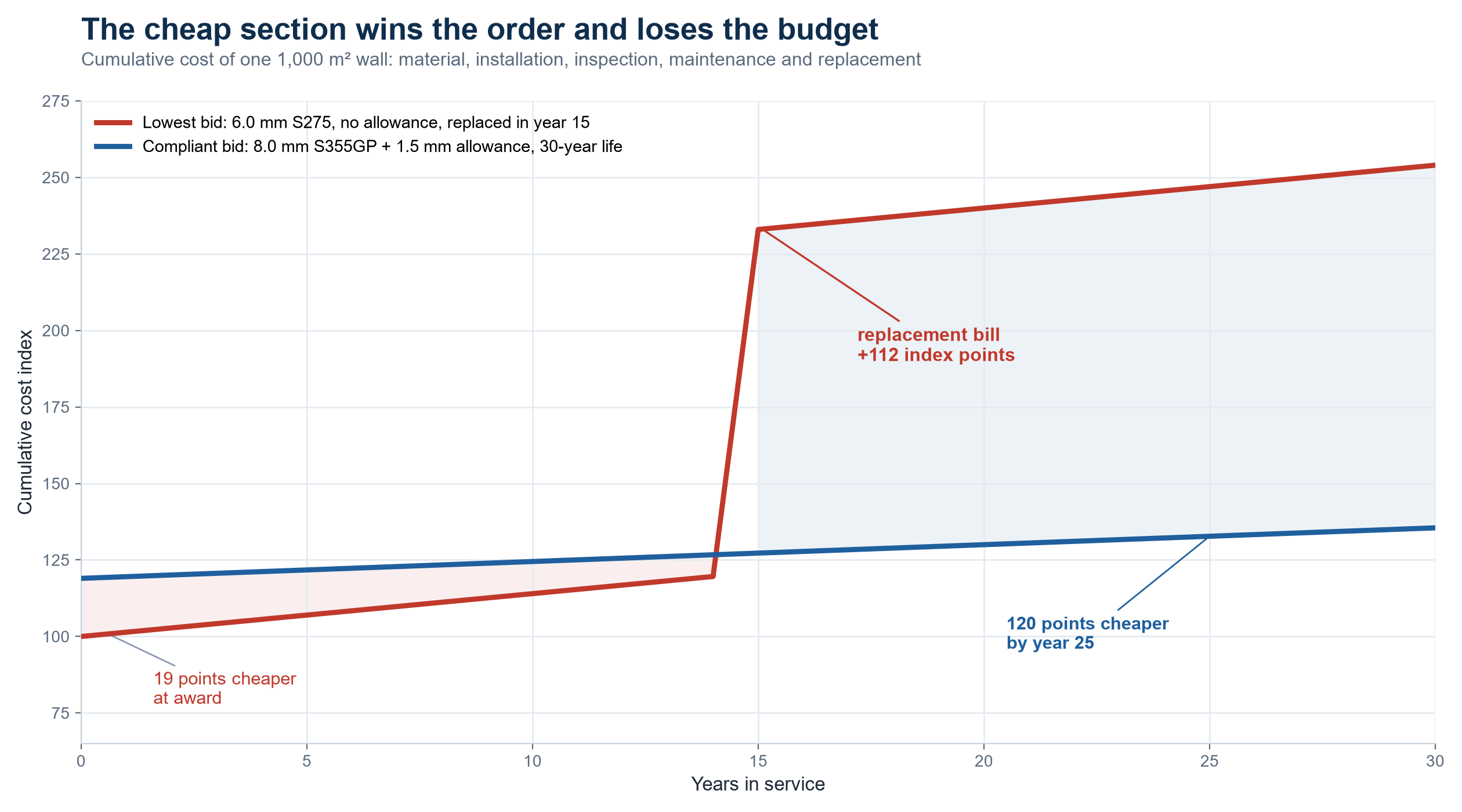
This is the part of the conversation where I sometimes sound like a salesman, so I use numbers instead. Take a 1,000 m² wall with a 30-year design life. Bid A uses a 6.0 mm S275 pile with no allowance. Bid B uses 8.0 mm S355GP with 1.5 mm allowance. Bid A is cheaper by roughly 19 index points on day one. Bid A also needs replacement around year 15.
Thirty-year cost stack for the same wall
| Cost block | Bid A, thin section | Bid B, compliant section |
|---|---|---|
| Material at award | 100 | 119 |
| Installation | 16 | 17 |
| Inspection and testing | 1.5 | 2.0 |
| Maintenance, years 0 to 15 | 21 | 8 |
| Replacement in year 15 | 112 | 0 |
| Maintenance, years 15 to 30 | 14 | 9 |
| Indicative 30-year total | 264 | 155 |
The arithmetic is deliberately simple, and it is also the reason I ask every buyer one question: what happens in year 16? If the answer is “we replace it”, the cheap bid was never cheap. Reuse changes the picture further, because a heavier section usually survives extraction in better condition; I covered that in my note on whether sheet piles can be reused. The whole-life view is the core of total cost of ownership thinking, and it belongs in the tender documents, not in a post-mortem.
What Does This Look Like on a Real Project?
Last year we supplied a riverbank protection scheme in Southeast Asia. The tender budget was built on an FOB tonne price, and the first cost report at month four was 46 percent over.
The overrun came from four lines the tender never carried: 13 m piles shipped breakbulk instead of container, monsoon-season storage on soft ground, pre-augering through a gravel layer, and 6 percent cut-off waste.
The fix was not a cheaper pile. We kept the U-type section, changed the shipping plan to two parcels so the first drive could start earlier, added timber bearers and a graded pad for storage, and priced the pre-augering as a separate measured item. The wall was completed three weeks inside the revised programme. The material price did not move at all.
How the revised budget was structured
| Original line | Revised treatment | Effect on budget clarity |
|---|---|---|
| FOB tonne price only | Cost per m² of finished wall | Made bids comparable |
| Freight as one lump | Breakbulk plus port charges, two parcels | Removed the 9 percent surprise |
| Storage not listed | Pad, bearers, security, 10 weeks | Added 2.1 percent, removed rework |
| Installation assumed | Pre-augering, splicing, cut-off measured | Exposed the real driver |
This is the case I use when a buyer tells me the budget is already tight. The budget was not tight. It was incomplete, and incomplete budgets always look tight until the site opens.
What Is My Own View on Hidden Costs?
After enough of these projects, I stopped believing that the cheapest quote is a negotiating position. It is usually a scope statement, and a narrow one.
My rule is simple: if a cost is certain to happen, it belongs in the budget, not in the contingency. Contingency is for unknowns, not for freight you knew about in week one.
I would rather quote a higher number with every layer visible than win on a tonne price and defend it for six months. That is also why we quote OEM sections, packing lists, loading plans and inspection scope together. The buyer can then see what is included and what is not, which is the only real basis for a decision.
There is a second reason I argue for the full budget. Once the layers are visible, the conversation changes from “can you take 3 percent off” to “can we shorten the piles by one metre” or “can we ship in two parcels”. Those questions save far more money than a discount, and they save it on both sides. A buyer who arrives with a complete RFQ and a supplier evaluation sheet usually gets a better wall, not just a better price.
Conclusion
Budget the wall, not the tonne. Add freight, handling, installation, waste, corrosion allowance and finance, then compare bids over the full design life.