When Should Engineers Specify Straight Web Steel Sheet Piles?
Straight web sheet piles fail when buyers use them like U or Z piles. The wall bends, the interlocks open, and the project pays for it twice.
Specify straight web steel sheet piles when the wall works as a tension membrane, not a bending beam — circular cells, cellular cofferdams, breakwaters, and anchor walls where the load pulls along the wall, not across it.
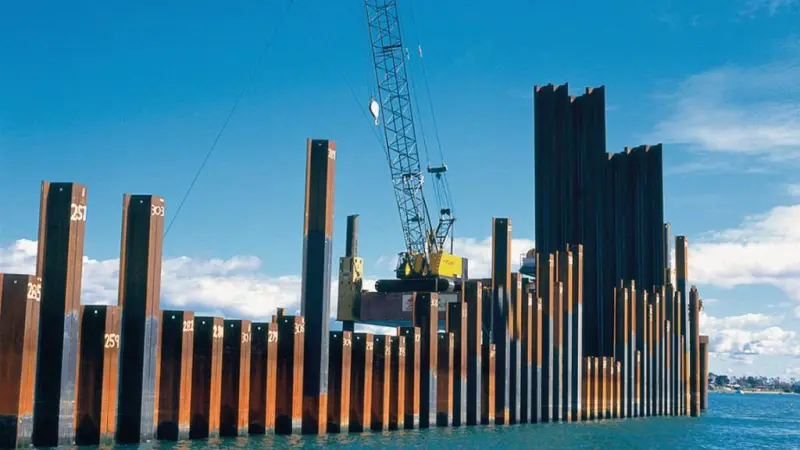
When a contractor first asks me about straight web piles, the question is almost always the same one: “Why would I use a flat pile with almost no section modulus?” It is a fair question. On paper, a straight web pile looks weak next to a deep Z profile. But in the right structure, it is the only profile that works, and it often works cheaper than any alternative. I supply straight web steel sheet piles from our factory network to ports and contractors across the Middle East, Australia, and Africa, and I have shipped them for circular harbor cells, river closure works, and breakwater cores. In this article I explain when the flat profile is the correct choice, when it is the wrong choice, and what I confirm with buyers before we load a single bundle into the container.
What Makes Straight Web Sheet Piles Different From U and Z Profiles?
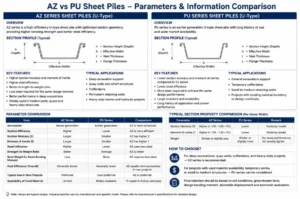
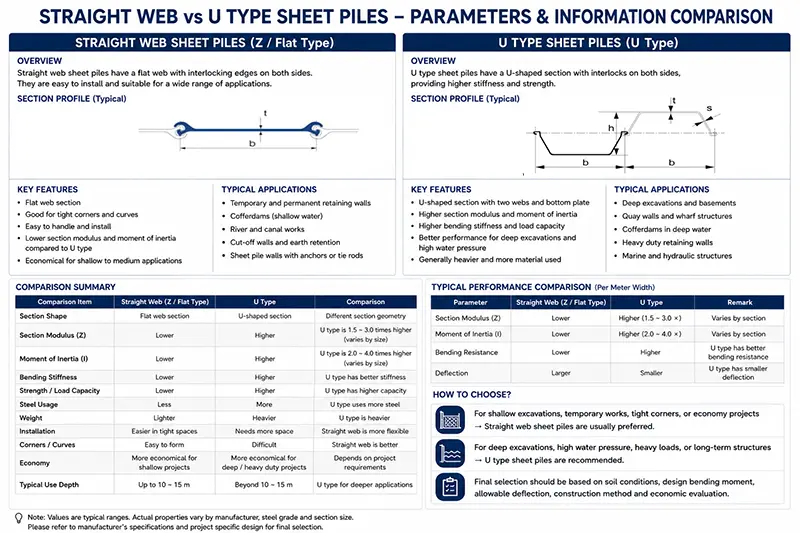
U and Z piles are bending beams. Straight web piles are tension ties. Once you understand that one sentence, every selection decision about this profile becomes obvious.
A straight web pile carries load as tension along its interlocks, like a stretched membrane. It has almost no bending stiffness of its own, so it must be formed into cells or flat walls where curvature or anchors carry the moment, not the pile itself.
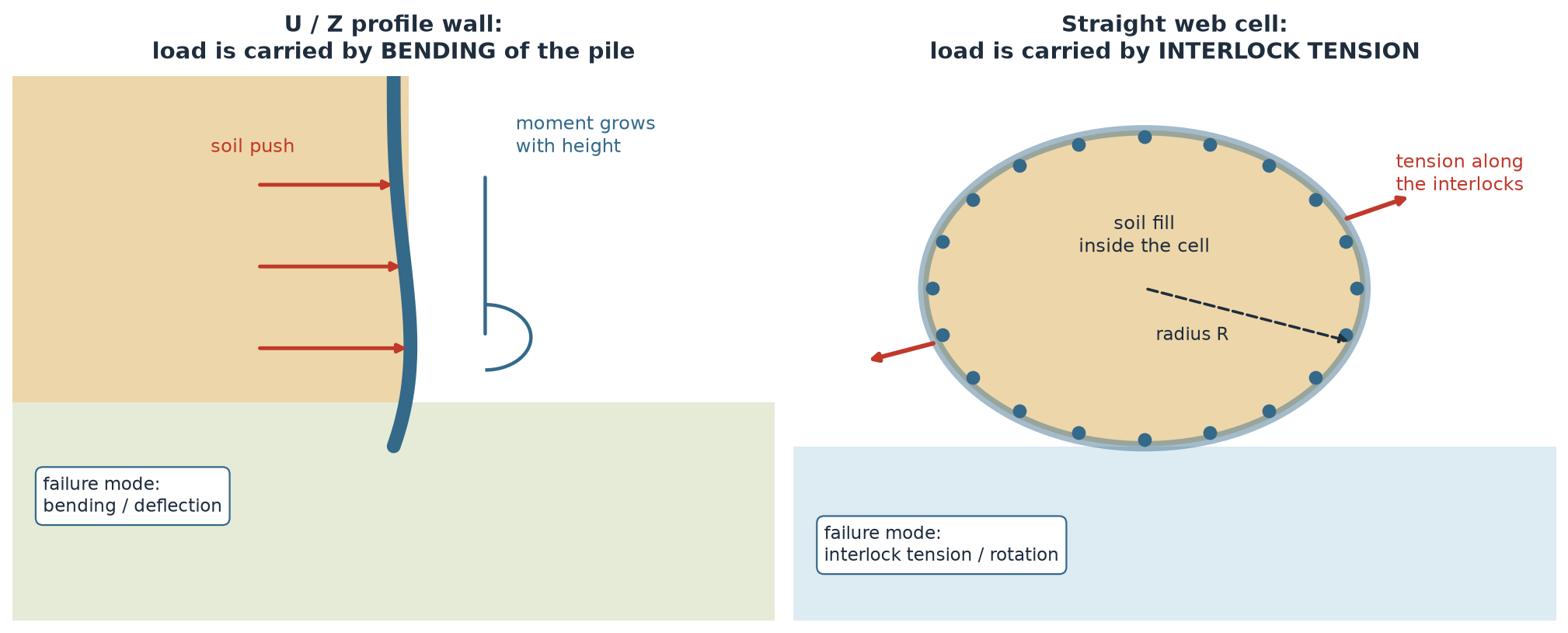
The geometry explains the behavior. A U or Z profile folds the steel into a deep section, so it resists bending the way an I-beam does — this is the mechanism I cover in my article on how to choose steel sheet pile thickness for heavy-duty retaining applications. A straight web pile has none of that depth. Its flanges lie almost flat, its webs are shallow, and its bending resistance is small. What it does have is a very strong interlock. In a straight web system, the load does not try to bend the pile. The load tries to pull the interlocks apart, and the interlock is engineered to resist exactly that pull. Engineers call this membrane action, and it is the same principle that makes a balloon strong: the skin works in tension, the shape does the rest. This is also why the interlock itself matters more than in any other profile — the connection types and tolerances I describe in my article on steel sheet pile interlock types and their performance advantages become the real “section property” of the wall.
How the Load Path Changes the Whole Design
In a bending wall, the pile fights the soil moment alone, and wall height drives the demand — I explain that relationship in how sheet pile wall height affects section selection and structural design. In a cell, the pile wraps a drum of soil, and the soil inside the drum does the resisting. The pile only has to stay in tension and hold its shape. That is a completely different design problem, and it is why comparing the two profiles by section modulus alone is a mistake.
| Property | U / Z Profile | Straight Web Profile |
|---|---|---|
| Load mechanism | Bending of the pile | Tension in interlocks |
| Section modulus | High to very high | Very low |
| Typical wall form | Vertical wall, cantilever or anchored | Circular cells, diaphragm cells, flat gravity walls |
| Soil inside the wall | Not structural | Part of the structure |
| Failure mode to check | Bending, deflection, toe stability | Interlock tension, cell rotation, sliding |
| Where it loses | Deep water, big cells | High moment, narrow vertical cuts |
Which Projects Actually Need Straight Web Sections?
Most straight web orders I ship fall into four families of structures. If your project is not in one of them, you are probably in U or Z territory.
Straight web piles are specified for circular and diaphragm cellular bulkheads, large cofferdams in deep or open water, breakwater and mole cores, tie-back anchor walls, and temporary closure dams — structures where tension, not bending, is the governing load.
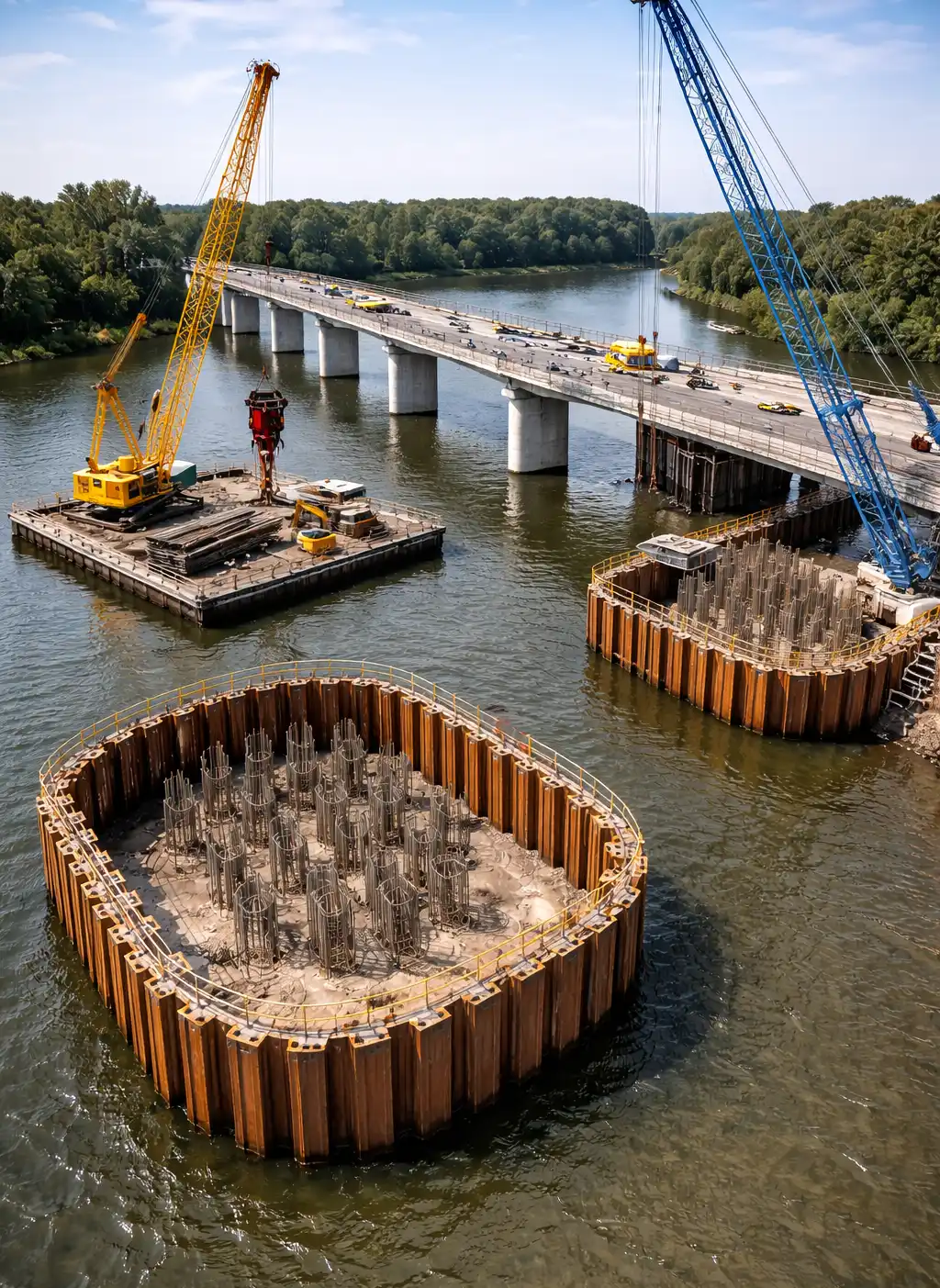
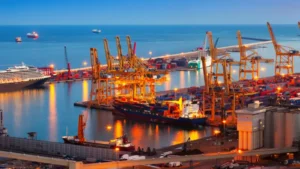
The first and most famous family is the circular cell bulkhead, the classic structure you see at large quay berths. Each cell is a big steel drum made of straight web piles, filled with dredged sand or gravel. Adjacent cells connect through arcs of smaller radius, and together they form a gravity wall that holds back the fill behind the berth. The second family is the cellular cofferdam — I supplied straight web piles for river closure cells where contractors dewatered the enclosed area to build bridge foundations and intake structures, the same application logic I describe in my article on using steel sheet piles for cofferdams and deep excavations. The third family is breakwaters and moles, where a straight web core carries wave loads as tension and protects a rock or concrete crest; this sits naturally inside the harbor structures I describe in my article on marine engineering applications of steel sheet piling systems. The fourth family is anchor walls — a flat run of straight web piles buried behind the main wall, connected by tie rods, pulling back against the active soil wedge.
Why Cells Beat Bending Walls in Deep Water
There is a simple economic reason behind these choices. A bending wall gets exponentially more expensive as water depth grows, because the moment grows with height. A cell does not care much about extra height — the drum just gets taller and holds more soil. On a 15-meter-deep berth, a cellular bulkhead often wins on total steel weight, and it can be built from the water without a separate cofferdam stage. That is why so many of the large harbor expansions I ship to in the Gulf use cells.
| Structure Family | Why Straight Web Wins | Typical Location |
|---|---|---|
| Circular cell bulkhead | Tension design, fast from water | Port berths, wharves |
| Cellular cofferdam | Big enclosed area, reusable | River works, bridge piers |
| Breakwater core | Tension under wave load | Harbor entrances, moles |
| Anchor wall | Flat buried tension tie | Behind anchored walls |
A note on cell shapes, because buyers often ask why the arcs exist. A circular cell is the most common form because a circle holds tension evenly — every pile around the ring carries the same pull, and construction can proceed cell by cell. A diaphragm cell uses straight front walls connected by two arcs, and it covers more area per ton of steel, which helps when the berth line is long and straight. The trade-off is more interlock length and more complex staging. On my side, the choice rarely changes the pile profile itself; it changes the lengths, the arcs, and the quantity mix. That is one more reason I ask for the cell drawings instead of guessing from a wall length alone: two projects with identical frontage can need very different tonnage depending on the cell layout the engineer chose.
What Are the Design Limits I Check Before Specifying Straight Web Piles?
The flat profile is powerful, but it has hard limits. Three checks decide whether it is feasible on your site, and I run through all of them before quoting.
Check interlock tension capacity against cell radius, check driving conditions because straight web piles are thin, and check the waterproofing plan — straight web interlocks need sealing in dewatered cofferdams, and cell walls are not stiff against local impacts.
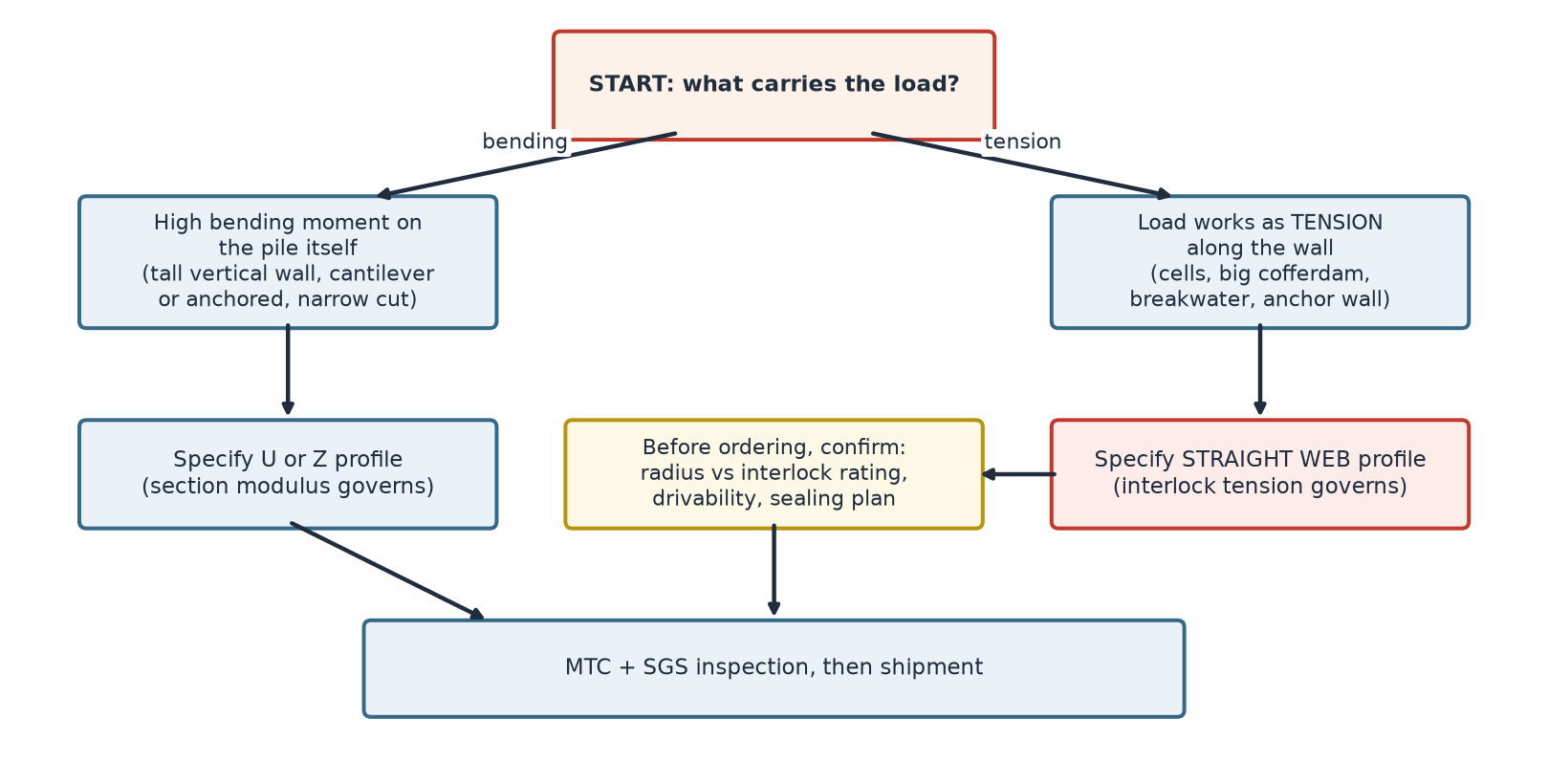
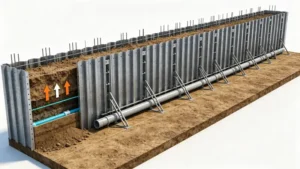
The first check is interlock tension. Every cell has a radius, and the tension in the interlock grows with that radius and with the fill pressure. The pile datasheet gives a maximum interlock strength, and the cell geometry must stay inside it. This is the number that governs the design, not the section modulus. The second check is drivability. Straight web piles are lighter and thinner than heavy U or Z sections, so they drive fast in soft and medium soils, but they are less forgiving in gravel, boulders, or dense sand. I always pair them with the right hammers and leads — the equipment logic in my article on steel sheet pile driving equipment and machinery overview applies directly, and the method comparison in steel sheet pile installation methods vibratory vs impact driving tells you which system to plan for. The third check is water control. A circular cell holds water in its fill; if the works inside the cell must be dewatered, the interlocks need sealing, the same way I describe in my article on waterproof performance of interlocked steel sheet piles. And one more limitation worth saying out loud: a flat straight web wall on its own has almost no bending capacity. If someone on the project proposes a simple vertical straight web retaining wall without cells, curvature, or anchors, I push back — the correct bending solutions for those cases are the cantilever and anchored walls I compare in what is the difference between cantilever and anchored steel sheet pile walls.
Field Problems That Show Up When Limits Are Ignored
I have seen the same two failures repeat when these checks are skipped. First, an oversized cell radius pushed the interlock tension past the pile rating, and the interlocks started to open during filling — caught early by monitoring, expensive to fix. Second, a crew drove straight web piles into a gravel layer with an underpowered hammer, the toes folded, and the seal failed. Both problems are cheap to avoid at design time and costly to fix in the water.
| Check | What I Verify | Red Flag |
|---|---|---|
| Interlock tension | Cell radius vs pile rating | Radius grown past datasheet limit |
| Drivability | Soil report vs hammer choice | Gravel or boulders in driving path |
| Sealing | Dewatering plan vs interlock type | Unsealed interlocks in a dewatered cell |
| Load type | Tension vs bending demand | Flat wall asked to resist bending |
One more thing I check, and it is not in any datasheet: monitoring. Cell walls talk to you during filling. If the survey crew watches the cell shape while fill goes in, an expanding radius or an opening interlock shows up as a movement trend long before it becomes a failure. I encourage every cellular project to budget for simple survey points on the cells and a fill sequence that lets each cell settle before its neighbors are loaded. It costs almost nothing on a project of this size, and it is the cheapest insurance I know for this structure family. The same habit of watching wall movement applies to conventional walls too — deflection monitoring is standard practice on urban excavations, and on cells it is even more informative because the whole structure responds together.
How Do I Confirm the Right Section Before Ordering Straight Web Piles?
Once the structure type is settled, ordering becomes straightforward — but there are five confirmations I always close with the buyer before we cut steel.
Confirm profile family and interlock type, steel grade and corrosion allowance, cell geometry against interlock tension, driving equipment against the soil report, and inspection scope — SGS or third-party checks before shipment for every wholesale order.
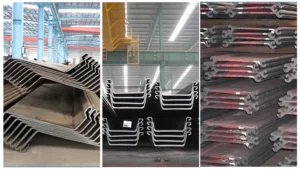
First, the profile family itself. Straight web piles come in several depth classes, and the deeper the web, the larger the allowable interlock tension and the easier the driving. I ask for the cell drawings early, because radius and fill height let me match the depth class in one pass. Second, the steel grade and the corrosion budget. Marine cells live in the splash zone, so grade choice and coating or sacrificial allowance follow the same service-life logic as any marine structure, and steel cost sensitivity is worth checking against my article on cost factors influencing steel sheet pile projects. Third, quantity. Cells consume piles in both the main circle and the connecting arcs, and the takeoff logic in my article on how to calculate steel sheet pile quantity from project drawings maps onto cell geometry cleanly once the radius is fixed. Fourth, the driving plan — hammer energy, leads, and staging from water or land. Fifth, inspection. Because we work wholesale with contractors and distributors, every straight web order ships with mill test certificates, and our customers in the Gulf, Pakistan, and Australia routinely add SGS inspection at the factory before loading. When all five confirmations are closed, the order runs without surprises: production, inspection, container loading, and delivery from Liaocheng on the agreed schedule.
What I Send With Every Straight Web Quotation
With each quotation I send the profile datasheet, the interlock tension rating, suggested hammer matching, and the packaging plan for the pile lengths involved. Long cell piles ship flat-rack or bulk depending on length, and confirming that logistics detail early avoids the classic port-side delay. None of this is complicated. It is just the checklist that separates a smooth cellular project from a stressful one.
A final point about reuse, because it changes the money math on temporary works. Cellular cofferdams for river closure or bridge works are classic temporary structures, and straight web piles recover well: the piles pull out with the right extraction equipment, the interlocks stay serviceable if driving and extraction were controlled, and the steel goes back into stock for the next cell. I have handled repeat orders where the same contractor rebuilt cells across several seasons, and the per-use cost of the steel ended up far below any cast-in-place alternative. If your project is temporary, tell me early — it affects which depth class and interlock condition make sense, and it changes what we inspect at the factory and how we pack for a return trip.
| Confirmation | What I Need From You | What I Provide |
|---|---|---|
| Profile family | Cell drawings, radius, fill height | Depth class match, datasheet |
| Grade and corrosion | Design life, splash zone exposure | Grade options, allowance advice |
| Quantity | Geometry takeoff | Weight summary, packing list |
| Driving plan | Soil report | Hammer matching guidance |
| Inspection | Third-party requirements | MTC, SGS support before loading |
My Take
After years of shipping this profile, my honest view is simple: straight web piles are not a niche product, they are a different way of thinking. Buyers who force them into bending roles get disappointment. Buyers who respect the membrane principle get some of the cheapest big-water structures in the industry. Ask for the cell geometry early, check the interlock tension, and the flat pile will do the rest.
Conclusion
Specify straight web sheet piles when tension, not bending, carries the load. Match the interlock to the cell, respect the soil, and the flat profile outperforms its looks.