What Should Project Owners Ask Before Approving a Steel Sheet Pile Supplier?
Approving the wrong steel sheet pile supplier can cost you months of delay and a wall that fails inspection. Here are the questions I ask before I sign.
Before approving a supplier, project owners should ask about steel sheet pile production capacity and backlog, quality certifications and mill test certificates, export packaging and shipping experience, traceability from heat number to delivery, and how the supplier handles claims after arrival. I put these into a five-part audit before I approve anyone.
When I review suppliers for owners and EPC contractors, I keep seeing the same pattern: the quotation looks perfect, the samples pass, and then the first shipment arrives late, short, or with paperwork that the consultant rejects. The problem almost never shows up in the price. It shows up in the questions nobody asked at approval stage. In this article I walk through the exact questions I ask — the same list I use when our own customers audit us at cnsteelplant.com — so you can approve a supplier with evidence instead of hope.
Why Does Supplier Approval Matter More Than the Quotation?
A quotation tells you what a supplier promises for one order. Approval decides whether that promise survives contact with your project schedule, your consultant’s review, and your port of discharge. I treat approval as a risk decision, not a purchasing formality.
Approval is where you convert a price into a supply chain. If the supplier cannot document capacity, quality control, and export experience during approval, every later stage — production, inspection, shipment — inherits that uncertainty. I never approve on samples alone.
The stakes are asymmetric. A 5% saving on the mill price disappears if one vessel slips by six weeks and your dewatering system keeps running. A rejected mill test certificate can freeze the whole material submittal while your excavation stands open. I have watched contractors pay demurrage because a supplier could not produce a corrected certificate in time. That is why I ask questions before approval that seem slow at the time and cheap afterwards.
The Questions That Separate Vendors From Partners
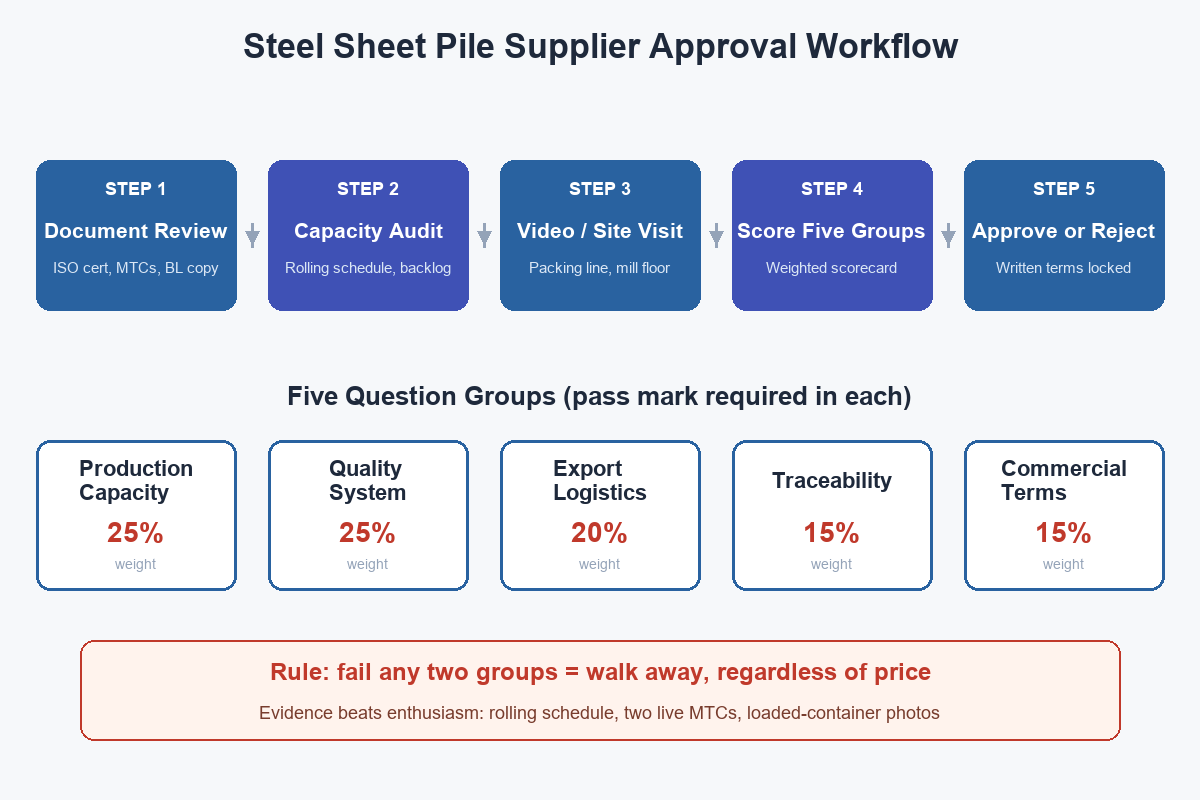
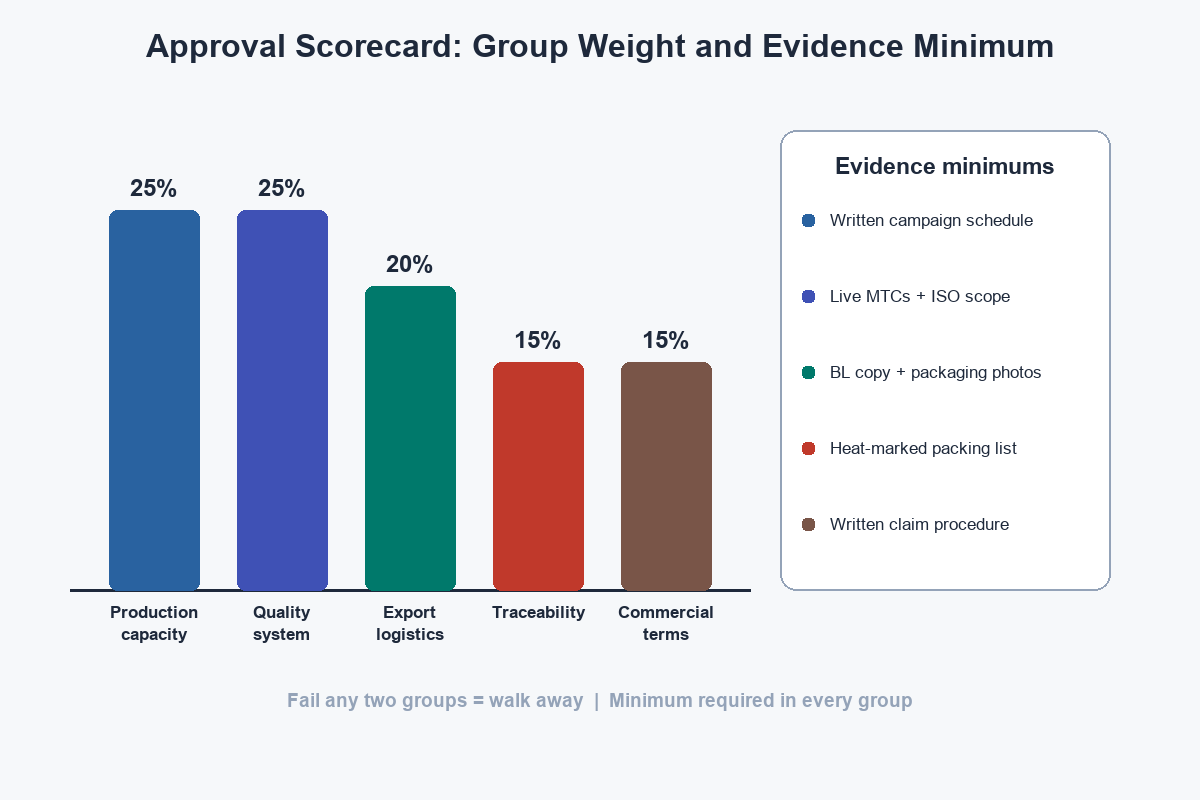
I split my approval questions into five groups: production capacity, quality system, export logistics, traceability, and commercial terms. Each group has a pass mark. If a supplier fails two groups, I walk away no matter how attractive the price is, because a failed group at approval time predictably becomes a failed shipment later. The table below summarizes the groups and the single question I weight most heavily in each.
| Question Group | Key Question | Evidence I Require |
|---|---|---|
| Production capacity | Monthly output vs my order volume? | Rolling schedule, current backlog |
| Quality system | Certified to ISO 9001 with in-house testing? | Valid certificates, MTC samples |
| Export logistics | Experience with my destination market? | Past BL copies, packaging photos |
| Traceability | Heat numbers stamped and documented? | Sample MTC, marking procedure |
| Commercial terms | Who owns risk after shipment? | Written claim procedure |
Asking these five groups takes me about two hours on a call plus a document review. Skipping them has cost people I know far more than that.
What Should I Ask About Production Capacity and Lead Time?
Capacity questions are the first group, and they are the ones suppliers dodge most politely. I ask them anyway, because the answer determines whether your piles are rolled to your schedule or squeezed between two bigger orders.
Ask for monthly rolling capacity for your specific sections, the current order backlog in weeks, and whether your profile will be produced continuously or in two campaigns. I also ask which mill actually rolls the sections, because trading companies often outsource quietly — a risk I explain in more detail when describing how steel sheet piles are manufactured.
The details matter more than the headline number. A factory may claim 10,000 tonnes per month, but if your order needs a cold-formed Omega section that runs on one line shared with three other projects, your real lead time is that line’s queue, not the factory’s brochure. I always ask for the production plan of the specific section, in writing, with a campaign start date and a rolling completion date. If your project runs in phases, this is also the moment to align the mill plan with your own delivery waves, the way I describe in planning split shipments for multi-phase projects. Then I ask what happens if the preceding order slips — does my campaign move, or does it hold? A supplier who can answer that honestly is worth approving; one who promises “no problem” is not.
I also verify which entity owns the mill. Some exporters present themselves as manufacturers and then buy from whoever is cheapest that month. That is not always bad — a good trader with two audited mills can be fine — but you deserve to know which model you are buying, because it changes where your inspection visit goes and whose mill test certificate you receive. When a customer asks us at cnsteelplant.com, I show them the rolling schedule directly rather than a sales deck, and that transparency is exactly what I look for elsewhere.
| Capacity Item | What I Ask | Red Flag Answer |
|---|---|---|
| Monthly output | Tonnage for my exact section? | Factory-wide number only |
| Backlog | Weeks until my campaign starts? | “We start immediately” |
| Mill ownership | Do you roll in-house? | Vague, or “depending on price” |
| Contingency | If the prior order slips? | No written answer |
If you want the deeper version of this audit, I wrote a full walkthrough of how to evaluate supplier production capacity for large infrastructure orders that pairs well with this section.
Which Quality and Certification Questions Must I Ask?
The second group covers the quality system, and here my questions aim at documents more than promises. Certificates expire, laboratories vary, and a stamped ISO number means nothing if the mill cannot show you live records behind it.
Ask whether the mill is ISO 9001 certified and who audits it, whether mechanical and chemical tests are done in-house or subcontracted, and request two mill test certificates from recent shipments — not blank templates. I read those MTCs line by line.
When I review MTCs, I look for three things. First, do the heat numbers on the certificate match the stamping procedure the supplier describes? Second, are the mechanical values comfortably inside the standard — a yield strength that only barely passes tells me the mill runs close to the line, and variability will find you eventually. Third, is the chemical composition complete, including carbon equivalent for weldability where your design needs it? A certificate missing fields is not a small omission; it is a preview of the paperwork fights you will have with your consultant.
I also ask who inspects the piles before shipment. If the answer is “our own QC team,” I ask whether third-party inspection — SGS or similar — is offered on request, and what it costs. For government and donor-funded projects the answer is usually mandatory anyway, so a supplier unfamiliar with third-party witness procedures will slow your submittal down. Our own practice is SGS-arranged inspection on every export order that requires it, and I expect the same fluency from anyone I approve. For the underlying requirements, I rely on the same references I used when studying quality standards and inspection for steel sheet piles.
| Quality Item | Document I Request | What I Verify |
|---|---|---|
| ISO 9001 scope | Certificate with mill name | Scope covers sheet piles |
| MTC realism | Two recent shipment MTCs | Heat numbers, margins on values |
| Testing location | Lab accreditation or in-house scope | Chemical + mechanical in scope |
| Third-party inspection | Past SGS/BV reports | Witness procedure fluency |
What Export and Logistics Experience Should I Verify?
The third group is where experienced buyers of Chinese steel actually earn their keep. A mill can roll perfect piles and still ruin your project with bad packaging, wrong container choice, or documents that stall customs at your port.
Ask how many shipments the supplier has sent to your region in the last year, request one bill of lading copy, and ask for photographs of their standard export packaging. Then ask who prepares the certificate of origin and how they handle pre-shipment inspection appointments.
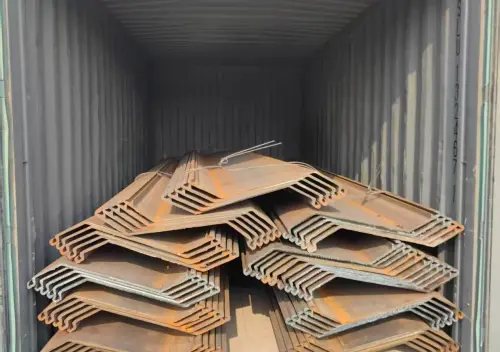
Packaging deserves its own questions because it is where steel gets damaged; the full checklist lives in my article on packaging, loading and transportation. I ask whether bundles are secured with steel strapping and timber dunnage, whether interlocks are protected, and how lifting points are marked. I once received a claim file where piles shifted in transit because bundles were strapped for a short domestic haul, not a thirty-day ocean voyage; the supplier had never been asked, so nobody had changed the practice. Photographs of recent loaded containers tell me more than any packaging specification sheet.
Documents are the other half. Ask who issues the commercial invoice, packing list, and certificate of origin, and whether they have shipped under the Incoterms rule your contract will use — CIF to a Middle East port is a different exercise from FOB. Ask about experience with your destination’s specific requirements; for example, Iraqi and Saudi consignments each carry documentation quirks that a first-time exporter discovers at the worst possible moment. If your contract involves bank settlement, confirm they have worked with a bill of lading consigned correctly for letter-of-credit presentation. If you are still shaping the commercial side at this stage, my guide on how to buy steel sheet piles from China covers the contract terms that pair with these questions. A supplier who answers these quickly has shipped to your market before; one who hesitates is learning on your money. I covered the destination-specific side separately in our Middle East procurement guide.
| Logistics Item | Question | Good Evidence |
|---|---|---|
| Market experience | Shipments to my region last year? | BL copies, not claims |
| Packaging | Standard export bundle spec? | Photos of loaded containers |
| Documentation | Who issues CO and packing list? | Sample document set |
| Payment documents | LC or DP experience? | Previous LC presentation |
How Far Must Traceability and After-Sales Support Go?
The fourth and fifth groups close the loop. Traceability protects you when something needs proving later, and the commercial terms decide who pays when reality disagrees with the plan.
Ask whether every bundle carries a heat number linking it to its MTC, and whether that mapping survives to the packing list. Then ask, in writing, what happens if piles arrive damaged, short, or off-tolerance — who inspects, who decides, and how fast.
Traceability sounds like paperwork until the day your consultant holds a shipment because one bundle’s certificate cannot be located. The fix costs nothing at the mill: stamp the heat number on every pile, record bundle-to-heat mapping in the packing list, and keep the mapping retrievable for years. I ask to see a real packing list from a past shipment, with heat numbers visible. If the packing list says only “sheet piles, 240 pieces,” I know their traceability ends at the factory gate, and any dispute later becomes my word against a container’s worth of anonymous steel.
After-sales terms are where negotiations get uncomfortable, which is exactly why they belong at approval, not after a problem. I ask three questions and want written answers. Who performs the joint survey when a claim is raised — the port surveyor, a third party, or photos only? What is the replacement policy for piles outside dimensional tolerance, and who pays freight? What is the response time commitment? Suppliers with export experience have answered these before; they usually have a one-page procedure ready. I also check how claims interact with payment: if the final balance is due before arrival, your leverage depends entirely on the supplier’s written commitments, so I make sure those commitments exist before I approve. This is the same discipline that separates good buyers in quotation comparison — and it is where most of the hidden costs in a steel sheet pile budget hide.
| Closure Item | Written Answer Needed | My Pass Mark |
|---|---|---|
| Heat number marking | Stamping procedure | Every pile, every bundle |
| Claim survey method | Named surveyor or third party | Agreed before shipment |
| Replacement policy | Tolerance breach + freight | In the contract, not email |
| Response time | Hours committed | 48h acknowledgement |
My Take: The Scorecard I Actually Use
If you take one thing from this article, take the structure. I do not approve suppliers by collecting impressions; I score the five question groups and require a minimum in each. Capacity and traceability are the two groups I weight highest, because they are the hardest to fix later. A weak quality system can be patched with third-party inspection; a mill that cannot hold your campaign slot, or piles you cannot trace, cannot be patched by any amount of site goodwill.
My second rule is to weight evidence over enthusiasm. Every supplier says “no problem”; the ones I approve are the ones who send a rolling schedule, two real MTCs, and a loaded-container photo within a day of being asked. Speed of documents is a proxy for the internal discipline you will depend on during production. And my third rule is to visit or video-audit the mill for any order above a few hundred tonnes — fifteen minutes watching the packing line tells me more than a week of email. Owners who skip the audit usually do it to save a week, and then spend a month recovering from the shipment they did not check.
| Scorecard Group | Weight | Minimum to Approve |
|---|---|---|
| Production capacity | 25% | Written campaign schedule |
| Quality system | 25% | Live MTCs + ISO scope |
| Export logistics | 20% | BL copy + packaging photos |
| Traceability | 15% | Heat-marked packing list |
| Commercial terms | 15% | Written claim procedure |
Conclusion
Ask about capacity, quality documents, export experience, traceability, and written claim terms before you approve. Two hours of questions at approval stage is the cheapest insurance your steel sheet pile project will ever buy.