Every week I watch the same scene repeat in our sales inbox: an inquiry arrives with nothing but “steel sheet piles, 500 tons, best price please,” and I know that buyer will receive five quotations that cannot be compared with each other.
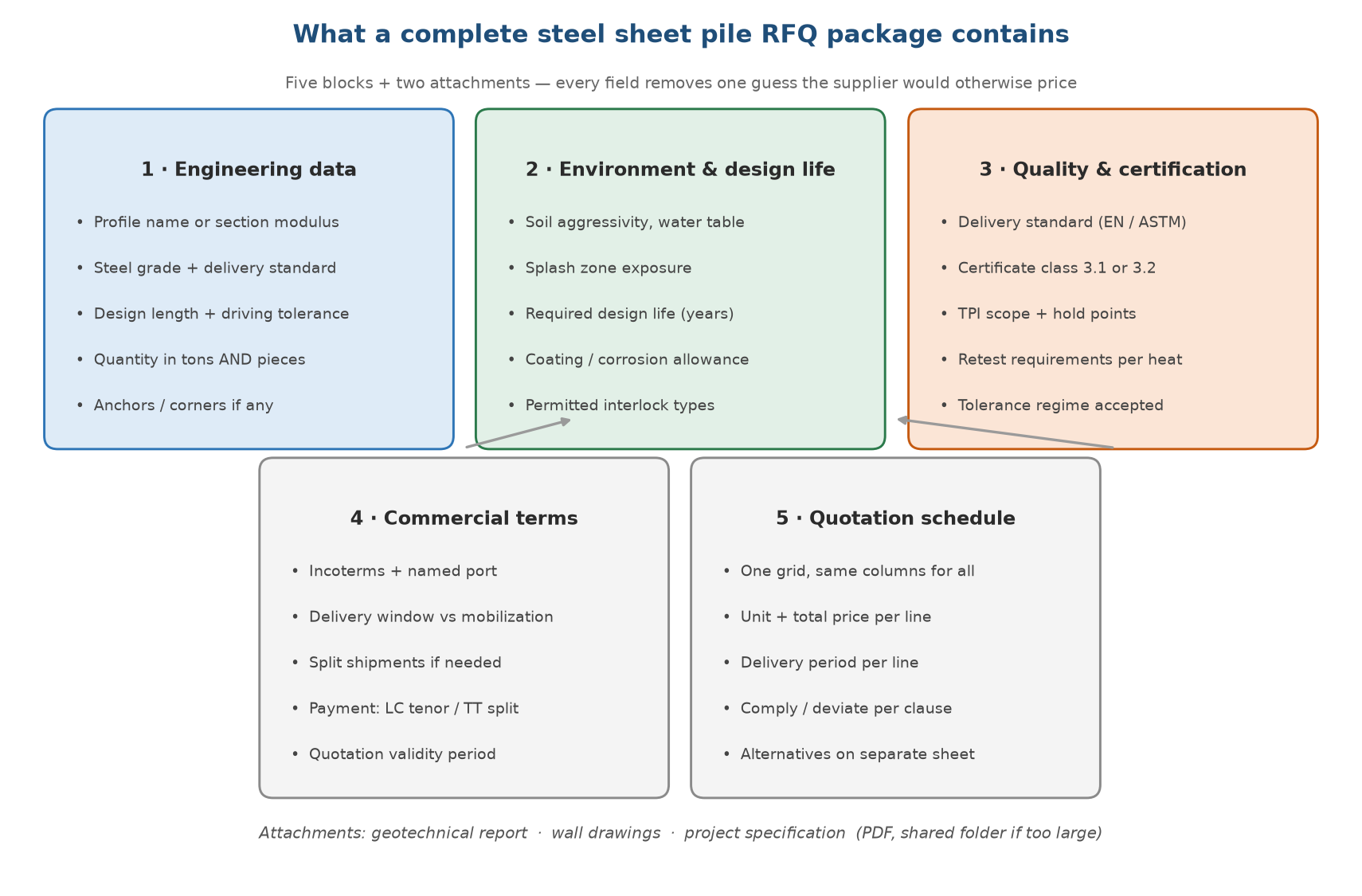
A complete steel sheet pile RFQ states the profile family or required section modulus, steel grade and standard, pile length, quantity with tolerance, corrosion allowance, certification level, delivery schedule and Incoterms — and attaches the soil report and wall drawings so suppliers quote one engineered solution instead of five guesses.
Now that you know what a good RFQ contains, let me walk you through how I help buyers build one piece at a time, drawing on questions our export desk fields from contractors in the Middle East, Australia and Africa.
Why Does an Incomplete RFQ Cost More Than You Expect?
I received an RFQ last quarter from a coastal project in East Africa. It listed one line: “Z sheet piles, 800 tons.” Our team still quoted it, but so did every competitor, and every quotation came back different — one priced an 8 mm hot-rolled section, another a 6 mm cold-formed lookalike, a third added a coating the drawings never asked for. The buyer spent three weeks reconciling numbers that could never align, and the final award went 6% above the price we would have quoted on day one with full information.
The hidden cost is not the paperwork; it is the risk premium. When I cannot see the soil conditions or the retained height, I price conservatively. I add margin for the possibility that the wall is 16 meters instead of 12, that the soil is soft clay instead of dense sand, and that delivery needs to accelerate. Every buyer in that position pays for uncertainty they could have removed for free, because from my side of the table a detailed RFQ signals a professional counterparty who will not change scope after award — and that signal alone tightens the number.
The same logic applies to schedule risk. A project that tells me the piling start date, the tides window and the site access constraints lets me plan mill slots precisely; a vague one forces me to hold stock “just in case,” and holding stock is never free. Our experience with port and harbor protection projects shows this clearly: the buyers with the most detailed first inquiry were consistently the ones who secured mill capacity in peak season without paying rush premiums.
| Cost driver | Vague RFQ effect | Complete RFQ effect |
|---|---|---|
| Section selection | Suppliers guess; quotes differ wildly | One profile family, comparable numbers |
| Risk premium | Hidden margins for unknowns | Engineered, transparent pricing |
| Lead time | Conservative estimates, buffer stock | Mill slot booked to your schedule |
| Award cycle | Weeks of clarification loops | Days from RFQ to firm offer |
What Technical Information Must the RFQ Contain?
If I could only ask for five fields, I would ask for: profile or section modulus, steel grade, length, quantity, and corrosion environment. Those five define the physical product and let any competent supplier check feasibility within an hour.
Profile selection is where the wall’s structural demand meets the catalogue. If your engineer has already selected a section — an AZ 18-700, a PU 22, or an Omega profile — name it and its standard. If not, state the design bending moment or the required section modulus, and let us propose the lightest section that satisfies it; this is the same logic we explain in how to match steel sheet pile grades with project load requirements. For buyers still at the early stage, our overview of standard sizes and profiles is a useful vocabulary check before you write the RFQ.
Steel grade follows the environment. For most soils, a grade under EN 10248 or ASTM A572 is sufficient, and the EN 10248 delivery standard defines what “S 355 GP” actually guarantees in chemistry and yield strength. Marine exposure is different: seawater splash zones demand a grade like the one defined in ASTM A690, and our article on common steel grades walks through that decision. Length matters just as much — driving tolerance, corner piles and the difference between design length and ordered length belong explicitly in the document.

| Field | What to write | Why it matters |
|---|---|---|
| Profile / section modulus | Named section or required Z (cm³/m) | Fixes the structural baseline |
| Grade & standard | e.g. S 355 GP (EN 10248) or ASTM A690 | Ties price to verified mechanicals |
| Length | Design length + driving tolerance | Prevents short-delivery disputes |
| Quantity | Tons and pieces, ±% tolerance | Aligns order with drawdown |
| Environment | Soil aggressivity, splash zone, design life | Drives grade, thickness, coating |
Which Project Documents Should You Attach?
A complete RFQ travels with three attachments: the geotechnical report, the wall drawings, and the project specification. Without them I am quoting a wall I have never seen.
The geotechnical report is the single most valuable attachment. When I read borehole logs myself — the way I describe in our soil investigation report guide — I can propose an embedment depth instead of copying your drawing blindly, and sometimes I find that 30 centimeters less embedment saves several tons of steel across a large wall. Wall drawings tell me the layout, anchor system, waler positions and any corners or junctions that need special fabrication. The specification closes the gaps: weld requirements, coating systems, permitted interlock types, and the tolerance regime your engineer will accept.
Attach them as PDFs, and strip commercially sensitive pages only if you must — but tell us what you removed. I once quoted a flood-control wall where the buyer withheld the drawings “for confidentiality” and asked suppliers to quote “by ton”; the spread between offers exceeded 20%, purely because each supplier assumed a different length-to-tonnage conversion. If the documents are too large for email, state that a shared folder will follow and name the folder structure. What kills RFQs is not confidentiality; it is silence between the documents you sent and the ones you did not.
| Attachment | Minimum content | Decision it unlocks |
|---|---|---|
| Geotechnical report | Borehole logs, SPT values, water table | Embedment depth, grade, drivability |
| Wall drawings | Layout, sections, anchors, corners | Fabrication scope, corner piles |
| Specification | Tolerances, welding, coatings, testing | Compliance scope and cost |
How Do You Specify Quality and Certification Requirements?
Name the delivery standard, the certificate class, and who inspects. In one sentence: “Hot-rolled sheet piles to EN 10248 S 355 GP, EN 10204 3.1 mill certificates, third-party pre-shipment inspection by SGS or equivalent.” That sentence removes every ambiguity that otherwise surfaces at loading port, when it is too late.
Certificate class matters more on large projects than buyers expect. A 3.1 certificate is issued by the mill’s own authorized inspector and is enough for most walls; a 3.2 certificate adds an independent inspector’s signature and is often mandated by public owners and EPC contractors. When the RFQ is silent, we quote 3.1 — and if the owner later demands 3.2, the difference in cost and time lands squarely on the buyer. Our overview of common certifications for export projects and the guidance in quality standards and inspection for steel sheet piles map out which certificate suits which owner type.
Inspection scope also needs writing down. Do you want visual and dimensional checks only, or tensile and chemical retests on heat numbers? Does your inspector visit the mill before coating, after coating, or at loading? We once supplied a jetty project where the owner’s TPI required witness of interlock tightness tests on every tenth piece — a reasonable request, but one that must be scheduled in production planning, not discovered at final inspection. The ASCE and PIANC technical literature both recommend defining inspection hold points before fabrication starts; the RFQ is where that definition belongs.
| Requirement | Typical option | When to choose it |
|---|---|---|
| Certificate class | EN 10204 3.1 / 3.2 | 3.2 for public owners and EPC |
| Inspection | Mill QC / TPI witness | TPI for export and marine works |
| Retests | Tensile + chemistry per heat | Critical or seismic applications |
| Surface | Blasted + coated / bare | Per design life and environment |
What Commercial Terms Belong in the RFQ?
State Incoterms, delivery window, shipment staging and payment structure explicitly — the commercial half of the RFQ moves the price as much as the technical half. A buyer who says “CFR Jubail, first 400 tons within 8 weeks, balance in two monthly tranches” will get a sharper number than one who says “deliver to Saudi Arabia.”
Incoterms decide whose freight, insurance and customs scope is inside the price, so name the rule and the port — and be consistent between the RFQ text and the quote schedule. The delivery window should be anchored to your mobilization date, not to a calendar month, because mills schedule production around driving seasons and tidal windows. If the site is remote or storage is limited, ask for split shipments explicitly; our notes on MOQ, lead time and customization explain how production slots align with staged deliveries. Payment terms deserve the same precision: letter of credit with what tenor and confirming bank, or telegraphic transfer with which percentage at order, at shipment and after installation?
Do not forget packaging and marking. Bundled with steel strapping, interlock protected, each bundle tagged with heat number and profile — these details cost the mill almost nothing when stated early, but rework at the port when stated late. Buyers planning multi-phase work should ask for split shipments explicitly and align the stages with mobilization dates before finalizing this section of the RFQ.

| Term | What to specify | Common mistake |
|---|---|---|
| Incoterms | Rule + named port (e.g. CFR) | Omitting the named port |
| Delivery | Weeks from PO, tied to mobilization | “As soon as possible” |
| Shipments | Split tonnages and dates | Assuming single delivery |
| Payment | LC tenor / TT milestones | Leaving terms “negotiable” |
| Packaging | Bundling, marking, protection | Silence until loading |
How Do You Structure the RFQ So Quotations Are Comparable?
The trick is to dictate the quotation format: one schedule, one line per item, identical columns for every bidder. When all suppliers fill the same grid, you compare numbers instead of narratives.
I recommend a schedule with fixed columns: profile, grade, standard, length, quantity in tons and pieces, unit price, total price, delivery period, certificate class and validity. Ask bidders to quote no alternatives except in a clearly separated “alternatives” sheet. This structure also disciplines the technical evaluation — your engineer compares section modulus against price directly, which is how value engineering should work. When a Korean contractor adopted this format for a 2,600-ton seawall, they told me their evaluation time dropped from two weeks of spreadsheet archaeology to a single afternoon, because every deviation was visible on one page.
Validity period and price adjustment basis deserve their own lines. Steel prices move; a quotation valid for 30 days with a clearly stated raw-material adjustment mechanism is far safer than an open-ended offer that quietly expires. Finally, ask each bidder to confirm compliance item by item — “comply / deviate” against every RFQ clause — so that deviations surface at evaluation, not after award. If your project uses an anchored wall system, also ask suppliers to state what anchor hardware they can supply, since that scope affects the total installed cost as much as the piles themselves; the sizing side of that question is covered in our tieback load guide.
| Column | Purpose |
|---|---|
| Profile / grade / standard | Technical alignment |
| Length / qty (t & pcs) | Logistics alignment |
| Unit & total price | Commercial comparison |
| Delivery period | Schedule comparison |
| Certificates / deviations | Compliance visibility |
What Should You Do After Sending the RFQ?
Send it, then manage the clarification window deliberately — the two weeks after issue are where good RFQs either become clean awards or dissolve into chaos. I tell buyers to set a fixed Q&A deadline, publish all answers to all bidders, and hold a single technical clarification call rather than answering emails one by one.
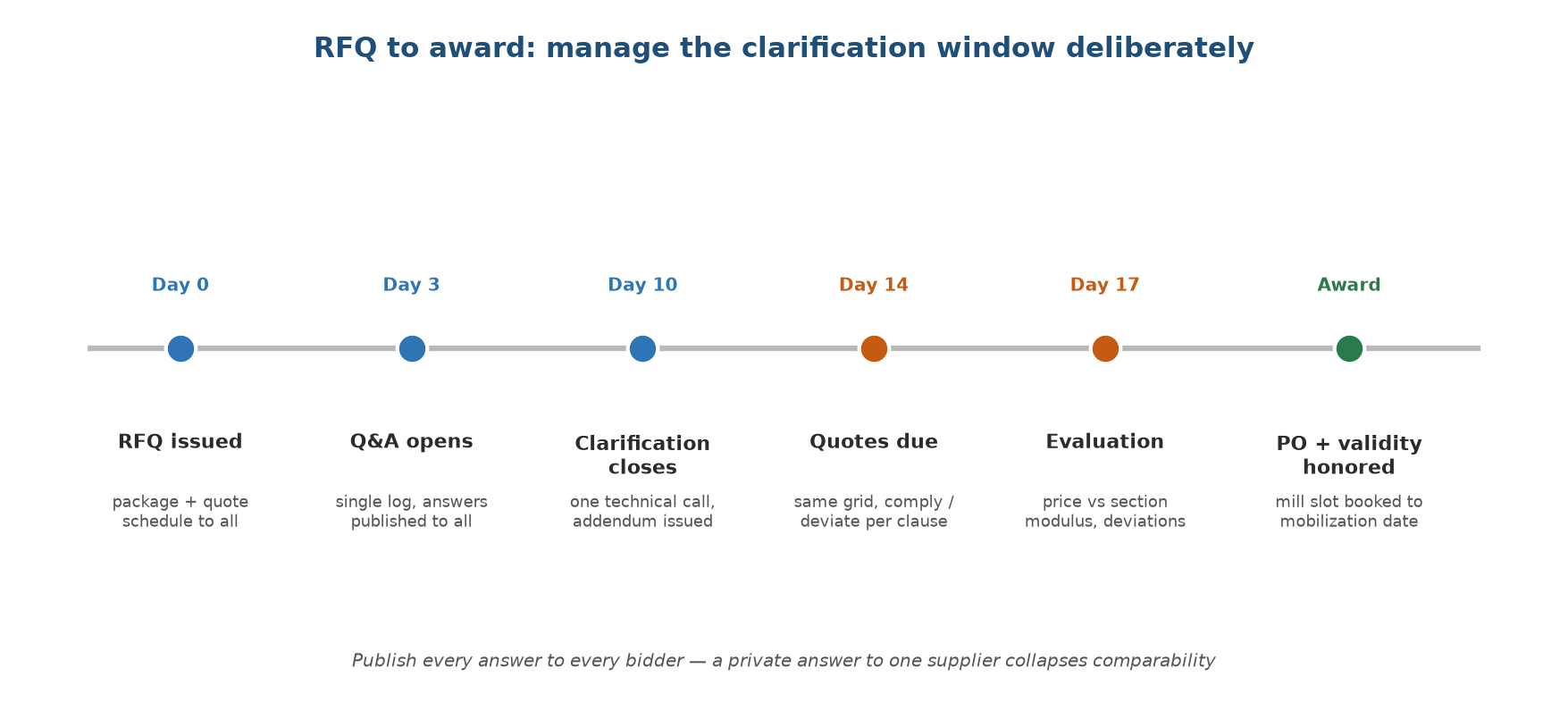
Publishing answers keeps the field level. If one supplier learns the water table is at 1.5 meters and others do not, your “comparable” quotations collapse again. A shared clarification log — question, answer, date — attached to every addendum costs you an afternoon and buys you an audit trail your commercial team will thank you for during evaluation. During that window, invite shortlisted bidders to visit or video-call the mill; seeing the production line answers questions no document can, and it is exactly how we run supplier evaluations for large infrastructure orders.
Finally, close the loop in writing. Award or no award, confirm receipt, state your timeline and thank the bidders. Markets are smaller than they look — the contractor who lost this project remembers how you handled the process when your next RFQ arrives, and from our side, buyers who close loops cleanly always move to the front of the queue when mill capacity tightens.
Conclusion
A complete RFQ replaces guesswork with comparability: state the engineering facts, attach the documents, dictate the quotation schedule — and let competition reward you.