Every quarter I receive a handful of RFQs that begin with a sentence like “500 tonnes of steel sheet piles, please quote” — and nothing else. No soil data, no pile length, no driving method. I understand the impulse: buyers want a number, not homework. But before I can quote responsibly, I always ask for the same document, and the answer to that request tells me more about the buyer than any price negotiation ever will. That document is the geotechnical (soil investigation) report. I have seen a 12-meter pile quote collapse into an 18-meter reality because nobody read the borehole log, and I have seen a buyer save roughly 9 percent on tonnage simply because his engineer noticed a dense sand stratum that allowed a shorter section. Reading the report is not academic. It is money.
In one line: the soil investigation report is the single document that converts “I need sheet piles” into “I need Z-type hot-rolled AZ 18-700, 14.0 m, S355GP, with interlock sealant” — and a buyer who cannot interpret it is negotiating blind.
In this article I will walk you through the report the way I read it myself, page by page, parameter by parameter, and show you exactly which numbers change which purchasing decisions. If you have not yet chosen between profiles, our guide on how to choose the right steel sheet pile profile covers the geometry side; here we deal with the ground side.
Why Does the Soil Report Decide What You Buy?
A steel sheet pile is not a standalone product; it is a soil-retaining instrument. The soil dictates four purchasing variables at once:
– Section modulus — how much bending resistance the wall needs, driven by soil pressures and surcharges. – Length — how deep the wall must embed to find passive resistance below the failure wedge. – Steel grade — driven by both structural demand and ground aggressivity (resistivity, chlorides, pH). – Drivability — whether the section can be installed with a vibratory hammer or needs impact driving, which affects your contractor’s plant list and my mill’s delivery tolerance on interlock friction.
When I quote from a report, I am really solving one equation with four unknowns. If you send me the report, I solve it. If you don’t, I price the worst plausible case, and that premium is always more expensive than the truth. This is also why our article on how to select steel sheet piles based on soil conditions treats the report as the starting point rather than the catalogue.
Which Pages of the Report Should a Buyer Actually Read?
A full investigation report can run to two hundred pages, and most of them are laboratory tables you will never need. As a buyer, I read five things, usually within twenty minutes:
1. The site plan with borehole locations — to check whether the holes actually pass through my wall alignment. 2. The borehole logs — layer by layer descriptions with depths, SPT results, and groundwater readings. 3. The interpreted ground model — the consultant’s simplified layering, which is what the structural designer used. 4. Design parameters per layer — unit weight, friction angle φ, undrained shear strength cu, and modulus values. 5. The chemical aggressivity annex — pH, sulfates, chlorides, resistivity, sometimes redox potential.
Everything else — index tests, mineralogy, repeat calibrations — is the designer’s business, not the buyer’s. I ask my customers to send pages matching those five items, which usually compresses two hundred pages into six. That six-page extract is what I forward to our technical department together with the enquiry, alongside any requirements from our MOQ, lead time and customization guide.
What Do Borehole Logs Tell You About Drivability?
The borehole log is a vertical storyboard of the ground along your wall. When I read one, I am asking three questions in order:
First: where does soft meet stiff? Driving through soft clay or loose fill is easy — the pile almost falls under its own weight. The transition into a dense stratum is where driving stresses peak and where welds break and heads deform. If the log shows fill over dense sand at 4 m, I already know the first 4 meters will drive effortlessly and the pile will refuse suddenly, which is precisely when an inexperienced crew cranks up the hammer and damages the interlocks.
Second: is there cobble, boulder or obstruction risk? Logs describe these honestly: “concrete fragments”, “brick inclusions”, “cobbles at 6.5–7.2 m”. Every mention is a procurement signal — it points toward a heavier section that can survive obstruction strikes, or toward pre-augering, both of which belong in the budget, not in a variation claim.
Third: where is the water table? It changes effective stresses, and therefore the required embedment, by more than most people expect. The log’s standing water level is not decoration; it is a design input I cross-check against the wall’s stability calculations.
How Do SPT N-Values Translate Into Section Choice?
The Standard Penetration Test (SPT, standardized as ASTM D1586) blows a split-spoon sampler into the ground and counts the blows needed to advance 300 mm. The resulting N-value is the coarsest but most universally understood drivability number in the report. Here is the working table I keep beside me when quoting:
| SPT N-value | Ground description | Driving behaviour | Typical implication for the wall |
|---|---|---|---|
| 0–4 | Very loose sand / very soft clay | Pile self-buries; little lateral support | Watch global stability; embedment is governed by toe stability, not refusal |
| 5–10 | Loose / soft | Easy vibro driving | Economical shorter sections viable; check interlock wear |
| 11–30 | Medium dense / firm | Smooth with vibratory hammer in most cases | The comfortable middle; normal tolerances apply |
| 31–50 | Dense / stiff | Vibro possible but slowing; impact driving often more efficient | Heavier section may pay for itself in fewer damaged piles |
| Over 50 | Very dense / hard | Refusal risk; pre-augering or jetting often needed | Budget for impact hammer mobilisation and possible pre-drilling |
Two cautions from hard experience. First, N-values in gravel are unreliable because the spoon meets particles, not soil matrix — I treat inflated gravel N-values with suspicion and lean on the consultant’s commentary instead. Second, N-values in clay measure a different property (undrained strength) than in sand (relative density), so I never compare them directly across strata; the log’s descriptions carry that nuance, and so should your section choice.
What Do Atterberg Limits and Fines Content Warn You About?
For cohesive soils, the laboratory pages add two numbers that matter commercially: the liquid limit (LL) and plasticity index (PI), which classify the clay under the USCS framework of ASTM D2487.
High-plasticity clays (PI above roughly 40) tell me three things. They tend to be softer and stickier, which slows driving slightly through adhesion. They creep against the wall and generate downdrag forces that the designer must include. And most commercially relevant: they often seal interlocks naturally, reducing leakage — which can mean you do not need interlock sealant in a mixed-face wall, a genuine line-item saving.
Low-plasticity silts and fine sands are the opposite warning. They are the classic running-soil risk during excavation, and they turn interlock leakage into a visible washout of fines at the wall face. If the log and gradation curves show a dominance of fine sands and silts below the water table, I recommend factoring leakage control measures and possibly sealed interlocks into the purchase from day one, rather than discovering the issue as a fountain on site.
How Do Groundwater and Chemistry Change the Steel Grade?
The chemical annex is where purchasing meets corrosion engineering. The report’s pH, sulfate, chloride and resistivity values feed directly into the durability model — the same logic we explain in our article on the service life of steel sheet piles.
My working translation is simple. Neutral soils (pH 5.5–8, resistivity above roughly 50 Ω·m, low chlorides) are comfortable with standard grades and a nominal corrosion allowance. Aggressive ground — low resistivity, high chlorides near the coast, acidic industrial fill — pushes me toward one or more of: a higher grade (S355GP or above) to preserve net section over life, a thicker section in the same class, or explicit protection such as coatings or, where the structure justifies it, cathodic protection.
One subtlety buyers miss: the aggressive zone is rarely the whole wall. Often only the fluctuating groundwater band and the soil-air interface matter most. That is why the report’s groundwater readings matter as much as its chemistry numbers — they locate the danger band that the corrosion allowance must survive. For seawater-front structures the picture changes again, as our marine engineering applications article describes.
How Did a Borehole Log Once Save a Project Nine Percent?
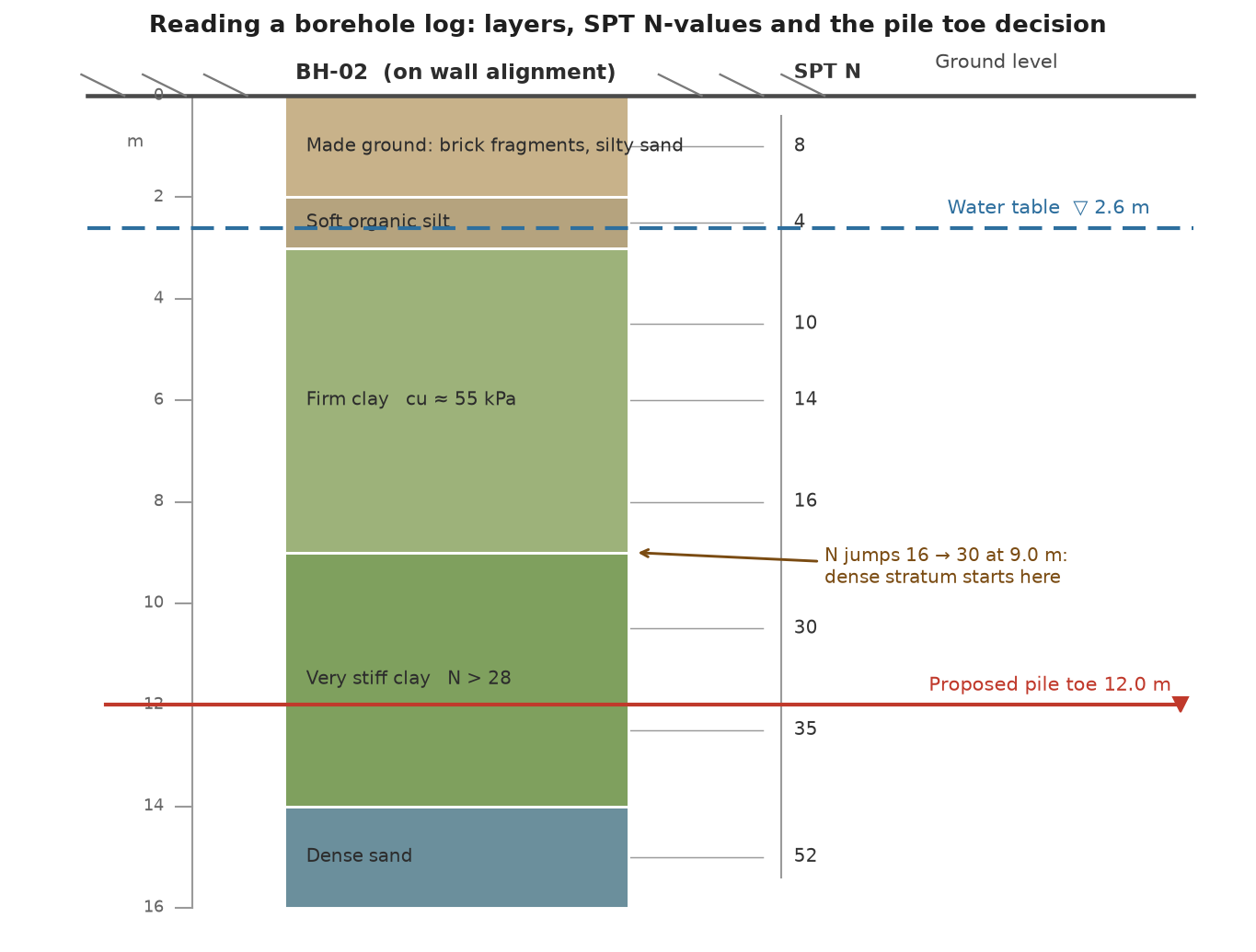
Let me make this concrete with a project I handled in early 2024. A contractor enquired for a 6.0 m deep excavation support in a river-adjacent industrial site and initially asked for 15 m piles, “as the last project used”. His report, which he did send, told a different story: 3 m of soft organic silt, then firm clay from 3 to 9 m (cu around 55 kPa), then very stiff clay below — with the log showing N-values jumping from 6 to 28 at exactly 9.0 m.
Reading that log, our technical desk proposed 12.0 m piles instead of 15 m. The very stiff stratum at 9 m offered dependable passive resistance well below the excavation base after allowing for the softened zone, and the cantilever height above the anchor level was modest. We recalculated, checked toe stability with the reduced embedment, and confirmed the wall with a section modulus comparable to his request. The tonnage saving landed near 9 percent, and installation recorded clean vibro driving with refusal only in the top of the stiff clay — exactly as the log predicted.
The counter-example is just as instructive. Another buyer skipped the report stage entirely, ordered from a competitor on tonnage alone, and discovered cobbles at 5 m that his 9-tonne vibratory hammer could not pass. Pre-augering, hammer re-mobilisation, and a month of delay cost him more than the piles. The report had shown the cobbles clearly on borehole BH-03. Nobody had read page forty.
How Should Report Data Appear in Your RFQ?
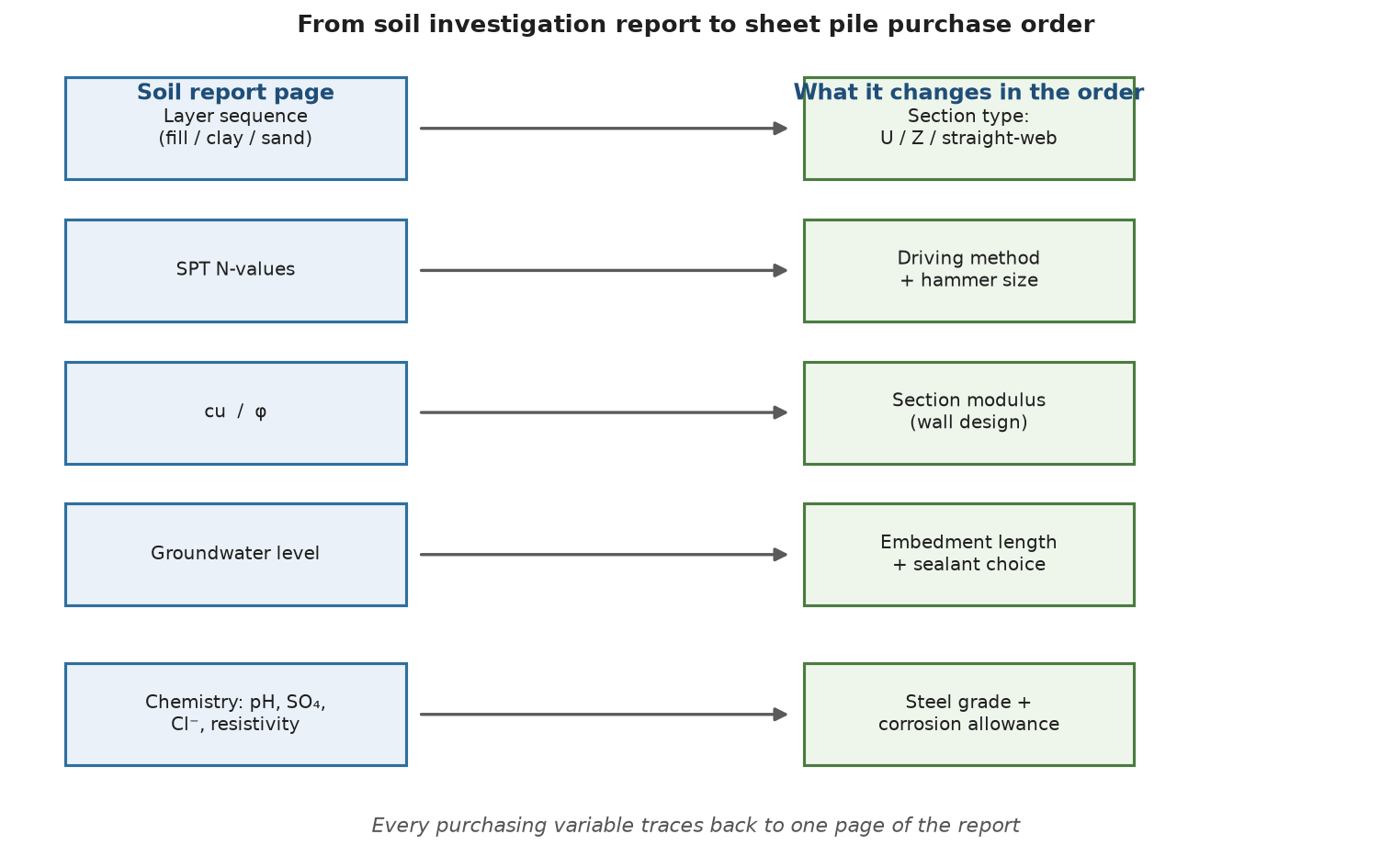
Once you know how to read the report, the final step is converting it into procurement language. This is the table I wish every enquiry arrived with:
| Report parameter | Value to extract | What it changes in the order |
|---|---|---|
| Soil description per layer | Fill / clay / silt / sand / gravel sequence | Section type (U vs Z vs straight-web) and drivability planning |
| SPT N-values with depth | Peak and average over embedment zone | Driving method, hammer size, spare pile allowance |
| Shear strength (cu) / friction angle (φ) | Per relevant layer | Section modulus and length via wall design |
| Groundwater level | Standing and seasonal high | Embedment, corrosion band location, sealant choice |
| Chemistry (pH, SO₄, Cl⁻, resistivity) | From chemical annex | Steel grade, corrosion allowance, coating decision |
| Obstructions / cobbles | Any log mention with depth | Pre-augering budget, heavier section, programme buffer |
A structured RFQ built on this table lets the supplier’s technical desk quote a solution rather than a guess, and it makes competing quotations genuinely comparable — the same discipline we recommend in how to buy steel sheet piles from China. If your project involves anchoring, the report data also feeds directly into load calculations, as explained in our tieback load guide.

What Is the Practical Checklist Before You Sign the Order?
Let me close with the five-minute check I perform on every enquiry’s report:
– Do the boreholes actually lie on (or very near) the wall alignment? If not, ask why before trusting the ground model. – Is the deepest boring deeper than the proposed pile toe? A borehole that stops above the toe proves nothing about refusal. – Are N-values consistent with the written descriptions? “Firm clay, N = 45” is a red flag for a clerical or sampling error. – Is the groundwater level seasonal-high or measured-on-the-day? Walls fail in the wet season, not the average one. – Does the chemical annex exist at all? If it is missing, assume moderately aggressive ground and price the allowance accordingly.
A soil investigation report is not an attachment to the tender; it is the tender’s most honest page. Read it the way the ground wrote it — layer by layer, number by number — and it will pay you back in shorter piles, smoother driving, and quotes that hold up on site. When in doubt, send me the six pages that matter, and we will read them together.