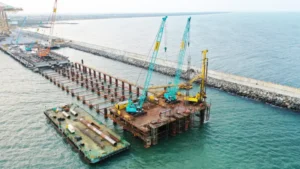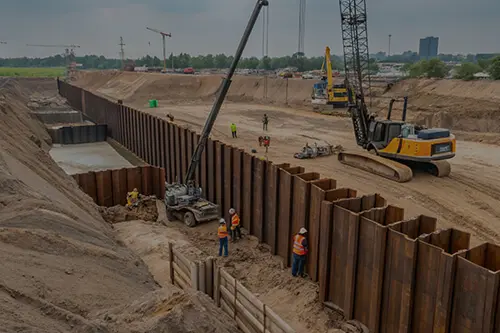
Tight city sites punish every extra meter of excavation. Neighbors stand meters away, schedules shrink, and the wrong support system can stop your project before it starts.
Steel sheet piles are ideal for confined construction sites because the wall rises vertically on the excavation line. They need almost no extra working space, install quickly with compact equipment, and shield neighboring structures far better than slopes or spread systems.
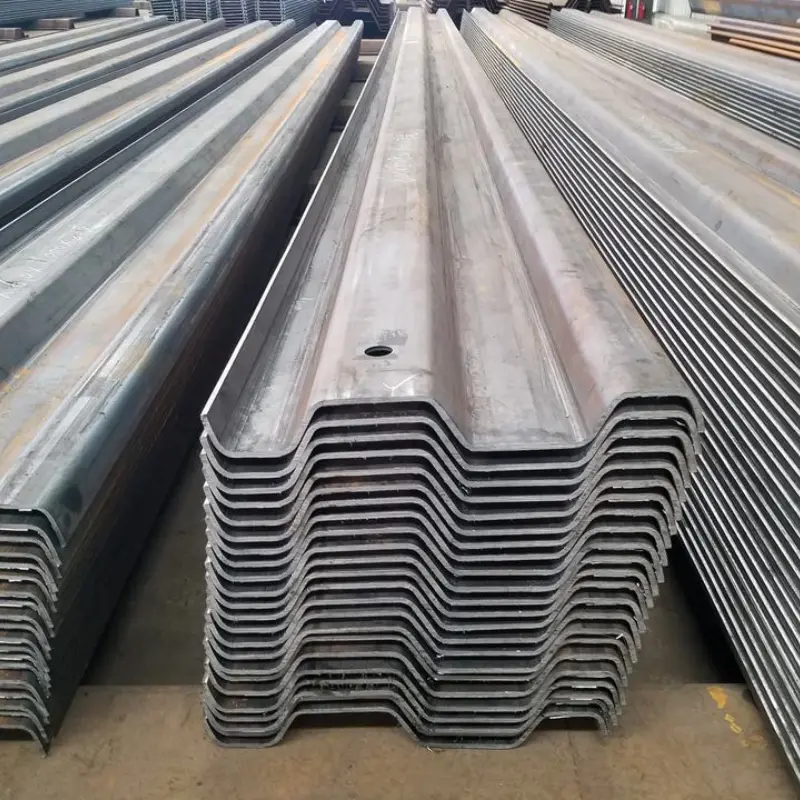
I have supplied steel sheet piles to contractors in the Middle East, Australia, and Africa for years, and many of their hardest projects were not the deepest ones. They were the tightest ones. A basement between two live buildings, a pipeline trench under a busy road, a pump station squeezed behind an existing plant. In this article I will explain, the way I explain it to my customers, why sheet piles keep winning these jobs.
What Counts as a Confined Construction Site?
Not every small site is a confined site. If you use the wrong definition, you will price the wrong system and lose either money or the contract.
A confined construction site is any job where the excavation cannot spread outward: buildings, roads, railways, or property lines sit close to the dig line, and every meter of working room must be borrowed rather than taken.
The Four Signs I Look for on a Site Visit
When a customer sends me drawings, I look past the pit itself. The first sign is the distance to the property line or neighboring foundation. If a sloped earthworks solution would reach that line, the site is confined no matter how open it looks on the plan.
The second sign is overhead and underground congestion. Power lines, fiber ducts, water mains, and old foundations all shrink the zone where a crane or a rig can swing. The third sign is public exposure. A trench beside an operating road cannot afford open slopes, stockpiles, or long periods of unsupported ground. The fourth sign is access: narrow gates, weak slab strength, or tight turning radii that rule out large rigs. My article on key considerations before installing steel sheet piles covers how I score these before recommending a system.
| Sign of a confined site | Why it matters |
|---|---|
| Close property lines or foundations | Sloped excavation would encroach on third parties |
| Overhead lines and buried utilities | Large rigs and wide plant cannot operate |
| Working next to live roads or railways | The excavation must be supported at all times |
| Narrow gates and weak access slabs | Equipment weight and size are limited |
The table above is the checklist I carry to every site visit. If two or more signs appear, I already know the answer will be a vertical wall, and in most cases that means sheet piles. Contractors who recognize this at tender stage price realistically; the ones who discover it after mobilization pay for crane moves, temporary roads, and redesign.
One more point from experience: confined does not mean small. I have supplied 800-ton wall packages for a single city block, and I have supplied 40 piles for a valve chamber behind a factory. The geometry of the problem is the same. What changes is how carefully you stage the work, and that is exactly where sheet piles give you options that other systems do not.
How Much Working Space Do Steel Sheet Piles Save?
Space is the whole argument. If a support system eats your site, it does not matter how strong or cheap it is on paper.
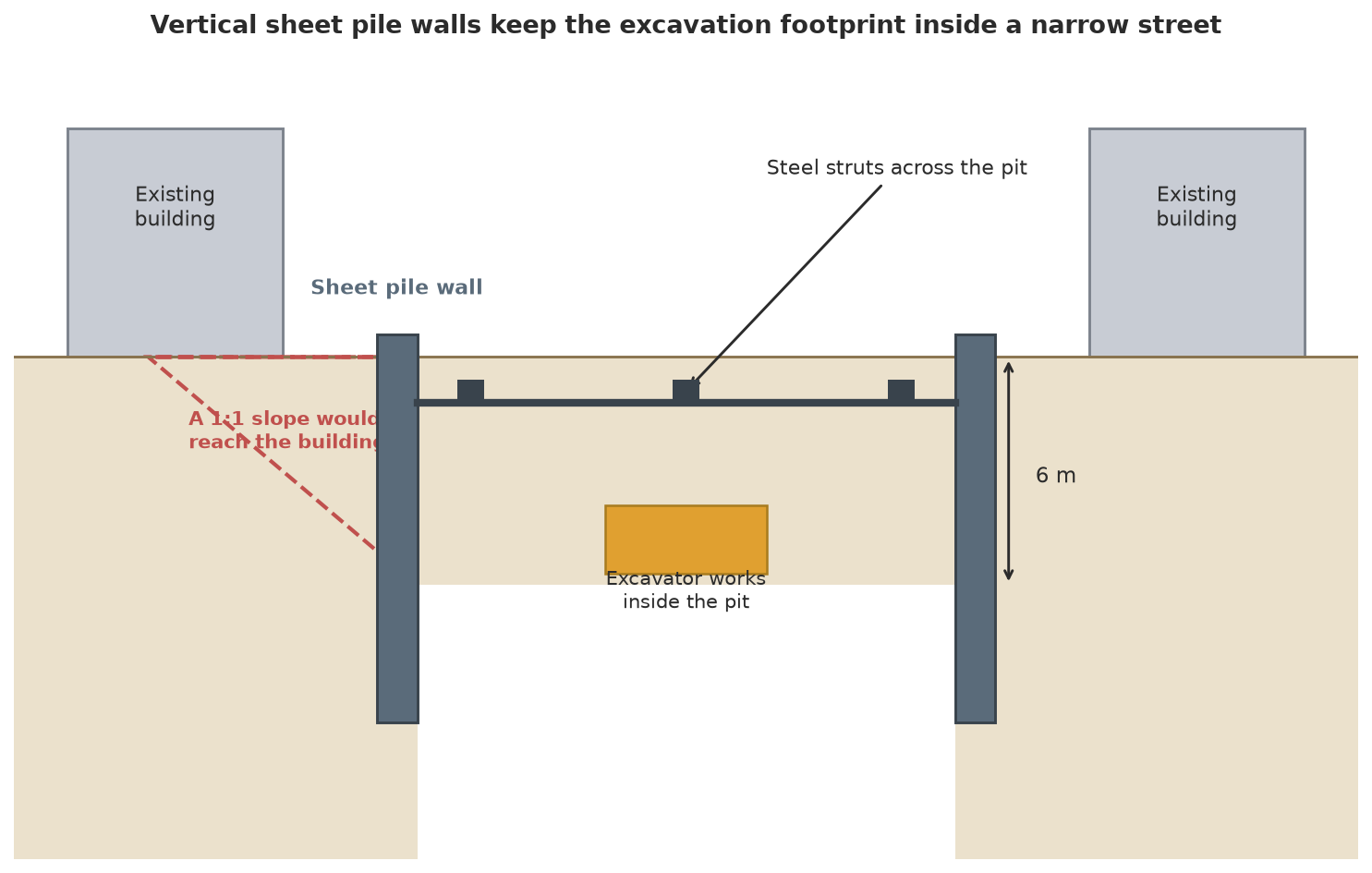
A sheet pile wall stands on the excavation line itself, so it needs roughly 0.3 meters of working allowance instead of the several meters a slope or a spread footing demands. On a 6 meter deep dig, that difference can free hundreds of square meters of site.
Comparing Footprints Method by Method
Let me put numbers on it. Take a 6 meter deep excavation. A 1:1 slope demands about 6 extra meters on each side before you even start digging. Soldier piles with lagging need room for the bored holes, the casing operation, and the lagging benches, usually around 1.5 meters. A sheet pile wall needs the thickness of the wall plus a small clearance for the equipment to work against the line, and that is about it.
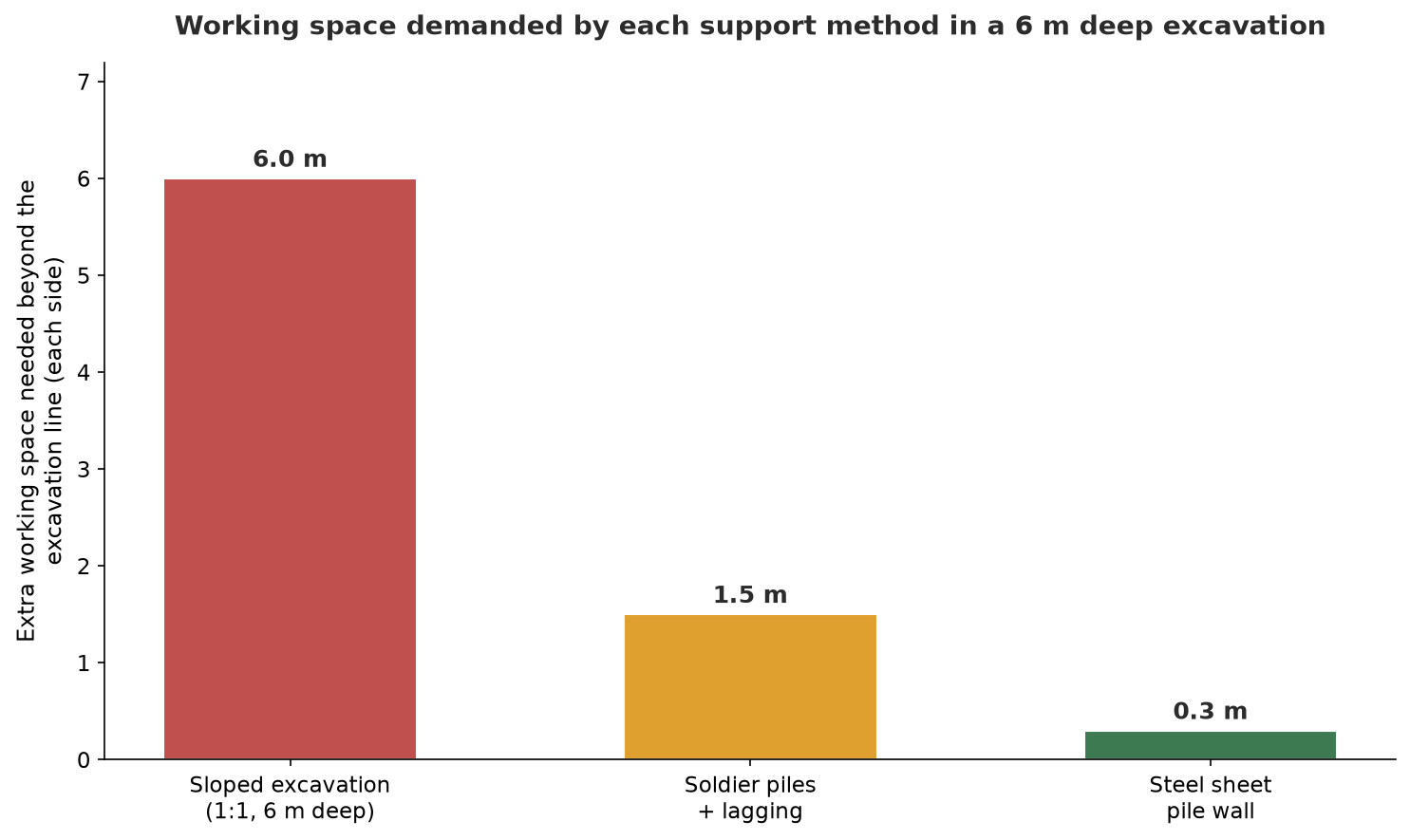
On a 40 by 20 meter pit, the difference between a slope and a wall is roughly 700 square meters of land that never has to be rented, fenced, or compensated. I have watched developers choose a city-center plot specifically because sheet piles made a tiny footprint workable; the land savings alone paid for the piling package. The same logic drives my article on temporary and permanent retaining walls, where the wall often becomes the permanent basement wall as well.
| Method at 6 m depth | Extra space beyond dig line | Practical consequence |
|---|---|---|
| Sloped excavation (1:1) | ~6 m each side | Usually impossible on urban plots |
| Soldier piles + lagging | ~1.5 m each side | Needs bored holes and staging room |
| Steel sheet pile wall | ~0.3 m each side | Wall sits on the property line |
The bar chart above is the picture I draw for customers who are comparing quotes. Space is not a detail; it is a cost line. Rent for adjacent land, compensation to neighbors, and haulage of extra spoil all shrink to zero when the wall goes vertical. If your tender ignores the footprint, it is not comparing the same project.
A practical detail buyers miss: because the wall occupies the dig line, your permanent structure can be built flush against it. Basements on sheet pile walls gain usable floor area all around the plan, which is why city architects increasingly ask for the wall to be designed as the finished outer face, not just a temporary support.
Why Do Sheet Piles Protect Neighboring Structures Better?
On a confined site, the buildings next door are the client you never met. Damaging them ends projects, relationships, and sometimes licenses.
Sheet pile walls reduce ground movement because they support the soil immediately, drive little vibration when installed correctly, and form a stiff continuous barrier that stops soil from migrating toward the excavation.
How the Wall Limits Settlement Next Door
The key word is immediacy. A slope leaves the ground unsupported while you cut it back, and soldier pile walls leave panels of soil open between the piles until lagging catches up. A sheet pile wall closes the whole line in one continuous operation, and once a pair of piles is driven, that stretch of soil is held. Settlement next door is driven by soil loss, and soil loss is what a tight wall prevents.
Stiffness is the second factor. Interlocked piles act as one composite wall, which spreads loads along the line instead of punching isolated columns into soft ground. My article on interlock types and their advantages explains how the clutch transfers these forces. Combined with proper walers and struts, the wall deflects in millimeters where an under-designed system moves in centimeters, and neighboring facades feel the difference.
There is also the water question. A driven wall cuts off seepage paths that would otherwise carry fines from under the neighbor’s foundation into your pit. I cover this in depth in my article on the waterproof performance of interlocked sheet piles. On silty sites, stopping that migration is often the difference between a quiet project and a claim.
| Risk next door | How a sheet pile wall responds |
|---|---|
| Settlement from soil loss | Continuous wall holds the soil face immediately |
| Vibration damage | Low-vibration pressing or tuned vibratory driving |
| Groundwater drawdown | Wall cuts off seepage and keeps the water table stable |
| Lateral wall movement | Composite stiffness plus walers and struts |
When I visit projects that had “neighbor complaints”, the cause is rarely the wall itself. It is the sequencing: leaving soil open too long, over-excavating below the design level, or skipping the struts to speed up. My article on common challenges in sheet pile construction lists these traps and how crews avoid them.
How Fast Can You Build When Space Is Tight?
Confined sites do not just lack room; they lack time. Road closures and neighbor agreements come with deadlines, and every day of mobilization is money.
Sheet piling is one of the fastest support systems to mobilize and install: piles arrive ready to drive, a single crew with one machine can install a full wall per shift, and excavation can follow the wall progressively without waiting for concrete to cure.
Where the Schedule Advantage Comes From
Compare the supply chain. A diaphragm wall needs guide walls, bentonite plants, rebar cages, and curing time before any excavation starts. A bored pile wall needs rigs, cages, and the same waiting. Sheet piles are rolled, delivered, and driven. On a normal day a crew installs 20 to 40 piles, which is 10 to 20 linear meters of finished wall, and excavation of the finished stretch can start the same week.
Progressive excavation is the hidden benefit. You do not wait for the whole wall; you drive a bay, install the waler and strut at that bay, and dig it. The pit and the piling crew work in leapfrog, which compresses the program in a way no cast-in-place wall can match. My step-by-step article on the sheet pile installation process shows how that sequence runs on site.
Compact plant is the third advantage. Mid-size excavators with vibratory attachments, or silent press-in rigs for sensitive stretches, fit through gates and work under the overhead lines that rule out big crawler rigs. I reviewed the equipment families in my article on sheet pile driving equipment.
| Schedule item | Sheet piles | Cast-in-place walls |
|---|---|---|
| Mobilization | Days; standard plant | Weeks; special rigs and plants |
| Curing before excavation | None | Days to weeks |
| Installation rate | 10–20 m wall per shift | Much slower per meter |
| Excavation start | Progressive, per bay | After wall completion |
One caution from the field: speed still belongs to planning. Sequencing, deliveries, and safety guidelines must be agreed before the first pile arrives, because on a tight site there is nowhere to put a pile that shows up early. Crews that stage deliveries by bay keep the pace; crews that dump everything at the gate lose a day untangling the yard.
Can You Control Noise and Vibration in Crowded Areas?
Neighbors tolerate a project; they do not tolerate shaking windows at seven in the morning. On confined urban sites, noise rules can decide the method.
Yes, modern sheet piling is surprisingly quiet when the right method is chosen: pressing rigs install piles with almost no vibration, balanced vibratory hammers stay within typical urban limits, and impact driving can be confined to short, screened stretches.
Matching the Driving Method to the Setting
The press-in method is the quietest option: the machine grips previously installed piles and pushes the next one in with hydraulic force, producing roughly the noise level of a running generator. I have seen walls installed beside hospitals and inside operating plants this way. It is slower and needs a reaction stand, but on the most sensitive 30 meters of a wall, it is worth every hour.
Balanced vibratory hammers come next. Modern variable-moment hammers cancel most of the resonance that older hammers transmitted into the ground, and they stay well inside limits that city authorities set for occupied buildings. Impact hammers remain the fastest in hard ground, but on confined sites I recommend them only behind acoustic screens and away from sensitive facades. The chart below compares the main methods on noise and vibration.
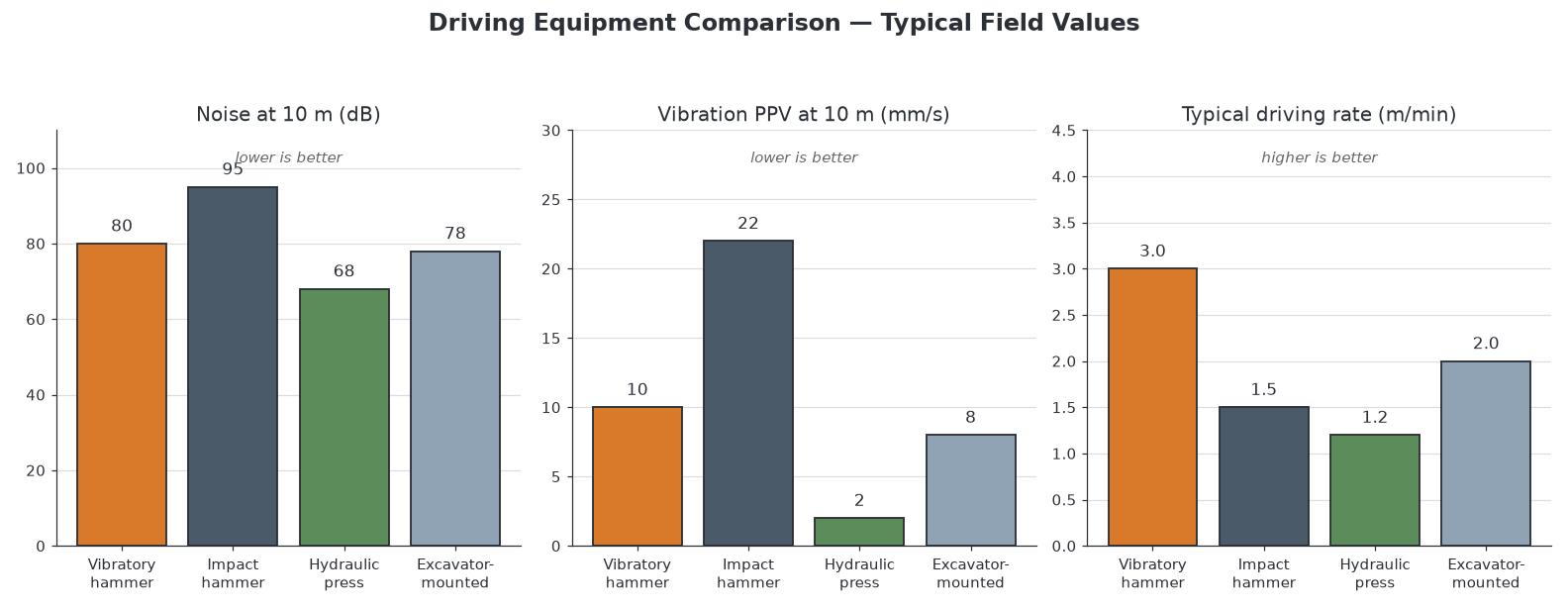
My article comparing vibratory and impact driving goes deeper into matching soil, noise rules, and wall length to the hammer. The practical rule I give customers: choose the quietest method the soil allows, monitor the first day, and keep a standby plan for the stretch next to the fragile facade.
| Method | Noise level | Vibration | Best urban use |
|---|---|---|---|
| Press-in (silent) | Very low | Almost none | Hospitals, occupied buildings |
| Balanced vibratory | Moderate | Low | Standard street walls |
| Impact + screen | High | Moderate | Hard strata, short stretches |
Preparation also matters more than the hammer. Pre-augering through hard layers, cutting old foundations before driving, and keeping piles in good alignment all reduce both noise and rework. Alignment matters double on tight sites because a drifted wall eats the little working room you have; my article on vertical accuracy during driving explains how crews keep the line straight.
Which Projects Gain the Most from a Small Footprint?
Not every project needs a vertical wall. Knowing where sheet piles pay off fastest helps you spend your engineering budget where it counts.
Deep urban basements, trench works under live roads, pump stations and shafts between existing structures, and waterfront repairs gain the most, because each of these jobs trades directly on saved space, speed, and neighbor protection.
The Projects I See Win with Sheet Piles
Urban basements are the classic case. Two or three levels deep, bounded by roads and party walls, they combine every confinement factor at once. A sheet pile wall gives the contractor a dig line he can build to, and often the wall becomes part of the permanent structure. My article on subway and underground engineering shows the same logic at metro station scale.
Trench works are the volume business. Pipeline crossings under live roads need overnight windows and same-day reinstatement; interlocked trench sheets driven ahead of the dig make that possible. Utility chambers, valve shafts, and pump stations inside operating plants are the same story in miniature: the wall arrives, closes, and the pit opens without shutting the plant down.
Waterfront repairs deserve a mention too. Rebuilding a quay wall or a river outfall means working over water with barges and no laydown area, which is a confined site with waves. Sheet piles handle it because the wall is both the method and the product, as my port and harbor case studies show.
| Project type | Why sheet piles win |
|---|---|
| Deep urban basements | Vertical dig line, wall often permanent |
| Trenches under live roads | Fast drive-and-reinstate cycles |
| Shafts and pump stations | Closed cells in tiny footprints |
| Waterfront repairs | Works over water with minimal staging |
If your project sits in one of these rows, the conversation with your supplier should start early. Wall design, corner pieces, and driving method all interact, and the cheapest wall is the one designed once, correctly, before mobilization.
My Take
After years of quoting confined-site projects across three continents, here is my honest view: the successful contractors are not the ones with the biggest machines. They are the ones who respect the footprint. They measure the site, choose a wall that fits it, stage deliveries by bay, and finish while others are still negotiating for storage space.
My second point is about honesty in tendering. On a confined site, the cheap system is rarely the cheap project. A slope that saves piling money but eats 700 square meters of rented land, or a slow wall that stretches a road closure by two weeks, will cost more than the sheet pile package ever did. I would rather show a customer the footprint math on day one than argue about variation claims in month six. That is why so many of my buyers now send me site photos before they price anything.
Conclusion
Steel sheet piles win confined sites by building vertically: minimal space, fast installation, and strong protection for neighbors. Measure your footprint early, then let the wall do the work.