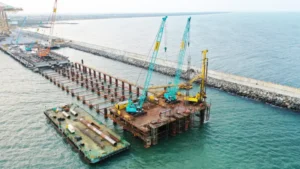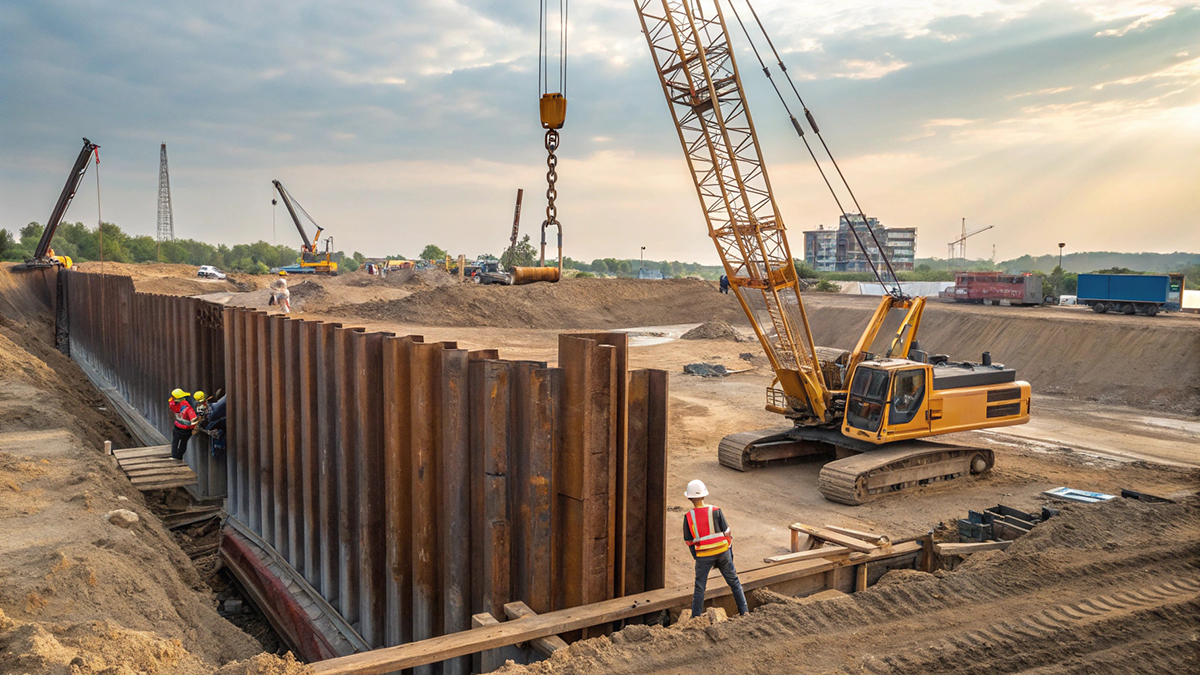
Temporary vs Permanent Steel Sheet Pile Structures: Which One Should You Choose?
Many contractors waste money because they pick the wrong sheet pile structure type from day one.
Temporary steel sheet pile structures support excavation or water control for months to a few years, while permanent structures act as long-term retaining walls, quay walls, or marine structures. The right choice depends on design life, load conditions, corrosion exposure, and whether the wall will stay in place forever.
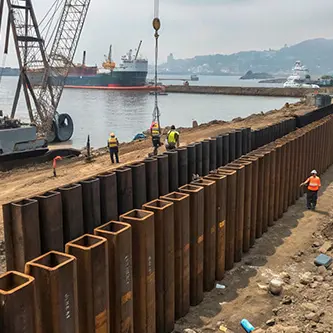
I have watched the same mistake happen on job sites from the Middle East to Southeast Asia. A project team orders heavy, corrosion-protected sheet piles for a simple six-month excavation. On the next job, they reuse light temporary sections for a permanent quay wall and watch them rust within a decade. The steel itself is not the problem. The problem is the mismatch between the structure type and the project need. In this article, I will walk you through the real differences between temporary and permanent steel sheet piles, how we choose between them at our mill in Liaocheng, and what you should ask your supplier before you sign the purchase order.
What Defines a Temporary Steel Sheet Pile Structure?
A temporary wall is built to be removed, but that does not mean it is an afterthought.
Temporary steel sheet pile structures are driven walls that provide soil or water support only during construction, then extracted once the permanent works are complete.
Typical uses and service life
From what I see in our export orders, temporary sheet piles do three main jobs. They brace deep excavations for buildings, metro and underground projects, and utilities. They form cofferdams so crews can pour concrete foundations in dry conditions. They also create short-term flood barriers or riverbank protection during seasonal work. The expected service life is usually between six months and five years. After that, the contractor pulls the piles and moves them to the next site.
Because the walls come back out, design engineers focus on stability during the construction phase, not on fifty-year durability. That choice affects everything from section modulus to steel grade. At our plant, we often supply Q235B or Q355B sections for temporary work because the loads are moderate and the piles will be reused. You can read more about these grades in our guide on common steel grades used for sheet piles.
Cost and reuse economics
The real savings with temporary sheet piles come from reuse. A single pile can be driven and extracted many times if the interlocks are not damaged and the toe is not deformed. Contractors in Australia and the Gulf States tell me that a well-managed temporary pile may serve five or more projects before it is downgraded to scrap. That reuse model only works if the initial specification leaves enough margin for handling damage.
The table below compares the key features of temporary sheet pile structures.
| Feature | Temporary steel sheet pile structure |
|---|---|
| Design life | 0.5 to 5 years |
| Typical steel grade | Q235B, Q355B, S235JR, S275JR |
| Corrosion protection | Usually none, or basic paint |
| Section modulus | Sized for construction-stage loads |
| Interlock seal | Standard; minor seepage acceptable |
| Installation method | Vibratory driving for fast extraction |
| End of life | Extracted and reused or recycled |
If your project needs only short-term support, do not over-specify. A temporary wall that is too heavy costs more to transport, more to drive, and more to pull. Our sales team often sees contractors overspend by ten to fifteen percent because they specify permanent-grade coatings for temporary walls.
What Defines a Permanent Steel Sheet Pile Structure?
Permanent sheet piles stay in the ground for decades, so the design must account for long-term loads and corrosion.
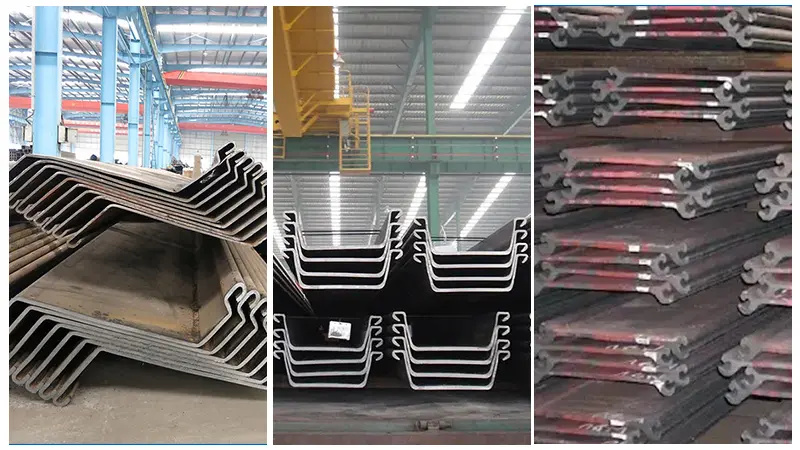
Permanent steel sheet pile structures are driven walls that remain in service as the final structural element, often for twenty-five to over one hundred years.
Design life and load cases
A permanent retaining wall must handle active earth pressure, surcharge loads, groundwater changes, and sometimes wave or traffic loads for its entire design life. In marine environments, the wall also faces tidal action, chloride attack, and possible abrasion from sediment. For these reasons, permanent structures usually use higher-strength grades such as Q355B, S355GP, or ASTM A690 for high-corrosion zones.
Our engineers in Liaocheng review permanent-wall drawings carefully. We check whether the specified section modulus covers both the construction stage and the long-term service stage. A wall that is safe during excavation may not be safe after the anchors are removed and the final ground level is applied. We also verify whether the client needs a tied-back wall, a cantilever wall, or a combined system. These decisions change the pile length and interlock requirements.
Corrosion protection for permanent work
Corrosion is the biggest threat to permanent sheet pile structures. In a marine setting, the corrosion rate can vary from less than 0.05 mm per year in low-energy zones to more than 0.3 mm per year in the splash zone. Permanent walls therefore need sacrificial thickness, protective coatings, or cathodic protection. Some port projects in the Middle East specify a corrosion allowance of three to five millimeters over the design life.
The table below summarizes the differences between temporary and permanent structures across key design factors.
| Design factor | Temporary structure | Permanent structure |
|---|---|---|
| Design life | 0.5 to 5 years | 25 to 100+ years |
| Load cases | Construction stage only | Construction + service stage |
| Steel grade | Q235B, Q355B, S235JR | Q355B, S355GP, ASTM A690 |
| Corrosion allowance | Minimal or none | 3 to 8 mm, or coating system |
| Section modulus | Lower | Higher |
| Monitoring | Visual during use | Long-term inclinometer, settlement |
When a permanent wall is designed well, steel sheet piles can outlast many concrete alternatives. The key is matching the material and protection system to the actual exposure.
How Do Design Life and Cost Compare Between Temporary and Permanent Structures?
The cheapest first price is rarely the cheapest total cost.
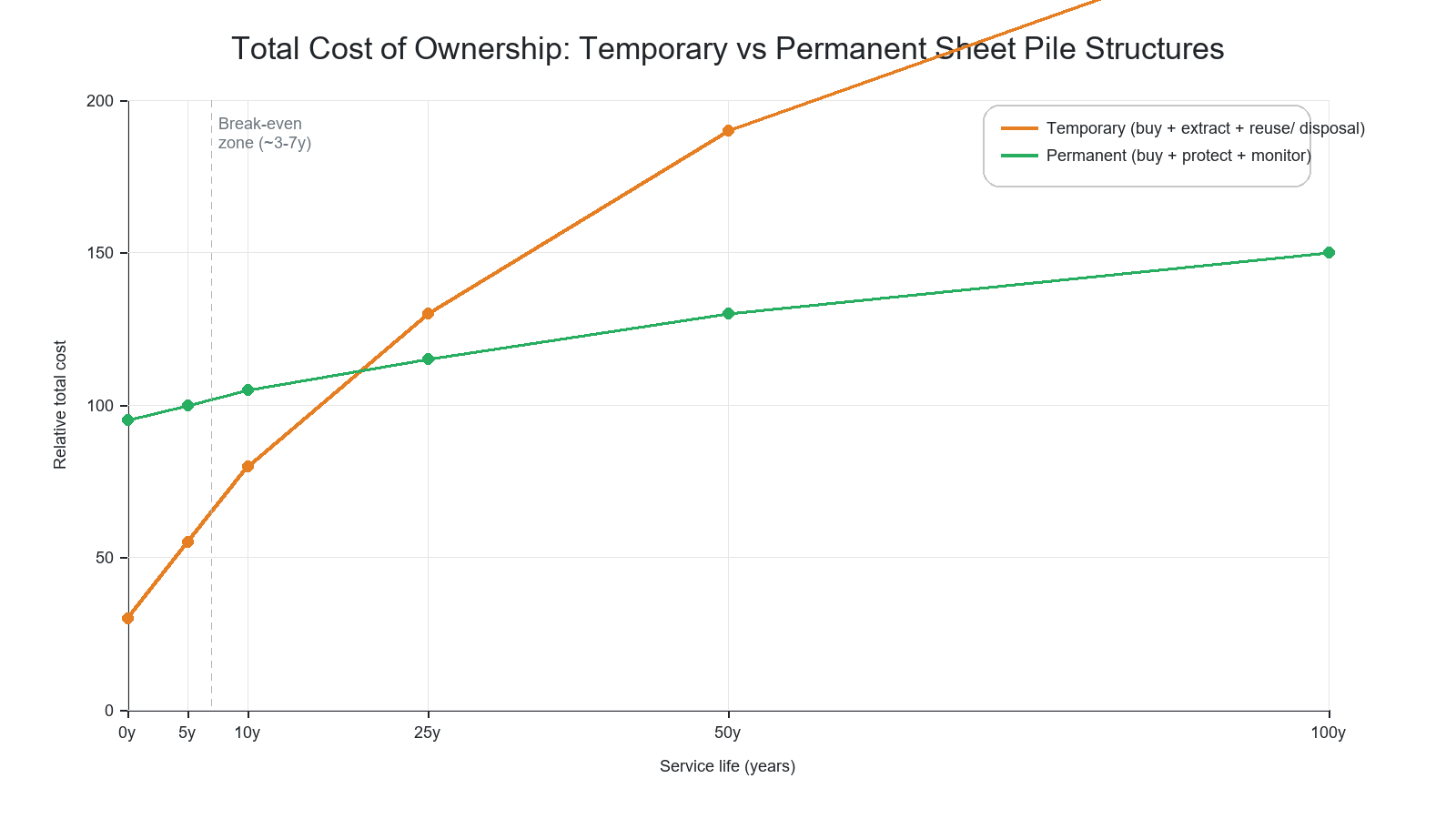
Permanent steel sheet pile structures cost more upfront because of thicker sections, higher-grade steel, and corrosion protection, but they eliminate the future cost of removal, replacement, or repeated rental cycles.
Initial cost versus life-cycle cost
A temporary wall often looks cheaper on the first invoice. You buy lighter sections, skip coatings, and drive them quickly. If the piles are reused on several projects, the cost per use drops sharply. However, if the piles are only used once, the total cost includes purchase, driving, extraction, cleaning, storage, and eventual disposal. That total can exceed the cost of leaving a permanent wall in place.
Permanent walls require a larger initial investment. You pay for heavier piles, protective coatings, possible cathodic protection, and more detailed engineering. Over a fifty-year design life, though, the annualized cost can be very low. You also avoid the disruption of returning to the site to replace a failed wall. For infrastructure owners in Australia and North America, that long-term reliability is often worth the upfront premium.
Rental versus purchase
Many contractors rent temporary sheet piles instead of buying them. Rental makes sense for one-off projects or when storage space is limited. The rental rate usually depends on the tonnage and the duration. For projects longer than about eighteen months, purchase often becomes cheaper. Our team can run the numbers both ways if you share the project duration and the expected reuse rate.
The table below compares cost drivers for the two structure types.
| Cost driver | Temporary structure | Permanent structure |
|---|---|---|
| Material unit cost | Lower | Higher |
| Coating and protection | Usually none | Required |
| Installation speed | Fast | Moderate |
| Extraction cost | Significant | None |
| Maintenance over life | Minimal | Periodic inspection |
| Life-cycle cost for short project | Lower | Higher |
| Life-cycle cost for long project | Higher | Lower |
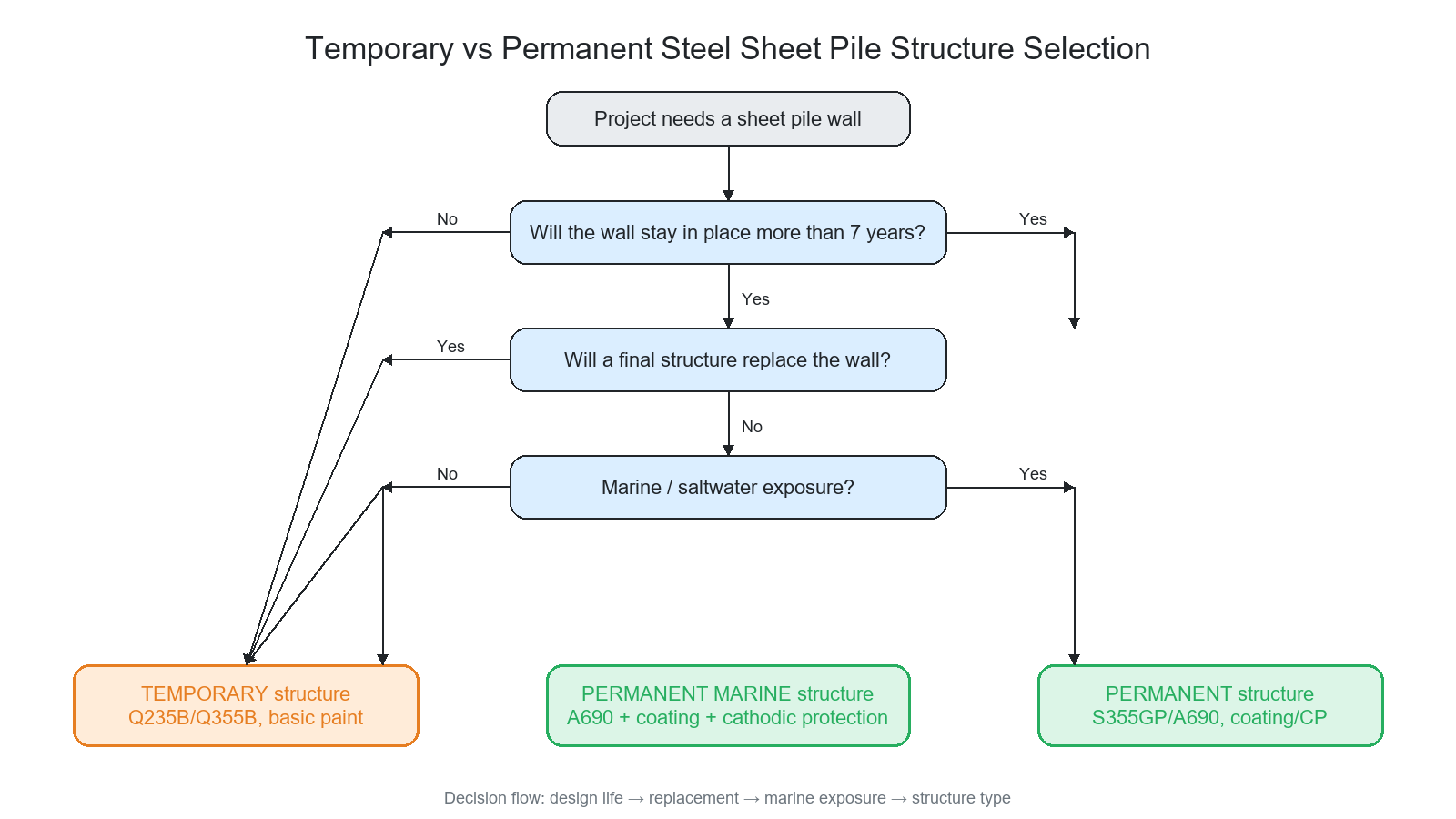
In my experience, the break-even point usually falls between three and seven years of service. If the wall will be in place longer than that, a permanent design is almost always the better economic choice.
Which Steel Grades and Coatings Suit Each Structure Type?
The steel grade should match the structure type, not just the strength requirement.
Temporary structures normally use mild structural grades, while permanent structures in aggressive environments need higher-strength, corrosion-resistant grades with protective coatings.
Grades for temporary work
For temporary walls, Q235B and Q355B are the workhorses. They have enough strength for most excavation supports and cofferdams. S235JR and S275JR are common in European-spec projects. Because the exposure time is short, the corrosion loss is small, and plain black steel is acceptable. If the temporary wall will be reused many times, we may specify a tougher grade to resist handling damage.
Grades and coatings for permanent work
Permanent walls need more attention. Q355B and S355GP provide higher yield strength, allowing thinner sections for the same section modulus. In marine or saline soils, ASTM A690 offers better corrosion resistance than ordinary carbon steel. For splash zones and aggressive environments, coatings such as epoxy or polyurethane systems extend service life significantly. Some projects add cathodic protection for the submerged zone.
At our mill, we can supply painted or coated sheet piles according to project specifications. We also provide SGS inspection reports so the client knows the actual chemical composition and mechanical properties. If you are unsure which grade to specify, our guide on steel grades for sheet piles gives a practical overview.
The table below matches structure type to typical material choices.
| Structure type | Common steel grades | Typical coatings | Best use case |
|---|---|---|---|
| Temporary | Q235B, Q355B, S235JR | None or shop primer | Excavation support, cofferdams |
| Temporary reusable | Q355B, S275JR | Basic paint | Multiple reuse cycles |
| Permanent inland | Q355B, S355GP | Epoxy coating | Retaining walls, basements |
| Permanent marine | S355GP, ASTM A690 | Epoxy + cathodic protection | Quay walls, breakwaters |
Choosing the right combination of grade and coating is where many projects save money or avoid premature failure. Do not assume that one specification fits every wall.
When Should You Choose Temporary Over Permanent Sheet Piles?
The decision is simpler than it looks once you ask the right questions.
Choose temporary steel sheet piles when the wall will be removed within a few years, when reuse is planned, or when the final structure will be replaced by concrete or another permanent system.
Questions we ask our clients
When a contractor contacts us from the Middle East or Africa, we start with four questions. How long will the wall stay in place? Will it be exposed to saltwater or aggressive soils? Is extraction possible without damaging nearby structures? Will the piles be reused on future projects? The answers usually point clearly to one structure type.
Temporary piles make sense for building basements, where the final basement wall will take over after construction. They make sense for cofferdams around bridge piers, where the cofferdam is removed after the concrete is cured. They also make sense for seasonal flood barriers or emergency works where speed matters more than long-term durability.
When permanent is the only safe choice
Permanent piles are the right choice when the wall itself is the final structure. Port quay walls, permanent riverbank protection, bridge abutments, and marine breakwaters fall into this category. In these cases, removing the wall would defeat the purpose of the project. The long-term design must include corrosion allowances, proper drainage, and monitoring provisions.
Our case study on steel sheet piles for temporary and permanent retaining walls shows how the same pile profile can serve both roles when the specification is adjusted. The physical pile does not change as much as the engineering around it changes.
The table below gives a quick decision reference.
| Project situation | Recommended structure type | Reason |
|---|---|---|
| Basement excavation | Temporary | Final wall replaces the sheet piles |
| Cofferdam for bridge pier | Temporary | Removed after concrete placement |
| Seasonal flood wall | Temporary | Short service period, quick install |
| Port quay wall | Permanent | Long-term marine exposure |
| Riverbank erosion control | Permanent | Continuous protection needed |
| Highway retaining wall | Permanent | Design life matches road |
If you are still unsure, send us the project drawings. Our team can recommend the structure type and the most economical pile section for your loads.
My Take
After years of supplying sheet piles to contractors and engineering firms across the Middle East, Australia, and Africa, I have learned that the biggest cost mistake is not the pile price. It is the wrong assumption about how long the wall will stay in the ground. A temporary wall that is over-engineered wastes capital. A permanent wall that is under-protected fails early and creates expensive repair work.
Our factory in Liaocheng can produce U-type, Z-type, and custom-profile sheet piles for both temporary and permanent applications. We do not push one option over the other. We ask about the project, review the design life, and then recommend the grade, coating, and section that fit the actual need. That approach has helped our clients avoid both over-specification and premature corrosion.
One more point: if you choose temporary piles, plan the extraction from the beginning. Driving method, sequence, and interlock condition all affect how easily the piles come back out. If you choose permanent piles, invest in corrosion protection and long-term monitoring. The small extra cost at the start is much smaller than the cost of a wall replacement.
Conclusion
Match the structure type to the design life, and you will save money while keeping the wall safe.
Tags: temporary steel sheet piles, permanent steel sheet piles, sheet pile design life, steel sheet pile structures, retaining wall selection