Marine Engineering Applications of Steel Sheet Piling Systems
Seawater is the toughest environment any retaining structure can face. I have supplied sheet piles for marine projects across the Middle East, Africa, and Australia, and I know what survives there.
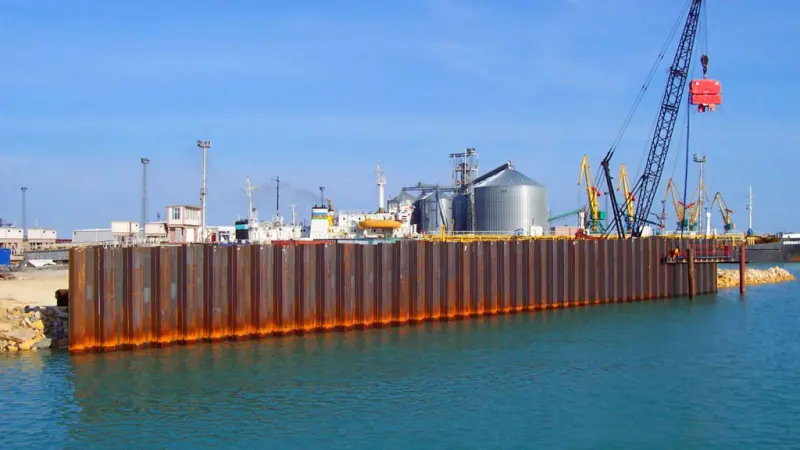
Steel sheet piles serve marine engineering as quay walls, breakwaters, jetties, seawalls, and pier foundations. The interlocked wall holds back soil and water, installs quickly from land or floating plant, and hot-rolled sections in marine-grade steel routinely serve 25 to 50 years in seawater with a proper corrosion protection scheme.
In this article, I will walk you through where sheet piles fit in marine work, how the sea attacks a wall, which profiles and steel grades we ship for coastal projects, how installation runs over open water, and how I plan corrosion protection. This is the same advice I give our export customers building ports and coastal infrastructure from the Gulf to West Africa.
Where Do Steel Sheet Piles Fit in Marine Engineering?
Marine projects mix soil, water, and waves in one structure. I group the applications into five families, and together they cover almost every marine inquiry we receive.
Marine sheet pile applications cover quay walls, breakwaters and seawalls, jetties and piers, dock and drydock walls, and temporary marine cofferdams. One interlocked wall system covers all five, which is why many contractors standardize on sheet piles across an entire port project.
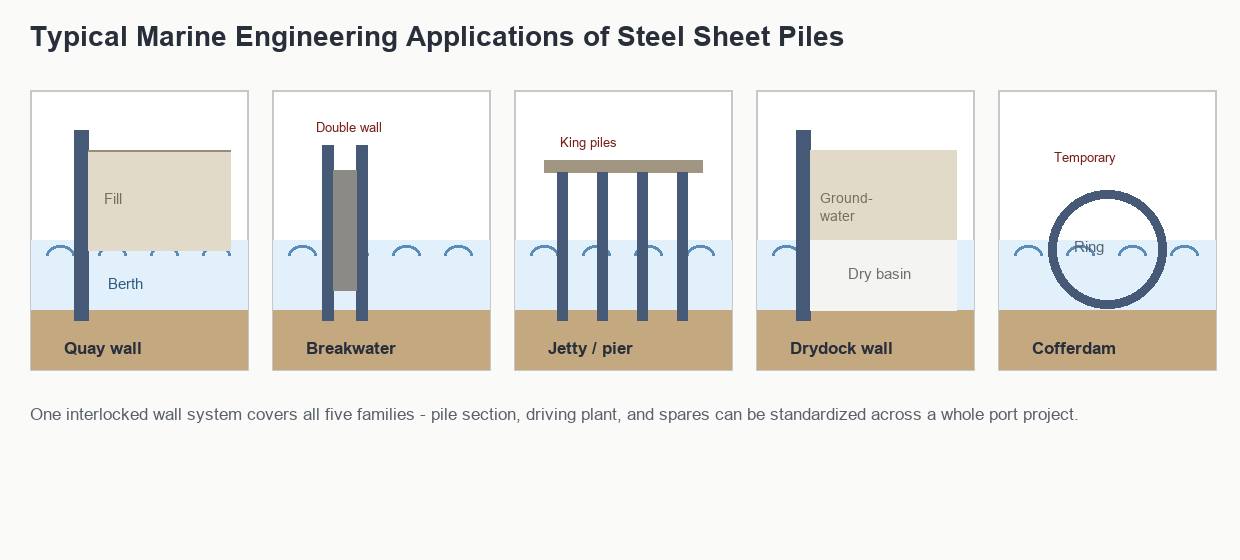
The five families I quote most often
First, quay walls. A steel sheet pile wall retains the reclaimed ground behind the berth and takes the pull of moored ships at the same time. Most of the container terminals I supply use sheet pile bulkheads because the wall, the anchor system, and the crane beam can all be built in one sequence.
Second, breakwaters and seawalls. Where a rubble mound is impossible or too wide, a double sheet pile wall filled with sand or rock does the same job in a much narrower footprint. I have shipped breakwater sections for fishing harbors where the entrance channel simply had no room for a stone mound.
Third, jetties and piers. Here the sheet piles often work as combined walls: king piles carry the vertical load from cranes or decks, and intermediate sheets retain the fill between them. Our own overview of combined walls shows how the king pile and the sheet share that work.
Fourth, dock and drydock walls. Shipyards need a wall that holds back groundwater while the dock is dry. The low permeability of an interlocked wall is the whole point, and our guide on how to prevent leakage in sheet pile walls explains the sealing details.
Fifth, temporary marine cofferdams. Bridge piers, intake structures, and outfalls all start with a sheet pile enclosure in the sea. When the permanent work is done, the piles come out and go to the next site. The reuse economics are exactly what I describe in our article on using steel sheet piles for cofferdams and deep excavations.
| Application | What the wall does | Typical design driver |
|---|---|---|
| Quay wall | Retains fill, takes mooring and crane loads | Berth depth and surcharge |
| Breakwater / seawall | Reflects or absorbs wave energy | Wave height and freeboard |
| Jetty / pier | Carries deck loads, retains fill | Vertical load on king piles |
| Dock / drydock | Keeps groundwater out of a dry basin | Water head and seepage |
| Marine cofferdam | Temporarily excludes the sea | Tide range and driving depth |
When a client plans two or more of these at once, buying one pile section that serves all of them simplifies logistics enormously. That is a quiet advantage of steel that concrete alternatives do not offer.
How Do Sheet Pile Walls Resist Waves, Tides, and Seabed Scour?
The sea attacks a wall in cycles, and the cycles never stop. Design that ignores them fails within a few storms.
A marine sheet pile wall resists wave pressure through its bending stiffness, handles tide cycles through its anchorage and freeboard, and survives seabed scour because the toe is designed below the predicted scour level with rock or mattress protection on the bed.
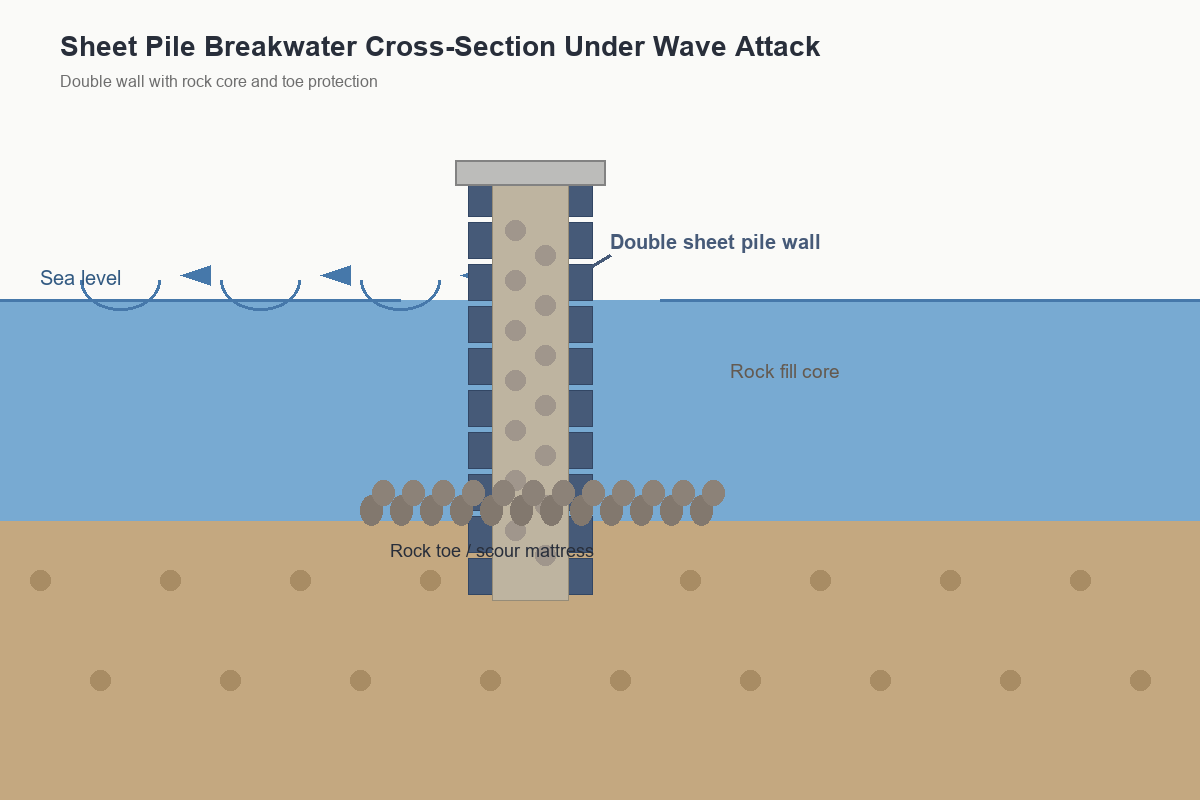
Three sea forces I design around
Wave pressure is the first. A standing or breaking wave loads the wall over its full height in seconds. The wall section, the anchor spacing, and the wall batter all follow from the design wave height. I always ask for the wave study before I quote, because a wall that looks fine for earth pressure alone can be undersized for a storm surge.
Tide is the second force. Twice a day the water level moves, and with it the pressure difference across the wall. The design must cover the full range, and the freeboard must sit above the highest expected tide plus wave run-up. Where the tide range is large, as in the Gulf, I see anchored walls with a tie rod and anchor block more often than pure cantilevers, because the anchor halves the bending moment and saves a full section class.
Scour is the third, and it is the one that sinks projects quietly. Currents and waves dig the seabed at the toe. If the embedment was measured from today’s bed, the wall loses its fixity as the bed drops. The fix is straightforward: measure embedment from the predicted scour line, and add a rock berm or mattress at the toe. For the stability math behind this, I point customers to our guide on how to calculate sheet pile wall stability.
| Sea force | What it does to the wall | Standard response |
|---|---|---|
| Wave pressure | Bends the wall, shocks the anchor | Stiffer section, closer anchors |
| Tide cycles | Reverses pressure difference twice daily | Freeboard plus anchored design |
| Seabed scour | Removes embedment at the toe | Design below scour line, rock toe |
| Salt spray | Corrodes the upper wall | Coating and corrosion allowance |
One more lesson from site: check the wall for the storm peak and for the rapid drawdown after it. The water inside the retained soil drains slower than the sea outside falls, and that reversed pressure difference is often the true worst case.
Which Profiles and Steel Grades Suit Marine Service?
Marine service is harder on a section than any land job. The profile and the grade have to be chosen for the water, not the catalog.
U-type hot-rolled sheet piles dominate moderate marine walls, Z-type sections take taller walls and heavy crane loads, and straight-web piles suit anchor walls and circular cells. For steel grade, marine-grade sections such as ASTM A690 outperform ordinary carbon steel in the splash zone by a wide margin.

Choosing the profile by the job
U-type hot-rolled piles are the workhorse for quay walls up to moderate heights. They give a good modulus per kilogram, they drive fast in marine soils, and their shape sheds impact well. Most of the port projects we ship to the Middle East use U sections for exactly these reasons.
Z-type piles come in when the wall gets tall or the loads get serious, for example where a quay carries gantry cranes on its crest. The interlock types and their performance advantages matter here, because a tight hot-rolled interlock keeps its strength under repeated wave loading better than a loose cold-formed one. If you are weighing the two families, our comparison of U-type versus Z-type steel sheet piles lays out the trade-offs.
Straight-web piles look unusual but solve a specific problem: walls that pull. In anchor walls and circular cell structures, the interlocks work in tension, and a straight web spreads that load without bending. If your project is a cell-type breakwater or a mooring anchor wall, this is the family to shortlist, and our guide to sheet pile types shows the full range.
Choosing the grade for seawater
Ordinary carbon steel loses thickness fast in the splash zone, where the wall is wet and dry in cycles and oxygen is plentiful. Marine environments need either extra thickness, a coating, or a grade designed for the job. ASTM A690 is the classic marine-grade choice for the splash and tidal zones, and our own breakdown of the ASTM A690 marine steel grade explains when it pays for itself. For most walls, we combine S355GP or Q355B base steel with added corrosion allowance in the critical zone, and our article on common steel grades for steel sheet piles compares the options.
| Zone on the wall | Severity for steel | What I specify |
|---|---|---|
| Atmospheric | Moderate | Paint system |
| Splash zone | Highest | A690 grade or extra thickness |
| Tidal zone | High | Coating plus allowance |
| Submerged | Moderate | Cathodic protection |
| Buried in seabed | Low | Nominal allowance |
How Are Sheet Piles Installed in Open Sea Conditions?
Open water changes everything about driving. Access, weather windows, and alignment control all get harder at once.
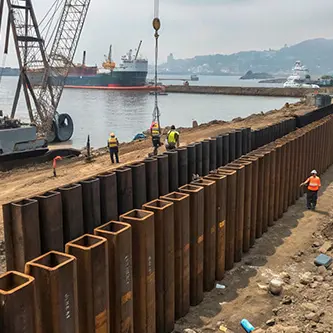
Marine sheet pile installation uses land-based cranes where the wall starts on shore, then floating plant or a temporary trestle as the wall moves offshore. Panels are pitched, driven in pairs with vibratory hammers, and checked against survey control from the first pair onward.
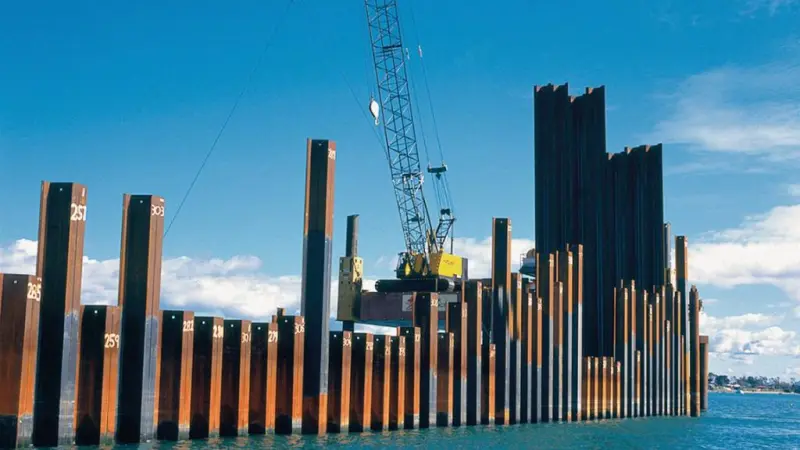
Method and sequence over water
Most marine walls start from the land. The crane sits on the finished shore, drives the first panels, and the contractor builds a working bench forward as the wall grows. Once the crane reach runs out, the crew moves onto a floating barge or a temporary steel trestle. I have seen both work well; the trestle costs more but keeps production steady in swell.
The vibratory hammer remains the main tool in marine soils, because sand and soft clay respond well to vibration and the noise over water bothers nobody. Where the wall must penetrate stiff layers or reach design depth in dense sand, an impact hammer finishes the pile. Our comparison of vibratory versus impact hammers covers how to sequence the two.
Alignment is the discipline that separates good marine crews from bad ones. The first pairs are set by survey, because every pair that follows threads into them. On long walls, the crew rechecks the line every few meters, because a wall that drifts offshore is expensive to correct once it is deep. Driving records go into the daily log: depth, time, blows, and refusal events. A pile that stops early gets investigated, never forced, because a torn interlock below the waterline is a leak you cannot see until the fill behind it washes out.
Weather windows matter as much as method. A marine job in monsoon season or during the Gulf’s summer shamal winds loses days at a time. I keep buffer stock of common marine sections in Liaocheng, so when a customer’s weather window opens, the piles ship the same week instead of the same quarter.
| Stage | Activity | Key control |
|---|---|---|
| Setup | Set out the wall line, prepare access | Survey control and anchor points |
| Land driving | Drive from the shore crane forward | First pairs set true and plumb |
| Floating phase | Move to barge or trestle | Panel pitch and interlock threading |
| Finishing | Cut tops, install capping and tie rods | Level, anchor tension, leak check |
How Do You Protect Marine Sheet Piles Against Seawater Corrosion?
Corrosion is the number-one lifecycle question in marine steel. Get it wrong, and the wall thins exactly where the loads are highest.
Marine corrosion protection combines a coating on the upper zones, extra steel thickness as allowance in the splash zone, and cathodic protection on the submerged section. Applied together, these three layers take a wall’s design life from 20 years to 50 or more.
The protection scheme I recommend
Start with the zones. Above water, a paint system carries the load; epoxy and polyurethane systems routinely give 15 to 20 years before recoating. In the splash zone, no coating survives forever, so I add sacrificial thickness: 2 to 4 millimeters of extra steel, depending on the design life the owner wants. In the tidal and submerged zones, cathodic protection takes over, either sacrificial anodes welded to the wall or an impressed current system. Our detailed guide on corrosion protection for steel sheet piles in seawater walks through each zone with numbers.
Where the budget allows only one upgrade, I put it in the splash zone. That thin band of steel sees more oxygen, more wet-dry cycles, and more wave impact than any other part of the wall, and it is also the hardest section to inspect or repair. A690 grade steel there, or plain extra thickness, is the cheapest life you can buy. For long-term planning across all zones, our guide on the lifespan of steel sheet piles gives realistic service-life figures.
| Protection layer | Where it works | Typical life added |
|---|---|---|
| Epoxy / PU coating | Atmospheric and tidal | 15-20 years per coat |
| Extra steel allowance | Splash zone | Full design life |
| Sacrificial anodes | Submerged zone | 15-25 years per set |
| Impressed current | Long submerged walls | 25+ years, needs power |
One more point from the factory: inspection is part of the scheme. A wall that gets its splash zone checked every five years will always outlive an identical wall that nobody looks at. I tell owners to plan the first inspection at year five and budget for anode replacement at year fifteen.
How Do Sheet Piles Compare With Concrete Caissons Over Their Lifetime?
This is the comparison that decides real port projects. Concrete caissons look cheaper on paper, but the picture changes when you count the ground they stand on.
Sheet pile walls beat concrete caissons on speed, footprint, and ground adaptability; caissons win on maintenance-free life in low-corrosion designs. For most medium-height quay walls and breakwaters on ordinary soil, a marine-grade sheet pile wall is the faster and more economical answer.
Where each system wins
Caissons need a dry dock or a heavy lift yard, a seabed prepared to fine tolerances, and a weather window to tow and sink each unit. A sheet pile wall needs a crane, a hammer, and a supply of piles. On a green-field port with good ground and a large budget, caissons are a fine answer. On a brown-field berth upgrade, or a fishing harbor with a narrow budget and a short construction season, sheet piles win almost every time.
Speed shows up in the schedule. I have seen a sheet pile quay wall advance tens of meters in a week with a single crew. A caisson yard, by comparison, needs months of lead time before the first unit even floats. Where a port operator lives on berth availability, that schedule difference is real money.
Maintenance is where caissons fight back. A well-built concrete caisson needs little attention for decades, while a steel wall lives on its corrosion scheme. But a steel wall is also repairable and extendable: a damaged length can be cut and replaced, and a wall can be driven deeper or extended upward as berth requirements grow. Concrete does not offer that flexibility. Our overview of steel sheet piles for port and harbor protection projects expands on this port-level comparison.
| Factor | Steel sheet pile wall | Concrete caisson |
|---|---|---|
| Construction speed | Fast, continuous driving | Slow yard, tow, and sink cycle |
| Footprint | Narrow, wall-line only | Wide, needs prepared bed |
| Ground adaptability | Drives through varied soils | Needs uniform bearing |
| Maintenance | Coating and anode cycle | Very low |
| Repair and extension | Cut, replace, drive deeper | Difficult |
My Take as a Supplier
Here is what twenty years of marine inquiries have taught me. The projects that fail rarely fail on steel strength. They fail on the boundary between the wall and the sea: the scour level nobody measured, the splash zone nobody protected, the wave study nobody ordered. So when a customer sends me a marine drawing, I ask for the wave and scour reports before I quote. Ten minutes with those documents tells me the real embedment, the real section, and the real corrosion budget. It has saved buyers more money than any discount I could offer. If you are planning a marine wall and want a second opinion before you commit, send me the drawings and the soil data, and I will tell you honestly whether sheet piles are the right structure. Our team at cnsteelplant.com quotes marine sections from stock with SGS inspection support.
Conclusion
Steel sheet piles give marine engineers one wall system that holds soil, resists waves, and survives seawater for decades when the corrosion scheme is planned from day one.