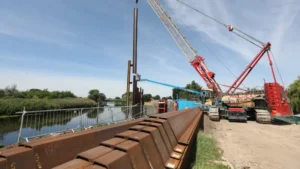
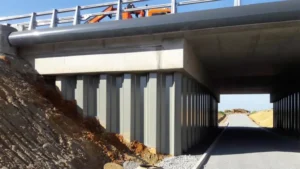
You are building a new foundation or a basement. The excavation is deep, and the soil wants to collapse. You need a retaining structure that holds the ground, works fast, and can be removed when the job is done.
Temporary retaining structures using sheet piles1 are the most common solution for excavations, basement construction, and underground utilities. Sheet piles are driven into the ground to form a continuous wall that holds back soil and water. After the permanent structure is built, the piles are extracted and reused on another project. They are fast to install, cost-effective, and 100% reusable.
](https://cnsteelplant.com/wp-content/uploads/2026/03/Article-Application-City-5.webp)
I have supplied sheet piles1 for temporary retaining structures2 across the Middle East, Southeast Asia, and Africa. A metro project in Southeast Asia used temporary sheet piles1 for a station box, then extracted them for reuse. A high-rise foundation in the UAE used temporary sheet piles1 for a deep basement. Let me walk you through how temporary retaining structures2 work.
Sheet piling retaining wall
A sheet piling retaining wall1 is a structure that holds back soil and water using interlocking steel sheet piles driven into the ground.
A sheet piling retaining wall1 consists of interlocking steel sections driven vertically to form a continuous barrier. For temporary work, the wall is designed to resist soil and water pressure during construction. After the permanent structure is built, the piles are extracted using a vibratory hammer. The piles can be reused on multiple projects.
[^1] diagram](https://placehold.co/600x400 "Sheet Piling Retaining Wall")](https://cnsteelplant.com/wp-content/uploads/2026/03/Article-Application-City-4.webp)
How Temporary Sheet Pile Walls Work
Let me explain the components and function of a temporary retaining wall.
Wall Components
- Sheet piles: Interlocking steel sections driven to depth
- Walers: Horizontal beams that distribute pressure
- Bracing: Struts or rakers that support the wall
- Tiebacks: Grouted anchors (for deep excavations)
Construction Sequence
- Drive sheet piles to required depth
- Excavate to first brace level
- Install walers and bracing
- Excavate to final depth
- Construct permanent structure
- Remove bracing
- Extract sheet piles
Advantages of Temporary Sheet Pile Walls
- Fast installation
- Reusable (up to 10 times or more)
- No curing time (unlike concrete)
- Minimal ground loss
- Can be installed in tight urban sites
Temporary vs Permanent Walls
| Feature | Temporary | Permanent |
|---|---|---|
| Design life | Months to years | 50+ years |
| Corrosion protection | Minimal (allowance) | Coatings or marine grade |
| Reusability | Yes, multiple times | No |
| Cost per use | Lower (amortized) | Higher |
My Experience
For a metro project, we used temporary sheet piles for the station excavation. After the concrete station was built, we extracted the piles and reused them on another station. The piles were used three times before being retired.
Steel sheet piling retaining wall
Steel sheet piling retaining walls1 are the standard choice for temporary excavations because of their strength, speed, and reusability.
A steel sheet piling retaining wall is made from hot-rolled or cold-formed steel sections with integral interlocks. The piles are driven using vibratory hammers for speed and minimal noise. For temporary work, standard carbon steel (ASTM A328) is used with minimal corrosion allowance. The wall is designed as a cantilever or anchored system depending on depth.
](https://cnsteelplant.com/wp-content/uploads/2026/03/Article-Application-City-3.webp)
Design of Temporary Retaining Walls
Let me walk through the design considerations for temporary sheet pile walls.
- Temporary walls are designed for the construction period (typically 6-24 months)
- No corrosion allowance needed for short duration
- Standard carbon steel (A328, S270GP) is sufficient
Wall Types for Temporary Work
| Depth | Wall Type | Typical Section |
|---|---|---|
| Up to 4 m | Cantilever | U 400 x 100 |
| 4-6 m | Cantilever | U 400 x 125 |
| 6-8 m | Cantilever or single brace | U 400 x 170 |
| 8-12 m | Braced or anchored | U 600 x 180 or Z-type |
| 12-18 m | Braced or anchored | Z-type (AZ 26, AZ 34) |
- Internal struts: Steel beams pushing against opposite walls
- Rakers: Diagonal braces bearing on a foundation or slab
- Tiebacks: Grouted anchors (require space behind wall)
- Piles should be driven with extraction in mind
- Vibratory extraction works for most soils
- Jetting or pre-drilling may be needed for hard soils
- Interlocks should be kept clean for easy extraction
My Experience
For a residential foundation in Australia, we used temporary sheet piles for a 5 m excavation. The U 400 x 125 piles were driven, the basement was built, and the piles were extracted in one day. The client reused the piles on another project.
Sheet pile retaining wall cost
Sheet pile retaining wall cost for temporary work is lower than permanent walls because the piles can be reused and less corrosion protection is needed.
Sheet pile retaining wall cost for temporary work ranges from $300 to $800 per linear meter for material and installation, depending on depth and site conditions. Material cost for used piles is $300-500 per ton, while new piles are $550-800 per ton. The total project cost includes installation, bracing, and extraction. Reusing piles on multiple projects reduces the cost per use.
[^1] chart](https://placehold.co/600x400 "Sheet Pile Retaining Wall Cost")](https://cnsteelplant.com/wp-content/uploads/2026/03/Article-Application-City-2.webp)
Cost Breakdown for Temporary Walls
Let me break down the costs for temporary sheet pile retaining walls.
Material Costs
| Section | New Cost ($/ton) | Used Cost ($/ton) |
|---|---|---|
| U 400 x 100-10.5 | 550-650 | 300-400 |
| U 400 x 125-13 | 600-700 | 350-450 |
| U 400 x 170-15.5 | 650-750 | 400-500 |
| U 600 x 180-13.4 | 600-700 | 350-450 |
| AZ 18 | 650-750 | 400-500 |
| AZ 26 | 700-800 | 450-550 |
Installation Costs
| Depth | Installation Cost ($/linear m) |
|---|---|
| 4 m | 200-300 |
| 6 m | 300-400 |
| 8 m | 400-500 |
| 10 m | 500-600 |
| 12 m | 600-800 |
Bracing Costs
- Internal struts: $200-400 per linear meter of wall
- Tiebacks: $150-300 per linear meter
- Rakers: $100-200 per linear meter
Total Project Cost Example
- Excavation depth: 8 m
- Wall length: 50 m
- Section: U 400 x 170-15.5
- Material: 50 m × 0.4 m width × 8 m depth? Actually, total length calculation:
Wall length = 50 m
Piles per meter = 2.5 (for 400 mm width)
Total pile length = 50 m × 2.5 × 8 m = 1,000 m
Material cost: 1,000 m × 76 kg/m = 76,000 kg = 76 tons
Material cost: 76 × $650 = $49,400
Installation: 50 m × $400 = $20,000
Bracing: 50 m × $300 = $15,000
Total: $84,400 ($1,688 per linear meter of wall)
Cost Savings with Reuse
- New piles: $49,400
- Used piles: $30,400 (saving $19,000)
- Reusing on second project: Material cost only extraction and handling
My Experience
For a residential project, we used used sheet piles from a previous job. The material cost was 40% less than new piles. The client saved $15,000 on a 30 m wall.
Sheet pile wall
A sheet pile wall1 is a retaining structure made from interlocking steel sections that are driven into the ground to hold back soil and water.
A sheet pile wall1 is a continuous barrier formed by driving interlocking steel sheet piles into the ground. The piles are connected by interlocks that create a watertight seal. The wall can be temporary (extracted after use) or permanent (left in place). Sheet pile walls are used for excavations, waterfront structures, and flood control.
[^1] cross section diagram](https://placehold.co/600x400 "Sheet Pile Wall")](https://cnsteelplant.com/wp-content/uploads/2026/03/Article-Application-City-1.webp)
Types of Sheet Pile Walls
Let me summarize the different types of sheet pile wall1s.
By Function
| Type | Description | Best For |
|---|---|---|
| Temporary | Extracted after construction | Excavations, basements |
| Permanent | Left in place | Quay walls, flood walls |
By Support
| Type | Description | Depth Range |
|---|---|---|
| Cantilever | No bracing, relies on embedment | Up to 6 m |
| Anchored | Tiebacks or ground anchors | 6-20 m |
| Braced | Internal struts or rakers | Any depth |
By Profile
| Type | Description | Best For |
|---|---|---|
| U-type | Symmetric, Larssen interlock | Curved walls, moderate depths |
| Z-type | Asymmetric, higher efficiency | Deep, straight walls |
| Straight web | Flat web | Cellular cofferdams |
My Experience
For a temporary excavation2, we used a braced U-type sheet pile wall1. The wall was 8 m deep with two levels of internal struts. After the basement was built, we extracted the piles and reused them.
Residential sheet pile retaining wall
Residential sheet pile retaining walls1 are used for basement excavations, driveway retaining walls, and slope stabilization on residential properties.
A residential sheet pile retaining wall is a smaller-scale version of industrial sheet pile walls. It is used for home foundations, basement excavations, and retaining walls on sloped lots. Light sections like U 400 x 100 or U 400 x 125 are common. For temporary work, used piles are often used to reduce cost. Installation can be done with smaller equipment.
](https://cnsteelplant.com/wp-content/uploads/2026/03/Article-Application-City-6.webp)
Residential Applications
Let me explain how sheet piles are used in residential construction.
Common Applications
- Basement excavation support2
- Driveway retaining walls (up to 2 m height)
- Slope stabilization3
- Foundation support
- Garden retaining walls
Typical Sections for Residential Work
| Height | Recommended Section |
|---|---|
| 1-2 m | U 400 x 100-10.5 |
| 2-3 m | U 400 x 125-13 |
| 3-4 m | U 400 x 170-15.5 |
| 4-5 m | U 600 x 180-13.4 |
Cost for Residential Walls
| Wall Height | Cost per Linear Meter (installed) |
|---|---|
| 1 m | $150-250 |
| 2 m | $250-400 |
| 3 m | $400-600 |
| 4 m | $600-800 |
Advantages for Residential
- Fast installation4 (days instead of weeks for concrete)
- No curing time
- Minimal site disturbance
- Can be installed on sloped lots
- Used piles available at lower cost
Installation for Residential
- Smaller equipment (mini-excavator with vibratory attachment)
- Can be done in tight spaces
- Less noise than industrial pile driving
- Can be extracted after construction
My Experience
For a residential project in Australia, we supplied U 400 x 125 piles for a 3 m retaining wall. The homeowner needed to level a sloped lot for a new house. The piles were installed in two days, and the wall has held the slope for years.
Conclusion
Temporary retaining structures1 using sheet piles are fast, cost-effective, and reusable. Cantilever walls2 work for depths up to 6 m. Braced or anchored walls are used for deeper excavations. Used piles reduce cost for temporary work. Residential applications use lighter sections and smaller equipment.
-
Explore this link to understand the advantages and applications of temporary retaining structures in construction. ↩ ↩ ↩ ↩ ↩ ↩ ↩ ↩ ↩ ↩ ↩ ↩ ↩
-
Learn more about cantilever walls and their effectiveness for various excavation depths in this informative resource. ↩ ↩ ↩ ↩ ↩ ↩
-
Discover effective slope stabilization techniques, including the use of sheet piles, to protect your property. ↩ ↩
-
Understand the significance of quick installation in retaining wall projects and how it can save time and costs. ↩ ↩