What Does Steel Sheet Pile Section Modulus Really Tell Infrastructure Buyers?
A wall that looks heavy on the shipping list can still bend twice as far as your design allows. Section modulus is the number that explains why.
Section modulus tells you how much bending moment a sheet pile can carry before the steel reaches its allowable stress. It is quoted per pile and per metre of wall, and it turns tonnage into real structural capacity.
I have quoted sheet pile walls for ports, riverbanks, and basement pits on four continents, and the same conversation keeps coming back. A buyer sends me a price list and asks why my section costs more per ton than another offer, when both piles weigh the same. Nine times out of ten the answer is one number that neither quotation spelled out. This article is my plain-language explanation of section modulus, what it does to your wall, and how to check it before you sign anything.
What Does Section Modulus Actually Measure on a Steel Sheet Pile?
Most buyers compare thickness and weight. Neither one tells you how the section behaves when wet soil pushes against it.
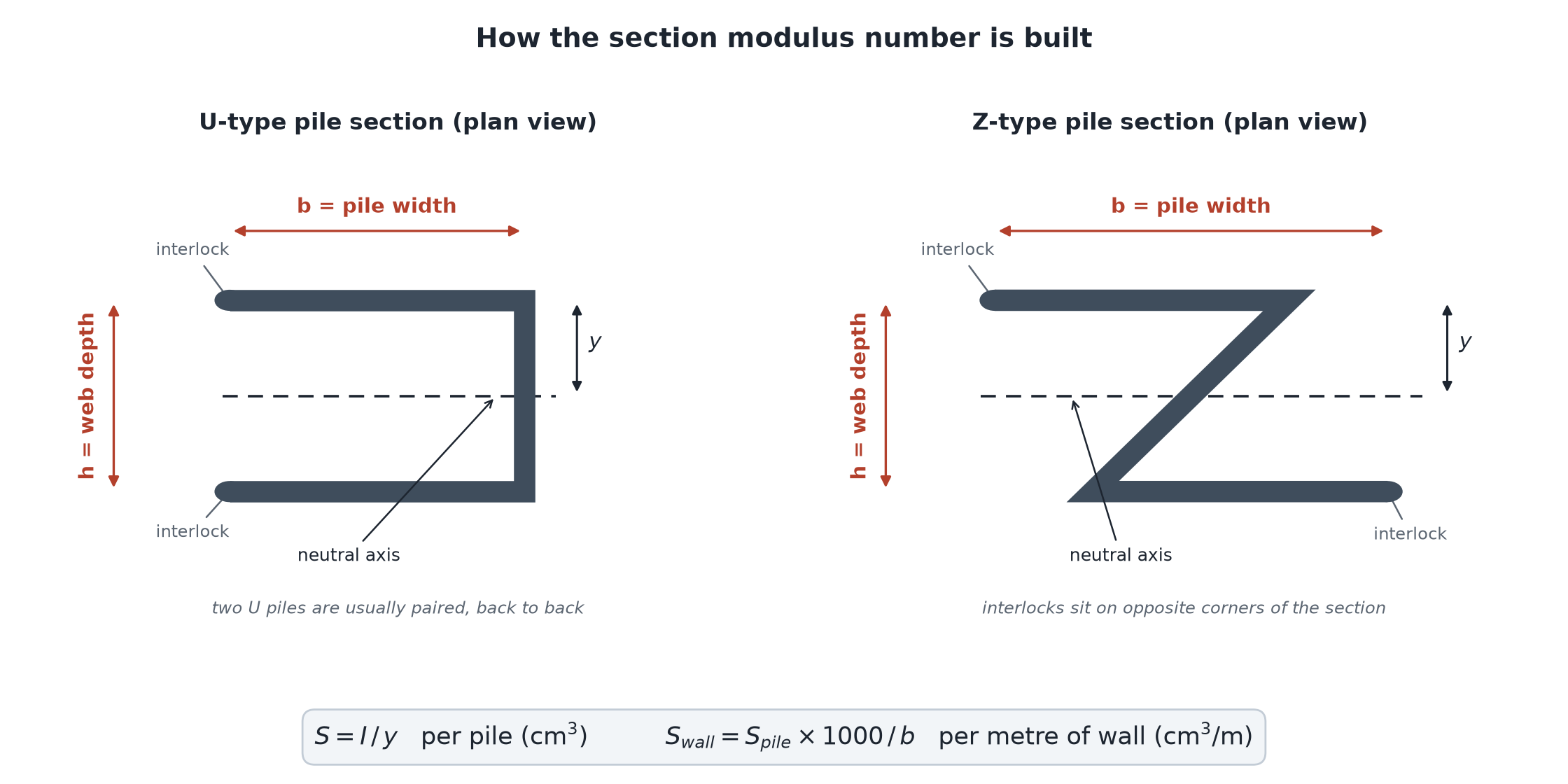
Section modulus equals the second moment of area divided by the distance from the neutral axis to the extreme fibre. It converts a bending moment into steel stress, so a higher value means lower stress under the same load.
The Formula Behind the Catalog Number
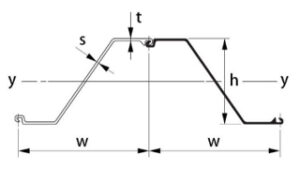
The relationship is short enough to write on the back of a business card: S equals I divided by y. I is the second moment of area of the section, measured about the axis the wall bends around. y is the distance from the neutral axis to the furthest steel fibre, which is the point that reaches yield first. Divide one by the other and you get a number in cubic centimetres, and that is the figure printed in every pile catalog.
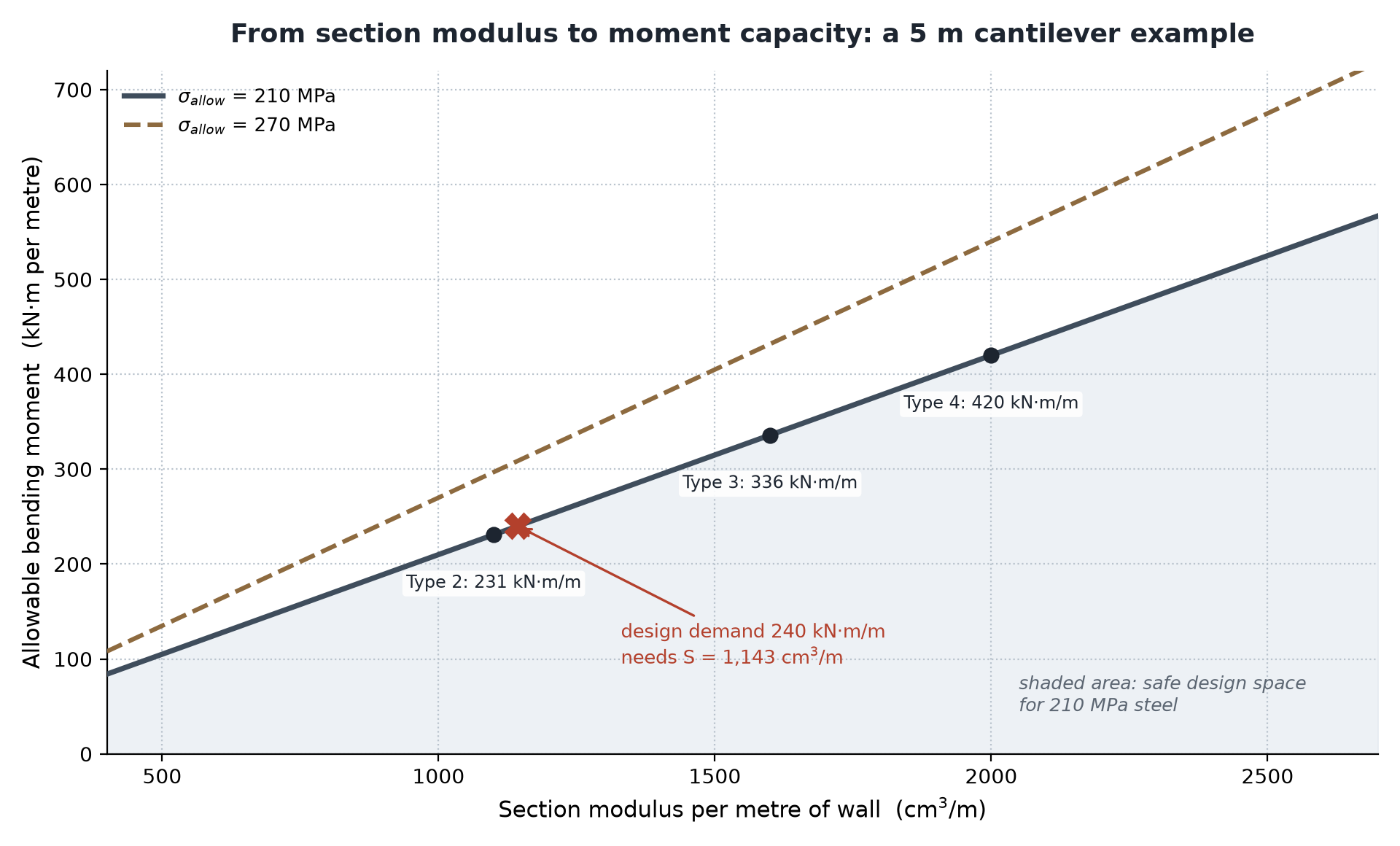
Why does it matter so much? Because bending stress is simply moment divided by section modulus. If you know the design moment per metre of wall, and you know the allowable stress of your steel, the required section modulus falls out of one division. Nothing else in the catalog does that job. Weight tells you what you pay for shipping. Thickness tells you how much corrosion you can lose. Section modulus tells you whether the wall stands up.
I still remember a buyer from Jordan who sent a hand sketch of a U section with three dimensions and asked me to confirm a catalog value of 1,240 cm³ per pile. We measured a sample in our yard, ran the numbers from the geometry, and got 1,228. The small gap came from the corner radii, which the sketch ignored. That is the level of precision you should expect: close enough to compare, never exact enough to replace the mill data sheet.
| Symbol | What it describes | Unit | Why a buyer should care |
|---|---|---|---|
| I | Second moment of area of the section | cm⁴ per pile | Sets stiffness and therefore deflection |
| y | Distance from neutral axis to extreme fibre | cm | Half the section depth in most symmetrical piles |
| S | Section modulus, I ÷ y | cm³ per pile | Converts moment into bending stress |
| σ allow | Allowable bending stress for the grade | MPa | Depends on steel grade and design factors |
| M | Design bending moment per metre of wall | kN·m/m | Comes from earth pressure and water load |
The table also explains why a stronger grade cannot rescue a weak section. Raising the allowable stress by 20 percent may let you use a smaller modulus, but the same wall will then deflect more, because deflection depends on stiffness, not on strength. That trade is exactly where most budget-driven specifications go wrong.
Why Is Section Modulus Usually Quoted per Metre of Wall?
A single-pile number means nothing until you know the wall width that pile covers.
Piles are rolled in different widths, so suppliers divide the single-pile value by the pile width and multiply by 1,000 mm. Only the per-metre figure lets you compare a 400 mm pile with a 700 mm pile fairly.

Why U and Z Piles Add Up Differently
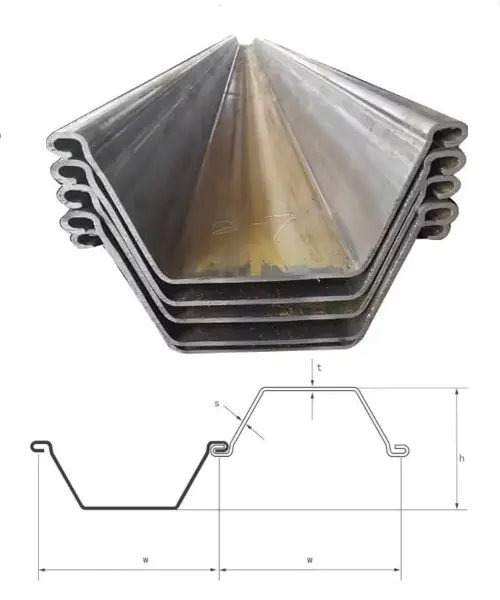
A Z pile is easy to read. One pile spans the full wall thickness on its own, so dividing its section modulus by its width gives the per-metre value directly. A U pile is not so simple. U sections are normally supplied and driven in pairs, with two piles interlocked back to back, and catalogs sometimes quote the width of one pile and sometimes the width of the pair. Mix those two conventions and your wall capacity is out by a factor of two before the first pile is even driven.
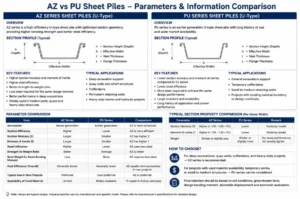
There is a second trap that even experienced engineers argue about. In a U pair, the two piles share load through the interlock. If the interlock is free to slip, the pair does not behave as one deep box, and the effective section modulus is lower than the simple sum of two piles. Many design guides therefore apply a reduction to U piles in certain soil and loading conditions, while others assume full composite action. I always ask the client’s engineer which assumption the design used, because the difference can be 30 to 50 percent of the wall capacity. Our article on U-type versus Z-type sheet piles walks through that behaviour in more detail.
| Profile family | How piles combine in the wall | How to read the catalog | Common misreading |
|---|---|---|---|
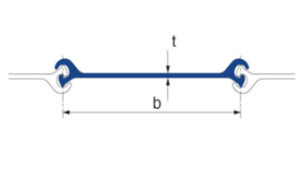
| U-type, single | Two flanges and one web, interlocked at both edges | Check whether width is per pile or per pair | Using single-pile S with pair width |
| U-type, driven pair | Two piles back to back, one driving unit | S per pair divided by pair width | Adding two single values without checking slip |
| Z-type | Each pile spans the wall on its own | S per pile divided by pile width | Ignoring interlock chain effects on long walls |
| Straight web | Cells or flat panels in tension | Different design mechanism entirely | Comparing S values with bending piles |
The practical lesson is to standardise on per-metre values in every document you exchange. When our engineers prepare a quotation, we state S per pile, S per metre, and the width the conversion used. When a customer sends an RFQ with only “section modulus 1,600”, I reply with a question, not a price. The section modulus and dimensions guide on our site shows the same convention in table form, and our note on flange width and web depth explains which dimension does the heavy lifting.
How Does Section Modulus Control Both Strength and Deflection?
Strength and stiffness are two different promises, and a section can keep one while breaking the other.
Section modulus sets bending stress, while the moment of inertia sets deflection. Because the two numbers scale differently, a section that passes the stress check can still move more than the structure can tolerate.
The Two Checks Every Wall Needs
The strength check is the one everybody runs. Take the design moment per metre, divide by the section modulus, and compare the result with the allowable stress. If the stress is below the limit, the steel will not yield. That is necessary, but it is not enough.
The serviceability check asks a different question: how far will the top of the wall deflect? For a cantilever wall, deflection grows with the cube of the retained height and falls in proportion to the moment of inertia. A section chosen only on section modulus can pass the stress check and still swing 60 mm at the top, which is enough to crack a nearby pavement or pull a crane rail out of alignment. Our article on structural strength and load bearing capacity covers the strength side in detail; here I want to make the pairing clear.
| Structure type | Deflection limit often specified | Why the limit exists |
|---|---|---|
| Temporary cofferdam | 50–100 mm, or about 1% of height | Working space and seal performance |
| Permanent retaining wall | About 0.5% of wall height | Protection of adjacent structures and services |
| Quay wall carrying a crane rail | 25–50 mm at rail level | Rail alignment and crane tolerance |
| Bridge abutment wall | 25 mm or less | Bearing seating and expansion joint travel |
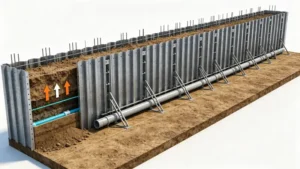
Two practical notes from my own quoting experience. First, a tall wall rarely fails on stress; it fails on movement, and movement is where anchors and walers earn their cost. Our guide on how wall height affects section selection shows how the required modulus climbs once you pass six or seven metres of retained height. Second, corrosion eats section modulus quietly. A pile that passes the check at 12 mm web thickness may fail it at 9 mm after twenty-five years in brackish water, so I always ask for the end-of-life check, not just the as-new one. The logic behind that allowance is set out in our corrosion resistance guide.
How Should Buyers Verify Section Modulus in a Quotation?
Two offers can show the same tonnage and hide section moduli that differ by a third.
Ask for section modulus per pile and per metre, the width it is based on, the steel grade behind the allowable stress, and whether the value is gross or net of corrosion allowance. Then match those numbers to the mill certificate and the shop drawing.
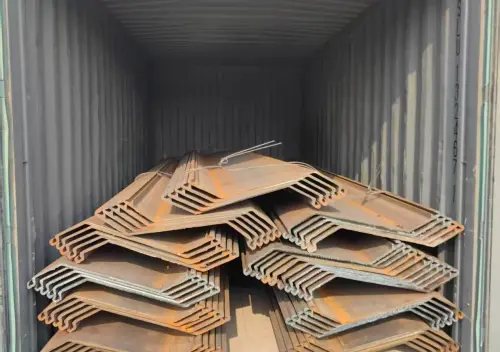
The Five Numbers I Want in Every Offer
When a contractor sends me a competitor’s quotation and asks whether it is comparable, I look for five items. Section modulus per pile. Section modulus per metre. The pile width used for the conversion. The structural steel grade and the thickness of web and flange. And the corrosion allowance that the design assumed. If any one is missing, the two prices are not comparable, whatever the tonnage says.
The mill certificate will not give you section modulus directly. It reports chemical composition, yield strength, and tensile strength, because those are the properties tested on each heat. Section modulus is a geometric property, so it has to be confirmed by measuring the delivered steel. This is where dimensional tolerances matter. A web rolled 0.5 mm under nominal thickness can lose two to three percent of its section modulus, which is small on its own but adds up when the design was already tight. Standards such as EN 10248 and ASTM A328 allow small deviations, and third-party inspection can verify them before shipment. If your project is heavy-duty, our note on choosing thickness for heavy-duty retaining explains how much margin to keep.
| Item to request | Where it comes from | Risk if unchecked | How to verify |
|---|---|---|---|
| Section modulus per pile | Mill data sheet or catalog | Nominal value, not measured | Recalculate from the section drawing |
| Section modulus per metre | Supplier calculation | Wrong width convention | Divide by width and multiply by 1,000 |
| Pile width and coverage | Drawing | Double or half counting in U pairs | Measure a sample pile |
| Web and flange thickness | Mill certificate plus measurement | Negative tolerance lowers S | Micrometer check on arrival |
| Grade and corrosion allowance | Design specification | End-of-life S below demand | Ask for the reduced-thickness check |
One more habit has saved my customers real money. I ask for the section modulus of two or three candidate profiles, not one. Seeing Type 2, Type 3, and Type 4 side by side makes the cost of stiffness obvious, and it usually reveals that the cheapest per ton is the most expensive per metre of wall. That comparison is the same logic we use in our guide to comparing quotations beyond price per ton, and it pairs well with the grade discussion in our steel grade overview. If you are still at the profile stage, the profile selection guide is the right place to start.
My Take: The Number Buyers Quote Without Reading
After years of shipping steel sheet piles from Liaocheng to Iraq, Australia, and West Africa, my honest view is that section modulus is the most quoted and least understood number in our trade. It appears in every catalog and almost never in the buyer’s own calculations. I have seen tenders won on a 40-dollar-per-ton saving that later needed an extra row of anchors, and I have seen a client pay 8 percent more for a deeper section and delete an entire bracing level. The modulus told him that story before the contract was signed. When a buyer asks me which pile is cheapest, I answer with a question: cheapest per ton, or cheapest per metre of wall that actually holds the soil? The second question is the one that keeps projects out of trouble, and section modulus is how you answer it.
Conclusion
Compare section modulus per metre, not tonnage. Check it against your moment demand, confirm it on the delivered steel, and let stiffness decide the rest.