Three sites, one rolling schedule, and one late container can stop all three. This is how I build a supply plan that holds when a site slips.
A reliable multi-site supply plan fixes three things before the first coil is rolled: a site-by-site demand map with real dates, one shared allocation rule for a single mill run, and a buffer level that covers the longest realistic delay. Everything else is tracking.

Most contractors do not lose their margin on the price per ton. They lose it in the gap between what the mill rolled and what each site could actually receive on the day the crane was free. I have watched this happen on projects with two sites in the same city and on projects with three sites in three countries. The pattern is always the same.
This article is the plan I now build with contractors before we roll a single coil. It is not a theory. It is a working document that sits on the wall of my office in Liaocheng and gets updated every Monday.
Why Do Multi-Site Projects Break a Single-Site Supply Plan?
A plan written for one site assumes one crane, one gate and one storage area. Add a second and a third site, and those quiet assumptions turn into queues that nobody budgeted for.
Multi-site plans break because the mill produces one batch while each site consumes at a different rate. The fix is to plan by delivery window and installation sequence, not by total tonnage.
Where the plan usually fails
When I audit a late project, I look for five specific failures. They repeat across regions, and none of them is about steel quality.
| Single-site assumption | What actually happens with three sites | What I plan instead |
|---|---|---|
| One delivery sequence | Site B waits behind Site A for the same vessel | Separate delivery windows per site, agreed in weeks |
| One storage yard | Site C stacks piles on a haul road and damages interlocks | Storage survey per site before the PO is signed |
| One unloading crane | Two sites book the same crane in the same week | Crane calendar shared with the shipping schedule |
| One approval cycle | Site B’s submittal is approved three weeks late | Per-site submittal tracker with named reviewers |
| Total tonnage is enough | Tonnage is right, but the lengths at Site C are wrong | Length schedule locked per site before rolling |
The last row is the expensive one. A steel sheet pile that is cut to the wrong length is still steel. It just cannot be driven. On a recent Middle East job, one site needed 9 m piles and another needed 12 m piles from the same profile. The contractor ordered the total tonnage in 12 m and planned to cut on site. Cutting hot rolled piles on site removes the mill’s end finish, slows the piling rig, and creates a new inspection problem. We re-cut at the mill instead, which cost two weeks but saved the installation program.
This is why I ask for the length schedule before I ask for the tonnage. Tonnage is a purchasing number. Lengths are a construction number. A supply plan needs both.
What Should a Multi-Site Supply Plan Start With?
Every plan I build starts with one page per site. If a contractor cannot fill that page, the plan will fail in week six, when changes are expensive.
Start with a demand map: for each site, list scope, profile, length mix, tonnage, first required date, unloading method and storage capacity. Then sequence the sites by the date they actually need steel, not by contract value.
Building the demand map
I use a simple table. It takes about an hour to complete with a competent site engineer, and it prevents most of the arguments that follow.
| Field | Why it matters | Example from a recent project |
|---|---|---|
| Site name and location | Defines shipping port and inland transport | Port expansion, Phase 2, Berth 4 |
| Scope | Tells me whether piles are temporary or permanent | Temporary cofferdam, 14 months |
| Profile and grade | Drives rolling sequence and mill availability | U-type, S430GP |
| Length mix | Determines cutting plan and container loading | 9 m: 60%, 12 m: 40% |
| Tonnage with waste allowance | Sets the order quantity and buffer | 1,850 t plus 4% |
| First required date | Anchors the whole backward schedule | Piles on site by week 13 |
| Unloading method | Crane capacity limits bundle weight | 50 t crawler crane, 6 t bundles |
| Storage area | Limits how much can arrive early | 900 m² hardstanding |
Two details in that table cause most of the trouble. The first is bundle weight. If the site crane can lift 6 t and the mill ships 8 t bundles, the site will break bundles on the truck. That is slow and it damages piles. We set bundle weight in the PO.
The second is storage area. This is not advanced construction logistics. It is basic scheduling. Contractors often want everything delivered early “to be safe”. Then the piles sit on soft ground for four months, the stacks sink, and the interlocks fill with mud. I would rather deliver in three waves than one. If you want to see how the quantity itself is calculated from drawings, I wrote a separate walkthrough on calculating steel sheet pile quantity from project drawings.
How Do You Split One Mill Run Across Several Sites?
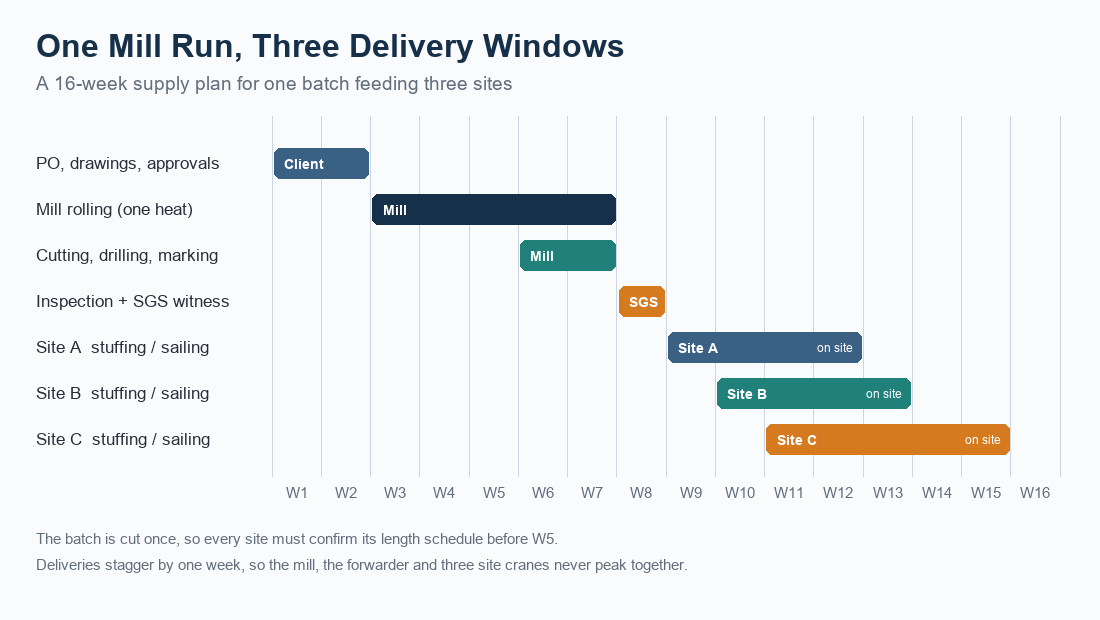
A single mill run is cheaper per ton, but it forces every site into one production window. The allocation rule decides who gets steel first when the rolling schedule slips.
Split the run by installation sequence, not by site size. Give the site that drives first the first coils, hold the middle site on a fixed call-off, and treat the third site as the buffer consumer.
Allocation rules that survive contact with site
There are three workable rules. I have used all of them, and I now recommend the third for most projects.
| Allocation rule | How it works | Best for | Main risk |
|---|---|---|---|
| Equal split | Each site gets one third of every profile | Sites with identical scope and start dates | Nobody has full lengths when they need them |
| Proportional to tonnage | Each site gets tonnage in proportion to its order | Large, similar sites | Small site runs out of the odd lengths first |
| Sequence-based | First site gets a complete set of lengths, then the next | Sites starting weeks apart | Needs discipline in the call-off |
Sequence-based allocation looks unfair on paper and works best in practice. Site A receives a complete length set, so it can start driving immediately. Site B receives a complete length set two weeks later. Site C receives the balance, which includes the buffer. No site is ever short of one length while holding surplus of another.
The rolling mill also prefers this. A change of profile or length costs setup time, so grouping the run by profile and then by length keeps the mill efficient. When the mill is efficient, my delivery dates are more reliable. That is not charity. It is scheduling.
I usually ask for the mill’s rolling sequence in writing before the PO is signed. If a supplier cannot show you a sequence, they are probably selling from stock and hoping. Capacity is worth checking properly, and I explain how in evaluating supplier production capacity for large orders.
How Much Buffer Stock Should You Hold?
Buffer stock is not a percentage you copy from another project. It is a number derived from the longest delay you can realistically expect between the mill and the furthest site.
Size the buffer from the delay, not from the tonnage. Add the longest sea transit, plus customs clearance, plus inland haulage, then convert those weeks into steel at the consumption rate of the fastest site.
Sizing the buffer without inflating the order
My rule is to hold buffer where it is cheapest to store and easiest to redirect. Usually that is the mill yard or a port warehouse, not the site.
| Buffer location | Cost | Reaction speed | Best when |
|---|---|---|---|
| Mill yard in Liaocheng | Lowest | 2 to 3 weeks to port | Long production run, flexible call-off |
| Port warehouse | Medium | Days | Vessel schedule is unstable |
| Site laydown | Highest | Immediate | Installation is already running |
| In-transit stock | Freight cost only | Fixed by vessel | Shipping in scheduled waves |
The chart below is the one I show contractors who want to reduce the order “just a little”. Demand is the light bar. Committed arrivals are the dark bar. The orange line is stock on hand.
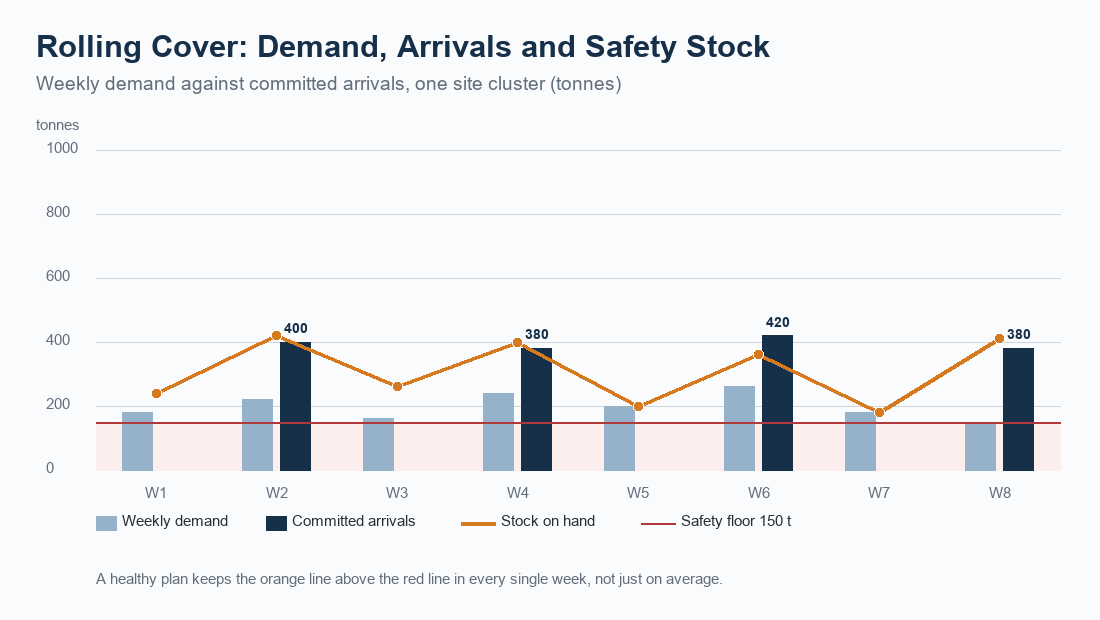
The plan is healthy when the orange line never touches the red line. Look at week five: demand is modest, but stock is at 200 t because the next arrival is still a week away. If a vessel slips by ten days at that point, the site stops. The average stock over eight weeks looks comfortable. The week-five minimum is what actually decides whether the piling rig works.
That is the mistake I see most often in supply plans. They report averages. Sites fail on minimums. I now ask for a weekly minimum stock figure for every site, and I treat any week below the floor as an open risk, even if the quarter looks fine.
Buffer has a cost, and it should be visible. If a contractor wants zero buffer, I write down the consequence: the first late vessel becomes a site stoppage. Then the decision belongs to the project director, not to the procurement officer. You can see how buffer and freight interact with other costs in my note on hidden costs in a steel sheet pile budget.
How Should Deliveries Be Sequenced and Shipped?
Once the allocation is fixed, deliveries become a wave plan. Each wave has a site, a length set and a vessel. Waves should overlap in production and separate in arrival.
Ship in waves that match installation sequence, and keep one wave in reserve. Two waves in transit at the same time is healthy. Three waves arriving in the same week is a storage problem, not a supply win.
Wave shipping and container planning
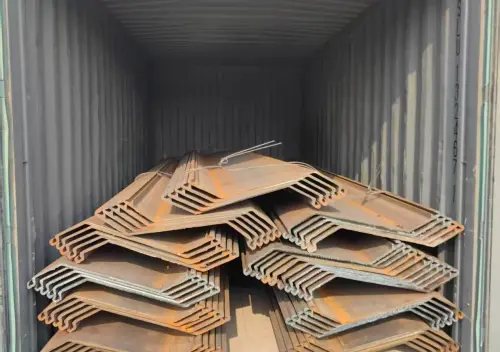
For container shipment, the length mix decides the loading pattern. A 12 m pile will not fit a 40 ft container without special handling, so long lengths usually go break bulk or in 20 ft frames depending on the route. Short lengths pack tightly and are ideal for the first wave, because the site can start on the shorter wall sections while the long piles are still at sea.
| Wave | Content | Shipping method | Purpose |
|---|---|---|---|
| Wave 1 | Short lengths, first 30% of tonnage | Containers, 20 ft | Start driving, prove the interlock |
| Wave 2 | Main length set for Site A | Containers or break bulk | Keep the main rig working |
| Wave 3 | Site B complete set | Break bulk | Open the second front |
| Wave 4 | Site C plus buffer | Mixed | Close the program, absorb changes |
Wave 1 has a second job that contractors undervalue. It tests the pile interlock and the driving equipment on site before the bulk of the steel is committed. If the soil is harder than the report suggested, or the interlocks need different handling, you learn it with 30% of the steel, not 100%. General steel piling guidance makes the same point about test sections.
For multi-phase projects, the same logic applies within one site, and I covered the mechanics in planning split shipments for multi-phase construction. Packaging matters too. Lifting points, bundle strapping and interlock protection all affect how fast a site can unload. I keep a detailed note on packaging, loading and transportation of steel sheet piles because most damage happens between the mill gate and the laydown yard.
What Paperwork Keeps Three Sites Aligned?
Three sites mean three sets of inspectors, three storage conditions and three filing systems. One shared document set prevents the classic argument about which heat number belongs to which site.
Issue one document package per shipment, with a site code on every mill test certificate, packing list and inspection report. Then give each site only the package it needs, plus a shared master register.
One document set, three site files
| Document | Owner | Site-specific element | Why it matters |
|---|---|---|---|
| Mill test certificate | Mill | Heat number mapped to site allocation | Traceability during inspection |
| Inspection report | Third party | Site code and inspection date | Release for shipment |
| Packing list | Supplier | Bundle count, weight, length | Unloading plan and crane lifts |
| Load plan | Supplier | Container or hold number | Customs and insurance |
| Delivery note | Supplier | Site address and contact | Prevents misdelivery |
| Submittal package | Contractor | Per-site approval status | Payment and construction approval |
The heat number mapping is the part people skip. If two sites receive piles from the same heat, the certificates look identical, and a site inspector cannot tell which bundle is covered. We print the site code and bundle range on the certificate annex. It takes ten minutes and saves days. Unloading is also a safety task, and HSE construction guidance applies to every bundle that arrives.
Submittals deserve their own tracker. If Site B’s submittal is approved late, its steel should not be rolled early. Otherwise the contractor owns steel that is not approved, and any comment from the engineer becomes a change order. I wrote a full checklist on what EPC contractors should include in a steel sheet pile material submittal. The inspection side is equally important, and our approach is summarised in quality standards and inspection for steel sheet piles.
How Do You Track the Plan Once Steel Is Rolling?
A supply plan that is not updated weekly becomes fiction. I keep a one-page control sheet with five numbers per site, and I review it every Monday morning with the mill and the forwarder.
Track five numbers per site each week: tonnage rolled, tonnage inspected, tonnage in transit, stock on hand, and days of cover. Any site below ten days of cover goes to the top of the next rolling slot.
The weekly control sheet
| Metric | Source | Green | Amber | Red |
|---|---|---|---|---|
| Tonnage rolled | Mill production report | On plan | 1 week behind | 2+ weeks behind |
| Tonnage inspected | Inspection report | Released | Pending | Failed or rework |
| Tonnage in transit | Bill of lading | Sailing on schedule | Port delay | Rolled to next vessel |
| Stock on hand at site | Site daily report | Above buffer | At buffer | Below buffer |
| Days of cover | Calculated | 15+ days | 10 to 14 days | Under 10 days |
The value of this sheet is not the numbers. It is the conversation. When the mill reports tonnage rolled but inspection is pending, we know the bottleneck is the inspector, not the rolling mill. When stock on hand is high but days of cover is low, we know the site is consuming faster than planned, and the next call-off must move forward.
I also ask each site to report pile damage and rejected piles in the same sheet. A site that rejects 3% of deliveries has a handling problem, and handling problems consume buffer faster than any vessel delay.
What Should the Supply Plan Say About Risk and Recovery?
Every plan needs a written recovery path, because the first reaction to a shortage is usually the most expensive one: air freight or emergency buying at spot prices.
Write the recovery levers in advance, in order of cost: pull forward the next rolling slot, redirect buffer from the slowest site, split a bundle, then buy spot. Most projects jump straight to step four.
Recovery levers in order of cost
| Lever | Cost impact | Lead time to recover | When to use |
|---|---|---|---|
| Pull forward next rolling slot | Low, if mill has capacity | 1 to 2 weeks | Rolling is behind, inspection is clear |
| Redirect buffer from another site | Transport only | 1 week | One site is ahead of program |
| Re-sequence installation | Site labour cost | Immediate | Long lengths are late, short lengths are ready |
| Split bundles at port | Handling cost | Days | Site crane capacity is the limit |
| Buy spot from another mill | Highest, plus quality risk | 2 to 4 weeks | Program is already critical |
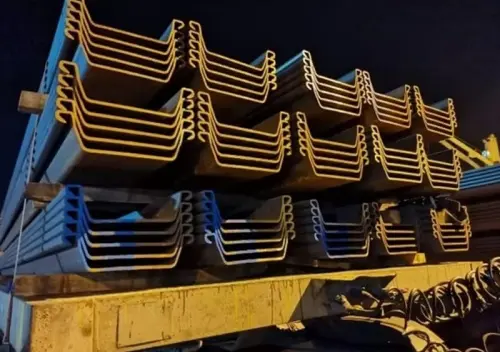
Redirecting buffer is the lever contractors forget. If Site A is three weeks behind because of excavation, its steel is not doing anything. Moving that steel to Site C costs a truck and a new packing list. It does not cost a new order. But this only works if all sites use the same profile and length set, which is another argument for standardising the profile across the project.
Spot buying is not automatically wrong. It is wrong when it is unplanned. If the project has a hard completion date and the penalty exceeds the spot premium, buying spot is rational. The mistake is buying spot without checking whether the spot steel meets the same standard. A mill test certificate to ASTM A328 or EN 10248 is not a formality. It is the only evidence that the steel you just bought in a hurry can carry the load you designed for.
What Should the Contract Say About Multi-Site Supply?
The supply contract should describe the allocation rule, the delivery windows and the buffer, not just the tonnage and the price. If those three items are missing, the supplier will optimise for the mill, and each site will optimise for itself.
Put the site allocation table, the wave schedule and the buffer quantity in the contract annex. Add a weekly review obligation, and name the person who can authorise a reallocation.
Contract items that prevent disputes
| Clause | What to write | Why |
|---|---|---|
| Allocation | Site-by-site profile and length table | Removes ambiguity when supply is tight |
| Delivery windows | Week ranges per wave, per site | Makes lateness measurable |
| Buffer | Quantity, location and owner | Clarifies who pays for storage |
| Inspection | Standard, sampling rate, witness rights | Prevents site-level rejection arguments |
| Reallocation | Who authorises, what notice is needed | Enables fast recovery |
| Shipping terms | Incoterms and named place | Fixes risk transfer and cost |
On shipping terms, I always recommend naming the exact place, not just the three-letter rule. Incoterms rules define risk transfer, but the named place decides who pays for the last truck. On multi-site jobs, that last truck is often the difference between a good delivery and a lost day.
One more clause is worth adding: the right to inspect before shipment. SGS inspection at the mill is standard for our export orders, and it is much cheaper than rejecting steel at the site. You can read more about how we handle steel sheet pile export solutions for global infrastructure projects and what a first order looks like in our guide to buying steel sheet piles from China.
What Does a Good Multi-Site Plan Look Like in Practice?
I will use a riverbank protection program I worked on as an example, because it had the same structure as larger jobs but fewer layers of management.
A good plan shows one page per site, one allocation table, one wave schedule and one weekly control sheet. If it needs more than four pages, the team will not use it.
A worked example
The program had three sites along the same river, all using hot rolled U-type piles, all needing a continuous wall for flood protection. The contractor wanted one order and one delivery. We built a four-wave plan instead.
| Item | Site A | Site B | Site C |
|---|---|---|---|
| Tonnage | 820 t | 640 t | 480 t |
| Main lengths | 9 m and 12 m | 9 m | 6 m and 9 m |
| First need | Week 13 | Week 15 | Week 17 |
| Storage | 900 m² | 500 m² | 350 m² |
| Wave | 2 | 3 | 4 |
| Buffer held | 40 t | 40 t | 60 t |
Site C received the largest buffer share, not because it was the biggest, but because it was the furthest from the port and had the smallest storage area. A delay there could not be absorbed by holding extra steel on site. That is the kind of judgement a tonnage table will never show you.
The plan also let the contractor re-sequence. When Site B’s excavation was delayed by two weeks, we moved its wave behind Site C’s without touching the mill schedule. Site C started earlier, Site B started later, and the overall completion date did not move.
My Take: The Plan Is a Communication Tool, Not a Spreadsheet
I have supplied piles to contractors who had a perfect schedule in Excel and no shared understanding on site. Those projects struggle. I have also supplied contractors with a one-page plan, handwritten changes and a Monday call. Those projects move.
My view is simple. A supply plan is not a document that proves you thought about logistics. It is a tool that lets three site managers, one mill planner and one forwarder make the same decision on the same day. If the plan cannot be explained in five minutes, it will not survive the first delay.
That is also why I push back when a contractor asks for the lowest price per ton and nothing else. Price per ton is one line. The cost of a stopped piling rig is another. A supply plan is how you keep the second line small.
Conclusion
Build the demand map first, fix one allocation rule, hold buffer at the cheapest point, and review five numbers every Monday. That is a supply plan that holds.