What Safety Guidelines Should Every Steel Sheet Pile Installation Site Follow?
A sheet pile wall can be built twice as fast as a concrete wall, and it can hurt someone twice as fast if the site is run carelessly.
Safe steel sheet pile installation rests on five pillars: a prepared and surveyed site, correct machine selection, mandatory PPE, controlled lifting and driving zones, and strict rules around excavation edges. Follow these guidelines and the most dangerous tasks on site become routine, repeatable work.
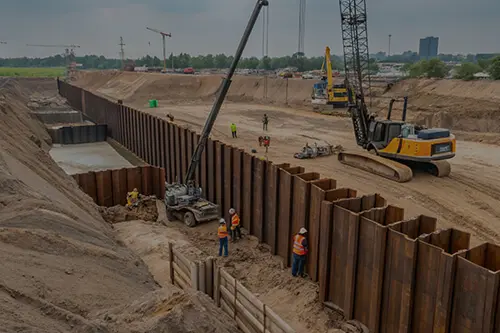
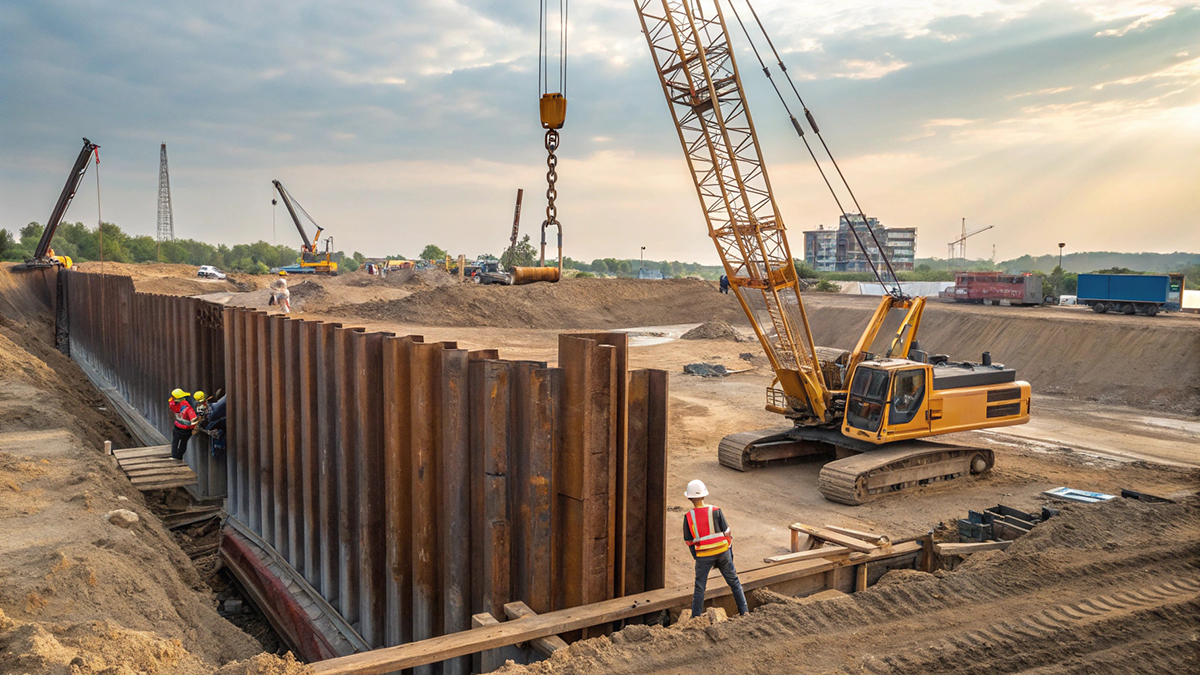
I have visited many piling sites over the years, from flood defense lines in Southeast Asia to port expansions in the Gulf. The good sites and the bad sites usually use the same sheet piles, the same hammers, and similar crews. The difference is rarely the equipment. The difference is the set of safety rules the site follows every single day, without exception. In this article, I will share the safety guidelines we hand to our contractor customers before their first steel sheet pile installation begins, based on what I have seen work on real projects.
Why Does Site Preparation Decide Most of the Safety Before Driving Starts?
Most sheet pile accidents are decided before the first pile enters the ground.
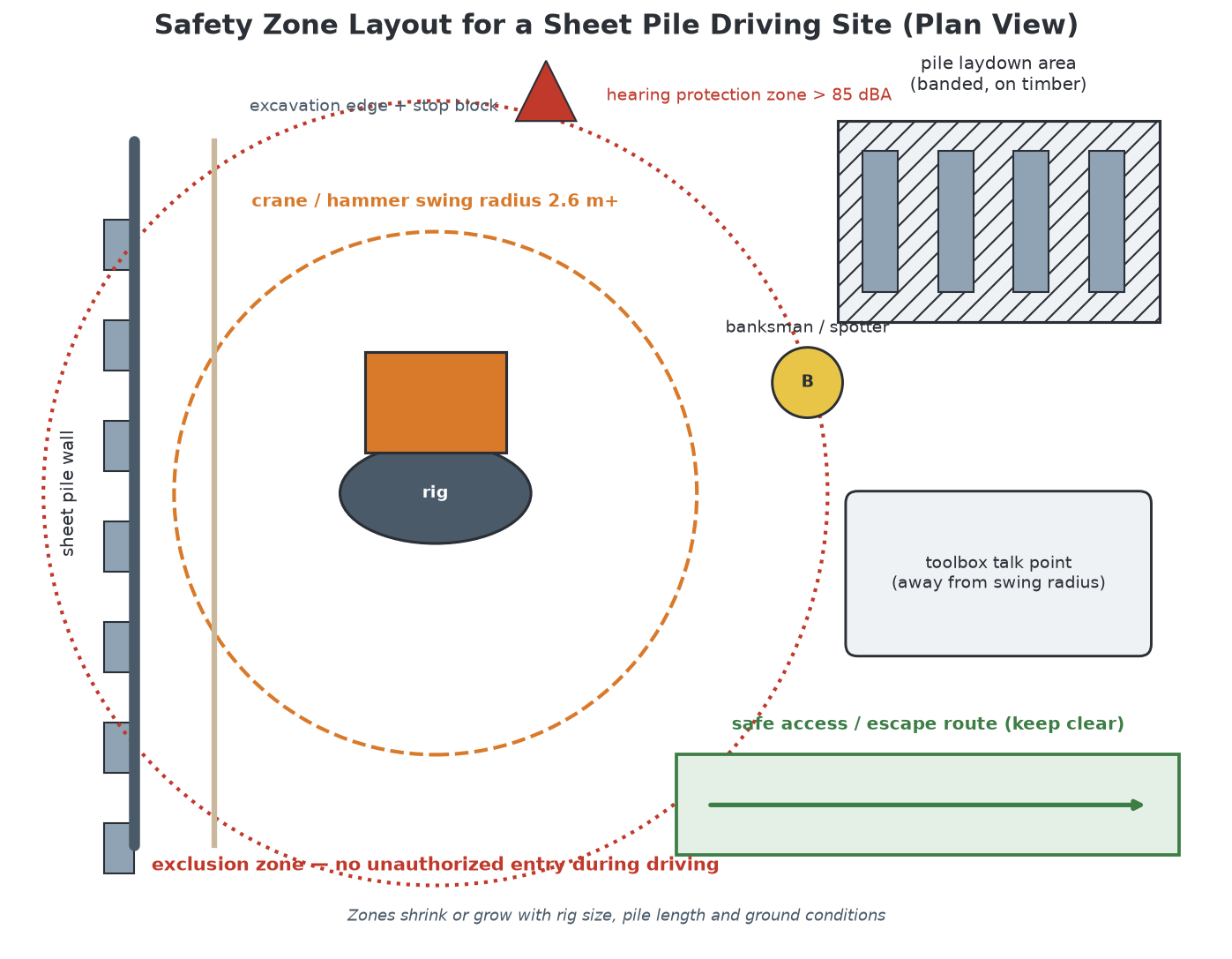
A safe start means a graded and surveyed working platform, buried utility clearance, a soil report on the desk, and a site layout with clear exclusion zones drawn before any rig arrives.
The pre-start checklist I insist on
When I talk with contractors who buy from our factory, I always ask the same first question: what does your working platform look like? A vibratory rig or a crane with an impact hammer needs firm, level ground. Soft spots cause the machine to tilt, and a tilting machine handling a twelve-meter steel pile is a serious hazard. I ask the site team to grade the platform, to know its bearing capacity, and to mark the rig positioning limits with stakes before mobilization.
The second thing is buried services. A sheet pile that hits an underground cable or a gas line can kill. Every site I trust uses utility scans and trial pits along the wall line. The line of the wall should be marked with spray paint, and every scan record should be kept in the site file. This step is also part of the preparation decisions we recommend long before delivery day.
The table below is the pre-start checklist I share with customers.
| Checklist item | What to confirm | Why it matters |
|---|---|---|
| Working platform | Graded, compacted, level, bearing checked | Rig stability prevents overturning |
| Buried utilities | Scanned, marked, trial pits done | Striking a live cable can be fatal |
| Wall line survey | Set out with pins and paint | Prevents sudden plan changes mid-drive |
| Soil report | reviewed by the piling engineer | Chooses the right hammer and method |
| Exclusion zones | Drawn, fenced, signed | Keeps people away from swing radius |
| Lifting plan | Rig capacity, sling ratings checked | Pile lifting is a critical lift |
| Emergency plan | Access route, first aid, contacts set | Cuts response time if something fails |
One more point from experience: confirm the delivery sequence. Trucks arriving with full bundles of piles while the rig is working create traffic conflicts. A simple one-way site route and a fixed laydown area solve most of it. I have seen near misses caused by nothing more than a badly placed truck queue.
What PPE Does a Sheet Pile Crew Actually Need on Site?
PPE will not stop a falling pile, but it decides whether small mistakes become injuries.
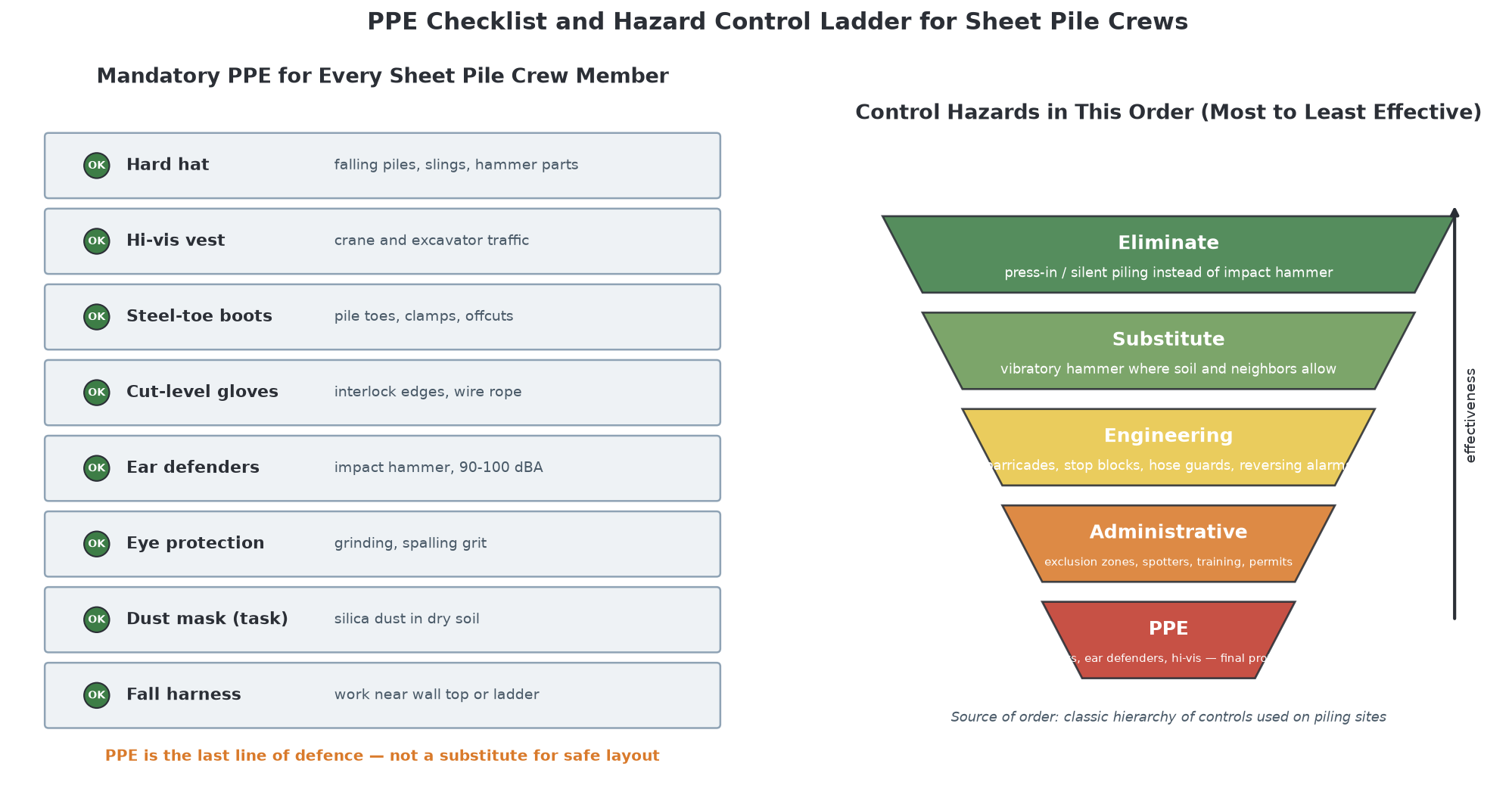
Every crew member needs a hard hat, hi-vis clothing, steel-toe boots, cut-resistant gloves, and hearing protection when hammers run. Eye protection and dust masks are task-based extras, and a harness is mandatory near open edges.
Matching protection to the real hazards
Let me be practical about what each item protects against. The hard hat covers you from slings, pile guides, and hammer parts. Hi-vis keeps crane and excavator operators able to see you. Steel-toe boots matter because piles, clamps, and offcuts land on feet constantly. Cut-level gloves are important in our trade because sheet pile interlock edges are sharp, and wire ropes hide broken strands.
Hearing protection deserves special attention. An impact hammer easily reaches 90 to 100 dBA at the operator position, and hearing damage is permanent. I tell supervisors to treat the hammer zone as a hearing protection zone with clear signs. For the exact exposure limits, we point customers to the occupational noise rules that apply in their country, because the numbers vary but the principle does not.
PPE is only one layer. I encourage every safety officer to follow the hierarchy of controls that health authorities promote. First try to remove the hazard, for example by choosing a press-in system instead of an impact hammer near hospitals. Then substitute, then add engineering controls like barricades and stop blocks, then administrative rules, and only at the end rely on PPE. Sites that work through this ladder spend less money on injuries than sites that just buy helmets and hope.
| Hazard near the crew | First control to try | PPE that backs it up |
|---|---|---|
| Falling or swinging loads | Exclusion zone plus banksman | Hard hat, hi-vis |
| Hammer noise | Barrier or reduced hours | Ear defenders |
| Sharp interlock edges | Gloves issued and inspected | Cut-resistant gloves |
| Silica dust in dry soil | Water suppression | Dust mask |
| Working at wall top | Guard rails and ladder rules | Harness |
How Do You Control the Biggest Hazards During the Drive Itself?
Driving is the loudest, heaviest, and most dangerous phase of the whole job.
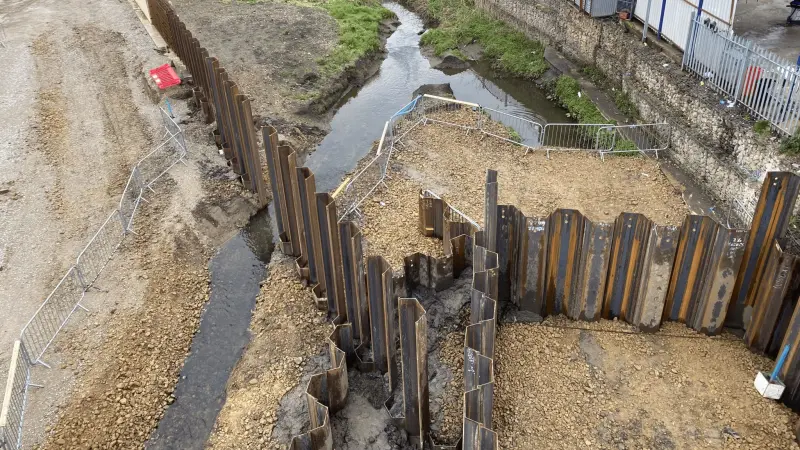
The core rules are simple: nobody stands inside the rig swing radius, every lift follows a lifting plan, guide frames are secured, and the machine stops immediately when an obstruction or sudden settlement appears.
Lifting, swinging, and driving hazards in practice
The suspended pile is the number one hazard. A twelve-meter sheet pile hanging from a crane behaves like a long pendulum in any breeze. The safe pattern I see on disciplined sites is always the same. Two tag lines, one banksman with a clear line of sight to the operator, a lifting plan that names the sling angles, and a hard rule that nobody walks under the load. Bundles in the laydown area are banded and rested on timber so slings can be released without workers climbing between piles.
During driving, the hazards change. With a vibratory hammer, the main risks are hose whip if a hydraulic line bursts and loosened soil collapsing near the wall. With an impact hammer, you add noise, flying debris, and blow damage to the pile head. The installation methods guide on our site explains how the two methods differ, and each method needs its own safety response. Hose guards, daily hose inspection, and a no-people rule near the hammer cover most of it.
Underground obstructions create the sudden surprises. Concrete, boulders, or old foundations stop a pile mid-drive. The correct response is to stop the machine, lift the pile clear, and investigate. I have heard of crews that kept driving to force through an obstruction, and the pile toe tore sideways or the hammer shoe cracked. That is how pile handling injuries and common site problems start. Stopping early is always cheaper.
Finally, watch the guide frame. Sheet piles need guides to stay aligned, and an unsecured guide frame can move under lateral loads. The frame should be pinned to the ground or braced against the structure, and checked after the first few piles are driven.
What Special Rules Apply Around the Excavation Edge and Existing Structures?
Once the wall is in and excavation starts, the risk picture changes completely.
Excavation inside a sheet pile wall needs edge protection, ladder access every few meters, no plant surcharge close to the wall, and daily inspection of deflection, seepage, and ground movement behind the wall.
Keeping people safe inside the cofferdam or trench
Workers inside the supported dig face three classic risks. They fall from the edge, they are struck by plant working above them, or the wall system itself shows unexpected movement. The defenses are straightforward. Guardrails and stop blocks at the edge, so machines cannot roll in. Dedicated ladder access points, kept clear, so nobody climbs the struts or wales. And a rule that spoil and materials are stockpiled at a distance from the wall, because extra surcharge pressure is one of the most common causes of wall distress.
Monitoring is the quiet hero here. On sites I respect, someone walks the wall line every morning. They look for bulging, fresh water paths through interlocks, cracks in the ground behind the wall, and movement in neighboring structures. Any change goes to the engineer the same day. This daily habit pairs well with the accuracy and alignment checks made during driving, because a wall that went in badly will show it during excavation.
If the wall is temporary and will be pulled, extraction has its own rules. The pulling loads can shock-load the crane, so extraction points, sling angles, and the pull direction must be in the method statement. Our temporary structures guide covers the design side; on site, the crew side needs the same seriousness.
Emergency readiness inside the dig
One more layer completes the picture: the emergency plan. Before excavation opens, the site should already know the answers to three questions. Who calls for help, and is that number posted at the gate? Where is the nearest hospital route, and can an ambulance actually reach the pit? And where is the rescue equipment if someone is trapped by a minor collapse or a fall? I ask site agents to run one short drill in the first week of excavation. The drill usually takes twenty minutes, and it always finds something: a blocked access route, a missing stretcher, or a gate that the foreman cannot open alone. Fixing those problems in week one is a bargain compared to finding them during a real incident. Emergency readiness is not paperwork. It is the part of the plan you hope to never use, and the part you must never skip.
How Do Weather, Neighbors, and Shift Routine Change Your Safety Plan?
Site safety is not only steel and machines. Conditions around the wall matter too.
Wind stops pile lifting above defined limits, heat and cold change how crews work, neighbors set noise windows, and a short daily toolbox talk keeps every rule alive from first pile to last.
Practical adjustments that keep the schedule safe
Wind is the first limit I check. Most lifting plans I have seen stop crane lifts of long piles around sustained winds of roughly 12 to 15 meters per second, and the exact limit comes from the rig manufacturer. Rain affects platform strength and visibility. In the Middle East projects we supply, extreme heat means hydration breaks and shifted working hours. In Australian winter jobs, mud changes the platform bearing capacity. The method statement should list these triggers before the project starts, not after the first bad day.
Neighbors shape the plan as well. Schools, hospitals, and existing buildings set the noise and vibration windows. Choosing a vibratory or press-in method, or limiting impact driving to certain hours, is both a courtesy and a safety measure, because rushed night work is where shortcuts happen. This is exactly the kind of trade-off we discuss with distributors and contractors when they select sections and installation equipment from us.
The last habit is the daily toolbox talk. Five minutes at the start of each shift. Yesterday’s issues, today’s tasks, wind forecast, lifting sequence, and who is the banksman. It sounds almost too simple, but the safest sites I have ever walked onto all did it, every day, and it shows in their incident records.
What Do I Tell Every Contractor Before Their First Container Arrives?
Here is my honest view after years of shipping sheet piles to projects on five continents. Most safety failures in our industry are not exotic. They come from treating the sheet pile stage as routine. Crews get relaxed because the wall goes in fast, and fast work with 600-kilogram steel sections is exactly where discipline pays. My advice is to write your safety guidelines as a short, numbered document, train every new crew member against it, and put the same rules in the subcontract. Contractors who do this tend to also run their schedules better, because safe sites are organized sites, and organized sites drive piles faster. I would rather lose a day to a good lifting plan than lose a worker to a skipped one.
Conclusion
Safe sheet pile installation comes from preparation, PPE, controlled lifting, edge discipline, and daily habits. Make these guidelines routine, and the wall goes in fast and everyone goes home.
Tags: steel sheet pile safety, sheet pile installation, construction site safety, piling PPE, excavation safety