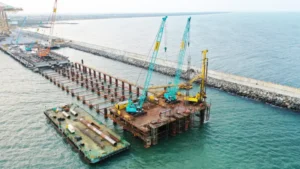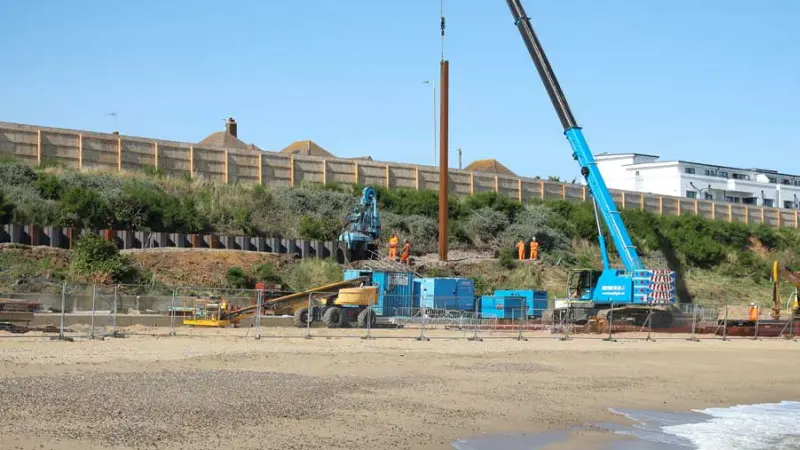
A coastal town in Southeast Asia was losing its beach and its road. I supplied the sheet pile wall that stopped both losses in one line.
A 620-meter hot-rolled Z-type steel sheet pile wall now shields this coastal road from wave attack and erosion. Driven in six weeks through soft sand, anchored with tie rods, and protected by a rock toe, the wall has survived two monsoon seasons with zero measurable shoreline retreat behind it.
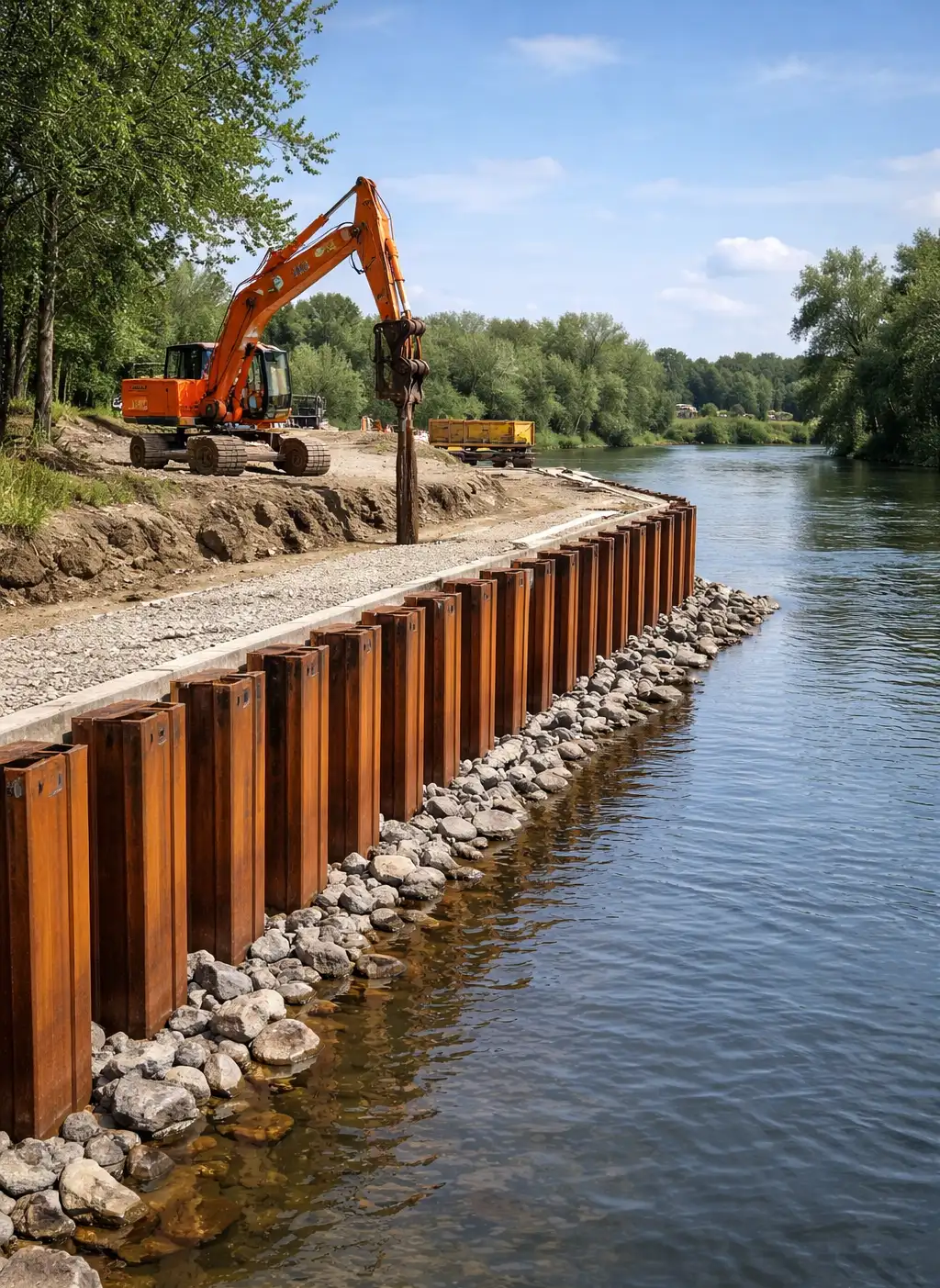
In this case study, I will take you through the project exactly as I lived it: the failed concrete revetment that came before us, the site data we demanded before quoting, the profile and steel grade we selected, the installation sequence on a live beach, and the numbers the client measured afterward. If you are evaluating coastal protection options, this is the honest, unfiltered version of how one wall went from inquiry to working structure.
Why Did This Coastal Town Need a Steel Sheet Pile Wall?
The town sits on a low sandy shore where the only coast road carries fishing traffic and tourism buses within thirty meters of the mean high-water line. For a decade the town protected the road with a sloped concrete revetment, and for a decade the sea dismantled it panel by panel.
Wave scour undermined the old concrete revetment’s toe, panels cracked and settled, and the beach in front of it narrowed every monsoon. The town needed a wall whose toe could not be undermined, whose sections could be replaced individually, and whose footprint would not eat what little beach remained.
I received the first inquiry through our website in March, with three photographs of the collapsed revetment and one sentence: “The sea is taking the road.” That sentence told me more than the photographs. Toe failure under a rigid revetment is the classic argument for a continuous interlocked wall, because a sheet pile wall drives its defense below the scour line instead of sitting on top of it. Our previous work on steel sheet piles for port and harbor protection projects had faced the same wave mechanics, just at a larger scale.
The three requirements the client fixed from day one
First, no beach sacrifice. A rubble mound breakwater needs a base width of roughly twice the wave height, and this beach could not give up that width. Second, speed. The road had to stay open, so the wall had to be built in short sections with the beach still in use between shifts. Third, repairability. The town’s maintenance budget is small, so any damaged length had to be replaceable without rebuilding the whole line. Steel sheet piles answered all three, and our interlock performance comparison in steel sheet pile interlock types and their performance advantages helped the client’s engineer accept that a driven wall would hold water and sand equally well.
What Did the Site Investigation Reveal Before We Quoted?
I refuse to quote coastal walls from photographs, and this project proved why. The client’s first concept assumed one uniform sand profile along the whole 620 meters. The actual ground told a different story.
Boreholes showed 4 to 6 meters of loose micaceous sand over firm clay, a groundwater table within 1 meter of beach level, and a calculated scour depth of 2.8 meters below the existing seabed at the wall line. That scour number, not the retained height, decided the pile length.
I asked for three documents before I priced a single pile: the tide record, the wave study from the regional port authority, and two boreholes per hundred meters. The client’s engineer pushed back on the borehole count, then thanked me later. Sand beaches migrate seasonally; the design had to account for a seabed that would not stay where the survey found it. The tidal range measured 2.1 meters, with monsoon waves offshore reaching 2.5 meters significant height, which the refraction study converted to about 1.8 meters at the wall line.
How the ground data changed the design
The loose sand layer dictated embedment: the piles needed to find the clay, not just satisfy a sand embedment rule of thumb. The high groundwater table meant the wall would work doubly hard, retaining saturated sand on the landward side during storms while waves attacked the seaward face. And the 2.8-meter scour depth meant every pile needed at least 3.5 meters of embedment below the predicted scour line, pushing our lengths to 14 meters for the exposed central section. Our guide on riverbank and flood control solutions using steel sheet piles describes similar scour-driven length decisions on river works, and the same logic applies with sharper teeth in tidal water. The client also cross-checked storm exposure against the regional tide data published by NOAA’s global station network for comparable Southeast Asian harbors.
Which Profile and Steel Grade Did We Choose?
Profile selection balanced three forces: the bending moment from the 3.2-meter retained height plus surge loading, the driving resistance through dense clay at the toe, and the town’s budget.
We supplied hot-rolled Z-type sheet piles, 600 mm wide, 14 meters long in the central 380 meters and 12 meters at the sheltered ends, in S355GP with a +2 mm sacrificial thickness built into the section selection. Z-type gave the required 1,350 cm³/m section modulus with the tightest interlocks for sand retention.
Why hot-rolled rather than cold-formed? The driving conditions included cemented sand seams that would have opened a cold-formed interlock seam and let fines wash out. Hot-rolled interlocks, rolled under pressure, hold their shape through hard driving, which is exactly the condition our common steel grades used for steel sheet piles guide addresses when matching grade and forming route to driving effort.
The grade decision and what it costs over 40 years
S355GP with a sacrificial thickness allowance beat upgrading to a marine-grade alloy on pure lifecycle economics for this site. The splash zone at this beach sits within a 1.2-meter band, and our corrosion allowance covers 40 years in that band without coating renewal, while the buried and submerged zones lose steel far more slowly. The client’s engineer reviewed the loss-rate tables in ASTM A690 and our own corrosion-adjusted service life data before accepting the scheme. For a town budget, spending the upgrade money on a heavier section bought more life per dollar than spending it on a fancier alloy.
| Design factor | Central 380 m | Sheltered ends |
|---|---|---|
| Pile type | Hot-rolled Z-type, 600 mm | Hot-rolled Z-type, 600 mm |
| Length | 14 m | 12 m |
| Steel grade | S355GP +2 mm allowance | S355GP |
| Section modulus | 1,350 cm³/m | 1,100 cm³/m |
| Embedment below scour | 3.5 m | 2.5 m |
How Was the Wall Installed on a Live Beach?
The beach stayed open to fishermen throughout construction, which set the rhythm of the whole installation. We planned the works around the tide, not against it.
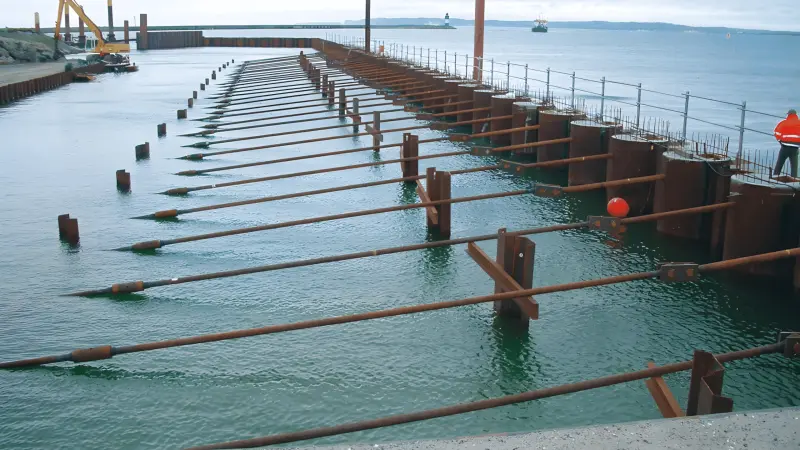
A 50-ton crawler crane with a vibratory hammer drove panel-by-panel in 12-meter shifts, working the low-tide windows. Serviceable tie rods tied the wall to deadman anchors, and each completed panel received its rock toe apron before the next panel started, so no length of wall ever stood unballasted overnight.
The vibratory hammer drove most piles to grade in under eight minutes each. Dense clay seams slowed the final meter, and a drop hammer finished those piles to refusal without damaging heads, a sequence explained in our comparison of vibratory versus impact hammer driving. The crew of fourteen completed 620 meters, including anchoring and toe protection, in six working weeks.
The installation sequence that kept the road open
Each week followed the same choreography. Monday morning, survey and set out the panel line. Monday through Thursday, drive in the low-tide windows, typically two shifts per day. Friday, install tie rods and deadman anchor blocks for the completed panel, then place the 300-kilogram rock apron over a geotextile filter at the toe. The geotextile matters as much as the rock: without it, waves pump sand out through the armor and the toe undermines itself, which is precisely how the old concrete revetment died. Our article on using steel sheet piles for cofferdams and deep excavations covers the same tide-window discipline for marine enclosures. Interlock sealing was limited to the six panels flanking the boat ramp, where our leakage prevention details specified bituminous seals; everywhere else, the natural sand-clogging of the interlocks did the sealing for free.
How Does the Wall Handle Waves, Scour, and Corrosion?
A coastal wall fails at its edges: the toe, the ends, and the splash band. We designed each edge deliberately rather than hoping the middle held.
The wall’s defense is a three-layer system: the piles themselves carry wave and soil loads down past the scour depth, the rock toe apron stops local seabert erosion in front of the wall, and the sacrificial steel thickness absorbs the corrosion budget in the splash band where loss rates peak.
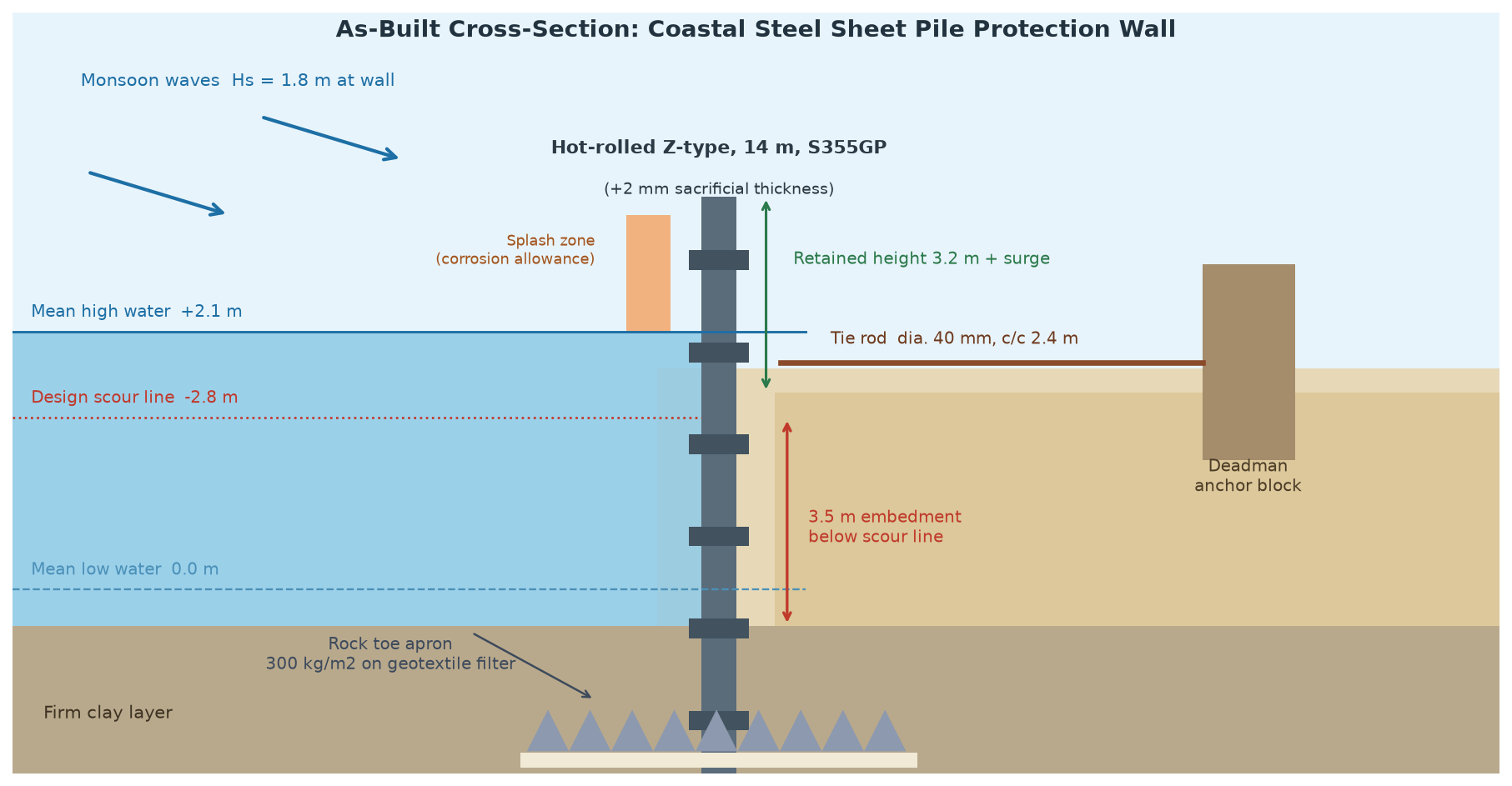
The wave climate here is seasonal, not extreme. Monsoon waves attack for roughly four months, then the shore quiets down. That rhythm suits steel, because the failure mode under cyclic wave loading is progressive scour and vibration, not a single overload. The tie rods see their peak forces during spring tides with onshore winds, and the deadman anchors sit far enough landward that the passive wedge behind them never intersects the wall’s active wedge. We sized the whole system with the coastal engineering guidance published by ASCE’s Coasts, Oceans, Ports and Rivers Institute, and the town’s engineer validated flood levels against the national mapping standards referenced by FEMA’s flood zone program, since insurers asked for that comparison before renewing the road’s policy.
What two monsoon seasons have proven
Two monsoons in, the survey shows zero measurable retreat of the sand line behind the wall, an unchanged toe level under the rock apron, and tie rod force monitors sitting within 8 percent of design values. The splash band shows surface oxidation where we predicted it, with pit depths under half the allowance. Sand has accumulated 40 centimeters against the seaward face in the shadow of the wall, which tells us the beach is rebuilding, not starving. 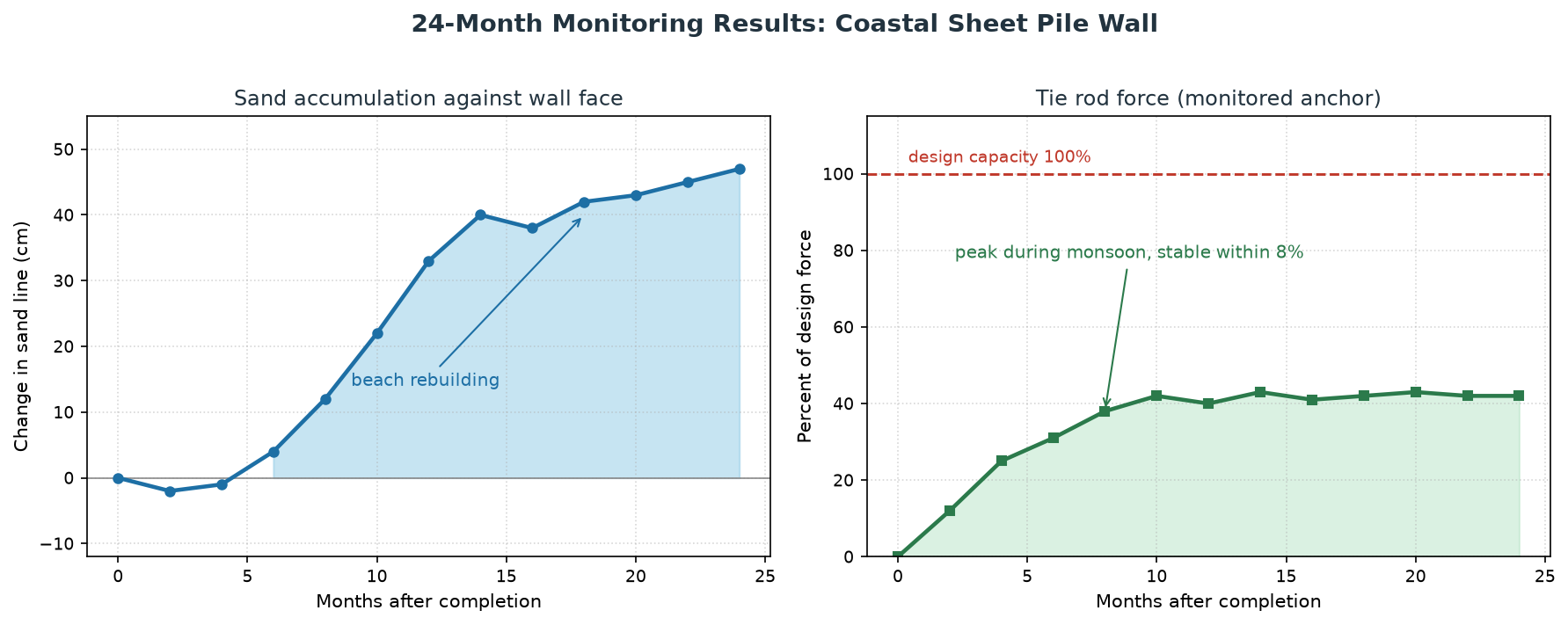
The general manager of the provincial roads office told me the line item he cares about is maintenance, and the wall has cost them two inspections and nothing else. For a municipality that was patching concrete panels twice a year, that is the whole business case, and our long-term port protection case experience shows the same maintenance curve at larger scale.
What Would I Do Differently on the Next Coastal Wall?
Every project teaches the supplier something, and pretending otherwise would be dishonest. This one taught me three things worth passing on.
Three lessons: demand the wave and scour studies before quoting, price the rock toe and geotextile as seriously as the piles themselves, and insist on tie rod force monitoring at two or three points so the client can see the wall working. The steel was never the risky part of this project. The edges were.
If I requote this wall tomorrow, I would push harder for instrumented tie rods at three points instead of two, because the middle anchor’s readings explained a redistribution the end anchors hid. I would also specify a slightly wider rock apron at the transition panels where the wall meets the boat ramp, since the survey found minor scour there during the second monsoon. Neither issue threatens the structure, but both are the difference between a wall that works and a wall that works without asterisks. Coastal protection is a system sale, and the buyer who understands that gets a wall that outlives the engineer who designed it. When I help customers select sections for similar shorelines, I start from the profile selection logic and then adjust for the two coastal specifics: wave-driven scour and the splash-zone corrosion budget.
My Take as a Supplier
Here is my honest view after supplying this wall and watching it work. Coastal protection buyers obsess over the steel price per square meter, and I understand why, but the quotes that look cheapest on paper usually differ from mine in one place: the toe. A wall without a designed toe and filter is a concrete revetment waiting to happen again. I would rather lose an order to a competitor who underprices the toe than win it and photograph the failure in three years. So when you compare coastal wall offers, compare the embedment below scour, the filter layer, and the splash-zone allowance first. The pile price differences will almost sort themselves out, and the wall you buy will still be standing when the beach in front of it has grown back. Our factory in Liaocheng rolls and supplies Z-type and U-type sections for coastal projects across Southeast Asia, the Middle East, and Africa, with SGS inspection before shipment, and we quote wholesale volumes for contractors and distributors through cnsteelplant.com.
Conclusion
Design the toe, protect the splash zone, and a sheet pile wall turns a losing shoreline into a stable one for decades.