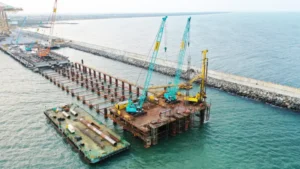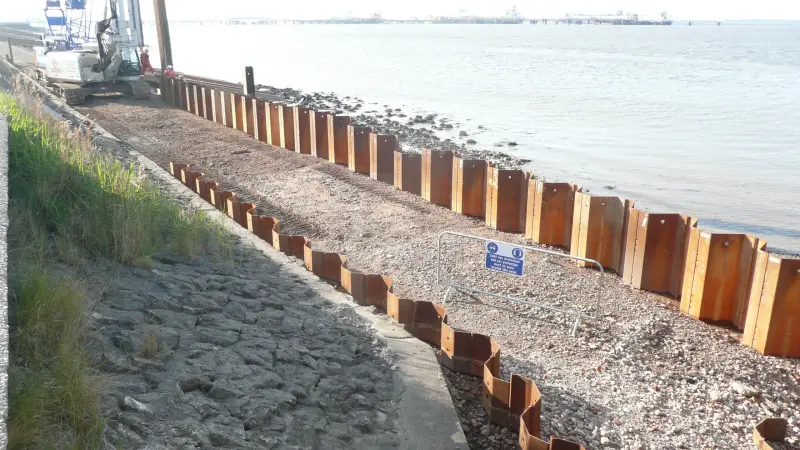
Every flood season, rivers eat away at soft banks and take roads, fields, and buildings with them. I have watched this happen on more than one project site.
Steel sheet piles solve riverbank and flood control problems by forming a continuous, interlocked steel wall along the bank. The wall stops soil erosion, holds back water, and can be driven fast with a vibratory hammer. A hot-rolled sheet pile wall typically serves 50 years or more with basic maintenance.
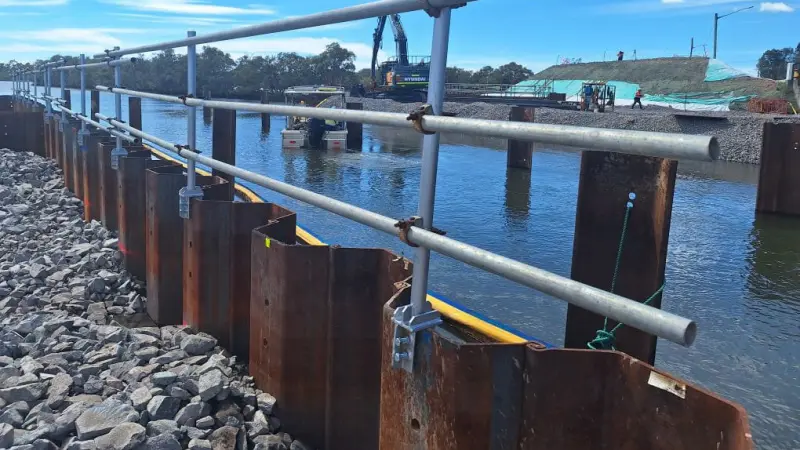
In this article, I will walk you through how we look at riverbank and flood control work from a factory point of view. I will cover why banks fail, how we design the wall, which profiles and steel grades we ship most often for river projects, how installation runs on a live bank, and what the wall costs over its full life. If you are a contractor, a civil engineering company, or a steel distributor planning a river project, this is the same advice I give our export customers in the Middle East, Australia, Africa, and the Americas.
Why Do Riverbanks Fail, and Where Do Steel Sheet Piles Fit In?
A riverbank rarely fails for one single reason. In most projects I review, two or three forces attack the bank at the same time.
Riverbanks fail through surface erosion from flowing water, scour at the bank toe during floods, and slope sliding when saturated soil loses strength. A steel sheet pile wall counters all three at once: it arms the face, drives below the scour level, and acts as a cut-off against seepage.
The three failure modes I see most often
First, there is surface erosion. Rain and waves wash the bank face away layer by layer. This is slow, but it never stops, and it steepens the slope until something bigger happens.
Second, there is toe scour. During high flow, the river picks up soil at the foot of the bank. Once the toe is undermined, the whole slope above it can slide into the water. I have seen pictures from a customer in Southeast Asia where five meters of bank disappeared in one flood night, right where a market road ran along the top.
Third, there is slope failure. When the river drops after a flood, the soil inside the bank stays saturated. The water pressure inside the slope pushes out, and the weak bank slides. This is why riverbank protection projects need a structure that works with groundwater, not just against the surface flow.
A steel sheet pile wall deals with each mode in a different way. The steel face stops surface erosion. The embedded toe reaches below the expected scour depth, so the river cannot undermine it. And the interlocked wall, when it penetrates into a low-permeability layer, slows down seepage through the bank. That third point matters more than most buyers think, and we cover it in detail in our guide on how to prevent leakage in sheet pile walls. For the wider system view, our overview of steel sheet piles for flood control systems shows how the same wall family fits dams, levees, and drainage channels.
| Failure mode | What happens on site | How a sheet pile wall responds |
|---|---|---|
| Surface erosion | Waves and rain peel the bank face away | Steel face fully arms the slope |
| Toe scour | Flood flow removes soil at the bank foot | Pile toe is designed below scour level |
| Slope sliding | Saturated soil loses strength and slides | Wall retains the slope and cuts off seepage |
When a bank needs all three protections at the same time, riprap or gabions stop looking economical. That is usually the moment a contractor calls us.
How Do You Design a Sheet Pile Wall for Riverbank and Flood Loads?
Design is where river projects differ most from ordinary retaining walls. The river changes the loads, and it changes the ground they stand in.
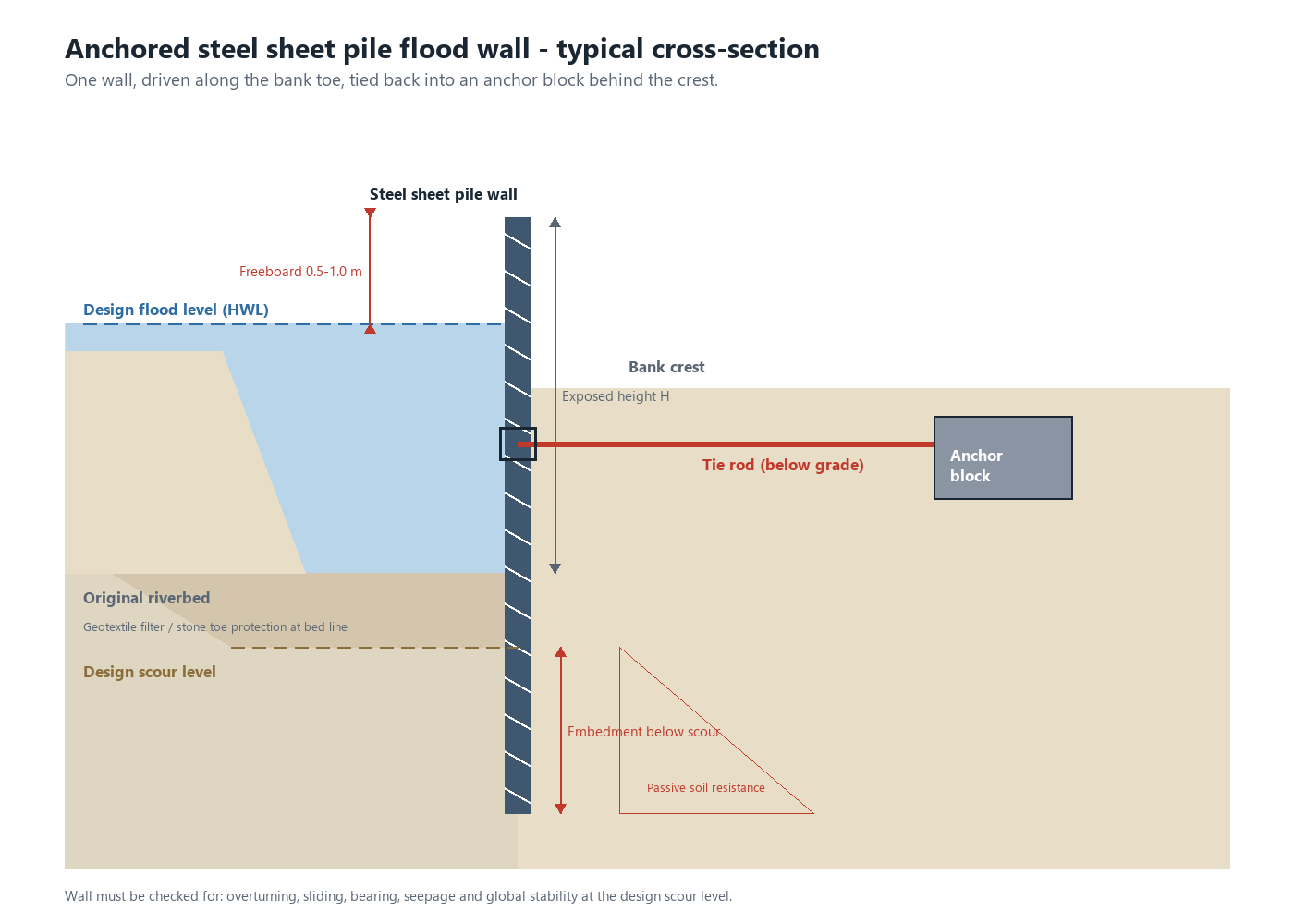
A riverbank sheet pile wall must be checked for earth pressure, water pressure difference, scour at the toe, and stability at the lowest expected riverbed. The wall is designed with its embedment measured from the scour level, not from the current bed, and with freeboard above the design flood level.
Load cases that drive the design
I always tell customers to start with four questions. How high can the flood get? How deep can the river scour? What is the soil? And is the wall cantilevered or anchored?
The design flood level sets the top of the wall. Most specifications ask for 0.5 to 1.0 meters of freeboard above the design levee water level. If the client has a 50-year or 100-year flood requirement, that number comes straight from their hydrology study, and my job is to match the wall to it, not to argue with it.
The scour level sets the bottom of the design. We calculate the embedment from the scour line, not from today’s riverbed. If the wall loses two meters of embedment in a flood, a cantilever design can fail even if the steel itself is untouched. This is the single most common mistake I see in first-round drawings from new customers. For stability checks we point them to our guide on how to calculate sheet pile wall stability, which follows the same limit-state steps most consultants use.
Soil decides the section. Soft river silt gives low soil resistance, so the wall needs either a bigger section, an anchor system, or both. Sand drains well but scours fast. Our own drawing shows the typical setup: a wall with a tie rod and anchor block behind the crest, embedment below the scour line, and a stone toe with a geotextile filter at the bed line. The anchor cuts the bending moment in the pile roughly in half, which often lets the buyer drop one full section class and save real money.
| Load case | What drives it | Design check |
|---|---|---|
| Earth pressure | Soil behind the wall | Bending moment and embedment |
| Water pressure difference | Flood outside, low water inside | Sliding and overturning |
| Scour | River flow at the toe | Embedment measured from scour level |
| Seepage | Head difference across the wall | Piping and heave at the toe |
One more point from experience: check the wall for the flood peak and for the rapid drawdown after it. Rapid drawdown is often the worse case for the slope behind the wall, because the retained soil is still wet when the supporting water is gone.
Which Sheet Pile Profiles and Steel Grades Suit River Work?
Buyers often ask me which profile to pick for a riverbank. My answer is always the same: the profile follows the wall height and the soil, not the catalog.
For riverbank walls up to 4-5 meters, U-type hot-rolled sheet piles in S355 or Q355 steel are the most common choice. Z-type profiles suit higher walls and heavy loads, straight-web piles suit walls that take pure tension in the interlocks, and corrosion allowance matters more near water than raw strength.
U, Z, and straight web near water
U-type piles dominate river work, and there is a simple reason. Most riverbank walls are moderate in height, and U sections give a good modulus per kilogram at exactly that range. Our Southeast Asia riverbank project used hot-rolled U-type piles driven with a vibratory hammer, and the contractor held the schedule without any special equipment.
Z-type piles come in when the wall gets tall or the loads get serious, for example where a flood wall carries a road on the crest. The interlock types and their performance advantages matter here too, because a tight hot-rolled interlock keeps soil and water where they belong. If you are comparing the two families in detail, our U-type versus Z-type guide for hot-rolled versus cold-formed sheet piles covers the trade-offs.
| Profile | Best fit in river work | Watch out for |
|---|---|---|
| U-type (hot-rolled) | Walls up to about 5 m, standard bank protection | Check combined bending in the interlock |
| Z-type | Tall flood walls, walls carrying surcharge | Higher cost per piece, plan the handling |
| Straight-web | Tie rod anchor walls, circular cells | Not for bending-heavy cantilever walls |
On steel grade, S355GP and Q355B cover most river projects we ship. Where the water is aggressive or the site sits in a splash zone, we quote grades with extra corrosion allowance or advise a coating system for the upper section. Fresh water is much kinder to steel than seawater, but a river wall still lives in wet soil, and buyers who ignore the corrosion allowance always pay for it later. For long-term planning, our guide on the lifespan of steel sheet piles gives realistic service-life numbers by exposure zone.
How Are Sheet Piles Installed on a Live Riverbank?
A riverbank is not a green-field site. The river keeps flowing, the access is narrow, and the schedule usually fights the rainy season.
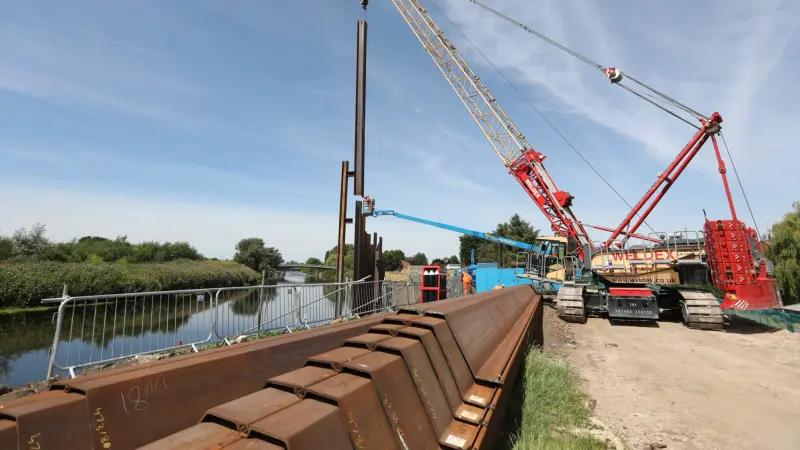
On a live riverbank, sheet piles are pitched panel by panel along the wall line and driven with a vibratory hammer, usually from the bank or from a temporary working platform. The key controls are leader accuracy, interlock alignment, and daily driving records that catch refusal early.
Driving method and sequence
Most of our customers drive U-type piles with a vibratory hammer mounted on an excavator or a crane with leaders. Vibration suits soft river soils, it is fast, and it keeps noise acceptable near towns. Where the wall must pass through stiff layers or old fill, we discuss impact hammers or pre-drilling, and our comparison of vibratory versus impact hammers is the page I send before every such call.
The sequence looks simple, but the details decide quality. The crew sets the first pairs carefully, because they define the wall line. Each new pair threads into the previous interlocks before driving starts. On curved alignments, the crew adjusts the pitch slightly to keep the wall on the design radius. Driving records go into a daily log: blows, depth, time, and any refusal. When a pile stops early, the crew checks for an obstruction before forcing it, because a forced pile tears interlocks and opens the wall.
| Stage | Activity | Key control |
|---|---|---|
| Preparation | Clear the bench, set the wall line | Alignment and access for the rig |
| Pitching | Thread piles into previous interlocks | First pairs set true and plumb |
| Driving | Vibratory driving in panels | Driving log and refusal checks |
| Finishing | Cut tops, install capping or tie rods | Level and anchor tension |
Timing matters as much as method. On flood rivers, the smart window is the dry season, when the water is low and the bank is workable. One of our Middle East customers lost two weeks to an early rainy season because procurement slipped; since then, we keep buffer stock in Liaocheng so the piles leave the yard fast when their window opens. For projects with coffered work zones inside the bank, the same piles often serve twice, first as a temporary cofferdam and then in the permanent wall, which brings us to money.
What Does a Sheet Pile Riverbank Wall Cost Over Its Lifetime?
Upfront price is what procurement sees. Whole-life cost is what the owner pays. These are not the same number.
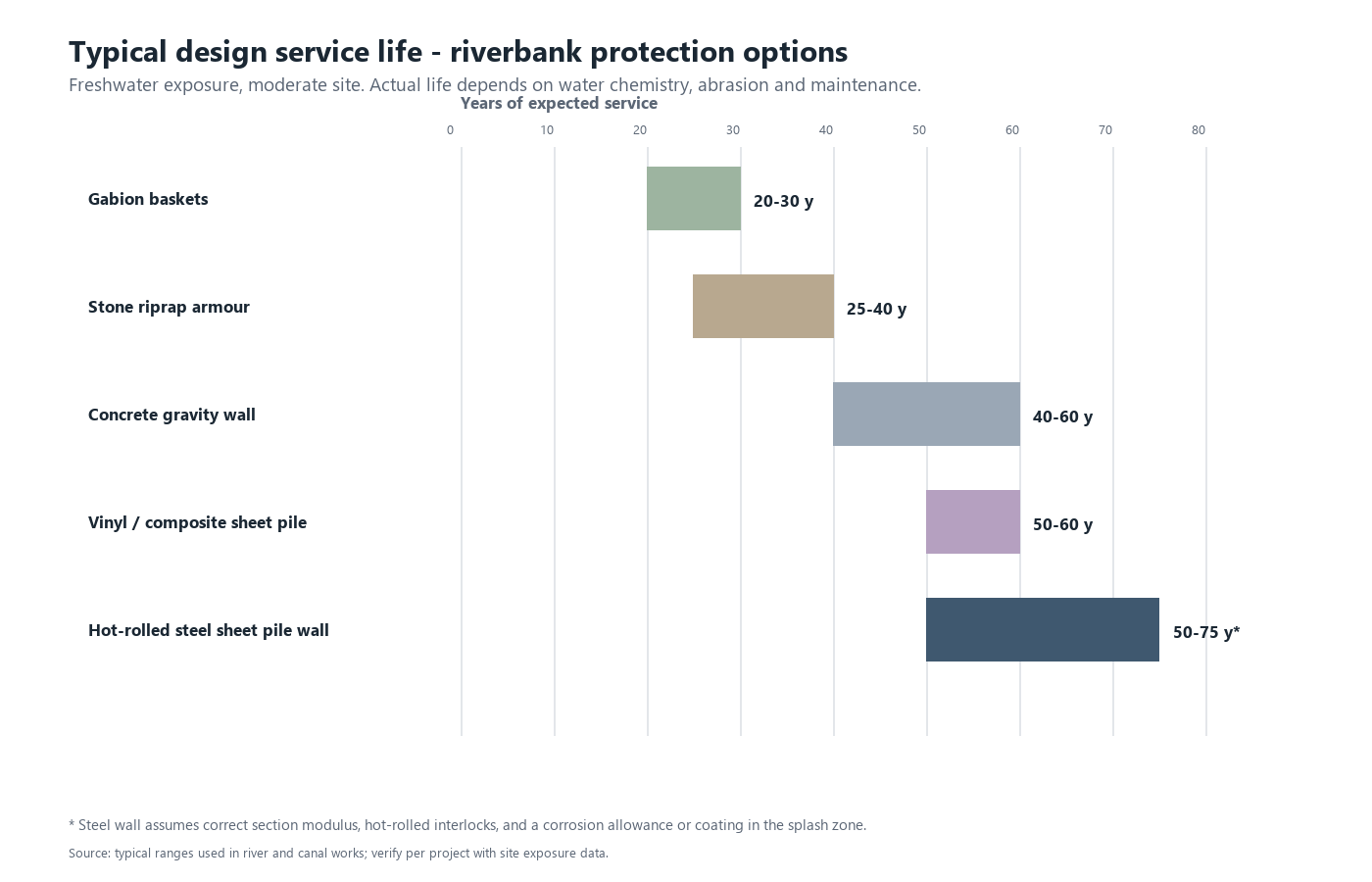
A steel sheet pile riverbank wall costs more per meter than riprap at day one, but it usually wins over the full life: it needs little maintenance, holds its line for decades, and a temporary wall can be extracted and reused, recovering part of the investment.
Whole-life cost drivers
Look at the chart above. Gabions and riprap look cheap, and for gentle slopes with low flow they are a valid choice. But they sit on the surface. When scour undermines them, the repair costs come back every few floods, and each repair closes the road or the levee crest while crews re-place stone.
A concrete gravity wall lasts long, but it needs formwork, reinforcement, curing time, and a wide foundation. On a narrow river bench, that width simply does not exist. A sheet pile wall takes up almost no width beyond the wall line itself, which is why city riverbanks keep choosing steel.
| Option | First cost | Maintenance | Usable where |
|---|---|---|---|
| Gabion / riprap | Low | High after floods | Gentle slopes, low flow |
| Concrete gravity wall | High | Low | Wide, strong foundations |
| Steel sheet pile wall | Medium | Low | Narrow banks, scour risk, flood walls |
Three factors decide the steel wall’s lifetime cost. First, the corrosion allowance: extra steel thickness at the splash zone is the cheapest insurance you can buy. Second, the driving conditions: hard driving wears equipment and can damage interlocks, so the soil survey pays for itself. Third, reuse: on temporary flood defense or works access walls, sheet piles can be reused after extraction, and our wholesale customers in Africa and the Middle East now plan buy-back of used piles into their next project. Owners who compare all three factors against a riprap repair cycle almost always see the steel wall differently.
My Take as a Supplier
Here is my honest view from the factory floor. Most riverbank failures I hear about were not steel problems or design problems. They were boundary problems: the wall was designed for today’s riverbed, and the river moved. So when a customer sends me drawings, I do not start with the price list. I ask for the scour study first. Ten minutes of reading that document has saved customers more money than any discount I could give, because it tells us the real embedment, the real section, and the real risk. Give your supplier the hydrology, not just the wall length, and the steel will do the rest. If you want to go deeper before you order, our dedicated guides on riverbank sheet pile walls and what type of sheet pile is best for riverbanks answer the questions we hear most in inquiries.
Conclusion
Steel sheet piles give riverbanks one structure that stops erosion, survives scour, and holds back floods, with low maintenance and real reuse value.
Tags: steel sheet piles, riverbank protection, flood control, sheet pile wall, erosion control