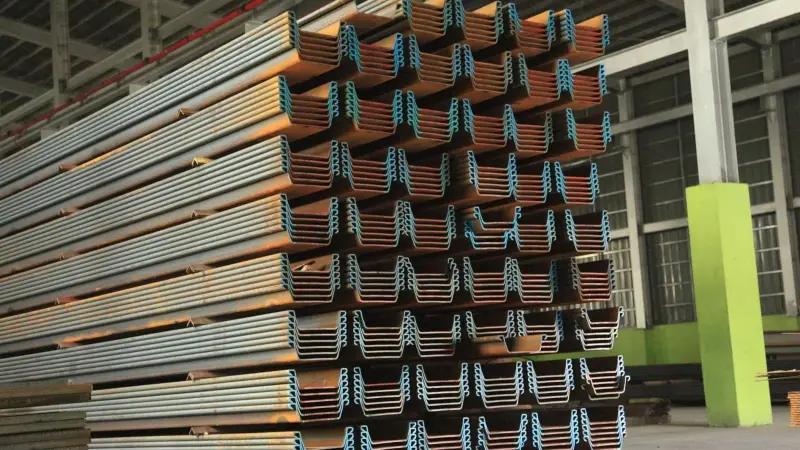
Unexpected groundwater and unstable soil can quickly stop a construction project. I have seen many contractors face delays because they selected the wrong cofferdam system.
Steel sheet piles are the most common material for temporary cofferdams because they create strong retaining walls, control groundwater, install quickly, and can often be removed and reused after construction.
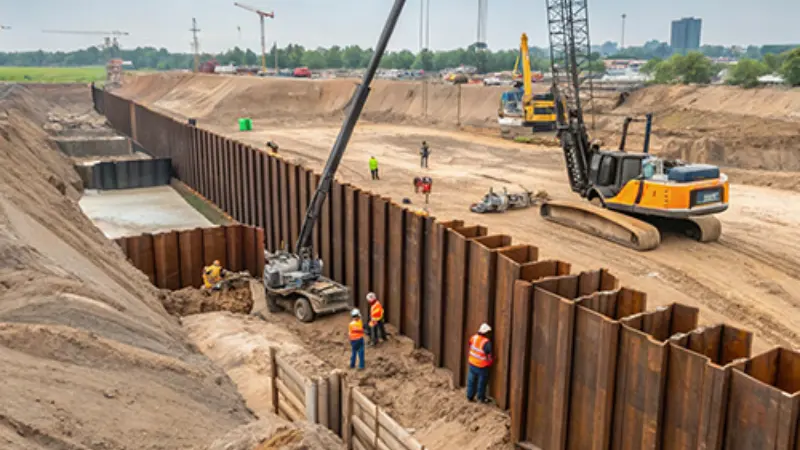
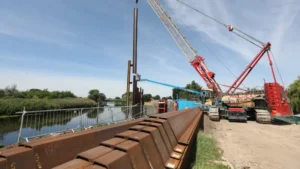
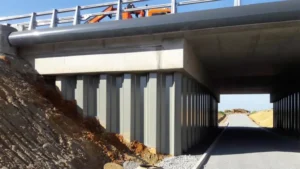
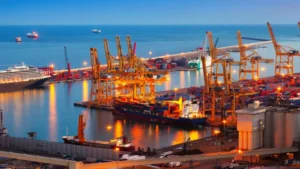
Temporary cofferdams are used in bridge construction, port expansion, pump stations, marine engineering, and deep excavation projects.[web:3] I often work with contractors who need a reliable solution that is both strong and cost-effective. From my experience, steel sheet piles remain the preferred choice because they provide high structural strength, fast installation, and excellent adaptability in different soil conditions.[web:17] In this article, I will explain what types of piles are commonly used for cofferdams and whether sheet piling should be considered temporary work.
What type of piles are typically used to construct cofferdams?
Choosing the wrong pile type can increase costs and delay construction. I always recommend selecting the pile according to soil conditions, water depth, and project duration.
Steel sheet piles are the most common piles used for temporary cofferdams because they form continuous interlocking walls that resist soil and water pressure. H-piles, pipe piles, and soldier piles may also be used for special foundation support.
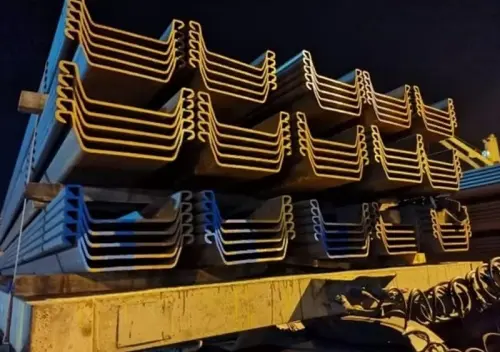
Why steel sheet piles are the first choice
A cofferdam creates a dry working area by keeping soil and water outside the construction zone.[web:4] The retaining system must withstand lateral earth pressure, hydrostatic pressure, and construction loads.
Steel sheet piles perform these tasks very well because every pile interlocks with the next one. The completed wall behaves like one continuous structure instead of many separate members.
This design improves stability and helps reduce water seepage during excavation.
For this reason, engineers choose steel sheet piles for many temporary projects around the world.
Common pile types for cofferdams
Several pile systems are available depending on project requirements.
| Pile Type | Main Function | Typical Application |
|---|---|---|
| U-Type Sheet Pile | Retaining wall | Bridge cofferdams, river projects[web:22] |
| Z-Type Sheet Pile | High bending strength | Deep excavations, ports |
| Ω-Type Sheet Pile | Special retaining structures | Marine engineering |
| Pipe Pile | Vertical load support | Bridge foundations |
| H-Pile | Heavy structural support | Deep foundations |
| Soldier Pile | Excavation support | Urban construction |
Each type has different structural characteristics. The correct choice depends on the design load, excavation depth, and surrounding environment.
Factors I evaluate before recommending sheet piles
Before recommending any section, I normally review several engineering conditions.
- Soil type
- Groundwater level
- Excavation depth
- Water pressure
- Construction schedule
- Reuse requirements
- Equipment availability
- Corrosion conditions
These factors affect both project safety and overall cost.
Why contractors prefer steel sheet piles
I have supplied steel sheet piles to contractors working on bridges, ports, flood control systems, and riverbank protection. Most buyers appreciate the flexibility of these products.
Some important advantages include:
- Fast installation with vibratory hammers
- Easy removal after construction
- High bending resistance
- Excellent interlocking performance
- Good water control
- Wide range of available sections
- Lower overall project cost through reuse
Because many temporary cofferdams only remain in place for several months, reusable steel sheet piles often provide better economic value than cast-in-place concrete structures.
Material selection
Marine and river projects often require higher corrosion resistance.
Engineers may select different steel grades depending on:
| Condition | Recommended Solution |
|---|---|
| Freshwater | Standard carbon steel sheet piles |
| Seawater | Corrosion allowance or protective coating |
| Long-term temporary work | Hot rolled sheet piles |
| Heavy loading | Z-type sheet piles |
| Moderate loading | U-type sheet piles |
Proper material selection extends service life while reducing maintenance during construction.
My opinion
Many customers ask me whether another pile type could replace steel sheet piles in temporary cofferdams.
My answer is usually simple.
It depends on the engineering purpose.
If the project mainly requires retaining soil and controlling groundwater, steel sheet piles are normally the most practical solution.
Our company supplies U-shaped, Z-shaped, Ω-shaped, flat plate, cap type, disc type, and straight flange steel sheet piles through long-term cooperation with certified mills in China. We support OEM production, SGS inspection, flexible MOQ, and fast delivery from Liaocheng, Shandong. Our products are widely exported to Iraq, Saudi Arabia, the UAE, Pakistan, Australia, Africa, Europe, and the Americas.
One project that always comes to my mind is our riverbank protection project in Southeast Asia. The contractor selected hot rolled U-type steel sheet piles because they needed a strong retaining wall with reliable interlocking performance. Installation was completed efficiently with vibratory equipment, and the finished structure successfully stabilized the riverbank while helping control water movement.
From my experience, choosing the correct sheet pile profile early in the design stage saves both construction time and long-term project costs.
Is sheet piling temporary work?
Many people think sheet piles are only temporary because they are often removed after construction. In reality, the answer depends on the project design.
Sheet piling is commonly used as temporary work for cofferdams and excavation support, but it can also serve as a permanent retaining structure when engineers design it for long-term service.
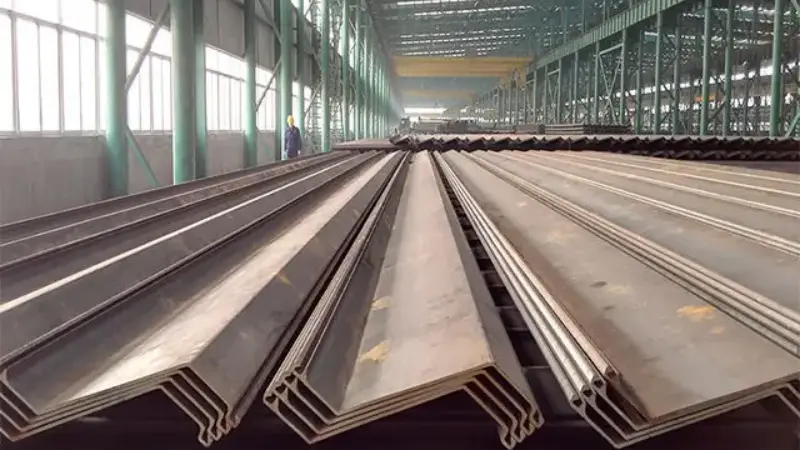
Temporary applications
Temporary sheet piling is one of the most common uses worldwide.[web:17]
Engineers install sheet piles to create safe excavation areas while construction takes place.
Typical temporary projects include:
- Cofferdams
- Basement excavation
- Utility installation
- Bridge pier construction
- Pump stations
- Underground pipelines
- Temporary flood barriers
After the permanent structure is completed, the sheet piles are often extracted and transported to the next project.
This makes them highly economical for contractors managing multiple construction sites.
Why temporary sheet piling is popular
The greatest advantage is reusability.
A contractor may use the same sheet piles dozens of times when handling different infrastructure projects.
This reduces material waste and lowers total ownership costs.
Another important benefit is construction speed.
Compared with cast concrete retaining walls, driven sheet piles require less curing time and allow excavation to begin much sooner.
This helps contractors meet tight project schedules.
Temporary versus permanent work
The same product can serve different purposes.
| Application | Temporary | Permanent |
|---|---|---|
| Cofferdams | ✔ | |
| Excavation support | ✔ | |
| Flood protection | ✔ | ✔ |
| Seawalls | ✔ | |
| Riverbank retaining walls | ✔ | |
| Port structures | ✔ | |
| Underground structures | ✔ | ✔ |
The intended service life determines how engineers design the sheet pile system.
Design considerations
When designing temporary sheet piling, engineers usually focus on:
- Construction duration
- Soil pressure
- Water pressure
- Equipment loads
- Installation method
- Removal process
Permanent structures require additional considerations such as corrosion allowance, protective coatings, inspection access, and maintenance planning.
My experience
I often explain to buyers that "temporary" does not mean "low quality."
Temporary sheet piles must still meet strict engineering requirements because worker safety depends on structural performance.
Many of our customers choose high-quality hot rolled sheet piles even for projects lasting only a few months. They know that reusable products reduce long-term costs while improving installation efficiency.
In my opinion, investing in better sheet piles is usually more economical than replacing damaged materials after every project. Good interlocking accuracy, stable dimensions, and reliable steel quality continue to create value every time the piles are reused.
What are the disadvantages of using sheet piles?
Every engineering solution has limitations. I always tell my customers that understanding the disadvantages is just as important as knowing the advantages before making a purchasing decision.
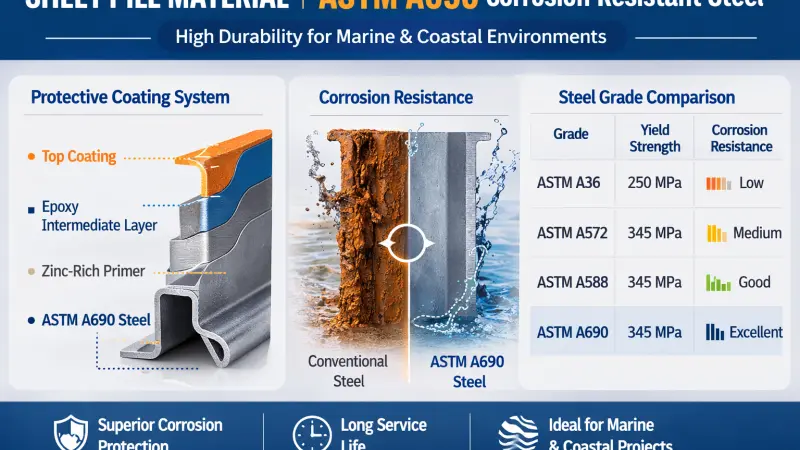
Steel sheet piles have some disadvantages, including corrosion in aggressive environments, installation noise and vibration, equipment requirements, and limited performance in very hard ground. However, proper design and material selection can reduce most of these challenges.
Every retaining system has trade-offs
I never describe steel sheet piles as a perfect solution because every construction method has strengths and weaknesses.
The key question is whether the advantages outweigh the disadvantages for the specific project.
For temporary cofferdams, the answer is often yes.
For some permanent structures, engineers may compare sheet piles with diaphragm walls, secant piles, or reinforced concrete retaining walls before making the final decision.
Corrosion is the biggest concern
Steel naturally corrodes when exposed to moisture, oxygen, and salt.
Marine projects are especially demanding because seawater accelerates corrosion.
Fortunately, modern engineering provides several solutions.
Common protection methods include:
- Protective coatings
- Cathodic protection
- Corrosion allowance
- High-quality steel grades
- Regular inspections
- Scheduled maintenance[web:6]
These methods greatly extend the service life of steel sheet piles.
Noise and vibration during installation
Steel sheet piles are usually installed using vibratory hammers or impact hammers.
This process creates:
- Noise
- Ground vibration
- Temporary disturbance to nearby structures
- Possible restrictions in urban areas
For projects close to hospitals, schools, or historic buildings, engineers may choose silent pressing equipment instead.
Although this equipment increases construction cost, it significantly reduces environmental impact.
Equipment requirements
Driving sheet piles requires specialized machinery.
Typical equipment includes:
| Equipment | Function |
|---|---|
| Vibratory hammer | Standard installation |
| Hydraulic press-in machine | Low vibration installation |
| Crane | Lifting sheet piles |
| Excavator | Site preparation |
| Welding equipment | Connection work |
Smaller contractors sometimes rent this equipment rather than purchasing it.
Difficult ground conditions
Sheet piles perform well in many soil types.
However, very hard rock or dense gravel can make installation difficult.
Possible solutions include:
- Pre-drilling
- Jetting
- Stronger driving equipment
- Selecting different pile sections
Good geotechnical investigation helps avoid these problems.
Initial investment
High-quality hot rolled sheet piles cost more than some temporary alternatives.
However, I encourage buyers to evaluate the total project cost rather than the purchase price alone.
Reusable sheet piles often reduce expenses over multiple projects.
Transportation, installation speed, labor savings, and resale value also influence the final economic result.
Advantages versus disadvantages
| Advantages | Disadvantages |
|---|---|
| Fast installation | Noise during driving |
| Reusable | Corrosion without protection |
| High structural strength | Heavy equipment required |
| Excellent water control | Difficult in rock formations |
| Lower long-term cost | Initial purchase cost |
My opinion
Many buyers focus only on the disadvantages because they compare steel sheet piles with cheaper temporary solutions.
I believe this comparison is incomplete.
I always recommend looking at the entire project life cycle.
Reusable steel sheet piles often save significant money over several construction projects.
In our company, we work closely with certified mills to maintain stable dimensions, accurate interlocks, and reliable steel quality. We also support OEM production, SGS inspection, and flexible MOQ. Many contractors tell me they recover much of their investment simply by reusing the same piles on future projects.
From my experience, the biggest mistake is selecting sheet piles only by price. Choosing the correct profile and steel grade usually delivers much better value than purchasing the lowest-cost option.
Are sheet piles temporary or permanent?
Many first-time buyers believe sheet piles are always temporary. I explain that the same product can perform both temporary and permanent functions depending on the engineering design.
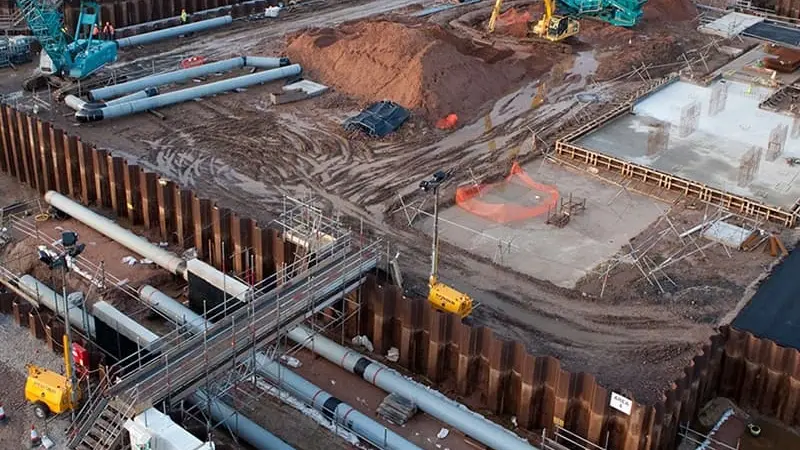
Steel sheet piles can be temporary or permanent. Temporary sheet piles are removed after construction, while permanent sheet piles remain in place as part of retaining walls, seawalls, flood barriers, bridge structures, and waterfront facilities.
Temporary applications
Temporary sheet piles are common in infrastructure projects.
Typical examples include:
- Cofferdams
- Bridge pier construction
- Deep excavation
- Utility installation
- Underground stations
- Pump stations
- Temporary flood protection
After the permanent structure is completed, contractors usually extract the piles for reuse.
This greatly reduces material waste.
Permanent applications
Many people are surprised to learn that steel sheet piles often remain in service for several decades.
Permanent applications include:
- Riverbank retaining walls
- Seawalls
- Port terminals
- Quay walls
- Flood defense systems
- Coastal protection
- Waterfront developments
These structures are designed with corrosion protection and long-term maintenance in mind.
How engineers decide
The intended service life determines the design.
Engineers evaluate several factors.
| Design Factor | Temporary | Permanent |
|---|---|---|
| Service life | Months to a few years | 30–100+ years |
| Corrosion allowance | Limited | Required |
| Protective coating | Optional | Common |
| Maintenance | Minimal | Planned |
| Reuse | Yes | No |
| Cost focus | Construction efficiency | Long-term durability |
This comparison helps owners choose the most suitable solution.
Design considerations
Permanent sheet pile systems usually require:
- Larger section modulus
- Corrosion allowance
- Protective coating
- Drainage design
- Regular inspection
- Maintenance planning
Temporary systems focus more on installation speed, safe excavation, and easy extraction.
Real project example
Our Southeast Asia riverbank protection project is a good example of permanent steel sheet pile construction.
The contractor selected hot rolled U-type steel sheet piles to stabilize the riverbank and reduce erosion.
The continuous interlocking system created a reliable retaining wall that controlled soil movement and improved long-term stability.
The project finished on schedule because vibratory installation allowed rapid construction while maintaining excellent structural performance.
This project demonstrates that steel sheet piles are not only temporary construction materials. They can also become durable infrastructure components.
My opinion
I often tell customers that the product itself does not decide whether it is temporary or permanent.
The engineering design makes that decision.
The same U-type or Z-type sheet pile may serve for six months on one project and remain in service for fifty years on another.
That is one reason I appreciate steel sheet piles so much.
Their flexibility gives engineers many design options without changing the basic construction method.
When customers ask me which type they should purchase, I first ask about their project schedule, design life, soil conditions, and future reuse plans. After understanding these details, I can recommend the most economical and technically suitable solution.
Conclusion
I believe steel sheet piles remain the best choice for most temporary cofferdams because they combine fast installation, structural strength, water control, and excellent reusability.