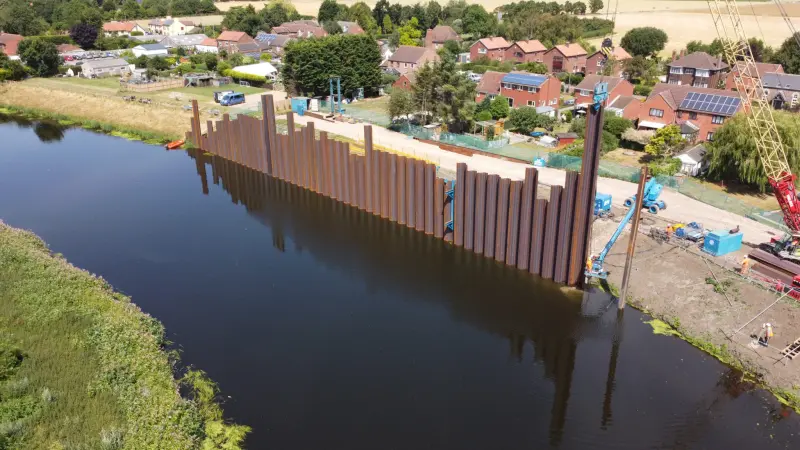
You are designing a new wastewater treatment plant or expanding an existing one. The tanks are large, the ground is often soft, and the environment is corrosive. The retaining walls must hold back water and soil for decades without failing.
Steel sheet piles are widely used in wastewater treatment plants for tank walls, excavation support, cut-off walls, and pipe trenches. U-type piles are common for circular clarifiers and aeration basins. For corrosive environments, fusion-bonded epoxy (FBE) coating1 or stainless steel is required. Standard carbon steel will corrode quickly from hydrogen sulfide and other chemicals.
](https://cnsteelplant.com/wp-content/uploads/2026/03/Article-Application-River-Embankment-1.webp)
I have supplied sheet piles for wastewater treatment plants across the Middle East and Asia. A plant in the UAE used FBE-coated U-type piles for clarifier walls. A plant in Southeast Asia used standard carbon steel with corrosion allowance. Let me walk you through the key applications and design considerations for sheet piles in wastewater treatment plants.
What are the main applications of sheet piles1 in wastewater treatment plants?
Sheet piles are used in wastewater treatment plants for tank walls, excavation support, cut-off walls, and pipe trenches. They provide a watertight barrier that resists soil and water pressure.
The main applications include circular clarifier walls2 (U-type piles driven in a circle), aeration basin walls (straight walls with U or Z piles), excavation support for underground piping, cut-off walls for groundwater control3, and retaining walls for plant expansion. Sheet piles are preferred over cast-in-place concrete because they can be installed faster and require no curing time.
](https://cnsteelplant.com/wp-content/uploads/2026/03/Article-Application-Port-3.webp)
Common Applications in Wastewater Plants
Let me explain each application in detail.
Circular Clarifier Walls
Clarifiers are large circular tanks where solids settle out of wastewater. Sheet piles are driven in a circle to form the tank wall.
- Recommended section: U-type (U 400 x 125 or U 400 x 170)
- Diameter: 10-40 m typical
- Installation: Driven in a circle using guide frames
- Water tightness: Larssen interlocks provide good seal
Aeration Basin Walls
Aeration basins are rectangular tanks where air is bubbled through wastewater. Sheet piles form the straight walls.
- Recommended section: Z-type for deeper basins, U-type for moderate depths
- Length: 20-100 m typical
- Bracing: May need tiebacks or internal struts
Excavation Support for Piping
Underground piping between treatment units requires deep excavations. Sheet piles support the excavation sides.
- Recommended section: U 400 x 125 for moderate depths
- Duration: Temporary (extracted after pipe installation)
- Reusability: Piles can be used on multiple projects
Cut-off Walls for Groundwater Control
Cut-off walls prevent groundwater from entering the plant site or contaminated water from leaving.
- Recommended section: U 400 x 125 or U 400 x 170
- Depth: Driven to impervious layer
- Water tightness: Essential for environmental protection
My Experience
For a clarifier in a UAE wastewater plant, we used U 400 x 125 piles driven in a 20 m diameter circle. The piles were FBE-coated for corrosion protection. The clarifier has been in service for 10 years with no issues.
How are sheet piles1 used for clarifiers and aeration basins2?
Sheet piles are used to construct the walls of circular clarifiers3 and rectangular aeration basins2. They provide a strong, watertight barrier that holds back the wastewater.
For circular clarifiers3, U-type sheet piles1 are driven in a circle to form the tank wall. The piles interlock to create a watertight seam. For aeration basins2, U-type or Z-type piles are driven in straight lines to form rectangular walls. The walls are often anchored with tie rods or braced with internal struts to resist water pressure.
](https://cnsteelplant.com/wp-content/uploads/2026/03/Article-Application-Port-1.webp)
Design and Construction of Tank Walls
Let me explain how sheet pile tank walls are designed and built.
Circular Clarifier Design
| Clarifier Diameter | Recommended Section | Wall Height | Notes |
|---|---|---|---|
| 10-15 m | U 400 x 125 | 3-5 m | Standard clarifier |
| 15-25 m | U 400 x 170 | 4-6 m | Larger capacity |
| 25-40 m | U 600 x 180 | 5-7 m | High capacity |
Installation Process for Circular Clarifiers
- Mark the circle center and radius
- Drive starter piles at key points
- Drive sheet piles1 in sequence around the circle
- Check plumbness and alignment continuously
- Drive to required depth
- Install concrete capping beam at top
Aeration Basin Design
| Basin Depth | Recommended Section | Bracing |
|---|---|---|
| 3-4 m | U 400 x 125 | Cantilever (no bracing) |
| 4-6 m | U 400 x 170 | Single tieback or strut |
| 6-8 m | U 600 x 180 | Double tieback or strut |
Key Design Considerations
- Water pressure: Increases with depth, requires adequate section modulus
- Corrosion protection: FBE coating or corrosion allowance
- Chemical resistance: Some wastewaters are acidic or alkaline
- Temperature: Thermal expansion of steel
- Settlement: Differential settlement between tanks and pipes
My Experience
For a large aeration basin in the Middle East, we used U 600 x 180 sheet piles1 with FBE coating. The basin was 6 m deep and 50 m long. Tiebacks at 2 m and 4 m below the top provided the necessary support.
What corrosion protection methods are needed for sheet piles in wastewater environments?
Wastewater environments are highly corrosive due to hydrogen sulfide (H₂S), acids, and other chemicals. Standard carbon steel sheet piles require corrosion protection to achieve a 50-year design life.
The main corrosion protection methods for sheet piles in wastewater plants are fusion-bonded epoxy (FBE) coating (most common), polyurethane coating, corrosion allowance (extra thickness), and stainless steel (for extreme conditions). FBE coating is applied in the factory and provides excellent resistance to hydrogen sulfide and acids. For the most aggressive environments, stainless steel sheet piles may be used.
](https://cnsteelplant.com/wp-content/uploads/2026/03/Article-application-5.webp)
Corrosion Protection Methods
Let me compare the different corrosion protection methods for wastewater environments.
Fusion-Bonded Epoxy (FBE) Coating1
- Application: Factory-applied, heated steel, powder coating
- Thickness: 300-500 microns (12-20 mils)
- Chemical resistance: Excellent for H₂S, acids, alkalis
- Advantages: Durable, abrasion resistant, uniform coverage
- Disadvantages: Can be damaged during driving, requires repair
- Cost: Moderate to high
- Application: Field or factory applied
- Thickness: 200-400 microns (8-16 mils)
- Chemical resistance: Good for most wastewater chemicals
- Advantages: Good UV resistance, flexible
- Disadvantages: Less chemical resistance than epoxy
- Cost: Moderate
- Application: Add extra steel thickness to the pile
- Thickness: 2-5 mm depending on expected corrosion rate
- Advantages: No coating to damage, simple
- Disadvantages: Adds weight and cost
- Cost: Low to moderate
- Application: Use stainless steel sheet piles (ASTM A240)
- Grades: 316, 2205 duplex
- Advantages: Excellent corrosion resistance, no coating needed
- Disadvantages: Very expensive (3-5× carbon steel)
- Cost: Very high
Recommended Protection by Zone
| Zone | Recommended Protection |
|---|---|
| Submerged in wastewater | FBE coating or corrosion allowance |
| Splash zone (above water) | FBE coating |
| Buried in soil | Corrosion allowance |
| Extreme chemical exposure | Stainless steel |
My Experience
For a wastewater treatment plant in the UAE, we used FBE-coated U 400 x 125 sheet piles. The coating thickness was 400 microns. The piles were driven carefully to minimize coating damage, and any damaged areas were repaired in the field.
Which sheet pile sections and steel grades are best for sewage treatment plants?
The best sheet pile sections for sewage treatment plants are U-type for circular clarifiers1 and Z-type for deep rectangular basins2. The best steel grade is ASTM A3283 or EN 10248 S270GP with FBE coating4.
For most sewage treatment plants, U 400 x 125 or U 400 x 170 sections with FBE coating4 are recommended. For deeper basins (over 5 m), Z-type piles like AZ 18 or AZ 26 may be used. The steel grade can be standard carbon steel (ASTM A3283) because the coating provides the chemical resistance. For extreme environments, stainless steel (316 or 2205) is used.
](https://cnsteelplant.com/wp-content/uploads/2026/03/Article-Application-Port-4.webp)
Section and Grade Selection Guide
Let me provide specific recommendations for sewage treatment plants.
Recommended Sections by Application
| Application | Recommended Section | Steel Grade | Protection |
|---|---|---|---|
| Circular clarifier (10-20 m dia) | U 400 x 125 | A328 | FBE coating4 |
| Circular clarifier (20-30 m dia) | U 400 x 170 | A328 | FBE coating4 |
| Aeration basin (3-4 m deep) | U 400 x 125 | A328 | FBE coating4 |
| Aeration basin (4-6 m deep) | U 400 x 170 | A328 | FBE coating4 |
| Aeration basin (6-8 m deep) | U 600 x 180 or AZ 26 | A328 or A572 | FBE coating4 |
| Pipe trench excavation | U 400 x 100 | A328 | Corrosion allowance |
Steel Grade Selection
| Grade | Yield (MPa) | Best Use | Cost |
|---|---|---|---|
| ASTM A3283 | 240 | Standard sewage plants, with coating | Low |
| ASTM A572 Gr50 | 345 | Deeper basins, with coating | Moderate |
| ASTM A690 | 345 | Seawater or brackish sewage | Moderate |
| Stainless 316 | 210 | Extreme chemical exposure | Very high |
Coating Requirements
| Environment | Coating Required | Thickness |
|---|---|---|
| Municipal sewage | Yes (FBE) | 300-400 microns |
| Industrial wastewater | Yes (FBE) | 400-500 microns |
| Extreme chemical | Stainless steel | N/A |
| Temporary structures | No (corrosion allowance) | N/A |
My Experience
For a municipal sewage treatment plant, we supplied U 400 x 125 sheet piles with FBE coating4 (400 microns) to ASTM A3283. The piles were used for two 25 m diameter clarifiers and one aeration basin. The plant has been in operation for 8 years with no corrosion issues.
Conclusion
Steel sheet piles are ideal for wastewater treatment plant structures. Use U-type piles for circular clarifiers and aeration basins. FBE coating1 is essential for corrosion protection in sewage environments. Standard carbon steel (ASTM A328)2 with coating is the most economical choice.
-
Explore this link to understand how FBE coating enhances corrosion protection in wastewater treatment environments. ↩ ↩ ↩ ↩ ↩ ↩ ↩ ↩ ↩
-
Learn why Standard carbon steel (ASTM A328) is the economical choice for construction, especially in wastewater treatment. ↩ ↩ ↩ ↩ ↩ ↩ ↩
-
Learn about ASTM A328 steel grade, its properties, and why it’s ideal for sewage treatment applications. ↩ ↩ ↩ ↩ ↩ ↩ ↩ ↩
-
Discover how FBE coating enhances the durability of steel in sewage treatment, preventing corrosion effectively. ↩ ↩ ↩ ↩ ↩ ↩ ↩ ↩ ↩