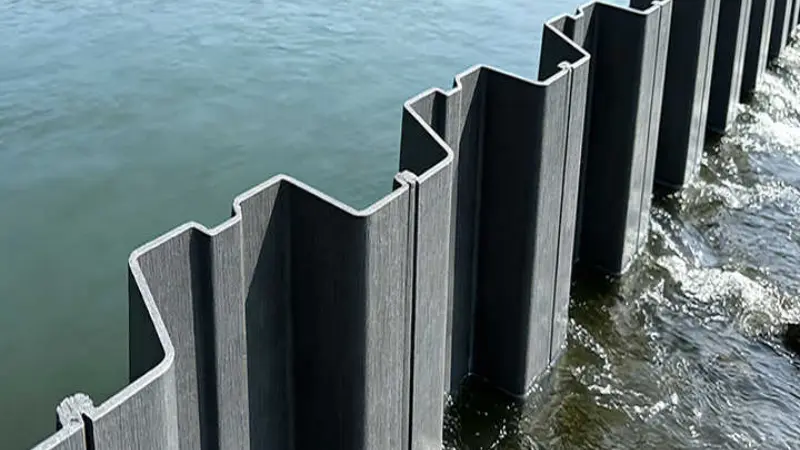
You are designing a water treatment plant or a desalination facility. The sheet piles will be exposed to treated water, chemicals, and sometimes seawater. Without proper corrosion protection, the steel will corrode and the structure will fail.
Corrosion resistant sheet piles for water treatment projects use three main protection methods: fusion-bonded epoxy (FBE) coating1 (most common), marine grade steel (ASTM A690 for seawater), and corrosion allowance (extra thickness). For aggressive water conditions (high chlorides, low pH), FBE coating is recommended. For seawater intake structures, ASTM A690 marine grade steel is preferred.
[^2] for water treatment plant](https://placehold.co/600x400 "Water Treatment Sheet Piles")](https://cnsteelplant.com/wp-content/uploads/2026/03/Article-Application-Port-1.webp)
I have supplied sheet piles for water treatment projects across the Middle East and Asia. A desalination plant in the UAE used ASTM A690 piles for the seawater intake. A water treatment plant in Southeast Asia used FBE-coated piles for the clarifiers. Let me walk you through the corrosion protection methods for water treatment projects.
Why is corrosion protection1 critical for sheet piles in water treatment projects?
Corrosion protection is critical because water treatment environments expose steel to corrosive agents like chlorides, chemicals, and biological activity. Without protection, sheet piles can corrode through in 10-20 years instead of lasting 50.
In water treatment plants, sheet piles are exposed to treated water (with residual chemicals), untreated water (with biological activity), seawater (high chlorides), and chemicals used in the treatment process. Standard carbon steel corrodes at rates of 0.05-0.20 mm/year in these environments. For a 50-year design life, unprotected steel would need 2.5-10 mm of corrosion allowance, which adds significant weight and cost.
](https://cnsteelplant.com/wp-content/uploads/2026/03/Article-Application-River-Embankment-1.webp)
Corrosion Mechanisms in Water Treatment
Let me explain the main corrosion mechanisms in water treatment environments.
Chloride Corrosion
- Source: Seawater intake, brackish water, or chlorination
- Effect: Pitting corrosion, localized attack
- Rate: 0.05-0.15 mm/year depending on chloride level
Chemical Corrosion
- Source: Coagulants (alum, ferric chloride), pH adjusters (lime, caustic)
- Effect: General corrosion, accelerated by low pH
- Rate: 0.10-0.30 mm/year for aggressive chemicals
Biological Corrosion
- Source: Bacteria in untreated water, sulfate-reducing bacteria
- Effect: Pitting, localized attack
- Rate: 0.05-0.20 mm/year
Galvanic Corrosion
- Source: Contact with dissimilar metals (stainless, copper)
- Effect: Accelerated corrosion of carbon steel
- Prevention: Isolate dissimilar metals
Consequences of No Protection
| Design Life | Unprotected Loss (mm) | Protection Needed |
|---|---|---|
| 25 years | 1.25-5.0 mm | Corrosion allowance or coating |
| 50 years | 2.5-10.0 mm | Coating + allowance |
| 100 years | 5.0-20.0 mm | Marine grade + coating |
My Experience
For a water treatment plant where the client did not specify corrosion protection1, the sheet piles showed significant corrosion after 8 years. The plant had to be shut down for repairs. That experience taught me that corrosion protection1 is not optional for water treatment projects.
What are the best steel grades for corrosion resistant sheet piles in water environments?
The best steel grades for water environments depend on the water chemistry. For seawater, use ASTM A690 marine grade1. For freshwater treatment plants, use ASTM A3282 or A572 with FBE coating3.
ASTM A690 is the best choice for seawater environments because it contains copper, nickel, and phosphorus that form a protective patina, reducing corrosion by 50%. For freshwater treatment plants with aggressive chemicals, standard carbon steel (ASTM A3282) with FBE coating3 is more economical. For brackish water, A690 is recommended.
](https://cnsteelplant.com/wp-content/uploads/2026/03/Article-Application-River-Embankment-4.webp)
Steel Grade Selection Guide
Let me provide specific recommendations for water treatment environments.
ASTM A690 – Marine Grade
- Yield strength: 345 MPa (50 ksi)
- Corrosion rate in seawater: 0.05 mm/year (50% better than carbon)
- Best for: Seawater intake, desalination, coastal plants
- Cost premium: 15-20% over A328
ASTM A3282 – Standard Carbon Steel
- Yield strength: 240 MPa (35 ksi)
- Corrosion rate in freshwater: 0.02-0.05 mm/year
- Best for: Freshwater treatment plants (with coating)
- Cost: Lowest
ASTM A572 Grade 50 – High-Strength
- Yield strength: 345 MPa (50 ksi)
- Corrosion rate: Similar to A328
- Best for: Deeper basins, heavier loads (with coating)
- Cost: Moderate
Grade Selection by Water Type
| Water Type | Recommended Grade | Additional Protection |
|---|---|---|
| Freshwater (treated) | A328 | FBE coating3 |
| Freshwater (untreated) | A328 | FBE coating3 + allowance |
| Brackish water | A690 | FBE coating3 recommended |
| Seawater | A690 | Cathodic protection for long life |
| Desalination brine | A690 | FBE coating3 + allowance |
| Chemical process water | A328 or stainless | FBE coating3 or stainless |
My Experience
For a desalination plant seawater intake, we used ASTM A690 sheet piles. The marine grade steel provided the corrosion resistance needed for the high-chloride environment. The plant has been operating for 12 years with no corrosion issues.
How does fusion-bonded epoxy (FBE) coating1 protect sheet piles in aggressive water conditions?
Fusion-bonded epoxy (FBE) coating creates a barrier between the steel and the aggressive water. It is the most effective coating for water treatment applications2.
FBE coating is applied in the factory. The steel is heated to about 230°C, and epoxy powder is sprayed onto the surface. The powder melts, flows, and chemically bonds to the steel. The resulting coating is 300-500 microns thick, chemically resistant to chlorides, acids, and alkalis, and has excellent adhesion. It protects the steel even if the water chemistry is aggressive.
](https://cnsteelplant.com/wp-content/uploads/2026/03/Article-Application-River-Embankment-3.webp)
FBE Coating Performance and Application
Let me explain how FBE coating works and how it is applied.
FBE Coating Properties
| Property | Value |
|---|---|
| Thickness | 300-500 microns (12-20 mils) |
| Adhesion | Excellent (chemically bonded) |
| Chemical resistance | Excellent for pH 3-11 |
| Chloride resistance | Excellent |
| Abrasion resistance | Good |
| Temperature range | -40°C to +100°C |
Application Process
- Steel sheet pile is cleaned (blasted to near-white metal)
- Pile is heated to 230°C
- Epoxy powder is sprayed onto the hot surface
- Powder melts and flows into a continuous film
- Coating cures in seconds
- Coating thickness is measured and inspected
Why FBE is Best for Water Treatment
- No pinholes or voids (factory applied)
- Uniform thickness around the profile
- Resists damage from handling and driving
- Can be repaired in the field if damaged
- Proven performance in water treatment for 30+ years
Limitations of FBE Coating
- Can be damaged during driving (requires repair)
- Not suitable for very high temperatures (>100°C)
- Not suitable for extreme pH (11)
- Factory application requires planning
My Experience
For a water treatment plant in the Middle East, we used FBE-coated U 400 x 125 sheet piles. The coating thickness was 400 microns. During driving, about 5% of the coating was damaged at the pile tips. The contractor repaired the damaged areas with a two-part epoxy. The piles have been in service for 10 years with no coating failure.
What corrosion allowance1 is needed for sheet piles in different water treatment applications?
Corrosion allowance is extra steel thickness added to the pile to account for expected metal loss over the design life. The amount depends on the water chemistry and design life.
For freshwater treatment plants with FBE coating, no corrosion allowance1 is needed. For uncoated carbon steel2 in freshwater, add 1-2 mm for 50-year life. For uncoated carbon steel2 in seawater, add 5-10 mm for 50-year life. For A690 marine grade3 in seawater, add 2-3 mm. For coated piles, the coating provides the protection, so no allowance is needed unless the coating is expected to be damaged.
[^1] chart for water treatment sheet piles](https://placehold.co/600x400 "Corrosion Allowance Chart")](https://cnsteelplant.com/wp-content/uploads/2026/03/Article-Application-River-Embankment-2.webp)
Corrosion Allowance Recommendations
Let me provide specific corrosion allowance1 recommendations for water treatment applications.
Corrosion Rates by Water Type
| Water Type | Uncoated Carbon Steel (mm/year) | A690 (mm/year) |
|---|---|---|
| Freshwater (treated) | 0.02-0.05 | 0.01-0.03 |
| Freshwater (untreated) | 0.05-0.10 | 0.03-0.05 |
| Brackish water | 0.10-0.20 | 0.05-0.10 |
| Seawater | 0.10-0.20 | 0.05-0.10 |
| Desalination brine | 0.15-0.30 | 0.08-0.15 |
Corrosion Allowance for 50-Year Design Life
| Water Type | Uncoated Carbon | A690 | Coated (any grade) |
|---|---|---|---|
| Freshwater (treated) | 1-2 mm | 0.5-1 mm | 0 mm |
| Freshwater (untreated) | 2-5 mm | 1-2 mm | 0 mm |
| Brackish water | 5-10 mm | 2-5 mm | 0 mm |
| Seawater | 5-10 mm | 2-5 mm | 0 mm |
| Desalination brine | 7-15 mm | 4-7 mm | 0 mm |
Coating Damage Allowance
Even with coating, some damage during driving is expected. For critical applications, add 1 mm allowance for coating damage.
My Experience
For a seawater intake structure, we used A690 piles with 3 mm corrosion allowance1 (no coating). For a freshwater treatment plant with FBE coating, we used standard A328 with no allowance. The coating provided all the protection needed.
Conclusion
Corrosion protection is critical for sheet piles in water treatment projects. For seawater, use ASTM A690 marine grade steel1. For aggressive water conditions, use FBE coating. For coated piles, no corrosion allowance is needed. For uncoated piles, add 2-10 mm depending on water chemistry.
-
Exploring ASTM A690 will provide insights into its benefits and suitability for seawater applications in construction. ↩ ↩ ↩ ↩ ↩ ↩ ↩ ↩ ↩ ↩ ↩
-
Exploring the properties of uncoated carbon steel can help you understand its applications and limitations in construction. ↩ ↩ ↩ ↩ ↩ ↩
-
Learn about A690 marine grade steel to see why it’s preferred for marine applications and its benefits over other materials. ↩ ↩ ↩ ↩ ↩ ↩ ↩ ↩