How Can You Plan Split Shipments for Multi-Phase Construction Projects?
One late shipment can stop a whole construction phase. I have watched cranes stand idle for weeks because everything arrived at once, in the wrong order.
To plan split shipments for a multi-phase project, divide the total steel sheet pile order by construction phase, set a delivery window for each phase, agree production waves with your supplier, and protect the schedule with clear contract terms on lead time, storage and freight.
When I visit sites in the Middle East and Africa, the question I hear most is not about pile strength. It is about timing. An order of steel sheet piles for a project that runs in phases is not really one purchase. It is several smaller purchases that share one contract. Plan them well, and each phase starts with piles waiting at the site gate. Plan them badly, and you pay for storage you do not need, or you wait for steel you need today. In this guide, I will walk you through the way we plan split shipments with our wholesale customers, from the first drawing to the last sailing.
What Is a Split Shipment in a Steel Sheet Pile Order?
Most buyers still order all their sheet piles in one consignment. For a project that runs in phases, that single big delivery is often a trap.
A split shipment divides one purchase order into two or more separate deliveries. Each consignment matches one construction phase, so piles arrive when the site can actually drive them into the ground.
Split Shipments Versus Partial Deliveries
I want to clear this up first, because buyers often mix the two terms. A partial delivery is what the supplier sends when the mill cannot finish the whole order at once. It is driven by production. A split shipment is planned by you, the buyer. It is driven by your construction program. The difference matters, because a partial delivery still arrives in the wrong order if nobody maps it to the phases. I saw this on a port project in West Africa. The mill shipped in three batches over two months, which looked like a split plan on paper. But the contractor never told the supplier which batch served which phase. The heavy Z piles for the quay wall arrived first, while the U piles for the temporary cofferdam sat in a bonded yard 400 kilometers away. The result was double handling, extra inland freight, and a two week delay. If you are unsure how to split a wall between temporary and permanent sections, it helps to decide that before you plan the deliveries, as we explain in our guide to temporary versus permanent sheet pile walls. A real split shipment starts from the construction schedule and works backwards to the mill. It also changes what you buy: section sizes, lengths, and corner profiles get assigned to a phase, not just to a tonnage total. That level of planning is easier than it sounds, and the table below shows the basic difference.
| Aspect | One Bulk Shipment | Planned Split Shipment |
|---|---|---|
| Order driver | Mill production speed | Construction phase schedule |
| Delivery count | Usually one | Two or more, per phase |
| Site storage | Large buffer needed | Small, phase-sized buffer |
| Working capital | Tied up from day one | Released in steps |
| Risk profile | One delay stops everything | A delay hits one phase only |
How Do You Match Shipment Windows to Construction Phases?
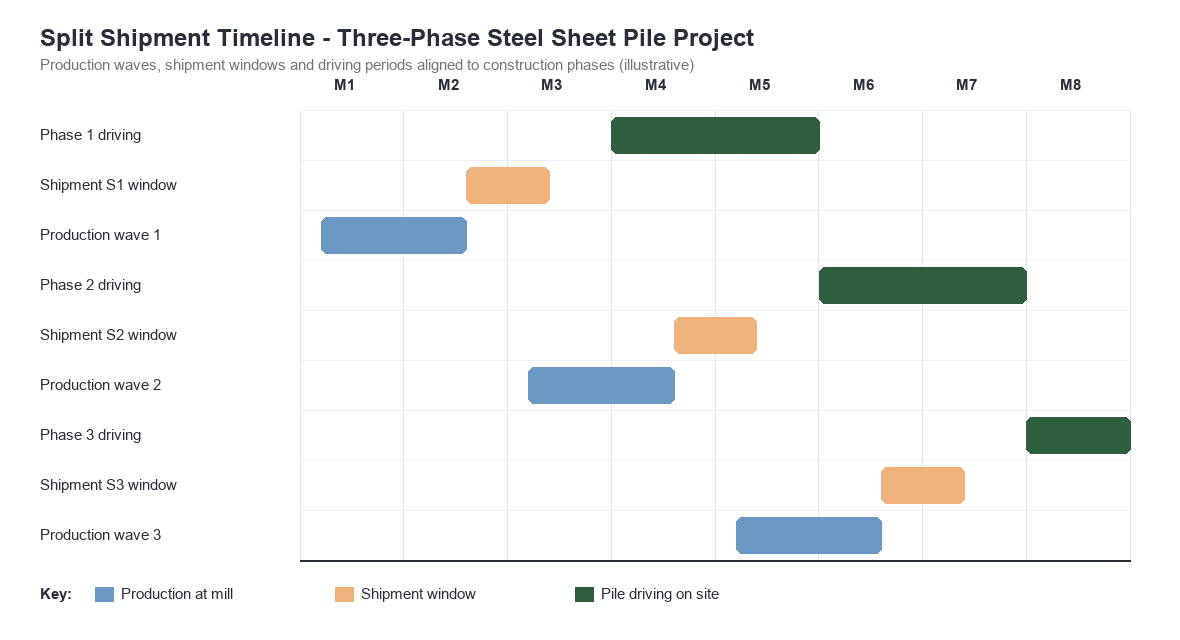
Phases rarely follow the tidy sequence on the bar chart. Weather, permits and client approvals move the dates, so your shipment windows need the same flexibility.
Start from the driving schedule, not the delivery date. For each phase, fix the first driving day, subtract transit and clearance time, and set a shipment window with at least ten days of float.
Build a Delivery Matrix Before You Sign
Before I confirm any order, I ask the contractor for three dates per phase: the earliest driving date, the target finish date, and the site holiday calendar. With those, we build a simple delivery matrix. Each row is a phase. Each row lists the pile sections, the tonnage, the shipment window, and the port of discharge. This matrix becomes part of the contract annex, so both sides work from the same page. The trick is to add float in the right place. I put float in the shipment window, not in the production lead time. Mills can usually hold a production wave for one or two weeks, but once a vessel sails, the days are gone. You should also sequence profiles inside each phase. Drive the piles for the deepest excavation first, because those sections usually carry the longest lead time. If your project has both temporary and permanent walls, ship the permanent sections later, since they often need extra coating or inspection before dispatch. And keep one contingency row in the matrix. If your program is tight, run the windows through a simple critical path check, so a late consignment cannot hide behind a comfortable total float. I always reserve space for one small emergency consignment, because no project of six months or more finishes exactly as drawn. The matrix below is a simplified version of what we use.
| Phase | Section & Length | Tonnage | Ship Window | First Driving Day |
|---|---|---|---|---|
| Phase 1 – temporary cofferdam | U 400 x 125, 12 m | 650 t | Week 8-10 | Week 14 |
| Phase 2 – quay wall | Z 700 x 600, 18 m | 900 t | Week 14-16 | Week 20 |
| Phase 3 – anchor rows + corners | U 600 x 180, 15 m | 350 t | Week 20-22 | Week 26 |
To fill this matrix with real numbers, you first need the exact tonnage per phase, and that starts with your drawings; most buyers work the tonnage out from the wall elevations and confirm it with us before the first production wave.
How Much Working Capital Can Split Shipments Release?
Cash, not steel, is what limits most mid-size contractors. Every tonne that sits in your yard is money that cannot pay for labor or fuel.
A planned split shipment can release 50 to 70 percent of the payment tied to site storage. You pay against phase milestones, so cash out follows the work done instead of running ahead of it.
Compare the Full Cost, Not Just Freight
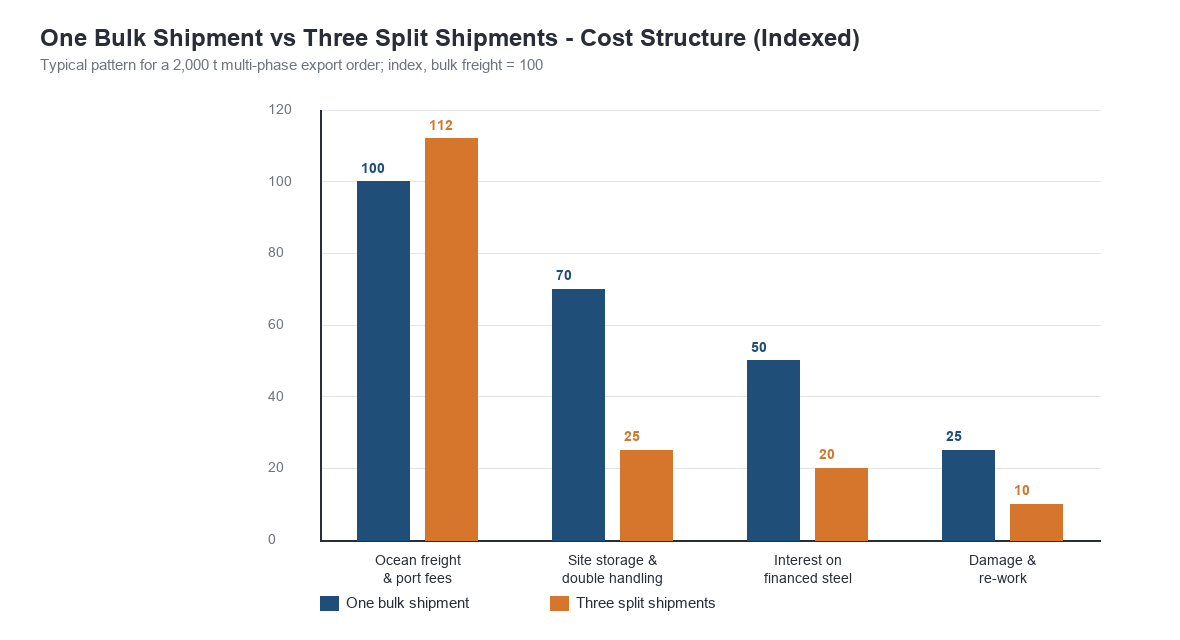
Here I have to be honest about the trade. Split shipments raise your freight and port charges. Three small consignments cost more to ship than one full charter, because you lose some vessel space efficiency and you pay fixed port fees more than once. On a typical order, I see total freight go up by 8 to 15 percent. So why do it? Because freight is rarely the biggest number in a steel sheet pile budget. The hidden costs are. Site storage is the first one. If 2,000 tonnes arrive at month one and driving starts at month three, you rent laydown space, cranes and guards for two months for steel you cannot use. Working capital is the second. Many contractors finance their steel with a loan or a letter of credit, and interest runs from the first payment, not from the first pile driven. The third is damage and re-mill losses. Piles that sit in a yard get moved five or six times, and every move scratches coatings and bends corners. When I add these up for a real project, the split plan usually wins by a clear margin, even with the higher freight. The chart above shows a typical pattern, and the table below breaks the numbers down.
| Cost Item | One Bulk Shipment | Three Split Shipments |
|---|---|---|
| Ocean freight and port fees | 100 (index) | 110 – 115 |
| Site storage and double handling | 60 – 80 | 20 – 30 |
| Interest on financed steel | 45 – 55 | 15 – 25 |
| Damage and re-work allowance | 20 – 30 | 8 – 12 |
| Total (indexed) | 225 – 265 | 155 – 180 |
These are indexed figures, not quotes. Your real numbers depend on distance, laydown rent and how you finance the order. The point is the shape of the result, not the exact values.
What Risks Come With Multiple Consignments?
A split plan spreads your risk across several sailings. But it also creates more documents, more port stops and more chances for something to go missing.
The main risks are port congestion, demurrage, document errors and interlock mismatch between consignments. Each one is manageable if you assign an owner and a deadline in the plan.
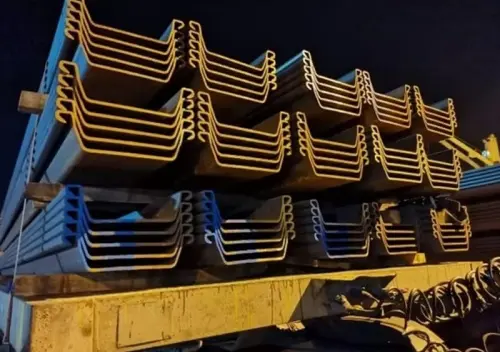
Port Congestion, Demurrage and Document Control
Let me go through the four risks one by one. Port congestion comes first, because it hurts the most. When a project needs three deliveries instead of one, the port fee per tonne goes up, and any congestion at the discharge port hits more sailings. Before I fix a discharge port, I check the queue history and the demurrage tariff. A port that is cheap on paper can be expensive once containers wait, so never judge a route on the port fee per tonne alone. Document errors come second. Each consignment needs its own bill of lading, certificate and packing list, and a mismatch between them can hold a shipment at customs for weeks. I keep one person responsible for documents across all consignments, so the format stays identical. Interlock mismatch is the third risk, and it is the one buyers notice last. If consignment two comes from a different mill run than consignment one, the interlocks may still work but drive less smoothly together. That is why I lock the mill and the rolling plan at contract stage, not per shipment. The fourth risk is simply confusion on site. Three deliveries mean three unloadings, and site teams lose track of what belongs to which phase. Good marking solves this: every bundle gets phase, section and bundle number painted on it. The table below sums up the plan.
| Risk | Typical Impact | Control |
|---|---|---|
| Port congestion | 1-3 week delay | Check queue history, pick backup port |
| Demurrage and detention | Extra fees per day | Pre-clear customs, track free days |
| Document errors | Customs hold | One document owner, fixed templates |
| Interlock mismatch | Slow driving | Lock mill and rolling plan in contract |
| Site confusion | Wrong piles at wrong face | Phase marking on every bundle |
What Should You Agree With Your Supplier Before the First Sailing?
The split plan lives or dies in the contract. If the delivery matrix stays in an email, it is not a plan. It is a hope. The details you collected in your RFQ become the annexes here.
Put the delivery matrix, production waves, shipment windows and a penalty-and-float clause into the supply contract. Agree who owns documents, who books vessels, and how delays are handled on both sides.
Contract Clauses That Protect the Schedule
I spend more time on contract annexes than on price, and buyers who do the same rarely get burned. Four clauses matter most for split shipments. First, the delivery matrix annex. It lists every consignment with sections, tonnage, window and discharge port, and both parties sign it. Second, a production wave clause. The mill commits to start each wave by a fixed date after your down payment or after your release call, whichever you define. This stops production from racing ahead of your site and filling a warehouse you did not rent. Third, the freight booking responsibility. Decide clearly whether you or the supplier charters the vessel, and who pays if a sailing slips. Incoterms decide the baseline, but the annex should go further and name the trigger for each cost. Fourth, a variation clause for phase dates. Sites move, so allow each phase window to shift by a fixed number of days with written notice, free of charge. Without this clause, any reschedule becomes a renegotiation. One more thing: agree the inspection points per consignment. For export orders we support SGS inspection before each sailing, not just once for the whole order. Each consignment should stand on its own paperwork, because each one enters the country on its own.
| Clause | What It Fixes | Why It Matters |
|---|---|---|
| Delivery matrix annex | Scope and dates per consignment | One shared reference for both sides |
| Production wave trigger | When each wave starts | Production follows the site, not the mill |
| Freight booking responsibility | Who charters, who pays for slips | No arguments after a delay |
| Phase date variation | Free window shift with notice | Rescheduling stays a notice, not a dispute |
| Inspection per consignment | SGS or mill QC per sailing | Every shipment clears customs on its own |
My Take: Split Shipments Reward Planning, Not Reaction
I have supplied steel for multi-phase projects for years, and the pattern never changes. The buyers with the smoothest projects are not the ones who negotiate the lowest tonne price. They are the ones who sit down early, map every phase, and treat the delivery plan as part of the engineering. I remember one infrastructure job where the contractor moved the second phase back by a month. Because the variation clause was in the contract, it cost him one email. His neighbor on the next plot had no such clause, and his supplier charged a restocking fee just to hold the steel. Same steel, same region, completely different result. If you take one thing from this article, take this: order your steel sheet piles the way you build them, in phases, and put the plan in writing before the first sailing. Everything else in this guide follows from that habit. It also pairs well with the site-side work, because the way you handle and install the first consignment decides how the rest of the wall goes together.
Conclusion
Plan split shipments from your construction schedule, not from the mill calendar. Match each consignment to a phase, write the windows into the contract, and control the risks one by one.