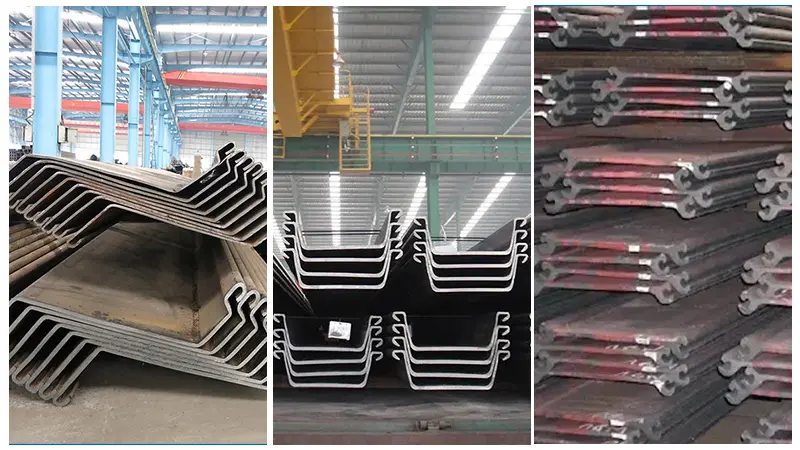
What Quality Standards and Inspection Steps Apply to Steel Sheet Piles?
A rejected steel sheet piles shipment can stop a project for weeks. I have seen it happen. Knowing the quality standards and the right inspection steps protects both your schedule and your budget.
Steel sheet piles are produced under standards such as EN 10248, EN 10249, ASTM A328, and JIS A5528. Quality is proven through mill test certificates, dimensional checks, interlock fit trials, mechanical and chemical tests, surface inspection, and optional third-party inspection such as SGS before shipment.
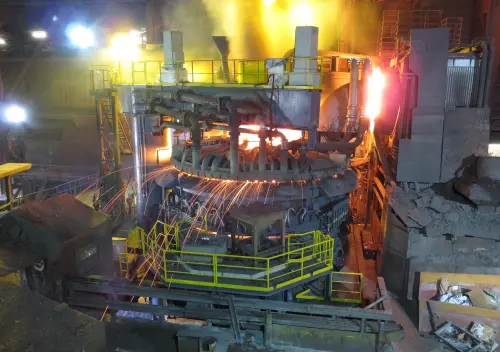
At our plant in Liaocheng, Shandong, we supply U-type, Z-type, Omega-type, flat, and other steel sheet pile profiles to contractors and steel distributors across the Middle East, Australia, Africa, and the Americas. Buyers rarely ask us for a lower price twice. They ask us for proof. Certificates, test reports, and inspection records are what turn a container of steel into a trustworthy product. In this article, I will walk you through the standards we follow and the inspection steps we run on every order, in the same words I use with our clients.
Which Quality Standards Govern Steel Sheet Pile Production?
Different markets accept different standards. A contractor in Dubai may specify EN 10248, while a project in Australia often references ASTM grades. If you order against the wrong standard, even good steel can fail acceptance.
Hot rolled sheet piles follow EN 10248 or GB/T 20933, cold formed piles follow EN 10249, and the American market mainly uses ASTM A328 and related ASTM grades. The standard defines chemical composition, mechanical properties, and dimensional tolerances.
How the Standards Define Grades and Tolerances
Each standard works in two parts. The first part defines the product and its steel grades. The second part defines the tolerances. For example, EN 10248-1 lists the chemical composition and minimum mechanical values for grades from S240GP up to S460GP. EN 10248-2 then fixes how much the thickness, width, height, length, and straightness may deviate. Our own common steel grades for sheet piles article explains Q235, Q355, and S355 in detail for buyers who compare Chinese and European grades.
The standard you choose affects inspection too. Under EN 10248, the mill samples one test unit per heat or per batch, and the results land on the mill test certificate. Under ASTM practice, buyers often ask for supplementary requirements, such as Charpy testing at a set temperature. When our clients order for marine environments, we sometimes suggest ASTM A690, which covers high-strength low-alloy H-piles and sheet piles with better corrosion performance in splash zones. You can read the scope of that standard at ASTM A690.
Here is how the main standards compare in daily export work:
| Standard | Scope | Where It Is Commonly Used |
|---|---|---|
| EN 10248 | Hot rolled sheet piling, grades S240GP–S460GP | Europe, Middle East, many export projects |
| EN 10249 | Cold formed sheet piling | Europe, lighter walls and temporary works |
| ASTM A328 and related ASTM standards | Steel sheet piling for the American system | North America, Australia, some Middle East projects |
| JIS A5523 / A5528 | Hot rolled and cold formed sheet piles | Japan and parts of Southeast Asia |
| GB/T 20933 | Chinese hot rolled sheet piles | Domestic projects and Chinese-spec export orders |
My advice is simple. Ask your engineer which standard the design is based on, and put that standard, the grade, and the tolerance class into the purchase order. That single line of text decides which test reports you can demand later.
What Documents Prove the Quality of Steel Sheet Piles?
Paperwork is not decoration. When a customs officer or a site engineer opens your file, the documents are the quality. Missing or inconsistent papers cause more delays than real defects.
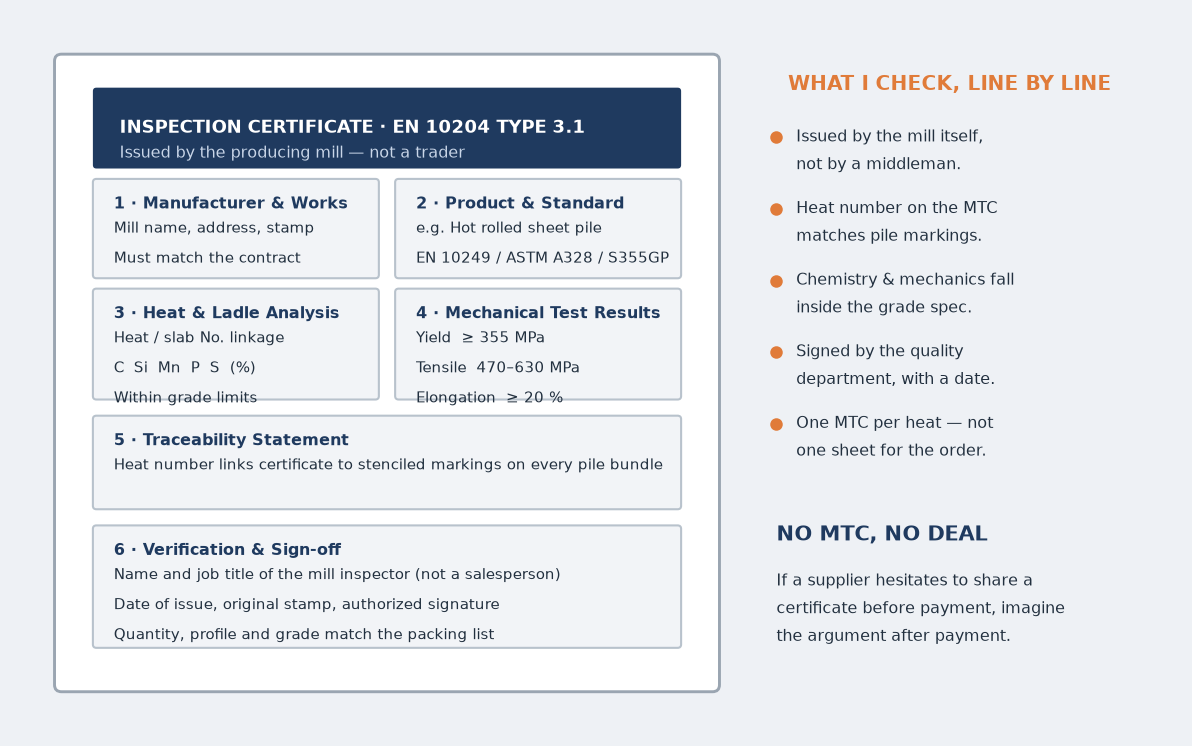
The core document is the EN 10204 mill test certificate, type 3.1, showing heat number, chemical analysis, and mechanical test results. It is supported by ISO 9001 certification, marking reports, and, when required, third-party inspection certificates.
Reading a Mill Test Certificate the Right Way
A mill test certificate, usually called an MTC, is the birth record of your steel. Under EN 10204, type 2.1 is only a declaration of compliance. Type 2.2 adds test results. Type 3.1 is a test certificate issued by the manufacturer’s authorized inspection representative, and type 3.2 is endorsed by an independent inspector. For export projects, most of our clients require 3.1 as a minimum and 3.2 when a third party such as SGS or Bureau Veritas witnesses the tests.
The most important line on the MTC is the heat number. Every bundle on our yard carries a tag with the same heat number. This links the physical steel to the certificate. If a client later asks about any property of the steel, we trace it back through that number in minutes. We also keep our factory certified to ISO 9001, which governs how we control documents, calibration, and corrective actions.
A basic document set for one export order looks like this:
| Document | What It Confirms | Issued By |
|---|---|---|
| Mill test certificate (EN 10204 3.1) | Heat number, chemistry, mechanical results | Steel mill |
| ISO 9001 certificate | Factory quality management system | Certification body |
| Dimensional inspection report | Tolerance checks on sampled piles | Factory QC or third party |
| Third-party inspection certificate | Independent verification before shipment | SGS, BV, or similar |
| Certificate of origin and shipping papers | Customs and trade compliance | Chamber of commerce, forwarder |
Our article on common certifications for steel sheet pile export projects covers each paper in more depth. Before any shipment, we cross-check that the heat numbers on the tags, the MTC, and the packing list match one hundred percent. It takes an hour at our yard. It saves days at your port.
How Do We Inspect Dimensions and Interlock Fit?
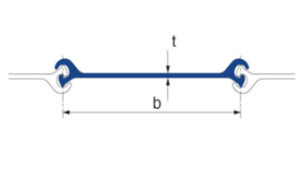
Interlocks are where sheet piles live or die. A wall can tolerate a small mark on the surface, but a tight or deformed clutch can stop driving halfway and force costly rework on site.
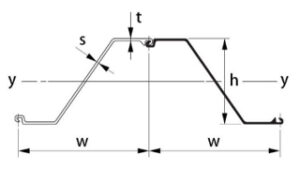
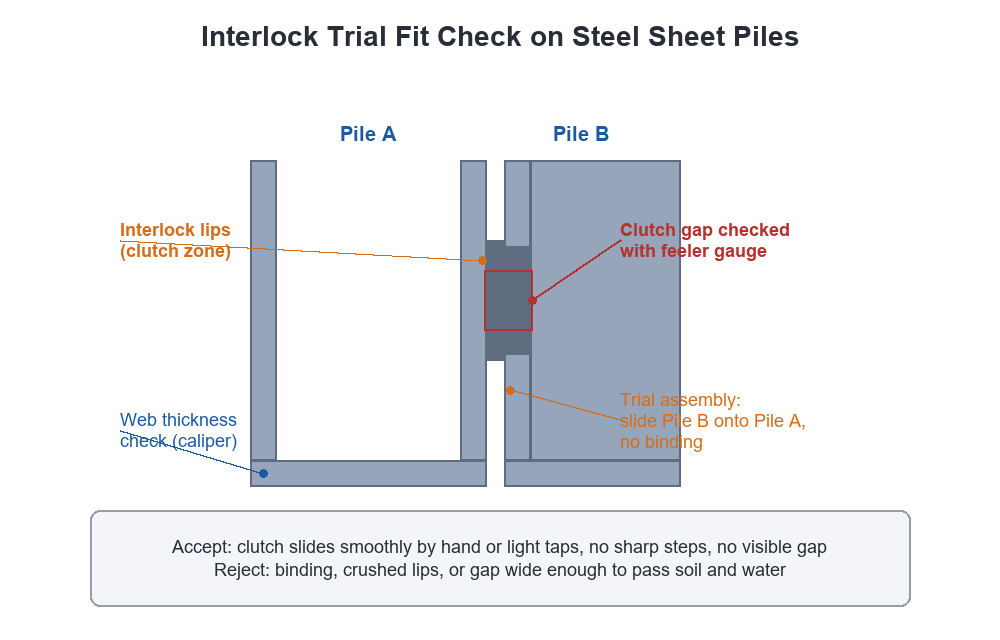
We check web thickness, section width and height, length, straightness, and twist against the standard, then trial-assemble interlocks to confirm a smooth sliding fit without excessive gap or hard spots.
The Checks We Run, Step by Step
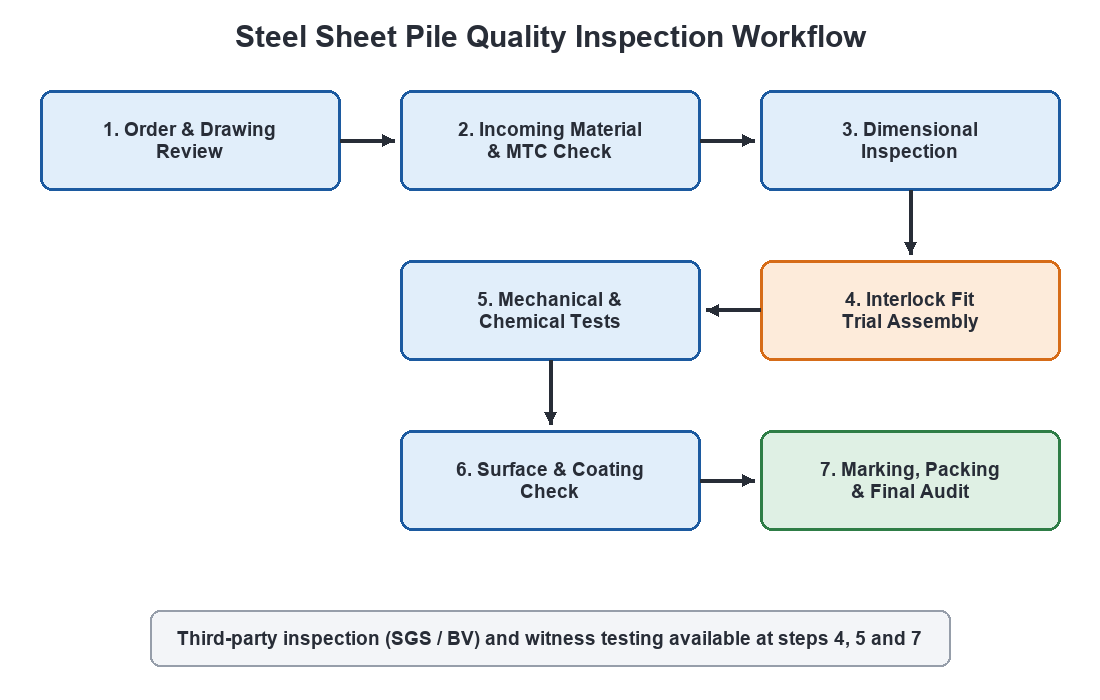
Inspection is a sequence, not a single event. On a normal export order our QC team works like this:
- Order and drawing review. We confirm profile, grade, standard, length tolerance, and marking rules before production starts.
- Incoming material verification. We check that incoming coils or blooms carry heat numbers that match the planned production and the MTC.
- Dimensional inspection. We measure web and flange thickness with calipers or ultrasonic gauges, section width and height with templates, and length with tape or laser. Straightness and camber are checked on a flat reference or with a string line.
- Interlock fit trial. We slide a short mating piece onto sampled piles. The clutch must slide by hand or with light hammer taps, without binding or a visible gap that would let water and soil pass.
- Final audit and marking. We verify tags, paint marks, and bundle composition against the packing list before loading.
This is also the stage where our waterproof performance of interlocked sheet piles expectations are set, because sealants and driving aids only work when the clutch geometry is correct.
| Check Item | Method | What We Watch For |
|---|---|---|
| Web and flange thickness | Calipers or ultrasonic gauge | Values below the tolerance limit of the standard |
| Section width and height | Templates and calipers | Twisted or off-profile sections |
| Length | Tape or laser measure | Short piles that break wall layout |
| Straightness and camber | String line or flat reference | Bows that make driving hard to control |
| Interlock fit | Trial assembly with mating piece | Binding, sharp steps, or excessive gap |
For buyers who want to see this with their own eyes, we welcome third-party inspectors during production. Our guide on how to evaluate a reliable steel sheet pile supplier lists the questions worth asking any factory before you place an order.
What Mechanical and Chemical Tests Are Performed?
Numbers on a certificate only mean something when the tests behind them are correct. This is the part of quality control that decides whether the steel matches the design assumption in your calculation model.
Each production heat is tested for chemical composition and tensile properties: yield strength, tensile strength, and elongation. Low-temperature Charpy impact tests are added when the project site or the specification requires them.
From Heat Sample to Test Report
Chemical analysis starts in the ladle. The mill samples the liquid steel and records carbon, silicon, manganese, phosphorus, sulfur, and alloying elements. Phosphorus and sulfur are kept low because they harm toughness and weldability. For grades that clients weld on site, we also watch the carbon equivalent value, since it predicts how easily the steel can be welded without cracking.
Mechanical testing then happens on machined samples cut from the heat. A tensile test gives three numbers that matter: yield strength, ultimate tensile strength, and elongation. The yield strength is what your structural design uses. Elongation shows ductility, which matters when piles bend around obstructions during driving. For cold regions or projects with impact loading, we arrange Charpy impact tests at the specified temperature, often 0°C or lower, to prove the steel absorbs enough energy before fracturing.
| Test | What It Measures | Why It Matters for Sheet Piles |
|---|---|---|
| Chemical (ladle and product analysis) | C, Si, Mn, P, S, alloy elements | Confirms grade and weldability |
| Tensile test | Yield, tensile strength, elongation | Basis of structural design values |
| Charpy V-notch | Impact energy at set temperature | Toughness for cold or dynamic sites |
| Bend or flattening checks (when specified) | Ductility of the material | Extra assurance for cold formed profiles |
One caution from experience: make sure the certificate shows the actual sample results, not just “complies”. Real numbers let your engineer check the steel against the design. If a supplier refuses to share them, that is a warning sign.
How Is Surface Quality and Corrosion Protection Checked?
Steel piles spend decades in soil and water. Small surface problems grow into big ones, so surface inspection is not about looks. It is about service life.
Inspectors check for seams, laps, cracks, laminations, and rust, removing or repairing defects within standard limits. For coated or galvanized piles, coating thickness and adhesion are verified before packing.
What We Accept and What We Reject
Mill scale and light surface rust are normal on hot rolled steel. They do not affect the section properties. What we remove or reject are sharp defects: seams and laps from rolling, laminations that split the material, and any crack. Within the limits of the standard, minor defects can be ground out smoothly, and deeper spots can be repaired by welding with approved electrodes, then blended and re-inspected. The rule is that the repaired area must not reduce the section below the tolerance limit.
For clients who order painted or galvanized piles, protection is measured, not guessed. We measure dry film thickness with a DFT gauge at set points along the pile, and we check adhesion by cross-cut or pull-off tests when the specification asks. Hot-dip galvanizing follows its own acceptance rules, which you can review in this overview of hot-dip galvanizing. For long-term marine structures, coating is only one layer of the strategy, and our article on corrosion resistance solutions for steel sheet piles explains how coatings, steel selection, and cathodic protection work together.
| Surface Condition | Typical Action |
|---|---|
| Mill scale or light rust | Accept; normal for hot rolled steel |
| Minor seams or laps within limits | Grind smooth and re-inspect |
| Deeper localized defects | Weld repair with approved electrodes, blend, re-check |
| Cracks or laminations beyond limits | Reject the pile, never ship it |
| Coating below specified thickness | Recoat and re-measure before packing |
What Should Buyers Check Before Shipment and on Arrival?
The last chance to catch a problem is before the container door closes. The second-to-last chance is at your port. Buyers who use both chances almost never face a claim.
Before shipment, arrange third-party inspection such as SGS to witness sampling, dimension checks, and marking. On arrival, count bundles, match tags to certificates, test-fit sample interlocks, and photograph everything before signing.
A Practical Arrival Checklist
When we ship, we expect the receiver to verify three things: quantity, identity, and condition. Quantity means counting bundles against the packing list. Identity means the heat numbers and bundle tags match the MTC and the invoice. Condition means no crushed interlocks, deep dents, or abnormal rust from transit. Our article on packaging, loading, and transportation of steel sheet piles explains how we prepare bundles so this check takes minutes instead of hours.
For larger projects, many clients book a pre-shipment inspection. An inspector from SGS or a similar agency visits our plant, witnesses the sampling of test pieces, reviews the MTCs, measures dimensions on sampled piles, and photographs the bundles before loading. We support this openly, because independent confirmation protects both sides. If you are planning your first import, the full purchase-to-delivery chain, including inspection timing, is described in our guide on how to buy steel sheet piles from China.
| Checkpoint | How to Do It | Red Flag to Watch For |
|---|---|---|
| Bundle count | Compare with packing list | Missing or extra bundles |
| Tag vs MTC heat numbers | Match each tag to the certificate | Any heat number not on the MTC |
| Interlock condition | Trial-fit a short mating piece on sampled piles | Binding clutches or crushed lips |
| Surface condition | Visual check under daylight | Deep pitting beyond normal rust |
| Documents | Check MTC, invoice, and certificates | Numbers that do not match the cargo |
After the piles pass arrival inspection, the next step is installation, and our step-by-step installation process guide shows what good handling looks like on site, from guide frames to final driving.
My View: Good Inspection Is the Cheapest Insurance on the Project
From where I stand in the factory, inspection is not a cost center. It is the cheapest insurance a project can buy. I have watched a client accept a lower quote from a trader who could not produce an original MTC, and then spend more on remedial work than the entire saving. That is why we never argue about inspection requests. Test every heat, measure every sampled pile, welcome any third party you trust, and put the heat numbers on the tags. Quality standards only protect you if somebody actually checks against them, and we prefer that somebody is both us and you.
Conclusion
Follow the right standard, demand complete certificates, verify dimensions and interlocks, and inspect before shipment and on arrival. These simple steps keep steel sheet pile projects safe, on schedule, and free of claims.