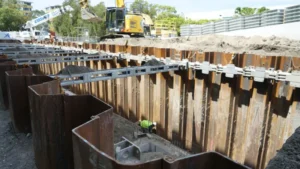
How Do Steel Sheet Piles Solve Problems in Challenging Ground Conditions?
Every project manager has faced that moment when the geotechnical report reveals surprises. The soil is softer than expected, or boulders hide below the surface, or groundwater sits higher than the survey showed. These challenging ground conditions can derail timelines, inflate budgets, and test the patience of even the most experienced crews. I have watched teams struggle with difficult soils across job sites in the Middle East, Australia, and Southeast Asia, and I have learned that the right steel sheet pile strategy turns those challenges into manageable tasks.
Steel sheet piles offer engineered solutions for difficult ground conditions, including soft clay, dense sand, gravel, boulder layers, and rock formations, through proper section selection, driving method adaptation, and supplementary support systems.
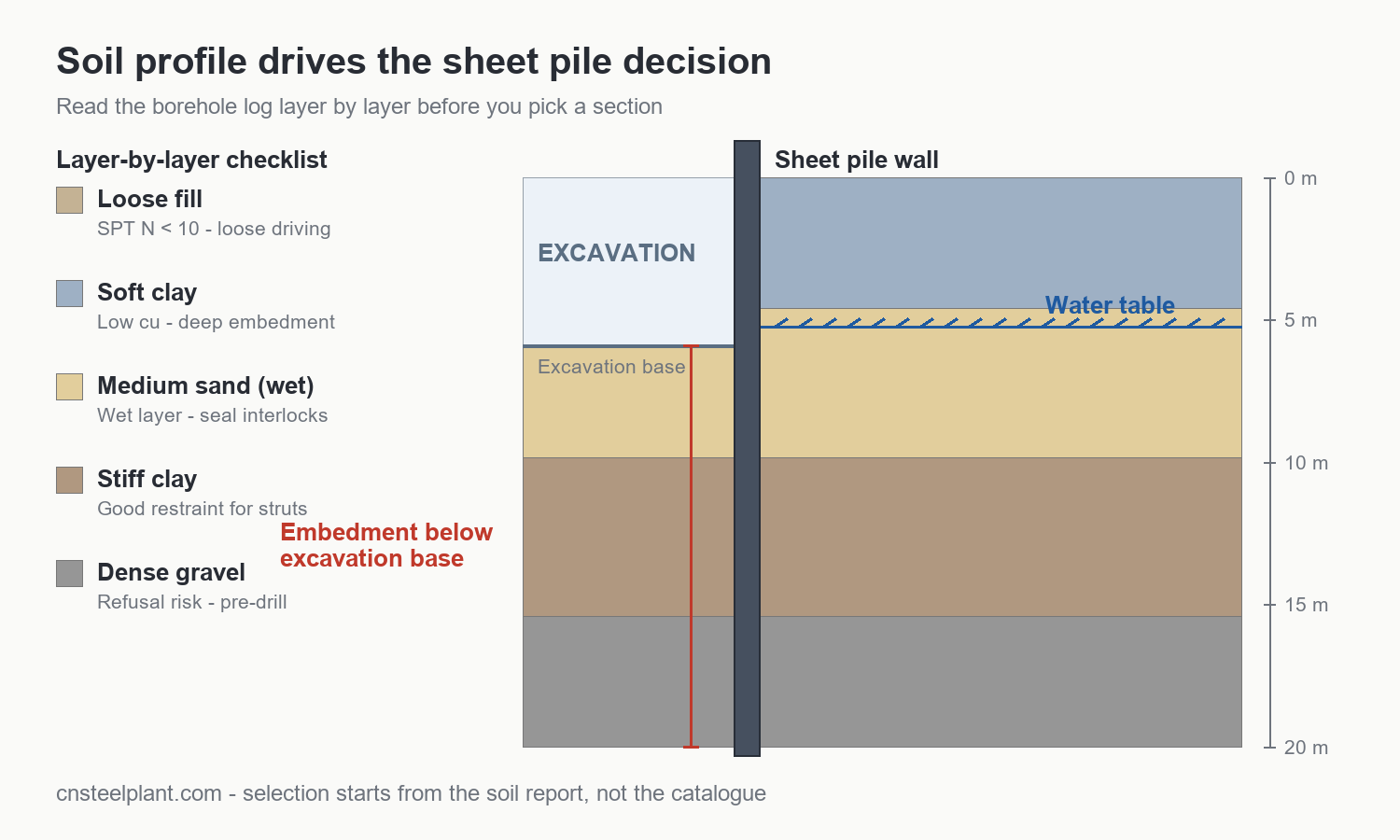
Challenging ground does not mean impossible ground. What it means is that standard assumptions need adjustment. In our factory in Shandong, we produce U-type, Z-type, and custom-profile sheet piles specifically for contractors who face these exact problems. Over the years, we have supplied piles to projects where the soil profile changed every ten meters, and the teams still completed their walls on schedule. The key is understanding which ground condition you are dealing with and matching the pile design and installation method to that reality.
What Makes Ground Conditions Challenging for Sheet Pile Installation?
Not all soil is created equal, and some profiles fight back the moment you start driving. I have seen vibratory hammers bounce off dense gravel layers and sheet piles refuse to penetrate soft clay that squeezes the interlocks shut.
Challenging ground conditions include soft cohesive soils with low shear strength, dense granular soils with high penetration resistance, heterogeneous profiles with boulders or obstructions, and bedrock or weathered rock formations that limit embedment depth.
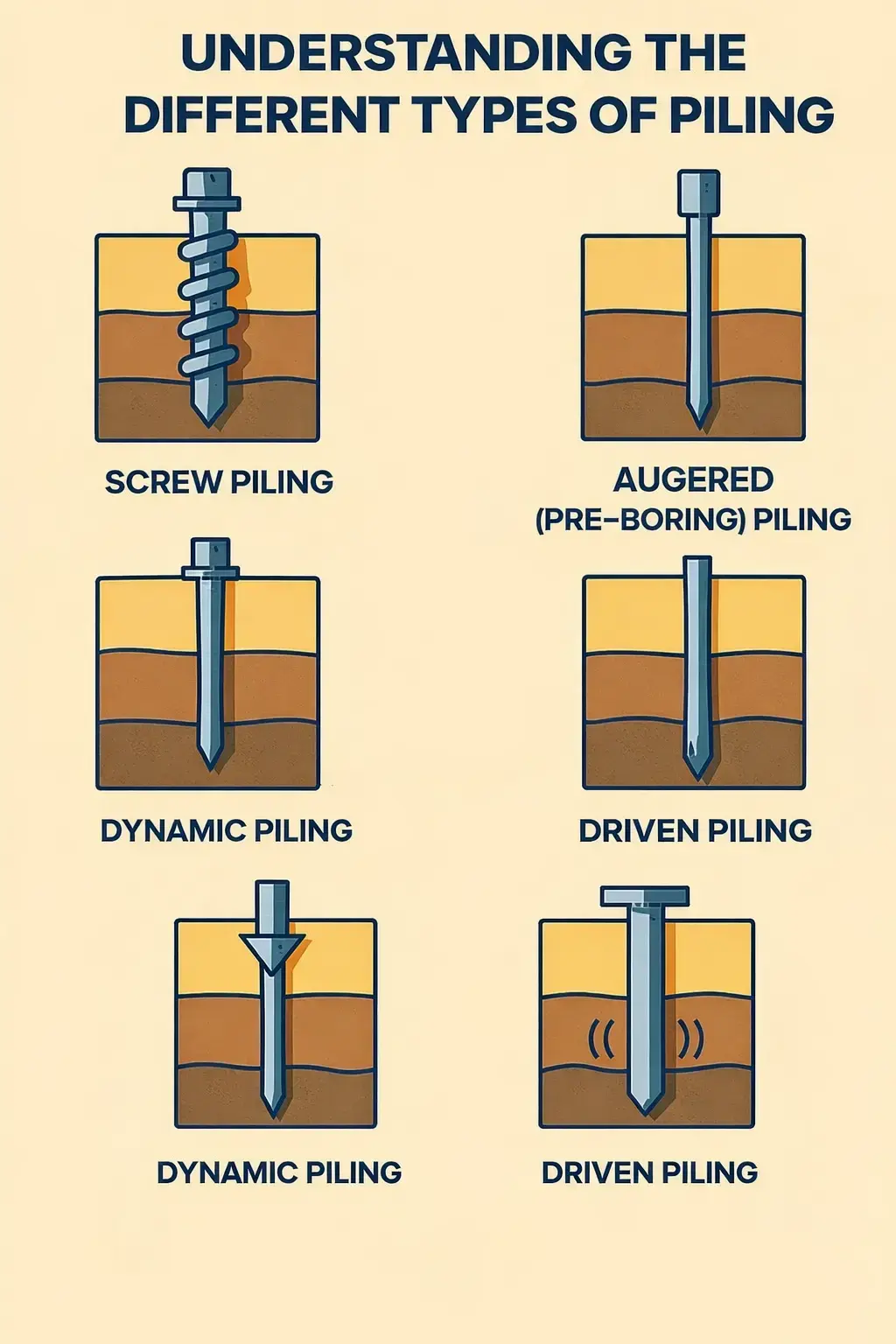
Understanding Difficult Soil Types
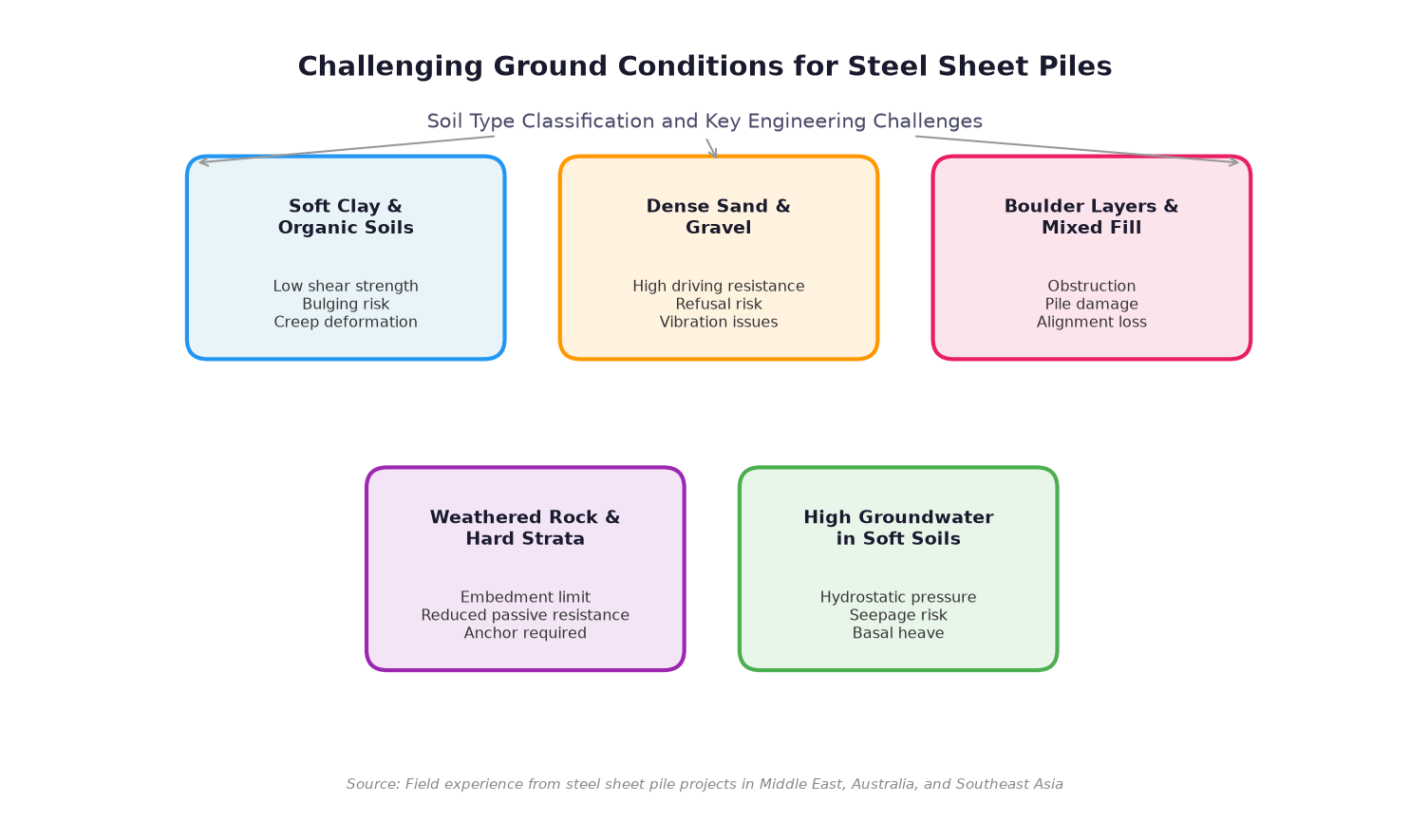
When I review a project’s geotechnical data, I look for four categories that consistently cause trouble. Each one demands a different approach from the contractor and a different specification from the supplier.
Soft Clays and Organic Soils
Soft clay presents a paradox. It is easy to push a pile through, but the soil offers almost no lateral support once the wall is in place. I have visited sites where the clay had an undrained shear strength below 15 kPa, and the sheet piles began to bulge within weeks of excavation. The problem is not installation. The problem is retention. In these conditions, the section modulus of the pile becomes critical. We have supplied sheet piles for retaining wall projects where soft clay was the dominant soil type, and the right section made the difference between success and failure. You need a heavier section than the depth alone would suggest, because the soil cannot help carry the load.
Dense Sands and Gravels
Dense sand is the opposite problem. The soil has excellent strength, but driving resistance skyrockets. I remember a port construction project in the Middle East where the contractor’s standard vibratory hammer could not achieve the required embedment in dense silty sand. The team had to switch to an impact hammer with a heavier cap, and even then, they needed to pre-drill pilot holes every two meters. The project finished successfully, but only because the contractor recognized the soil resistance early and adapted.
Boulder Layers and Mixed Fill
Boulder layers are the most frustrating condition I encounter. You can drive twenty meters without trouble, then hit a single boulder that stops the pile cold. In one Australian project, the fill contained concrete fragments from previous demolition work. The crew used a pre-augering rig to clear a path, then resumed driving. The extra step added a day to the schedule, but it prevented pile damage and maintained wall alignment.
Weathered Rock and Hard Strata
Bedrock or highly weathered rock formations create an absolute embedment limit. Unlike soil, you cannot drive deeper by adding force. You either accept the reduced embedment and design the wall for the shorter length, or you switch to a drilling and anchoring system. I have supplied sheet piles for projects where the rock head sat only three meters below grade, and the design solution was a combination of short sheet piles and a tensioned anchor system behind the wall.
| Soil Type | Key Challenge | Recommended Pile Adaptation | Driving Method Adjustment |
|---|---|---|---|
| Soft clay (cu < 20 kPa) | Low lateral support, bulging risk | Higher section modulus, wider pile | Vibratory with low frequency, avoid excessive vibration |
| Dense sand/gravel (SPT N > 30) | High driving resistance, refusal risk | Stronger steel grade, thicker wall | Impact hammer or pre-drilling, water jetting |
| Boulder/mixed fill | Obstruction, pile damage, misalignment | Robust interlock, heavier section | Pre-augering, chiseling, or obstacle removal |
| Weathered rock | Embedment limit, reduced passive resistance | Shorter piles with anchor support | Drilling and anchoring, accept reduced embedment |
The table above summarizes what I have learned from dozens of projects. The critical point is that you must know your soil before you order your piles. A pile designed for soft clay will fail in dense gravel, and a pile specified for dense sand is overkill and wasteful in soft clay.
How Do You Select the Right Sheet Pile Section for Difficult Soils?
Section selection is where engineering meets economics. Choose too light, and the wall deflects or fails. Choose too heavy, and you pay for steel you do not need. In challenging ground, the margin for error shrinks, so the selection process matters even more.
Selecting the right sheet pile section for difficult soils requires matching the section modulus and steel grade to the soil’s lateral resistance, considering both the active pressure during excavation and the passive resistance available in the embedment zone.
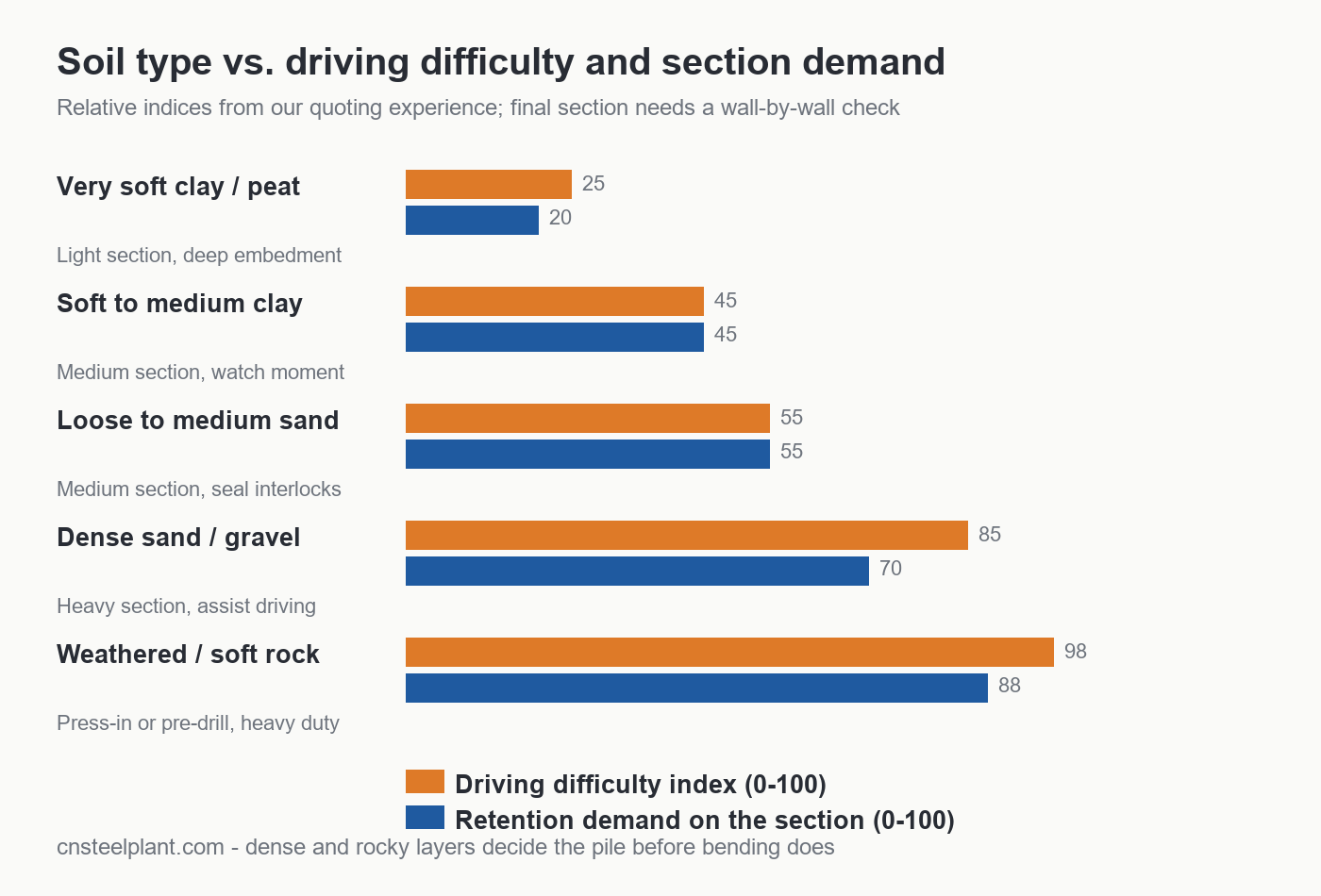
Matching Pile Properties to Ground Conditions
At our mill in Liaocheng, we produce sheet piles in grades from Q235 to S355GP, with section moduli ranging from 600 cm³/m to over 5,000 cm³/m. The trick is matching those numbers to the ground profile.
Section Modulus in Soft Soils
In soft clay or loose silt, the soil provides minimal passive resistance at the toe of the pile. That means the pile itself must resist almost the entire bending moment. I typically recommend a section modulus at least 30% higher than standard charts suggest for these soils. For example, if a 4-meter excavation in medium clay calls for a 1,200 cm³/m section, I would push for 1,600 cm³/m or greater in soft clay. The extra stiffness prevents the bulging and cracking that I have seen ruin walls in Southeast Asian riverbank projects.
Steel Grade for Dense and Obstruction-Prone Soils
When driving through dense sand, gravel, or boulder layers, the pile experiences enormous local stress at the toe. A standard Q235 pile might buckle or tear at the interlock when it hits a hidden obstruction. For these conditions, I recommend S355GP or higher. The higher yield strength gives the pile the ductility to absorb impact without permanent deformation. In one Middle Eastern project, switching from Q235 to S355GP reduced pile damage during driving from 8% to under 2%.
Z-Type vs U-Type in Heterogeneous Profiles
Z-type piles offer higher section modulus per unit weight because the flanges sit farther from the neutral axis. That makes them efficient in soft soils where you need stiffness. U-type piles have a more robust interlock geometry, which makes them better suited to conditions where interlock damage is a risk, such as boulder layers or oblique driving angles. In mixed profiles, I have seen contractors use Z-type piles for the upper section where bending governs, and U-type piles for the lower section where driving resistance is the main concern.
| Ground Condition | Priority Design Factor | Recommended Section | Recommended Grade |
|---|---|---|---|
| Soft clay, organic silt | Section modulus (stiffness) | Heavy Z-type or wide U-type | Q355 or S355GP |
| Dense sand, gravel | Strength and driving resistance | Thick-wall U-type or hat-type | S355GP or higher |
| Boulder fill, demolition debris | Interlock durability | Robust U-type with reinforced lock | S355GP |
| Mixed profile (soft over dense) | Balanced stiffness and strength | Combination Z-type upper, U-type lower | S355GP |
I always tell contractors to bring us the geotechnical report before they finalize their bill of quantities. We can run the numbers and recommend a section that balances safety and cost. It takes an hour of engineering review and often saves thousands of dollars in unnecessary steel or costly repairs.
What Driving Methods Work Best in Rock, Boulders, and Dense Layers?
Driving method is just as important as pile selection. I have seen the same pile section succeed in one soil and fail in another, purely because the driving method was wrong. In challenging ground, you need a strategy, not just a hammer.
In rock, boulder, and dense soil conditions, sheet pile installation success depends on pre-drilling, impact driving with heavy rams, hydraulic pressing, or specialized extraction of obstructions before driving the pile to design depth.
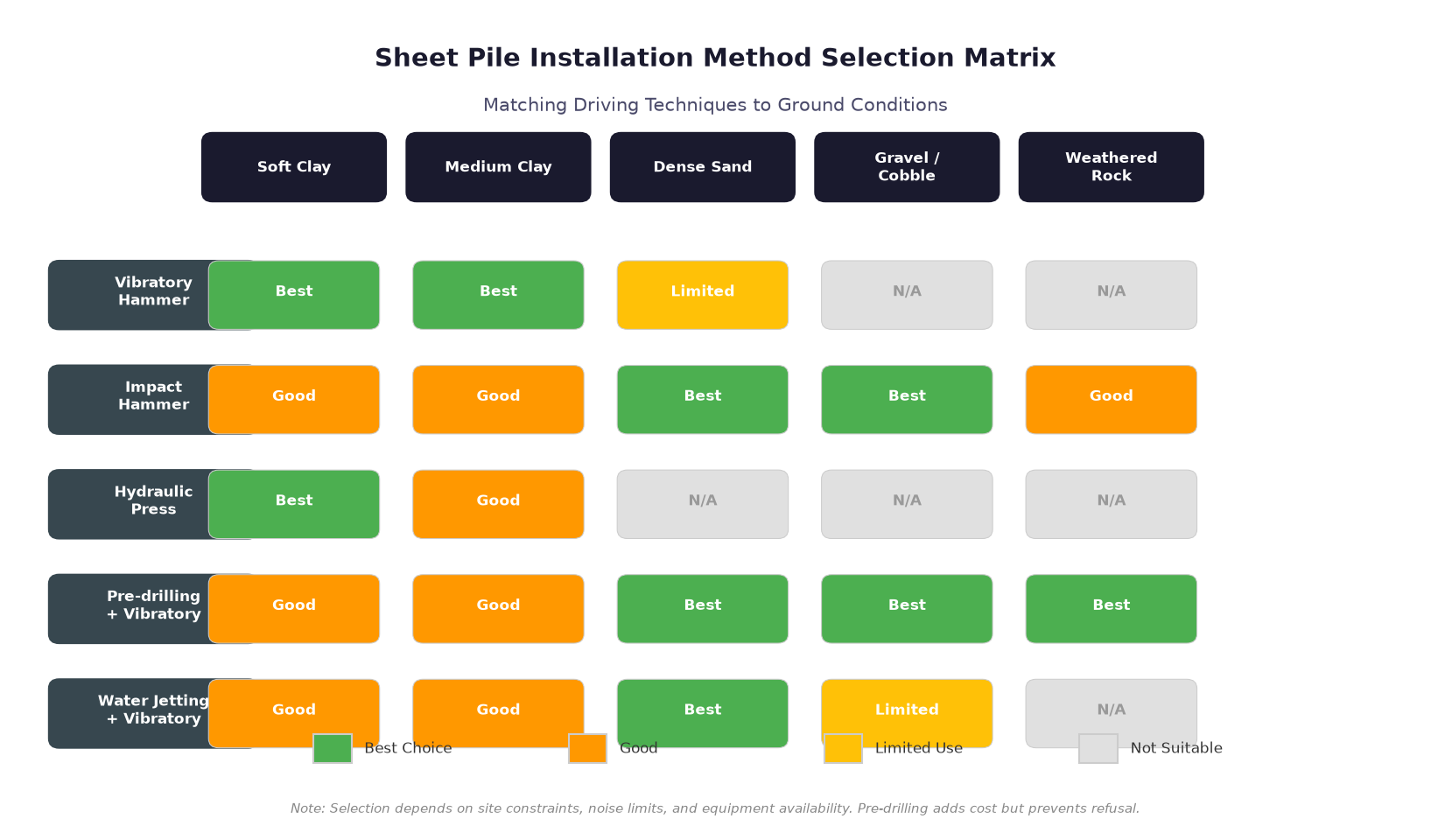
Adapting Installation Techniques to Ground Resistance
The standard vibratory hammer works beautifully in soft to medium soils. When the Standard Penetration Test (SPT) N-value climbs above 30, or when boulders appear, vibration alone is not enough. Here is how I have seen successful teams adapt.
Pre-Drilling and Pre-Augering
Pre-drilling is the most common solution for boulder layers and dense strata. The crew drills a pilot hole slightly smaller than the pile width, removing the obstruction or loosening the dense soil ahead of the pile. In one project near a river in Pakistan, the contractor used a 400-mm auger to pre-drill through a cobble layer at 8 meters depth before driving the sheet piles. The sheet piles then slid through the pre-drilled holes with a standard vibratory hammer, and the wall alignment stayed within tolerance. The extra cost of pre-drilling was less than 5% of the total pile supply cost, but it prevented pile refusal and maintained schedule.
Impact Driving in Dense Granular Soils
Impact hammers deliver concentrated energy at the pile toe, which helps penetrate dense sand and gravel that vibratory hammers cannot fluidize. The trade-off is noise and vibration. I always remind contractors to check local regulations before switching to impact driving. In urban projects, you may need to use hydraulic impact hammers with noise suppression caps, or limit impact driving to specific hours. The energy per blow matters too. A light hammer hitting fast does not penetrate dense soil as effectively as a heavy hammer dropping from a moderate height.
Hydraulic Pressing and Silent Piling
For projects where vibration or noise is unacceptable, hydraulic presses offer an alternative. These machines grip the pile and push it into the ground using static force. They work well in soft to medium clays and loose sands, but they struggle in dense gravel and boulder layers. I have recommended hydraulic pressing for a hospital project in an urban area of Australia where vibration could not exceed 2 mm/s PPV. The soil was medium clay, and the press achieved full embedment without disturbing adjacent structures.
Water Jetting Assistance
Water jetting can help in dense sand and fine gravel by fluidizing the soil around the pile toe. A jet pipe runs alongside the pile, pumping water at high pressure to loosen the soil. I have seen this method work well in marine projects where dense marine sand resists penetration. The key is controlling the water pressure and flow rate. Too much water can destabilize the surrounding soil, and too little has no effect. I typically recommend test sections to calibrate the jet parameters before full-scale driving.
| Driving Method | Best Soil Type | Limitation | Relative Cost Index |
|---|---|---|---|
| Vibratory hammer | Soft to medium clay, loose sand | Ineffective in dense sand and rock | 1.0 (baseline) |
| Impact hammer | Dense sand, gravel, stiff clay | High noise and vibration | 1.3 |
| Hydraulic press | Soft clay, loose sand, urban sites | Limited penetration in dense soils | 1.8 |
| Pre-drilling + vibratory | Boulder layers, mixed fill | Extra step, schedule impact | 1.4 |
| Water jetting + vibratory | Dense fine sand, marine deposits | Risk of soil destabilization | 1.2 |
The right method often combines two techniques. I have lost count of how many projects used pre-drilling with vibratory driving, or water jetting with impact hammers. The best contractors treat each panel of the wall as a test section and adjust their method based on what the soil tells them.
How Do Groundwater and Soft Soils Affect Sheet Pile Performance?
Groundwater is the silent enemy of sheet pile walls. It adds hydrostatic pressure, reduces effective stress in the soil, and can create seepage paths that undermine the wall foundation. In soft soils, these effects are magnified because the soil already has low strength.
High groundwater in soft soils increases hydrostatic pressure on sheet pile walls, reduces passive soil resistance, and creates seepage risks that require dewatering systems, tighter interlock seals, or deeper embedment to maintain wall stability.
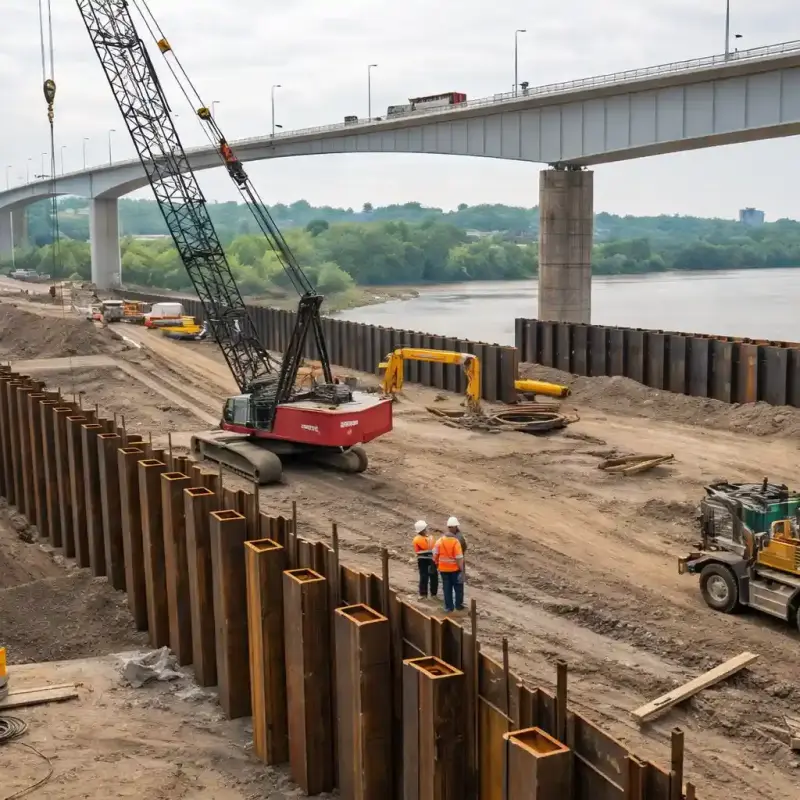
Managing Water and Weak Soil Together
When groundwater sits above the excavation base and the surrounding soil is soft clay or loose silt, the design challenge doubles. You are fighting both the soil and the water at the same time.
Hydrostatic Pressure and Wall Design
Hydrostatic pressure acts uniformly on the wall face, adding to the active earth pressure from the soil. In a 6-meter-deep excavation with groundwater at ground level, the water pressure alone creates 60 kPa at the toe. That is often more than the soil pressure. The sheet pile must be designed for the combined load, which typically means a heavier section and deeper embedment. I have reviewed designs where ignoring the water pressure would have led to wall failure within days of excavation.
Dewatering Inside the Excavation
The most common solution is dewatering. Wellpoints, deep wells, or sump pumping lower the water table inside the excavation, reducing the pressure differential across the wall. But dewatering has limits. In clay soils, the permeability is so low that pumping has little effect. In sandy soils, aggressive dewatering can draw fines through the soil matrix, causing settlement outside the wall. I always recommend monitoring drawdown and settlement during excavation, especially when buildings or utilities sit nearby.
Interlock Sealing for Seepage Control
Even with dewatering, some water seeps through the interlocks between piles. In soft soils where the wall may deflect, the gap at the interlock can widen, increasing leakage. For projects where seepage must be minimized, such as cofferdams or contaminated site containment, I recommend interlock sealants. These are applied to the interlock grooves before driving and expand when wet, creating a flexible seal. In one cofferdam project for a bridge foundation, sealant-treated interlocks reduced seepage to less than 5 liters per minute across a 50-meter wall.
Toe Erosion and Scour Protection
In riverbank and marine applications, groundwater flow can erode the soil at the toe of the wall, reducing embedment and passive resistance. This is called toe scour, and it is particularly dangerous in soft soils where the remaining embedment may be only a meter or two. I have specified stone aprons, geotextile filters, and concrete toe protection for projects where scour is a risk. For long-term durability, we also consider corrosion protection in these designs. The cost of protection is small compared to the cost of wall failure.
| Groundwater Condition | Soft Soil Risk | Primary Mitigation | Secondary Protection |
|---|---|---|---|
| High water table in clay | Low dewatering effectiveness, basal heave | Wellpoint system, staged excavation | Heavier pile section, deeper embedment |
| High water table in sand | Seepage, piping, settlement from pumping | Deep wells with filter packs | Interlock sealant, toe drainage |
| Artesian pressure | Basal blowout, uplift | Relief wells, pressure relief system | Weighted base slab, deeper cutoff |
| Tidal fluctuation | Cyclic loading, interlock fatigue | Robust interlock, corrosion allowance | Flexible sealant, regular inspection |
The interaction between groundwater and soft soil is one of the most complex problems in sheet pile design. I always tell engineers to model the worst-case water level, not the average. A wall that works in dry conditions can fail in the first rainy season if the design ignored seasonal groundwater fluctuations.
My Take: What I Have Learned from Challenging Ground Projects
After fifteen years of supplying steel sheet piles to projects across six continents, I have developed a simple philosophy about difficult ground: respect the soil, and the soil will respect your wall. Every challenging project I have been part of taught me that surprises are inevitable, but failure is optional.
The most successful contractors I work with share three habits. First, they invest in geotechnical investigation before design. A borehole every twenty meters is cheaper than a wall repair. Second, they build flexibility into their pile order. They specify a range of sections and keep a contingency stock on site, because the soil never reads the geotechnical report. Third, they monitor during installation. If refusal starts at 10 meters instead of 12, they stop and figure out why, rather than hitting the pile harder until it bends.
At our factory, we see the aftermath of poor ground-condition planning more often than we would like. Bent piles, cracked interlocks, and walls that lean more than they should. Most of these problems were preventable with better soil investigation, heavier sections, or adapted driving methods. We produce the steel, but the contractor produces the success. The best outcomes happen when the supplier and the contractor talk before the first pile hits the ground.
One project that sticks with me was a port expansion in Southeast Asia. The geotechnical report showed soft clay to 15 meters, but the contractor hit a thin layer of dense coral sand at 8 meters. Their standard vibratory hammer refused. Instead of forcing the piles, they paused, brought in a pre-drilling rig, and completed the wall on schedule. That moment of patience saved the project. I shipped them an extra ten piles as backup, but they did not need them. They needed a plan, not more steel.
Conclusion
Challenging ground conditions demand respect, preparation, and adaptation. With the right steel sheet pile section, driving method, and groundwater strategy, even the most difficult soils become manageable. Talk to your supplier early, test your assumptions, and adjust your approach as the ground reveals itself.