You are designing a new port terminal or expanding an existing harbor. The water is deep, the ships are large, and the soil conditions are complex. The sheet pile wall must last for 50 years in a harsh marine environment.
Selecting steel sheet piles1 for port construction requires consideration of water depth, soil conditions, corrosion protection, structural loads, and installation method. Z-type piles are preferred for deep water (over 10 m), while U-type piles work well for moderate depths and curved alignments. Marine grade steel (ASTM A690) is recommended for seawater environments.
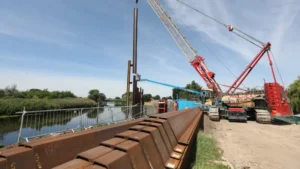
[^1] for port construction project](https://placehold.co/600x400 "Port Construction Sheet Piles")](https://cnsteelplant.com/wp-content/uploads/2026/03/Article-Application-Port-4.webp)
I have supplied sheet piles for ports across the Middle East, Southeast Asia, and Africa. A port in the UAE used AZ 26 piles for an 18-meter deep quay wall. A harbor in the Philippines used U-type piles for a curved breakwater. Let me walk you through how to select sheet piles for port construction.
What are the different types of steel sheet piling?
Steel sheet piling comes in several types, each suited for different port applications. The main types are U-type, Z-type, and straight web.
U-type sheet piles1 are symmetric with Larssen interlocks, ideal for curved walls and moderate depths. Z-type sheet piles2 are asymmetric with higher structural efficiency, preferred for deep, straight walls. Straight web piles are used for cellular cofferdams. Combination walls use H-piles with sheet piles between them for very deep water.
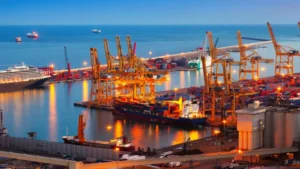
](https://cnsteelplant.com/wp-content/uploads/2026/03/Article-Application-Port-3.webp)
Overview of Sheet Pile Types for Ports
Let me explain each type and its port application.
U-Type Sheet Piles
- Profile: Symmetric, looks like a U
- Interlock: Larssen ball-and-socket
- Width: 400 mm or 600 mm
- Best for: Curved breakwaters, moderate water depths (up to 10 m)
- Advantages: Easy installation, forgiving alignment, good water tightness
- Common sections: U 400 x 125, U 400 x 170, U 600 x 180
Z-Type Sheet Piles
- Profile: Asymmetric, looks like a Z
- Interlock: Ball-and-socket (AZ, PZC) or hook-and-grip (PZ)
- Width: 630-700 mm
- Best for: Deep water quay walls, straight alignments (10-20 m depth)
- Advantages: Higher strength per kg, wider sections, fewer piles
- Common sections: AZ 18, AZ 26, AZ 34, PZC 18, PZC 26
- Profile: Flat web with interlocks on edges
- Interlock: Ball-and-socket or thumb-and-finger
- Width: 500-800 mm
- Best for: Cellular cofferdams, circular cells
- Advantages: Can form large diameter cells
- Profile: H-piles (king piles) with sheet piles between
- Interlock: Special connectors
- Best for: Very deep water (over 20 m), heavy loads
- Advantages: Highest bending strength
My Experience
For the port project in the UAE (18 m water depth, straight wall), we used Z-type AZ 26 piles. For a marina project with curved berths (6 m water depth), we used U-type U 400 x 125 piles.
What is the rule of thumb for sheet pile depth1?
The rule of thumb for sheet pile depth1 in port construction depends on whether the wall is cantilever or anchored.
For cantilever walls (used in shallow water up to 6 m), the embedment depth2 (D) is 1.0 to 1.5 times the exposed height (H). For anchored walls (used in deeper water), D is 0.5 to 0.8 times H. In soft soils, use the higher end of the range. In dense sands, use the lower end.
[^2] rule of thumb for ports](https://placehold.co/600x400 "Sheet Pile Depth Rule of Thumb")](https://cnsteelplant.com/wp-content/uploads/2026/03/Article-Application-Port-2.webp)
Embedment Rules for Port Walls
Let me provide specific embedment rules for port construction.
Cantilever Walls (Water depth up to 6 m)
| Soil Type | D/H Range | Example (H=6m) |
|---|---|---|
| Dense sand | 1.0 – 1.2 | 6.0 – 7.2 m |
| Medium sand | 1.1 – 1.3 | 6.6 – 7.8 m |
| Loose sand | 1.2 – 1.5 | 7.2 – 9.0 m |
| Stiff clay | 1.2 – 1.5 | 7.2 – 9.0 m |
| Soft clay | 1.5 – 2.0 | 9.0 – 12.0 m |
Anchored Walls (Water depth over 6 m)
| Soil Type | D/H Range | Example (H=12m) |
|---|---|---|
| Dense sand | 0.5 – 0.6 | 6.0 – 7.2 m |
| Medium sand | 0.6 – 0.7 | 7.2 – 8.4 m |
| Loose sand | 0.7 – 0.8 | 8.4 – 9.6 m |
| Stiff clay | 0.6 – 0.7 | 7.2 – 8.4 m |
| Soft clay | 0.7 – 0.9 | 8.4 – 10.8 m |
Additional Factors for Ports
- Wave action: Add 10-20% to D for exposed locations
- Scour potential: Add 1-2 m below expected scour depth
- Seismic: Add 10-20% in seismic zones
My Experience
For the port project in the UAE (H = 18 m, dense sand, anchored wall), the rule gave D = 9 to 11 m. The detailed analysis gave D = 11 m, right in the middle of the range.
What is the difference between U type and Z-type sheet piles?
The main difference between U and Z type sheet piles is the shape and the position of the interlocks, which affects structural efficiency1 and installation.
U-type piles have interlocks at the neutral axis and are symmetric. Z-type piles have interlocks at the outer flanges and are asymmetric. Z-type piles have higher structural efficiency1 (more strength per kilogram of steel) and are wider (630-700 mm vs 400-600 mm). U-type piles are easier to install in curved alignments2 and are more forgiving during driving.
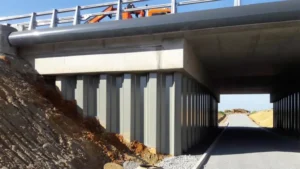
](https://cnsteelplant.com/wp-content/uploads/2026/03/Article-Application-Port-1.webp)
Comparison for Port Construction
Let me compare U and Z piles specifically for port applications.
U-Type for Ports
| Feature | Performance |
|---|---|
| Best water depth | Up to 10 m |
| Curved alignments | Excellent |
| Installation complexity | Simpler |
| Structural efficiency | Good |
| Width | 400-600 mm |
| Water tightness | Good (Larssen interlock) |
Z-Type for Ports
| Feature | Performance |
|---|---|
| Best water depth | 10-20 m |
| Curved alignments | Difficult |
| Installation complexity | More skill required |
| Structural efficiency | Higher |
| Width | 630-700 mm |
| Water tightness | Good (ball-and-socket) |
Selection Guide for Ports
| Port Application | Recommended Type |
|---|---|
| Curved breakwater | U-type |
| Marina with curved berths | U-type |
| Straight quay wall, deep water | Z-type |
| Container terminal, straight wall | Z-type |
| Moderate depth (under 10 m) | U-type or Z-type |
| Deep water (over 10 m) | Z-type |
My Experience
For a container terminal with 15 m water depth and a straight quay wall, we used Z-type AZ 26 piles. The higher structural efficiency1 allowed us to use a lighter section than U-type. For a marina with curved berths (6 m depth), we used U-type U 400 x 125 piles.
What are the different types of sheet piles in the Philippines?
In the Philippines, both U-type and Z-type sheet piles1 are used for port construction, with U-type being more common for smaller ports and Z-type for major terminals.
The Philippine port industry2 uses sheet piles conforming to international standards (ASTM, EN 10248, or JIS). U-type piles (400 mm width) are widely available and used for moderate-depth ports, river walls, and coastal protection. Z-type piles (AZ series) are used for major port projects like the Manila International Container Terminal3. Japanese standards (JIS) are also common due to historical ties.
](https://cnsteelplant.com/wp-content/uploads/2026/03/Article-Application-Port-3-1.webp)
Sheet Pile Market in the Philippines
Let me explain the sheet pile types commonly used in Philippine ports.
Commonly Available Sections
| Type | Common Sections | Source |
|---|---|---|
| U-type | U 400 x 125, U 400 x 170 | Japan, China, Korea |
| Z-type | AZ 18, AZ 26 | Europe, Japan, China |
| JIS U-type | Type 2, Type 3, Type 4 | Japan |
JIS (Japanese Industrial Standard) Types4
The JIS standard is common in the Philippines due to historical ties with Japan.
| JIS Type | Width (mm) | Height (mm) | Weight (kg/m) | S (cm³/m) |
|---|---|---|---|---|
| Type 2 | 400 | 100 | 48.0 | 1,080 |
| Type 3 | 400 | 125 | 60.0 | 1,590 |
| Type 4 | 400 | 170 | 76.1 | 2,470 |
| Type 6 | 600 | 180 | 81.6 | 3,820 |
Port Projects in the Philippines
| Project | Sheet Pile Type |
|---|---|
| Manila International Container Terminal3 | Z-type (AZ series) |
| Cebu International Port | U-type (JIS Type 4) |
| Davao Port | U-type and Z-type |
| Subic Bay Freeport | Z-type |
My Experience
I have supplied sheet piles to Philippine ports. For a project in Cebu, we used JIS Type 4 U-type piles (U 400 x 170). The client was familiar with the JIS standard, and the piles met the project requirements. For a larger project in Manila, we supplied AZ 26 Z-type piles.
Conclusion
Selecting steel sheet piles1 for port construction requires considering water depth, soil conditions, and alignment. Use U-type piles for curved walls and moderate depths (up to 10 m). Use Z-type piles for deep, straight walls (10-20 m). Marine grade steel (ASTM A690) is recommended for seawater. In the Philippines, JIS standards are common.
-
Understanding best practices for steel sheet piles can enhance your construction project’s efficiency and durability. ↩ ↩ ↩ ↩ ↩ ↩ ↩ ↩ ↩
-
This resource will provide insights into the international standards that govern the Philippine port industry, ensuring quality and safety. ↩ ↩ ↩ ↩
-
Discover the importance of the Manila International Container Terminal and how it utilizes Z-type sheet piles for major port projects. ↩ ↩ ↩
-
Learn about the JIS types of sheet piles, their specifications, and why they are preferred in the Philippines due to historical ties. ↩ ↩