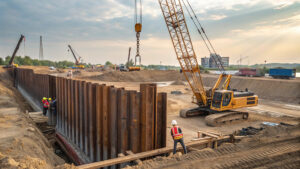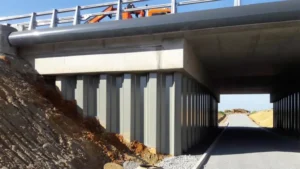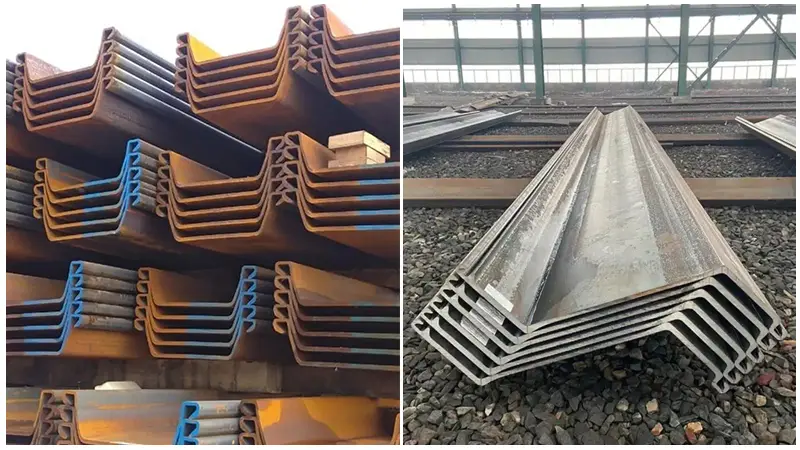
Many sheet pile projects fail because engineers underestimate section modulus requirements. This leads to bending, deformation, and structural instability.
The required section modulus for sheet piles depends on soil pressure, water load, excavation depth, and wall height. Engineers calculate it based on bending moment and choose a sheet pile profile that provides enough resistance to prevent excessive deflection or failure.
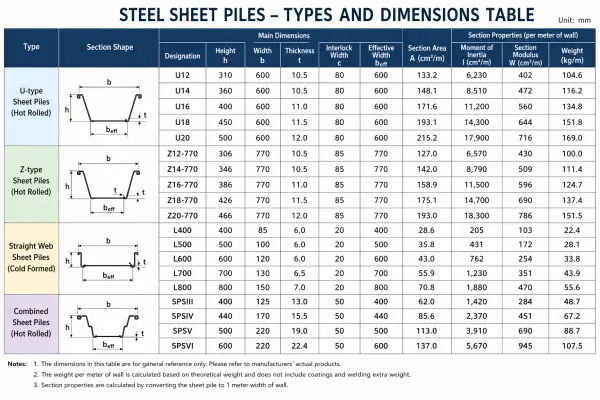
I often see buyers focus only on steel grade or pile type. They forget that section modulus is the real structural driver. In sheet pile design, steel strength alone is not enough. The shape of the section decides how well the wall resists bending. In my experience, understanding section modulus early prevents costly redesign and project delay.
How to calculate section modulus of sheet pile?
Many engineers ask how section modulus is calculated. This is one of the most important concepts in sheet pile design.
Section modulus of a sheet pile is calculated by dividing the second moment of area (I) by the distance from the neutral axis to the extreme fiber (y). The formula is Z = I / y, and it measures the bending resistance of the section.
Basic Formula Explanation
Section modulus is written as:
Z = I / y
Where:
- Z = section modulus
- I = second moment of area
- y = distance from neutral axis
This formula shows how geometry affects strength. Learn more from AISC Steel Construction Manual.
Why Section Modulus Matters
Steel grade gives material strength.
Section modulus gives shape strength.
Both must work together.
If Z is low:
- Wall bends easily
- Deflection increases
- Failure risk increases
Structural Design Use
Engineers use section modulus to:
- Calculate bending stress
- Select sheet pile type
- Check safety factors
Bending stress formula is:
σ = M / Z
Where M is bending moment.
Practical Engineering View
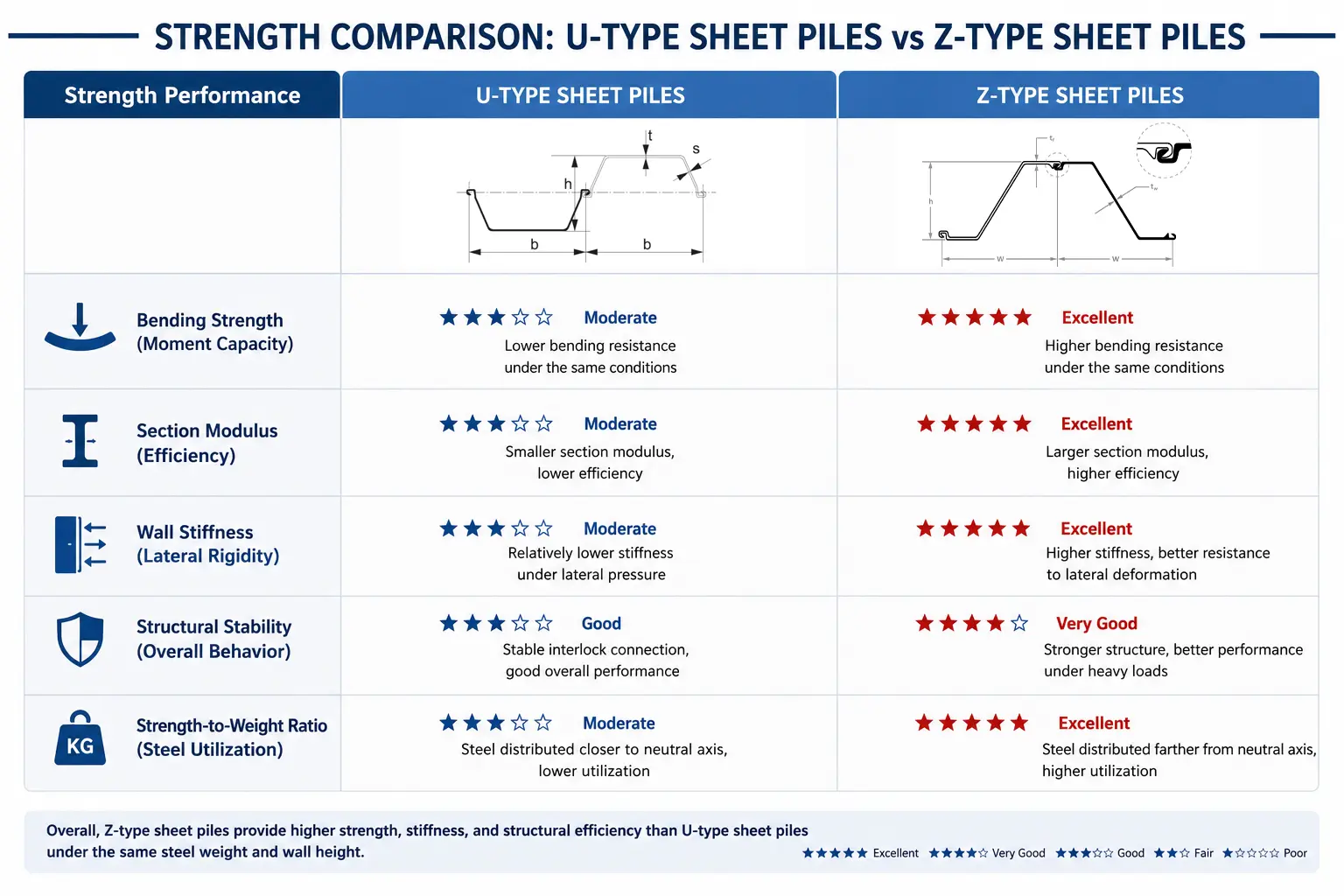
In real projects, I see engineers choose Z-type piles because they provide higher section modulus than U-type piles with similar weight.
This improves efficiency without increasing steel cost too much.
My opinion is simple. Section modulus is more important than steel grade in bending control.
What is the section modulus of PZ27 sheet pile?
Many buyers ask about specific product values when selecting sheet piles.
The section modulus of PZ27 sheet pile is approximately 270–280 cm³/m depending on manufacturer standards. It is designed for medium-duty retaining walls and shallow to moderate excavation projects.
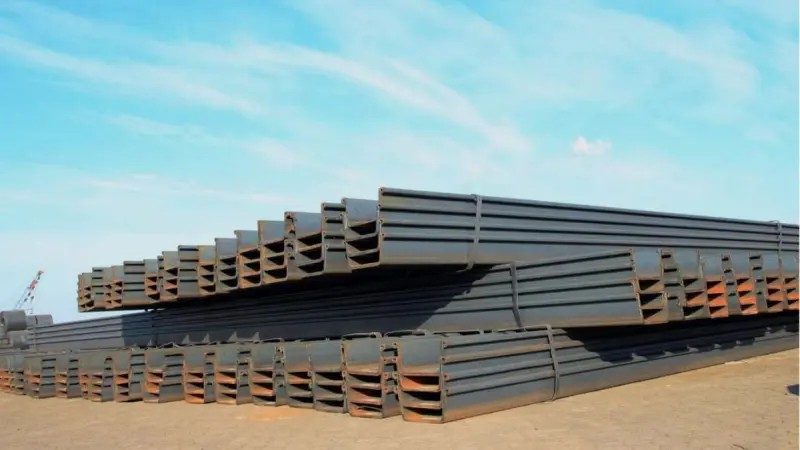
Understanding PZ Series Sheet Piles
PZ sheet piles are widely used in North America.
They are known for:
- Reliable interlocks
- Standardized geometry
- Predictable structural performance
PZ27 Structural Capacity
PZ27 is a mid-range section.
Typical properties:
| Property | Value |
|---|---|
| Section Modulus | ~270 cm³/m |
| Application | Medium excavation |
| Strength Level | Moderate |
Where PZ27 Is Used
Common applications include:
- Light retaining walls
- Temporary excavation support
- Small infrastructure works
It is not suitable for deep marine structures.
Limitations of PZ27
PZ27 has lower bending resistance compared to larger sections like PZ40.
Limitations include:
- Lower load capacity
- Limited depth use
- Higher deflection under pressure
My Field Observation
I have seen PZ27 used in small excavation projects where soil pressure was low. It performed well.
But in deeper soil conditions, engineers upgraded to higher Z-type sections.
My view is that PZ27 is safe only when soil conditions are controlled and loads are moderate.
What is the BS standard for sheet pile?
Many international projects require compliance with British standards.
The BS standard for sheet piles is mainly BS EN 10248, which defines hot rolled steel sheet pile requirements including mechanical properties, dimensions, tolerances, and testing procedures.
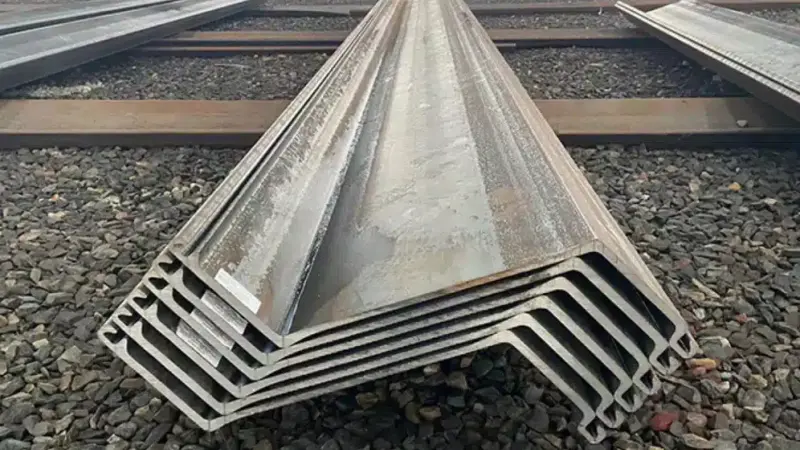
Overview of BS EN 10248
BS EN 10248 is part of the European standard system.
It covers:
- Hot rolled sheet piles
- Structural performance
- Dimensional accuracy
- Material testing
You can review details from the British Standards Institution.
Why Standards Matter
Standards ensure:
- Safety
- Consistency
- International compatibility
Without standards, project risk increases.
Sheet Pile Requirements in BS EN 10248
Key requirements include:
- Yield strength levels
- Chemical composition limits
- Impact testing
- Shape tolerances
Application in Global Projects
Many projects in:
- Middle East
- Africa
- Asia
- Europe
use BS EN standards for procurement.
My Practical View
I often supply sheet piles to projects that require EN certification.
Engineers trust BS EN 10248 because it reduces uncertainty in structural performance.
My opinion is that compliance with standards is as important as steel grade itself in international projects.
What is the plastic section modulus ratio of hot rolled steel sheet pile PZ22 to PZ40?
Many engineers compare different PZ sections when optimizing design.
The plastic section modulus ratio of PZ22 to PZ40 is approximately 1:2.5 to 1:3, meaning PZ40 provides about 2.5 to 3 times higher bending capacity than PZ22 depending on manufacturer specifications.
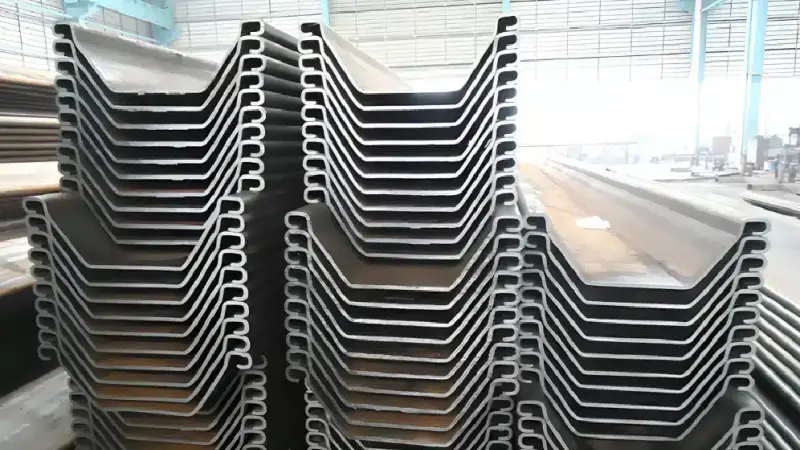
Understanding Plastic Section Modulus
Plastic section modulus is used when:
- Material reaches yield stress
- Plastic deformation begins
- Ultimate capacity is evaluated
It shows maximum bending capacity before failure.
Comparison of PZ22 and PZ40
| Section | Plastic Modulus | Strength Level |
|---|---|---|
| PZ22 | Low | Light duty |
| PZ40 | High | Heavy duty |
Why the Difference Is Large
PZ40 has:
- Larger geometry
- Thicker section
- Higher moment capacity
This increases bending resistance significantly.
Engineering Impact
Choosing PZ22 instead of PZ40 can:
- Reduce cost
- Increase deflection
- Limit excavation depth
Choosing PZ40 increases:
- Stability
- Safety margin
- Structural performance
My Field Experience
I often see buyers choose smaller sections to reduce cost.
But later they face deformation issues in deep soil conditions.
My view is that structural safety should always come before material savings.
What is the difference between section modulus S and Z?
Many engineers confuse S and Z when reading technical documents.
Section modulus S refers to elastic section modulus, while Z refers to plastic section modulus. S is used for elastic design, and Z is used for ultimate strength and plastic deformation analysis.
Elastic Section Modulus (S)
S is used when:
- Material is in elastic range
- No permanent deformation occurs
Formula:
S = I / y
It is used in normal design conditions. Learn more from Engineering Toolbox.
Plastic Section Modulus (Z)
Z is used when:
- Material reaches yield point
- Plastic deformation is allowed
It represents maximum capacity.
Key Difference Table
| Property | S | Z |
|---|---|---|
| Design Type | Elastic | Plastic |
| Load Condition | Service load | Ultimate load |
| Safety Level | Normal | Maximum |
Why Engineers Use Both
Engineers use S for:
- Serviceability checks
Engineers use Z for:
- Ultimate strength design
Both are required for full structural safety.
My Engineering View
I often explain to clients that S is about everyday performance, while Z is about failure limit.
Both are important.
But in sheet pile design, Z is often more critical because walls face extreme soil pressure conditions.
Understanding this difference helps avoid under-designed structures.
Conclusion
Sheet pile section modulus determines bending resistance, and correct selection based on soil and load conditions is essential for safe and efficient retaining wall design.