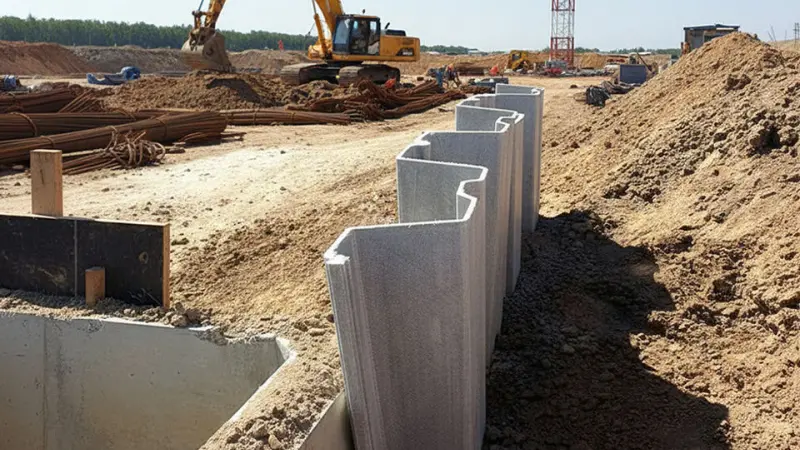
You are standing at the edge of a 10-meter deep excavation in the middle of a city. The buildings around you are old and sensitive. The soil is unstable. You need a support system that is strong, reliable, and can be installed quickly without damaging adjacent structures.
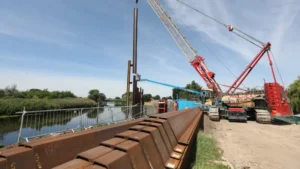
Steel sheet pile walls1 are the most common solution for deep excavation support. They provide a continuous, interlocking barrier that holds back soil and water, allowing safe excavation. Cantilever walls work for moderate depths (up to 6 m). Anchored walls with tiebacks or internal bracing are used for deeper excavations (10-20 m). Combination walls with H-piles handle the deepest applications.
](https://cnsteelplant.com/wp-content/uploads/2026/03/Article-application-3-1.webp)
I have supplied sheet piles for deep excavations across the Middle East and Southeast Asia. A metro project in Southeast Asia used anchored Z-type piles for a 15-meter station box. A high-rise foundation in the UAE used combination walls for a 20-meter basement. Let me walk you through how steel sheet pile walls work for deep excavation support.
Steel sheet piling for sale1
Steel sheet piling for deep excavation projects is available through manufacturers, service centers, and distributors. Understanding the market helps you source the right piles for your project.
Steel sheet piling for sale1 includes new hot-rolled sections from mills like ArcelorMittal, Nucor, and Chinese manufacturers, as well as used sheet piles from decommissioned projects. For deep excavations, new piles are recommended to ensure consistent quality, tight interlocks, and reliable strength. Prices range from $550 to $800 per ton depending on section and grade.
](https://cnsteelplant.com/wp-content/uploads/2026/03/Article-Application-Subway-2.webp)
Sourcing Sheet Piles for Deep Excavations
Let me explain the options for sourcing sheet piles for deep excavation projects.
- Source: Direct from mills or through distributors
- Quality: Certified to ASTM or EN standards
- Sections: Full range of U-type, Z-type, and combination walls
- Lead time: 4-12 weeks depending on quantity
- Cost: $550-800 per ton
- Best for: Permanent structures, deep excavations, critical applications
- Source: Used pile dealers, salvage from decommissioned projects
- Quality: Variable, may have corrosion or interlock damage
- Sections: Limited availability, often older sections
- Lead time: Immediate to 4 weeks
- Cost: $300-500 per ton
- Best for: Temporary excavations, non-critical applications
| Supplier | Location | Product Range |
|---|---|---|
| ArcelorMittal | Europe, global | PU (U-type), AZ (Z-type) |
| Nucor Skyline | North America | PZC, PZ series |
| Chinese mills | China | EN and ASTM sections |
| JFE Steel | Japan | U-type, Z-type |
What to Look for in Sheet Piles for Deep Excavations
- Mill certificates showing chemical and mechanical properties
- Consistent interlock geometry for water tightness
- Straightness within tolerance (critical for deep driving)
- Section modulus adequate for the excavation depth
My Experience
For a metro project with 15 m excavation, we used new AZ 26 piles from ArcelorMittal. The quality was consistent, and the interlocks were tight. Used piles would not have provided the reliability needed for such a critical project.
Sheet pile wall design1
Sheet pile wall design1 for deep excavations requires careful analysis of soil conditions, water pressures, and adjacent structures.
Sheet pile wall design1 involves determining the required embedment depth2, calculating the maximum bending moment3, and selecting a pile section with adequate section modulus. For deep excavations, anchored walls4 with tiebacks or internal bracing are used. The design must account for soil layers, water table, surcharge loads, and potential seismic conditions.
](https://cnsteelplant.com/wp-content/uploads/2026/03/Article-application-6.webp)
Design Steps for Deep Excavation Support
Let me walk you through the design process for a deep excavation sheet pile wall.
Step 1: Determine Site Conditions
- Excavation depth (H)
- Soil properties (γ, φ, c) for each layer
- Water table location
- Surcharge loads (adjacent buildings, equipment)
Step 2: Select Wall Type
- Cantilever: Up to 6 m depth
- Single anchor: 6-12 m depth
- Multiple anchors: 12-20 m depth
- Combination wall: Over 20 m depth
Step 3: Calculate Earth Pressures
- Active pressure from retained soil
- Passive pressure from embedded portion
- Water pressure if water table is above excavation
Step 4: Determine Embedment Depth
- For cantilever walls: D = 1.0 to 1.5 H
- For anchored walls4: D = 0.5 to 0.8 H
- Verify through iterative equilibrium calculation
Step 5: Calculate Bending Moment
- Maximum moment occurs between supports
- Use beam-on-elastic-foundation or limit equilibrium methods
Step 6: Select Pile Section
- Required S = Mmax / σallowable
- Select section with S ≥ required
Design Example: 12 m Anchored Wall
- Excavation depth: 12 m
- Soil: Sand, φ = 32°, γ = 18 kN/m³
- Water table: at 3 m depth
- Anchor: Single anchor at 2 m below top
- Required embedment: 7.5 m
- Maximum moment: 380 kN-m/m
- Required S: 1,650 cm³/m
- Selected: AZ 26 (S = 2,600 cm³/m)
My Experience
For a metro project with 15 m excavation, we used a two-anchor system with AZ 26 piles. The design was verified with DeepEX software, and the wall performed exactly as predicted.
Steel sheet piling retaining wall
A steel sheet piling retaining wall1 for deep excavation is a temporary or permanent structure that holds back soil and water during construction.
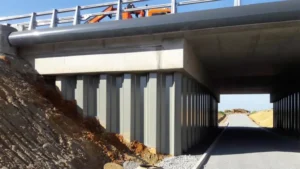
A steel sheet piling retaining wall1 consists of interlocking sheet piles driven to depth, with bracing or tiebacks2 to resist lateral pressure. For deep excavations, anchored walls are standard. The wall is installed before excavation begins, and bracing is added as excavation progresses. After the permanent structure is built, the wall may be extracted (temporary) or left in place (permanent).
[^1] with bracing](https://placehold.co/600x400 "Steel Sheet Piling Retaining Wall")](https://cnsteelplant.com/wp-content/uploads/2026/03/Article-Application-City-3.webp)
Components of a Deep Excavation Retaining Wall
Let me explain the key components of a deep excavation support system.
Sheet Piles
- Function: Primary retaining structure
- Type: Z-type for deep excavations, U-type for moderate
- Sections: AZ 18, AZ 26, AZ 34, AZ 42
Bracing Systems
| Type | Description | Best For |
|---|---|---|
| Internal struts | Steel beams pushing against opposite walls | Rectangular excavations |
| Rakers | Diagonal braces bearing on foundation | Deep excavations |
| Tiebacks | Grouted anchors drilled into soil | Wide excavations, urban sites |
| Walers | Horizontal beams distributing loads | All bracing systems3 |
Construction Sequence
- Drive sheet piles to required depth
- Excavate to first brace level
- Install walers and bracing (or tiebacks2)
- Excavate to next brace level
- Repeat until final depth
- Construct permanent structure
- Remove bracing and extract piles (if temporary)
Bracing Design Considerations
| Factor | Consideration |
|---|---|
| Excavation shape | Rectangular, circular, or irregular |
| Adjacent structures | Vibration and settlement control |
| Access | Space for excavation equipment |
| Tieback rights | May need permission from adjacent property |
My Experience
For a high-rise foundation in the UAE, we used a steel sheet pile retaining wall with two levels of tiebacks2. The excavation was 18 m deep, and the tiebacks2 extended 20 m behind the wall. The system allowed the contractor to excavate the entire site without internal bracing, providing clear access for construction.
Sheet pile wall types
Sheet pile walls for deep excavation come in several types, each suited for different depths and site conditions.
The main sheet pile wall types for deep excavation are cantilever walls (up to 6 m), anchored walls with tiebacks (6-20 m), braced walls with internal struts (any depth), and combination walls (over 20 m). The choice depends on excavation depth, soil conditions, adjacent structures, and available space for bracing.
](https://cnsteelplant.com/wp-content/uploads/2026/03/Article-application-4.webp)
Comparison of Wall Types
Let me compare the different wall types for deep excavation support.
- Depth: Up to 6 m
- Support: None (relies on embedment)
- Advantages: Simple, no bracing
- Disadvantages: Limited depth, requires deep embedment
- Sections: U 400 x 125, U 400 x 170
- Depth: 6-20 m
- Support: Grouted anchors drilled behind wall
- Advantages: No internal bracing, clear work area
- Disadvantages: Requires tieback rights, longer installation
- Sections: AZ 18, AZ 26, AZ 34, AZ 42
Braced Walls (Internal Struts)3
- Depth: Any depth
- Support: Steel struts pushing against opposite walls
- Advantages: No tieback rights needed, works in any soil
- Disadvantages: Obstruction inside excavation
- Sections: U-type or Z-type depending on depth
- Depth: Over 20 m
- Support: H-piles (king piles) with sheet piles between
- Advantages: Highest bending strength, can handle extreme depths
- Disadvantages: Complex installation, higher cost
- Sections: HP 12 x 53 with sheet piles
Wall Type Selection Guide
| Excavation Depth | Recommended Wall Type |
|---|---|
| Up to 6 m | Cantilever |
| 6-10 m | Anchored (single anchor) or braced |
| 10-15 m | Anchored (single or double) or braced |
| 15-20 m | Anchored (double) or braced |
| Over 20 m | Combination or slurry wall |
My Experience
For a metro station excavation (15 m depth), we used an anchored wall with two levels of tiebacks. The site was in a dense urban area with limited space for internal bracing. The tiebacks allowed the contractor to excavate the entire station box without obstructions.
Conclusion
Steel sheet pile walls1 are the standard solution for deep excavation support. Cantilever walls work for shallow excavations up to 6 m. Anchored walls with tiebacks2 are used for deeper excavations (6-20 m). Braced walls with internal struts work for any depth where tiebacks are not feasible. Combination walls handle the deepest applications over 20 m.
-
Explore this link to understand the advantages and applications of steel sheet pile walls in deep excavation support. ↩ ↩ ↩ ↩ ↩ ↩ ↩ ↩ ↩ ↩
-
Learn more about anchored walls with tiebacks and their effectiveness in supporting deeper excavations. ↩ ↩ ↩ ↩ ↩ ↩ ↩ ↩
-
Discover the advantages of Braced Walls with Internal Struts, a versatile option for various soil conditions. ↩ ↩ ↩ ↩
-
Find out how Combination Walls can provide superior strength for extreme depths, making them a vital choice for complex projects. ↩ ↩ ↩ ↩