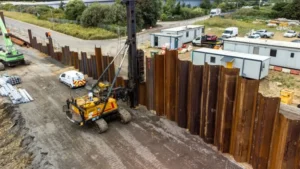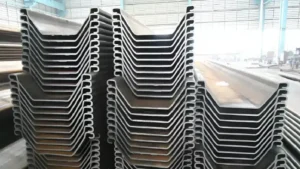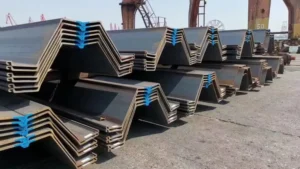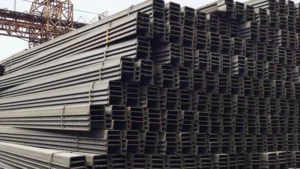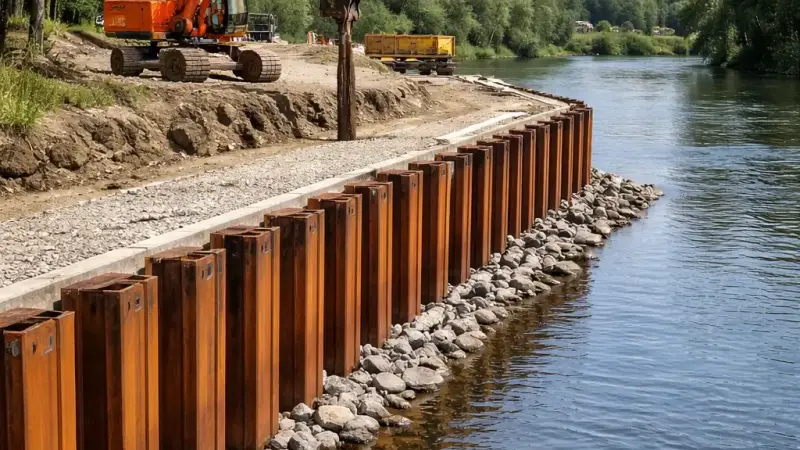
You are designing a sheet pile wall for a riverbank or a dam. The steel will be exposed to water, soil, and varying conditions for 50 years or more. Without protection, corrosion will thin the steel and eventually cause failure.
Corrosion protection methods for river sheet piles include corrosion allowance (adding extra steel thickness), protective coatings (epoxy, polyurethane), and in some cases, cathodic protection. For freshwater rivers, a corrosion allowance of 1-2 mm is typically sufficient. For brackish or tidal rivers, marine grade steel1 (ASTM A690) or coatings are recommended.
[^2] for river sheet piles diagram](https://placehold.co/600x400 "Corrosion Protection for River Sheet Piles")](https://cnsteelplant.com/wp-content/uploads/2026/03/Article-Application-River-Embankment-4.webp)
I remember the riverbank project in Southeast Asia where we added a 2 mm corrosion allowance to standard carbon steel piles. The river was freshwater, and that allowance provided a 50-year design life. Let me walk you through the corrosion protection methods2 that work for river environments.
Steel pile corrosion protection
Steel pile corrosion protection in river environments requires understanding the corrosion mechanisms and selecting the appropriate method for the exposure conditions.
Steel piles in rivers experience corrosion from water, soil, and sometimes biological activity. Corrosion rates vary by water chemistry: freshwater (0.02-0.05 mm/year), brackish water (0.05-0.10 mm/year), and polluted water (0.10-0.20 mm/year). Protection methods include corrosion allowance, coatings, and marine grade steel. The splash zone (above water) often requires additional protection.
](https://cnsteelplant.com/wp-content/uploads/2026/03/Article-Application-River-Embankment-3.webp)
Corrosion Zones in River Environments
Let me explain the different corrosion zones for river sheet piles.
Corrosion Zones
| Zone | Description | Corrosion Rate (mm/year) | Protection Needed |
|---|---|---|---|
| Atmospheric | Above high water | 0.02-0.05 | Coating or corrosion allowance |
| Splash | Waves and spray | 0.05-0.10 | Coating or marine grade |
| Fluctuating | Water level varies | 0.05-0.10 | Corrosion allowance |
| Submerged | Always underwater | 0.02-0.05 | Corrosion allowance |
| Buried | Below riverbed | 0.01-0.03 | Minimal |
Protection Methods
1. Corrosion Allowance1
Add extra steel thickness to account for expected corrosion over the design life.
- For 50-year life in freshwater: Add 1-2 mm
- For 50-year life in brackish water: Add 2-3 mm
- Simple and reliable
- Increases steel weight and cost
2. Protective Coatings2
Applied to the steel surface to create a barrier.
- Fusion-bonded epoxy (FBE): Excellent for submerged and splash zone
- Polyurethane: Good for atmospheric and splash zone
- Coal tar epoxy: Good but restricted in some regions
3. Marine Grade Steel (ASTM A690)3
Steel with copper, nickel, and phosphorus that forms a protective patina.
- Reduces corrosion rate by about 50% compared to carbon steel
- Cost premium of 15-20%
- Best for brackish or tidal rivers
4. Cathodic Protection4
Uses sacrificial anodes or impressed current.
- Rarely needed for freshwater rivers
- Used for brackish water or long-life structures
Recommended Protection by River Type
| River Type | Recommended Protection |
|---|---|
| Freshwater, clean | 1-2 mm corrosion allowance |
| Freshwater, polluted | 2-3 mm corrosion allowance or coating |
| Brackish (tidal) | ASTM A690 steel + 2 mm allowance |
| Tidal, splash zone | Coating (FBE) or A690 |
My Experience
For the riverbank project, the water was clean freshwater. We used standard carbon steel (ASTM A328) with a 2 mm corrosion allowance. The piles were specified with 13 mm thickness instead of 11 mm. That extra 2 mm provides 50 years of life at 0.04 mm/year corrosion.
Weathering steel sheet piles
Weathering steel (Corten) is a high-strength low-alloy steel that forms a protective rust layer1 when exposed to the atmosphere. However, its use in river environments is limited.
Weathering steel sheet piles develop a dense, adherent patina in atmospheric exposure that slows further corrosion. In freshwater rivers, weathering steel2 can be used in the atmospheric zone3 but is not recommended for submerged or fluctuating zones. In brackish water, weathering steel2 is not recommended because chlorides prevent proper patina formation.
[^2] sheet pile with protective patina](https://placehold.co/600x400 "Weathering Steel Sheet Piles")](https://cnsteelplant.com/wp-content/uploads/2026/03/Article-Application-River-Embankment-5.webp)
When to Use (and Not Use) Weathering Steel for Rivers
Let me explain the limitations of weathering steel2 in river environments.
How Weathering Steel Works
Weathering steel contains copper, chromium, nickel, and phosphorus that promote the formation of a dense, adherent rust layer. This patina forms during alternating wet and dry cycles. Once formed, it acts as a barrier, reducing further corrosion.
Limitations in River Environments
- The patina does not form properly in continuous immersion
- In the fluctuating zone, wet/dry cycles are too rapid for stable patina formation
- Chlorides in brackish water break down the protective layer
- Corrosion rates in submerged zones are similar to carbon steel
Where Weathering Steel Can Be Used
- Atmospheric zone above high water
- Architectural applications where appearance matters
- Temporary works that will be removed
- Clean freshwater with good wet/dry cycles
Comparison for River Use
| Zone | Carbon Steel | Weathering Steel | Marine Grade |
|---|---|---|---|
| Atmospheric | Good with coating | Excellent | Good |
| Splash | Poor | Fair | Good |
| Fluctuating | Fair | Poor | Good |
| Submerged | Fair with allowance | Poor | Good |
My Experience
I have rarely specified weathering steel2 for river sheet piles. The conditions in the fluctuating zone are not ideal for patina formation. For one bridge project, we used weathering steel2 for the above-water portion of the piles, with standard carbon steel below water. The transition zone required careful detailing.
Sheet pile coating
Protective coatings are applied to steel sheet piles to create a barrier between the steel and the corrosive environment. They are especially important in the splash and fluctuating zones.
Common sheet pile coatings for river applications include fusion-bonded epoxy (FBE), polyurethane, and coal tar epoxy. FBE is the most durable and is applied in the factory. Polyurethane1 is used for splash zone and atmospheric applications. Coatings can be damaged during driving, so they are often combined with a corrosion allowance for the submerged zone.
](https://cnsteelplant.com/wp-content/uploads/2026/03/Article-Application-River-Embankment-2.webp)
Coating Types and Applications for Rivers
Let me compare the main coating options for river sheet piles.
- Application: Factory-applied, heated steel, powder coating
- Thickness: 300-500 microns (12-20 mils)
- Advantages: Excellent adhesion, abrasion resistant, chemical resistant
- Disadvantages: Requires factory application, can be damaged during driving
- Best for: Splash zone, fluctuating zone, submerged
- Cost: Moderate to high
- Application: Field or factory applied, liquid
- Thickness: 200-400 microns (8-16 mils)
- Advantages: Good UV resistance, flexible, good abrasion resistance
- Disadvantages: Less chemical resistance than epoxy
- Best for: Atmospheric and splash zone
- Cost: Moderate
- Application: Field or factory applied, liquid
- Thickness: 300-500 microns (12-20 mils)
- Advantages: Excellent water resistance, durable
- Disadvantages: Environmental restrictions, limited availability
- Best for: Buried and submerged
- Cost: Low to moderate
- Application: Factory, steel dipped in molten zinc
- Thickness: 80-100 microns (3-4 mils)
- Advantages: Sacrificial protection, uniform coating
- Disadvantages: Limited thickness, can be damaged during driving
- Best for: Atmospheric, light river exposure
- Cost: Moderate
Coating Selection Guide for Rivers
| Zone | Recommended Coating | Notes |
|---|---|---|
| Atmospheric | Polyurethane1 or galvanizing | UV resistant |
| Splash | FBE or polyurethane | High durability |
| Fluctuating | FBE with corrosion allowance | Combination approach |
| Submerged | Corrosion allowance (coating optional) | Coating may be damaged |
| Buried | Corrosion allowance | Minimal protection needed |
Coating Damage During Driving
- Coatings can be scratched, chipped, or abraded during driving
- Interlocks are especially vulnerable
- Damaged areas become corrosion points
- Solution: Combine coating with corrosion allowance
My Experience
For the riverbank project, we did not use coatings. The river was clean freshwater, and the corrosion allowance was sufficient. For a project in a brackish tidal river, we used FBE coating on the splash zone and upper fluctuating zone, with a 2 mm corrosion allowance for the lower portions.
Conclusion
Corrosion protection for river sheet piles is achieved through corrosion allowance, coatings, and sometimes marine grade steel1. For freshwater rivers, 1-2 mm corrosion allowance is sufficient. For brackish or tidal rivers, use ASTM A690 steel or FBE coatings. Weathering steel is limited to atmospheric zones.
-
Discover the properties and applications of marine grade steel, crucial for projects exposed to harsh environments. ↩ ↩ ↩ ↩ ↩ ↩ ↩
-
Explore the advantages of FBE, including its durability and resistance, essential for effective sheet pile protection. ↩ ↩ ↩ ↩ ↩ ↩ ↩ ↩
-
Understand the limitations and benefits of Coal Tar Epoxy, especially regarding environmental regulations. ↩ ↩ ↩
-
Discover how Hot-Dip Galvanizing provides sacrificial protection and its applications in various environments. ↩ ↩