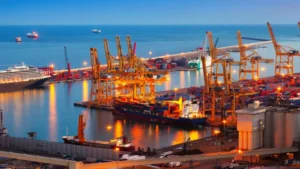
You are designing an offshore terminal for oil, gas, or bulk cargo. The structure is exposed to waves, currents, and ship impacts. The foundation must be strong, durable, and reliable for decades in a harsh marine environment.
Steel sheet piles are widely used in offshore terminal projects for quay walls, dolphin structures, cofferdams, and scour protection. Z-type piles (AZ series) are preferred for deep water quay walls. U-type piles are used for dolphin structures. Combination walls are used for very deep water and heavy loads. Marine grade steel (ASTM A690) is essential for seawater corrosion resistance.
](https://cnsteelplant.com/wp-content/uploads/2026/03/Article-Application-Port-2.webp)
I have supplied sheet piles for offshore terminals across the Middle East and Southeast Asia. A terminal in the UAE used AZ 26 piles for the quay wall. Another project used sheet pile cofferdams for foundation construction. Let me walk you through the key applications of steel sheet piles1 in offshore terminal projects.
How are sheet piles used for quay walls in offshore terminals?
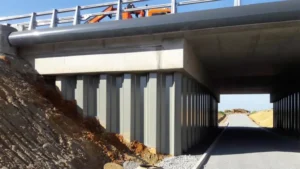
Sheet piles are used to construct the main quay wall in offshore terminals. The quay wall provides the vertical face where ships berth and cargo is transferred.
In offshore terminals, sheet pile quay walls1 are typically anchored walls with tie rods or ground anchors. The piles are driven to depth below the seabed, and the wall is anchored to resist lateral pressure from soil and water. For water depths of 10-15 meters, AZ 26 or AZ 34 Z-type piles are used. For depths of 15-20 meters, AZ 42 or AZ 50 piles are used. Combination walls may be used for depths over 20 meters.
](https://cnsteelplant.com/wp-content/uploads/2026/03/Article-Application-Port-1.webp)
Quay Wall Design for Offshore Terminals
Let me explain the key design considerations for sheet pile quay walls1 in offshore terminals.
Typical Quay Wall Sections by Water Depth
| Water Depth | Recommended Section | Wall Type | Anchor Type |
|---|---|---|---|
| 8-10 m | AZ 18 or AZ 26 | Anchored | Single tie rod |
| 10-12 m | AZ 26 | Anchored | Single tie rod |
| 12-15 m | AZ 34 | Anchored | Single or double tie rod |
| 15-18 m | AZ 42 | Anchored | Double tie rod |
| 18-20 m | AZ 50 | Anchored | Double tie rod |
| Over 20 m | Combination wall | Anchored | Multiple tie rods |
Key Components of a Sheet Pile Quay Wall
- Sheet piles: Primary retaining wall
- Tie rods: Connect sheet piles to anchor wall
- Anchor wall: Driven behind the quay wall to resist pullout
- Concrete capping beam: Distributes loads and provides deck support
- Fender system: Absorbs ship berthing energy
- Bollards: Mooring points for ships
Design Loads for Offshore Terminals
| Load Type | Source | Design Consideration |
|---|---|---|
| Soil pressure | Retained soil | Active and passive earth pressure |
| Water pressure | Tides, waves | Hydrostatic and hydrodynamic |
| Surcharge | Crane loads, cargo | Heavy equipment on deck |
| Berthing loads | Ships | Impact energy absorption |
| Mooring loads | Ship lines | Pullout forces on bollards |
| Wave loads | Storms, cyclones | Extreme event design |
My Experience
For an offshore terminal in the UAE with 16 m water depth, we used AZ 42 sheet piles2 for the quay wall. The piles were driven to 25 m total length (16 m exposed + 9 m embedment). Double tie rods at 3 m and 8 m below the deck provided the necessary support.
What is the role of sheet piles1 in dolphin and breasting dolphin2 structures?
Sheet piles are used to construct dolphin structures, which are isolated mooring points for ships. Breasting dolphins absorb berthing energy, while mooring dolphins provide tie-off points.
In dolphin structures, sheet piles1 are driven in a circular or rectangular pattern to form a cellular cofferdam3. The cells are filled with sand or gravel to create a stable mass. U-type sheet piles4s](https://www.escpile.com/single-post/top-five-advantages-of-using-vinyl-sheet-pile-for-marine-construction)[^1] with Larssen interlocks are commonly used because they can form curved cells. The cell diameter typically ranges from 5 to 15 meters depending on the berthing energy requirements.
](https://cnsteelplant.com/wp-content/uploads/2026/03/Article-Application-Port-3-1.webp)
Dolphin Design and Construction
Let me explain how sheet pile dolphins are designed and built.
Types of Dolphins
| Type | Function | Sheet Pile Configuration |
|---|---|---|
| Breasting dolphin | Absorbs berthing impact | Circular cell, larger diameter |
| Mooring dolphin | Provides tie-off points | Smaller circular or rectangular |
| Berthing dolphin | Combination of both | Circular cell with fenders |
Cellular Cofferdam Design for Dolphins
- Sheet piles are driven in a circle to form a cell
- The cell is filled with granular material (sand or gravel)
- The fill provides stability and weight
- The sheet pile interlock transfers tension around the cell
Recommended Sheet Pile Sections for Dolphins
| Cell Diameter | Recommended Section | Wall Thickness | Fill Material |
|---|---|---|---|
| 5-8 m | U 400 x 125 | 13 mm | Sand or gravel |
| 8-10 m | U 400 x 170 | 15.5 mm | Sand or gravel |
| 10-12 m | U 400 x 170 | 15.5 mm | Gravel |
| 12-15 m | U 600 x 180 | 13.4 mm | Gravel |
Advantages of Sheet Pile Dolphins
- Fast construction compared to concrete
- Can be built in deep water
- Fill material provides stability without heavy foundation
- Sheet piles can be extracted and reused for temporary dolphins
My Experience
For an offshore terminal, we constructed breasting dolphin2s using U 400 x 170 sheet piles1 in 10 m diameter circles. The cells were filled with gravel, and fenders were mounted on the face. The dolphins have handled ship berthing for over a decade without issues.
Why are sheet pile cofferdams1 essential for constructing offshore terminal foundations?
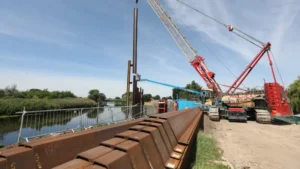
Sheet pile cofferdams are essential for creating dry work areas during the construction of offshore terminal foundations. They allow workers to build pile caps, foundations, and other structures in the dry.
A sheet pile cofferdam is a temporary enclosure made by driving sheet piles in a circle or rectangle around the foundation area. The enclosure is dewatered using pumps, creating a dry work environment. After the permanent foundation is built, the cofferdam is removed and the sheet piles are extracted for reuse.
](https://cnsteelplant.com/wp-content/uploads/2026/03/Article-Application-Port-4.webp)
Cofferdam Design for Offshore Construction
Let me explain how sheet pile cofferdams1 are designed and used.
Types of Cofferdams for Offshore Terminals
| Type | Shape | Best For |
|---|---|---|
| Single-walled | Rectangular or circular | Shallow water, small areas |
| Cellular | Interlocking circular cells | Deep water, large areas |
| Braced | With internal struts | Deep excavations in soft soil |
Cofferdam Design Considerations
| Factor | Consideration |
|---|---|
| Water depth | Determines pile length and wall thickness |
| Soil conditions | Affects embedment and dewatering |
| Wave action | Requires robust design for exposed sites |
| Dewatering | Pump capacity for seepage control |
| Access | Space for construction equipment |
Recommended Sheet Pile Sections for Cofferdams
| Water Depth | Recommended Section | Bracing Required? |
|---|---|---|
| Up to 5 m | U 400 x 125 | No (cantilever) |
| 5-8 m | U 400 x 170 | Yes (single brace) |
| 8-10 m | U 600 x 180 | Yes (single or double brace) |
| 10-12 m | U 600 x 210 | Yes (double brace) |
Construction Sequence
- Drive sheet piles around the foundation area
- Install bracing (if needed)
- Dewater the enclosure using pumps
- Excavate to foundation depth (if needed)
- Construct pile caps or foundations
- Backfill and remove bracing
- Extract sheet piles for reuse
My Experience
For an offshore terminal foundation, we used a sheet pile cofferdam 15 m in diameter. The water depth was 8 m, and we used U 600 x 180 piles with one level of internal bracing. The cofferdam was dewatered in 24 hours, and the foundation was built in two weeks.
What sheet pile sections are recommended for cyclone and wave load resistance?
For offshore terminals in cyclone-prone regions, sheet pile sections must be designed to resist extreme wave loads, storm surge, and wind forces.
For cyclone and wave load resistance, use Z-type sheet piles1 (AZ 34, AZ 42, or AZ 50) with high section modulus and thick walls. The embedment depth2 should be increased by 20-30% to account for storm surge and scour. Marine grade steel (ASTM A690) is essential for corrosion protection. For very extreme conditions, combination walls with H-piles3 may be required.
](https://cnsteelplant.com/wp-content/uploads/2026/03/Article-Application-Port-3.webp)
Design for Extreme Wave and Cyclone Loads
Let me explain how to select sheet piles for cyclone-prone regions.
Design Loads for Cyclone Conditions
| Load Type | Design Consideration |
|---|---|
| Wave height | Extreme storm waves (10-15 m+) |
| Storm surge | Elevated water levels (2-5 m above tide) |
| Wind forces | Direct pressure on wall and structures |
| Scour | Erosion at the toe of the wall |
| Debris impact | Floating objects hitting the wall |
Recommended Sections for Cyclone-Prone Regions
| Water Depth | Recommended Section | Additional Protection |
|---|---|---|
| 8-10 m | AZ 26 or AZ 34 | Increased embedment by 20% |
| 10-12 m | AZ 34 or AZ 42 | Increased embedment by 25% |
| 12-15 m | AZ 42 or AZ 50 | Increased embedment by 30% |
| 15-18 m | AZ 50 or combination | Increased embedment by 30% |
| Over 18 m | Combination wall | Special design |
Design Modifications for Cyclone Resistance
- Increase embedment depth2 by 20-30% to account for scour
- Add scour protection (riprap or concrete mat) at the toe
- Use thicker wall sections for corrosion allowance
- Add tie rods at multiple levels for deep water
- Design for wave impact pressures
Steel Grade for Cyclone-Prone Regions
| Environment | Recommended Grade |
|---|---|
| Seawater, cyclone zone | ASTM A690 (marine grade) |
| Splash zone | A690 + coating |
| Below water | A690 + corrosion allowance |
My Experience
For an offshore terminal in a cyclone-prone region, we used AZ 42 sheet piles with 20 mm wall thickness. The embedment depth2 was increased by 30% from 9 m to 12 m. Riprap scour protection was placed at the toe. The terminal has survived multiple cyclones without damage.
Conclusion
Steel sheet piles are essential for offshore terminal projects. Use Z-type piles1 for deep water quay walls. Use sheet pile dolphins for mooring and berthing. Use cofferdams for foundation construction. For cyclone-prone regions, increase embedment depth and use marine grade steel2.
-
Discover the advantages of Z-type piles for deep water quay walls and their role in enhancing structural integrity. ↩ ↩ ↩ ↩ ↩ ↩ ↩ ↩ ↩ ↩
-
Learn about marine grade steel’s properties and its critical importance in ensuring durability in harsh marine environments. ↩ ↩ ↩ ↩ ↩ ↩ ↩
-
Discover how combination walls with H-piles can provide superior protection in challenging marine conditions. ↩ ↩
-
Find out how U-type sheet piles are used in various construction projects, especially in marine settings. ↩