You are designing a new port or expanding an existing harbor. The water is deep, the ships are large, and the soil conditions are complex. Choosing the wrong sheet pile type can lead to structural failure, costly delays, or a wall that does not last.
The recommended sheet pile types1 for port construction depend on water depth, wall alignment, and load conditions. Z-type piles (AZ series) are best for deep water quay walls over 10 meters. U-type piles are recommended for curved breakwaters and marina berths. Combination walls are used for heavy load ports and very deep water over 20 meters. For seawater corrosion protection, use ASTM A690 marine grade steel2.
[^1] for port construction](https://placehold.co/600x400 "Port Sheet Pile Types")](https://cnsteelplant.com/wp-content/uploads/2026/03/Article-Application-Port-3-1.webp)
I have supplied sheet piles for ports across the Middle East, Southeast Asia, and Africa. A port in the UAE used AZ 26 Z-type piles for an 18-meter deep quay wall. A marina in Southeast Asia used U-type piles for curved berths. Let me walk you through the recommended sheet pile types1 for port construction.
What are the best sheet pile types for deep water quay walls?
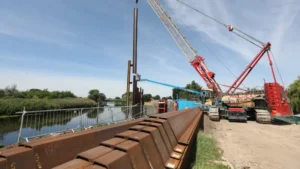
For deep water quay walls with water depths over 10 meters, Z-type sheet piles1 are the best choice. They offer higher structural efficiency than U-type piles.
Z-type sheet piles1, such as the AZ series from ArcelorMittal2 or PZC series from Nucor3, have a higher section modulus per kilogram of steel. This means they can resist greater bending moments from soil and water pressure without increasing weight. For water depths of 10-15 meters, AZ 26 or PZC 18 are recommended. For depths of 15-20 meters, AZ 34 or AZ 42 are used.
](https://cnsteelplant.com/wp-content/uploads/2026/03/Article-Application-Port-3.webp)
Recommended Z-Type Sections for Deep Water
Let me provide specific recommendations for deep water quay walls.
Water Depth 10-12 meters
| Section | Width (mm) | Weight (kg/m) | S (cm³/m) | Best For |
|---|---|---|---|---|
| AZ 18 | 670 | 75.0 | 1,800 | Moderate loads |
| AZ 26 | 670 | 109.0 | 2,600 | Standard deep water |
| PZC 18 | 635 | 75.0 | 3,360 | North American projects |
Water Depth 12-15 meters
| Section | Width (mm) | Weight (kg/m) | S (cm³/m) | Best For |
|---|---|---|---|---|
| AZ 26 | 670 | 109.0 | 2,600 | Moderate loads |
| AZ 34 | 670 | 143.0 | 3,400 | Heavy loads |
| PZC 26 | 708 | 110.0 | 4,960 | North American projects |
Water Depth 15-20 meters
| Section | Width (mm) | Weight (kg/m) | S (cm³/m) | Best For |
|---|---|---|---|---|
| AZ 34 | 670 | 143.0 | 3,400 | Moderate loads |
| AZ 42 | 670 | 177.0 | 4,200 | Heavy loads |
| AZ 50 | 670 | 211.0 | 5,000 | Very heavy loads |
Why Z-Type is Best for Deep Water
- Higher section modulus per kilogram means less steel weight
- Wider sections (670 mm) mean fewer piles to drive
- Ball-and-socket interlocks provide good water tightness
- Available in marine grade steel4 for corrosion protection
My Experience
For a deep water quay wall in the UAE (18 m depth), we used AZ 26 piles. The section modulus of 2,600 cm³/m was adequate for the design loads, and the 670 mm width reduced the number of piles by 40% compared to U-type.
Which sheet pile type is recommended for curved breakwaters1 and marina berths2?
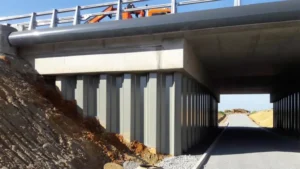
For curved breakwaters1 and marina berths2, U-type sheet piles3 are the recommended choice. Their symmetric shape allows them to follow curved alignments easily.
U-type sheet piles3 have a symmetric profile with Larssen ball-and-socket interlocks. The symmetry means the pile can be rotated and still interlock correctly, making it ideal for curved walls. For small to medium curved breakwaters1, U 400 x 125 is common. For larger curved structures, U 400 x 170 or U 600 x 180 are used.
](https://cnsteelplant.com/wp-content/uploads/2026/03/Article-Application-Port-2.webp)
Recommended U-Type Sections for Curved Walls
Let me provide specific recommendations for curved breakwaters1 and marina berths2.
Small Marinas and Curved Breakwaters (Water depth up to 5 m)
| Section | Width (mm) | Weight (kg/m) | S (cm³/m) | Best For |
|---|---|---|---|---|
| U 400 x 100-10.5 | 400 | 48.0 | 1,080 | Light loads |
| U 400 x 125-13 | 400 | 60.0 | 1,590 | Standard marina berths2 |
Medium Curved Walls (Water depth 5-8 m)
| Section | Width (mm) | Weight (kg/m) | S (cm³/m) | Best For |
|---|---|---|---|---|
| U 400 x 125-13 | 400 | 60.0 | 1,590 | Moderate loads |
| U 400 x 170-15.5 | 400 | 76.1 | 2,470 | Heavy loads, wave action |
Large Curved Structures (Water depth 8-10 m)
| Section | Width (mm) | Weight (kg/m) | S (cm³/m) | Best For |
|---|---|---|---|---|
| U 400 x 170-15.5 | 400 | 76.1 | 2,470 | Standard |
| U 600 x 180-13.4 | 600 | 81.6 | 3,820 | Heavy wave action |
Why U-Type is Best for Curved Walls
- Symmetric shape allows rotation and curved alignments
- Larssen interlocks4 tighten under soil pressure
- Forgiving installation in curved configurations
- Proven track record in marinas worldwide
My Experience
For a marina project in Southeast Asia with curved berths, we used U 400 x 125 piles. The U-type piles followed the curve easily, and the installation was straightforward. The wall has performed well for over a decade.
When should engineers use combination walls1 for heavy load ports?
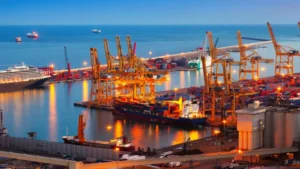
Engineers should use combination walls1 for heavy load ports when water depth exceeds 20 meters, when crane loads are very high, or when soil conditions are poor.
Combination walls consist of H-piles2 (king piles) driven at regular intervals with sheet piles between them. The H-piles2 provide the bending strength, while the sheet piles fill the gaps. They are used for very deep water (over 20 m), for container terminals with heavy crane loads3, and in soft soils where standard sheet piles lack capacity. Typical H-pile sections include HP 12 x 53, HP 14 x 73, or HP 16 x 88.
](https://cnsteelplant.com/wp-content/uploads/2026/03/Article-Application-Port-1.webp)
When to Choose Combination Walls
Let me explain the specific conditions that call for combination walls1.
Water Depth Over 20 meters
Standard Z-type piles may not have enough bending strength for water depths over 20 m. Combination walls with large H-piles2 can handle these extreme depths.
Heavy Crane Loads
Container terminals with ship-to-shore cranes impose very high surcharge loads behind the wall. Combination walls provide the additional strength needed.
Poor Soil Conditions
Soft clays or loose sands require deeper embedment and higher bending strength. Combination walls can be designed with larger H-piles2 to meet these demands.
Recommended Combination Wall Sections
| Water Depth | H-Pile Section | Sheet Pile Type | Spacing |
|---|---|---|---|
| 15-20 m | HP 12 x 53 | U 400 x 125 | 2-3 m |
| 20-25 m | HP 14 x 73 | U 400 x 170 | 2-3 m |
| 25-30 m | HP 16 x 88 | U 400 x 170 | 2-3 m |
Advantages of Combination Walls
- Highest bending strength of any sheet pile system
- Can be designed for very deep water
- H-piles2 can be driven deeper than sheet piles
- Suitable for heavy crane loads3 and surcharge
Disadvantages of Combination Walls
- Higher cost than standard sheet piles
- More complex installation
- Requires welding of connectors
My Experience
For a container terminal with 22 m water depth and heavy crane loads3, we used a combination wall with HP 14 x 73 H-piles2 at 2.5 m spacing and U 400 x 170 sheet piles between them. The wall has handled the crane loads for over a decade.
What sheet pile steel grade is recommended for seawater corrosion protection?
For seawater environments, ASTM A6901 marine grade steel is the recommended sheet pile steel grade. It provides 50% better corrosion resistance than standard carbon steel.
ASTM A6901 contains copper (0.20-0.50%), nickel (0.20-0.50%), and phosphorus (0.07-0.12%) that form a protective patina in seawater. This reduces the corrosion rate2 from about 0.10 mm per year (standard carbon steel) to about 0.05 mm per year. For a 50-year design life, A690 requires only 2.5 mm corrosion allowance versus 5 mm for carbon steel.
](https://cnsteelplant.com/wp-content/uploads/2026/03/Article-Application-Port-4.webp)
Steel Grade Recommendations for Ports
Let me provide specific steel grade recommendations3 for port construction.
Steel Grade Comparison
| Grade | Yield (MPa) | Corrosion Rate (mm/year) | 50-Year Loss (mm) | Best Use |
|---|---|---|---|---|
| ASTM A328 | 240 | 0.10 | 5.0 | Freshwater ports |
| ASTM A572 Gr50 | 345 | 0.09 | 4.5 | Brackish water |
| ASTM A6901 | 345 | 0.05 | 2.5 | Seawater, permanent ports |
| EN S355GP | 355 | 0.10 | 5.0 | Freshwater (with alloying for marine) |
Corrosion Protection Options for Seawater
| Option | Protection Level | Cost | Best For |
|---|---|---|---|
| A690 only | Good | Moderate | Moderate design life (25-50 years) |
| A690 + cathodic protection4 | Excellent | High | Long design life (50-100 years) |
| Carbon steel + coating | Moderate | Moderate | Splash zone protection |
| Carbon steel + corrosion allowance | Fair | Low | Short design life |
Recommended Grade by Port Environment
| Environment | Recommended Grade |
|---|---|
| Seawater, permanent port | ASTM A6901 |
| Seawater, with cathodic protection4 | A572 Gr50 or A690 |
| Brackish water | A690 or A572 with coating |
| Freshwater port | A328 or A572 |
| Tidal zone, splash zone | A690 + coating |
My Experience
For the port project in the UAE (seawater, permanent structure), we used ASTM A6901 sheet piles. The marine grade steel provided the corrosion resistance needed for a 50-year design life. The client chose not to use cathodic protection4, relying on the A690 patina alone.
Conclusion
For deep water quay walls (over 10 m), use Z-type piles (AZ series)1. For curved breakwaters and marina berths, use U-type piles. For heavy load ports and water over 20 m, use combination walls. For seawater corrosion protection, use ASTM A690 marine grade steel2.
-
Explore this link to understand the applications and benefits of Z-type piles in deep water quay wall construction. ↩ ↩ ↩ ↩ ↩ ↩ ↩ ↩ ↩ ↩ ↩ ↩ ↩ ↩ ↩ ↩ ↩
-
Learn about ASTM A690 marine grade steel to discover its advantages in seawater corrosion protection. ↩ ↩ ↩ ↩ ↩ ↩ ↩ ↩ ↩ ↩ ↩ ↩ ↩ ↩
-
Discover expert recommendations for steel grades tailored to various marine environments to ensure durability. ↩ ↩ ↩ ↩ ↩ ↩ ↩
-
Learn how cathodic protection works and its importance in extending the life of marine structures. ↩ ↩ ↩ ↩ ↩