Construction waste keeps growing, and more of my clients now ask where my materials end up after the project. Steel sheet piles are my honest answer to that pressure.
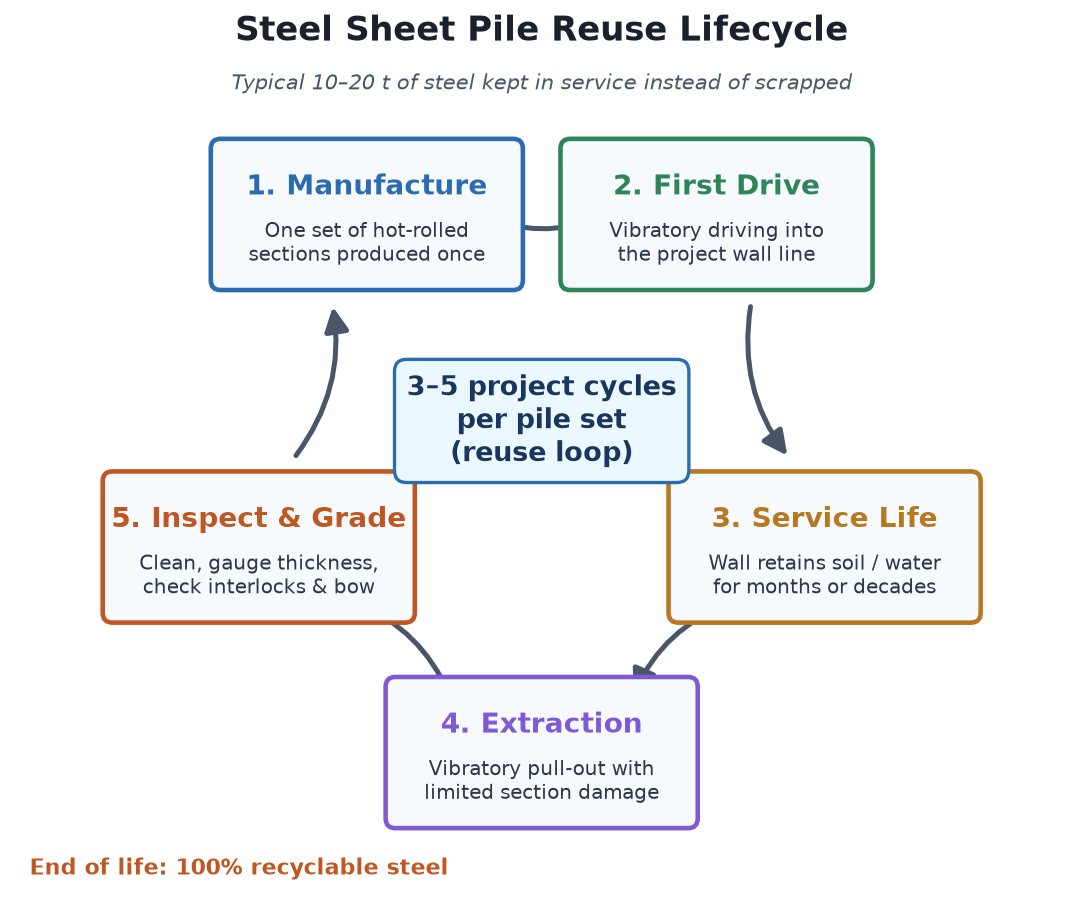
Reusable steel sheet piles are steel walls that can be extracted after use, inspected, and driven again on a new project. One set can serve three to five projects over decades, which cuts waste, saves embodied carbon, and keeps a valuable asset in circulation.
In this article, I want to show you why reusability is more than a marketing word. I will explain what makes these piles extractable, how much carbon and waste reuse can really save, what happens to a pile after I pull it out of the ground, and where reused piles deliver the biggest environmental wins. I will also share a riverbank case from my own order book, because the numbers convinced me long before any brochure did.
Why Can Steel Sheet Piles Be Reused at All?
Most retaining structures are buried and forgotten the day the project ends. Steel sheet piles are different. Their interlocks let me pull them back out of the ground cleanly, almost like unzipping a wall.
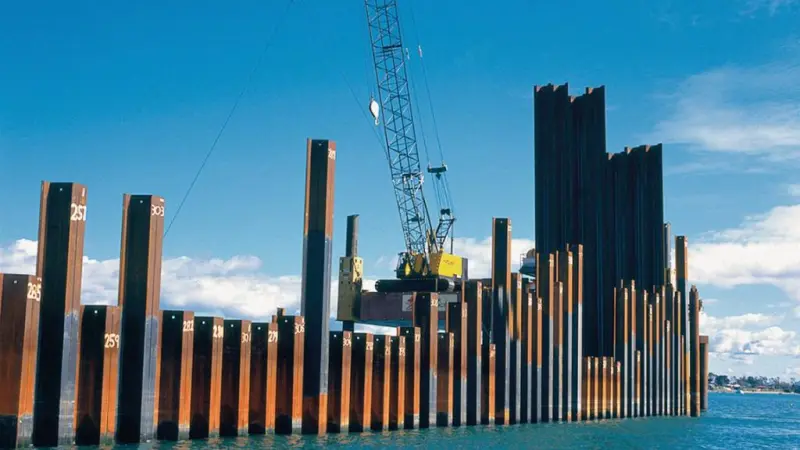
Steel sheet piles are reusable because they are discrete steel sections joined by interlocks, not one cast concrete mass. A vibratory hammer can extract them with limited damage, so the same sections can be graded and re-driven on the next site.
The Interlock Design Is the Real Hero
The whole idea of reuse rests on one mechanical detail: the pile driving and extraction process must not destroy the connection between sections. A sheet pile wall is a chain of individual profiles. Each profile has one crimped or threaded shoulder and one open shoulder. When I drive them, the interlocks slide into each other and form a continuous wall. When I extract them, the same interlocks let go.
Concrete does the opposite. A diaphragm wall or a bored pile wall bonds with the soil and with itself. There is no joint to reverse. The only way to remove it is to break it into rubble, and that rubble usually stays buried.
From what I see in my factory and at customer sites, three physical properties decide how many reuse cycles a pile can survive:
- Interlock robustness. Hot-rolled piles have thicker, more forgiving interlocks than most cold-formed profiles. They tolerate several drive-and-pull cycles with less deformation.
- Section straightness. A pile that comes out straight can go back in without re-rolling. A bent pile needs straightening work or gets downgraded.
- Corrosion reserve. The wall thickness above the minimum design thickness is the pile’s savings account. Every cycle spends a little of it, mostly at the interlock lips.
The table below summarizes what I check when a customer asks how many cycles they can plan for.
| Reusability factor | Why it matters | Typical field value |
|---|---|---|
| Interlock type | Decides whether sections separate cleanly during extraction | Hot-rolled Larssen/Cornu interlocks handle 3–5 cycles |
| Section straightness | Bent piles resist re-driving and overstress neighbors | Most extracted piles stay within tolerance straight from the ground |
| Corrosion loss | Eats the thickness reserve needed for the next design life | 0.02–0.08 mm/year depending on exposure zone |
| Extraction method | Rough pulling deforms shoulders and ruins the next interlock | Vibratory extraction keeps damage lowest |
| Handling practice | Torch cuts and weld blobs on shoulders often kill reusability | Standard lifting holes preserve full reuse value |
If you want to go deeper into how the different interlock shapes behave under load and wear, I wrote a full comparison of interlock types and their performance advantages. The short version: pick a robust hot-rolled interlock today if reuse is anywhere in your project plan.
How Much Carbon and Waste Can Reuse Actually Save?
Every concrete wall I pour stays in the ground forever. Every steel wall I install can come back out. That single difference changes the whole carbon math of a project.
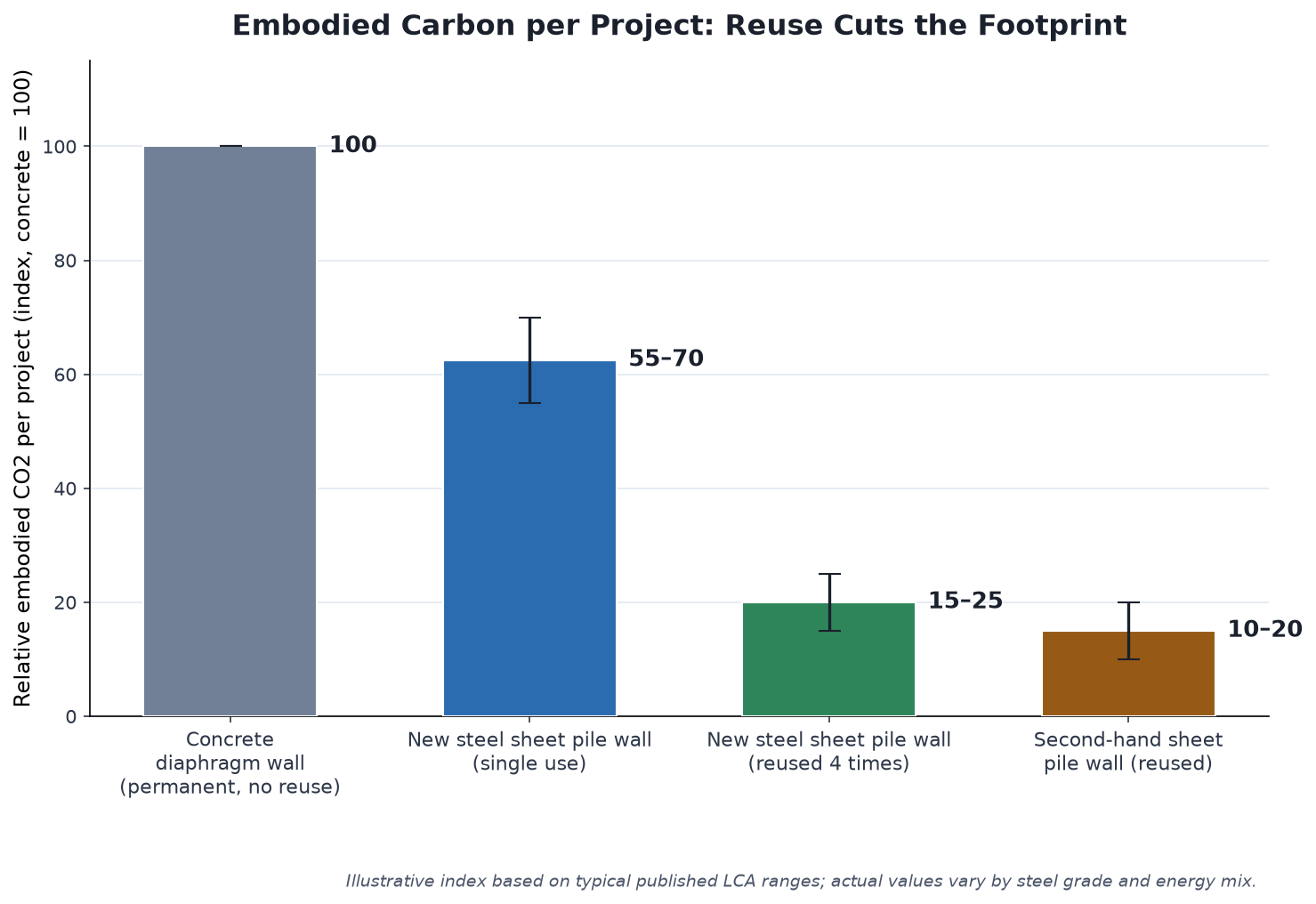
Reusing steel sheet piles avoids new steel production and eliminates demolition waste. Published life-cycle studies suggest reuse can cut the embodied carbon of a temporary wall by well over half compared with a single-use steel or concrete system.
Reading the Numbers Honestly
I will not pretend reuse makes steel carbon-free. Producing a new sheet pile still carries real embodied carbon, mostly from steelmaking. The environmental advantage appears when I divide that upfront burden by the number of projects the pile serves. A wall used once carries its full footprint. The same wall used four times spreads that footprint across four projects, and the extra cost of each extra cycle is only transport, inspection, and re-driving.
A proper life-cycle assessment counts three things for each wall type: production impact, construction impact, and end-of-life impact. This is where sheet piles quietly outperform almost every alternative:
- Production: one set of piles covers several projects, so the per-project production share drops sharply.
- Construction: driving is faster and quieter than excavation and casting, which lowers site energy use.
- End of life: extracted piles either re-enter service or go to steel recycling. Steel is one of the few structural materials with a mature, closed recycling loop, so almost nothing goes to landfill.
Concrete walls, in contrast, generate excavation spoil, curing water, and demolition rubble. The rubble is sometimes crushed for fill, but the cement paste cannot be re-cast into structural walls.
The honest numbers I use when talking to contractors look like this:
| Wall type | Typical reuse cycles | Relative embodied CO2 per project | End-of-life waste |
|---|---|---|---|
| Cast concrete diaphragm wall | 0 (permanent) | 100 (index) | Demolition rubble, mostly buried |
| New steel sheet pile wall, single use | 1 | 55–70 | Recyclable steel scrap |
| New steel sheet pile wall, reused 4 times | 4 | 15–25 | Recyclable steel scrap |
| Reused (second-hand) sheet pile wall | 1+ on top of prior life | 10–20 | Recyclable steel scrap |
The exact ratios vary by steel grade and energy mix, and I always tell clients to run their own LCA for a bid that demands it. But the direction never changes. Reuse multiplies the value of every tonne of steel that was already produced, which is the cleanest form of carbon saving available in deep excavation work.
One warning from my own experience: corrosion eating the section is the silent enemy of these savings. If a pile loses too much thickness in an aggressive marine zone, it drops out of the reuse pool. That is why I always pair reuse planning with proper corrosion protection, including coatings or cathodic protection on the splash zone.
What Happens to a Pile After It Is Pulled Out of the Ground?
Extraction is only half the story. What I do in the yard after pulling a wall decides whether those piles serve one more project or end up as scrap.
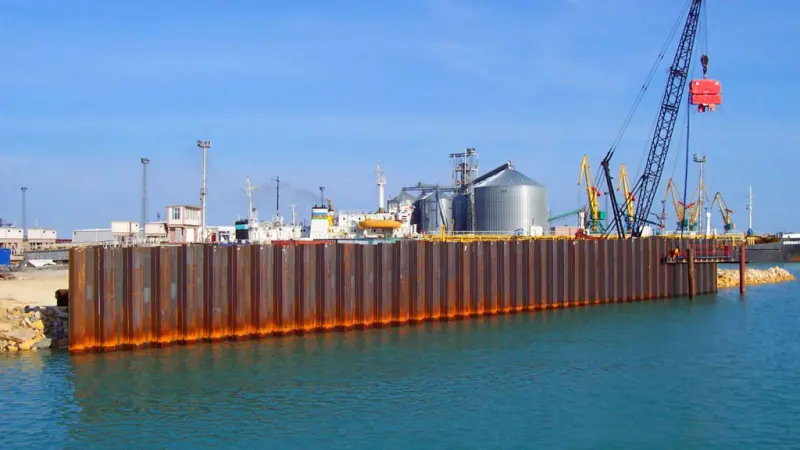
After extraction, each sheet pile is cleaned, visually inspected, and graded for interlock wear, corrosion loss, and straightness. Piles that pass are restocked for the next project; damaged ones are sold as scrap into steel recycling, not dumped.
A Grading Process You Can Copy
When a contractor returns piles from a finished temporary or permanent works contract, my yard team treats the job like a health check. The process is simple, and any serious distributor or contractor can copy it:
- Debris removal. Soil, concrete splatter, and old weld beads come off first, usually with a needle scaler or grinding.
- Visual grading. Each pile is laid flat and walked end to end. We look for interlock damage, torch cuts, dents, and weld repairs.
- Thickness measurement. An ultrasonic gauge checks web and flank thickness at the zones where corrosion attacks hardest: the splash zone marks, the low-water line, and the interlock lips.
- Straightness check. A string line or laser shows any bow. Small bows get pressed straight; big ones downgrade the pile.
- Classification. Piles get sorted into grades: ready for structural reuse, usable for light-duty temporary works, or scrap for recycling.
The outcome decides the next life, and it is worth putting the rules in writing before the project starts, so nobody argues at the demobilization stage.
| Inspection item | Method | Common pass criterion | Action if failed |
|---|---|---|---|
| Interlock condition | Visual + trial engagement with a short male section | Slides freely, no open gaps | Grind, or downgrade to scrap |
| Web/flank thickness | Ultrasonic gauge at 5+ points per pile | Above minimum for next design life | Downgrade duty class or scrap |
| Straightness | String line along web | Bow within a few mm over full length | Press straight or downgrade |
| Surface corrosion | Visual, rust scale removed | No pitting beyond corrosion allowance | Wire brush and coat |
| End condition | Visual, cut ends square | Square cuts, no ripped toes | Re-square by sawing |
For piles destined for aggressive new environments, I also recommend a fresh corrosion assessment before re-driving, because the old exposure history matters as much as the new one. A pile that spent ten years in a river cannot automatically serve ten more in a tropical splash zone without checking the remaining thickness reserve.
Where Do Reused Sheet Piles Deliver the Biggest Environmental Wins?
Not every project benefits equally. From my own orders, the biggest environmental gains show up where walls are temporary, water is close, and schedules are tight.
The biggest wins appear in temporary works such as cofferdams, riverbank and flood walls, and port structures. These projects can often reuse the same set of piles several times within a single year, multiplying the saving per tonne of steel.
A Riverbank Project That Proved the Point
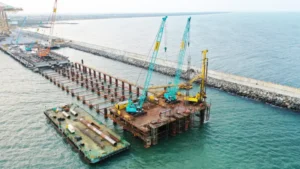
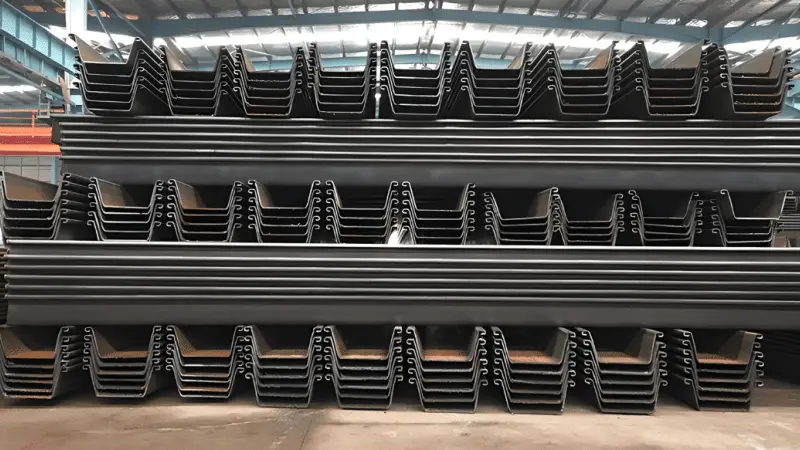
One of my favorite examples is a riverbank protection project in Southeast Asia. The contractor needed a retaining wall along an eroding river bend, close to a residential area. They chose hot-rolled U-type steel sheet piles, driven with a vibratory rig, to form a continuous barrier against soil erosion and flood water.
The environmental logic was baked into the design. The main wall stayed in place as the permanent flood barrier. But the working platform edging and the temporary cofferdam for the outfall structure were built from the same pile section. When the outfall work finished, the crew extracted those temporary lines the same week and re-drove them at the next bend of the river, two kilometers downstream. One purchase order served two protection lines and one temporary works package, and the site sent almost zero wall material to waste.
That project shaped how I price and advise today. When the application fits, reuse is not a compromise; it is simply the smarter plan. This table shows where I see the strongest fit:
| Application | Why reuse fits so well | Typical reuse pattern |
|---|---|---|
| Construction cofferdams | Dry space is temporary by definition; extraction is planned from day one | Same piles rotate across 3–5 cofferdams per year |
| Riverbank and flood walls | Long linear sites let one stock serve many sections and phases | Permanent core wall plus rotating temporary lines |
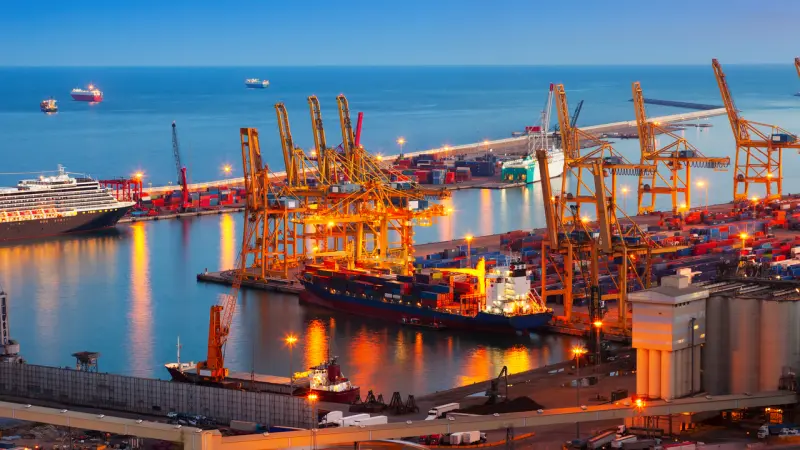
| Port and harbor works | Quay upgrades happen in stages, matching pile availability | Piles shift between berths as each stage completes |
| Temporary excavation support | Basement box walls are removed after the permanent structure rises | Two or three basins per pile set in dense city programs |
| Bridge foundation works | Cofferdams and temporary platforms share the same sections | Reuse across several piers on one site |
If your project is a deep excavation in soft ground, my article on cofferdams and deep excavations explains how the extraction-friendly design works in practice. For water-adjacent sites, the riverbank and flood control guide shows how a permanent wall and a reusable temporary system can share one pile stock.
My Take
Here is my honest view after years of shipping piles to contractors on four continents: reuse only works if you design for it from day one. I still see projects where the site crew torch-cuts lifting holes or welds a header directly across the interlocks, and just like that, a five-cycle pile becomes a one-cycle pile. My advice is simple. Choose standard hot-rolled sections, not exotic custom profiles, because a standard section has a second-hand market waiting for it. Ask for extraction method approval in the contract, not as an afterthought. And treat the piles as an asset on your balance sheet, not a consumable, because when the job ends, that steel still has real value either as a re-driven wall or as recycled scrap. Every tonne we reuse is a tonne that no blast furnace has to make again. From where I stand in my factory in Liaocheng, that is the most practical environmental policy our industry has.
Conclusion
Reusable steel sheet piles turn a temporary wall into a long-lived asset. They cut waste, lower carbon, and pay back project after project. That is environmental progress you can measure.