What Are the Common Steel Grades Used for Steel Sheet Piles?
Choose the wrong steel grade and you either pay too much or watch your wall corrode early. Here is what each grade really means.
The three most common steel grades for sheet piles are Q235, Q355, and S355. The number is the minimum yield strength in MPa. Q355 (GB/T 1591) and S355 (EN 10025-2) are metallurgically equivalent. For seawater projects, ASTM A690 is the better choice.
I have quoted sheet piles for buyers in more than 30 countries, and the steel grade is the first real question in almost every project. Some buyers know exactly what they want. Many others just say “standard grade” and hope for the best. This guide walks through every grade I deal with daily, so you can pick the right one before you ask for a quote.
What do the numbers in Q235, Q355, and S355 actually mean?
The number is not a model code. It tells you the minimum yield strength, and yield strength drives nearly every design decision.
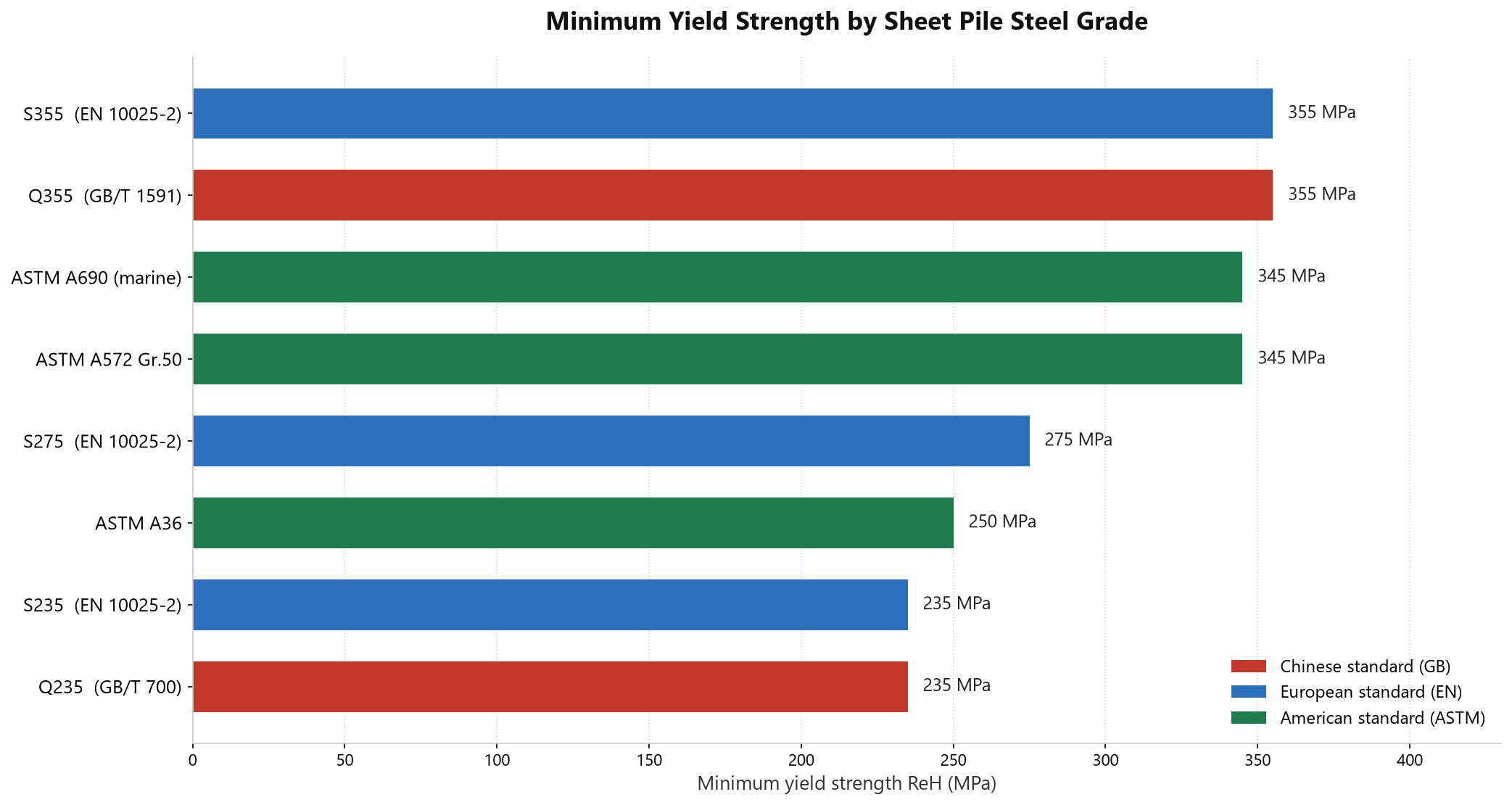
The number in Q235, Q355, or S355 is the minimum yield strength in megapascals. Q235 yields at 235 MPa, while Q355 and S355 yield at 355 MPa. Higher yield strength lets a thinner wall carry the same load, which cuts steel weight and cost.
Breaking down the naming systems
Let me start with the basics. All these grades belong to the family of structural steel, which means their mechanical properties are defined by published standards, not by individual mills.
The “Q” grades come from the Chinese standard system. Q stands for the Chinese word *qufu* (屈服), which means yield. The number that follows is the minimum yield strength in MPa. So Q235 yields at 235 MPa and Q355 at 355 MPa. Q235 is covered by GB/T 700, the standard for carbon structural steel. Q355 is covered by GB/T 1591, the standard for high-strength low-alloy structural steels.
The “S” grades come from the European standard EN 10025-2. S stands for structural steel. The number works exactly the same way: S235 yields at 235 MPa, S275 at 275 MPa, and S355 at 355 MPa.
Here is the point many buyers miss. Q235 and S235 are close cousins. Q355 and S355 are, for most practical purposes, metallurgically equivalent. Both are low-alloy steels with similar carbon content, similar manganese levels, and very similar weldability. When a European customer asks me for S355 and a Southeast Asian contractor asks me for Q355, I am often rolling from the same heat or at least the same mill process.
| Grade | Standard | Min yield (MPa) | Typical use |
|---|---|---|---|
| Q235 | GB/T 700 | 235 | Light duty walls, temporary works |
| S235 | EN 10025-2 | 235 | Light duty walls, temporary works |
| S275 | EN 10025-2 | 275 | Medium duty retaining walls |
| Q355 | GB/T 1591 | 355 | Quay walls, deep excavation |
| S355 | EN 10025-2 | 355 | Quay walls, deep excavation |
| ASTM A572 Gr. 50 | ASTM | 345 | Structural walls, US-spec projects |
| A690 | ASTM | 345 | Seawater immersion, marine |
Yield strength matters because sheet pile walls are usually governed by bending. A higher yield strength means the same wall section can resist a larger bending moment. Or, put another way, you can use a lighter section to carry the same load. That is where the money is.
How does Q355 compare with S355 for export projects?
On paper they are equivalent. In practice, the difference shows up in paperwork, mill availability, and what your local engineer will accept.
Q355 and S355 have nearly identical chemistry and strength. The real difference is the certificate: EN 10025-2 paperwork is accepted across Europe and the Middle East, while GB/T 1591 is standard across Asia and Africa. Match the grade to your consultant’s requirement.
What actually changes between Q355 and S355
I get this question at least three times a week, usually from buyers in the Middle East who are working with a European consultant. Here is my honest answer after years of shipping both.
Chemically, the two grades overlap heavily. Both limit carbon to roughly 0.20-0.24% depending on thickness, both use manganese as the main strengthening element, and both allow similar levels of silicon, phosphorus, and sulfur. The impact test requirements differ slightly. S355 is usually supplied with Charpy V-notch testing at room temperature or 0°C as standard. Q355 has equivalent impact requirements, but the test temperature bands are defined differently in GB/T 1591.
The practical difference is paperwork and acceptance. If your project is financed by a European bank, designed by a European consultant, or sits in a country that follows Eurocodes, the engineer will almost always insist on EN 10025-2 certification, which means S355 on the mill test certificate. If your project follows Chinese design codes, or your contractor is comfortable with GB standards, Q355 is the natural choice.
Most of Africa, Southeast Asia, and the Middle East accept both without argument. I have shipped Q355 to Jordan and S355 to Iraq for nearly identical port projects, because the deciding factor was which consultant reviewed the submittal.
My advice is simple. Ask your engineer which standard the design calculation is based on. Then buy that grade. Do not pay a premium to switch standards unless the project demands it.
If you are still comparing options, our full range of sheet pile solutions shows which profiles and grades we keep in rolling schedules for each market.
When should you specify ASTM A690 instead of Q355 or S355?
In seawater, the grade that wins on paper often loses in real life. A690 was designed specifically for the splash and tidal zones.
ASTM A690 is a low-alloy steel formulated for marine piling. It yields at 345 MPa, similar to Q355, but its chemistry slows corrosion in the splash and tidal zones by 2 to 4 times. For harbor walls in seawater, A690 is worth the premium.
What makes A690 different
ASTM A690 (also written as ASTM A690/A690M) is the American standard for high-strength low-alloy steel specifically intended for marine piling. Its minimum yield strength is 345 MPa, which puts it in the same strength class as Q355 and S355. So why does it exist?
The answer is chemistry. A690 adds roughly 0.5% copper and 0.5% nickel together with a controlled level of chromium and silicon. This combination changes how the steel corrodes in seawater. In regular carbon steel, the splash and tidal zones lose metal quickly and keep losing it. In A690, an adherent oxide film forms and slows the attack down. Field and laboratory data commonly show two to four times lower corrosion rates in the critical zones compared with carbon steel.
I have seen the difference myself. I visited a bulk terminal in Southeast Asia where two adjacent walls were built about ten years apart. The older wall used plain carbon steel. The newer wall used A690. Standing at the apron edge, the contrast was obvious. The carbon steel piles showed deep, scaly loss right at the tidal line. The A690 piles still had a relatively even surface with only light, uniform weathering.
The same logic applies when you step up to heavy Z-type sheet piles or combined wall systems. The bigger the section and the longer the design life, the more the corrosion allowance matters, and the more attractive a corrosion-resistant grade becomes.
A690 is not cheap. Expect a premium of roughly 15 to 30% over equivalent carbon steel grades, and expect longer lead times because fewer mills roll it. That premium is easy to justify when the wall has a 50-year design life and driveability is critical.
If you want to go deeper, I have written a full guide on A690 marine sheet piles that covers the chemistry in more detail.
How do you match a steel grade to your project environment?
Strength ratings do not tell the whole story. Environment decides how much corrosion allowance you need, and that changes the effective grade choice.
Match grade to environment: Q235 or S235 for temporary inland works, Q355 or S355 for permanent structural walls, A690 for direct seawater exposure. In corrosive soils, add corrosion allowance rather than jumping grades. Read the wall design first, then pick the grade.
The decision framework I use with customers
Here is the process I walk through with buyers, one question at a time.
Question one: is the wall permanent or temporary? Temporary cofferdams and excavation support usually live for 6 to 24 months, then come out. Corrosion barely has time to matter, so Q235 or S235 is normally fine. Permanent walls stay in the ground for decades, so you need the strength and toughness of Q355 or S355 from day one.
Question two: is it dry soil, wet soil, or seawater? Dry inland soil is the gentlest environment. Natural soils with some moisture accelerate corrosion slightly. Seawater is by far the most aggressive, especially the splash and tidal zones. For seawater, I push customers toward A690, or toward Q355/S355 with an extra corrosion allowance and a corrosion protection system. If you want a deeper discussion of the exposure zones, my article on port and harbor protection breaks down the splash, tidal, and immersion zones with real corrosion rates.
Question three: what wall thickness does the design need? This is where yield strength pays for itself. A wall designed around Q235 needs a heavier section to resist the same bending moment compared with Q355. For a deep quay wall, moving from Q235 to Q355 can save 15 to 25% on steel weight. That saving easily outweighs the higher per-tonne price of the stronger grade.
| Environment | Recommended grade | Why |
|---|---|---|
| Temporary inland works | Q235 / S235 | Short life, low cost wins |
| Permanent inland retaining | Q355 / S355 | Strength saves steel weight |
| Brackish or contaminated soil | Q355 / S355 + allowance | Strength plus corrosion margin |
| Direct seawater | A690 or Q355 + protection | Slows splash-zone attack |
For customers who want the full picture on durability, I have a separate article on the service life of steel sheet piles that walks through expected corrosion rates by zone.
What should you check on the mill test certificate before shipment?
The grade on the quotation means nothing until you see the mill test certificate. Here is what I tell buyers to actually check.
Every bundle should come with an EN 10204 Type 3.1 mill test certificate. Check the heat number matches the bundle, the chemistry falls inside the standard, and the yield, tensile, and elongation values meet or exceed the grade minimum. No MTC, no payment.
Reading an MTC without being a metallurgist
I have helped many first-time buyers read mill test certificates, and it is easier than it looks. You are checking three things.
First, the heat number. Every heat of steel produced gets a unique number. That number is stamped or painted on the physical bundles. The MTC lists the heat number at the top. When your goods arrive, match the number on the bundle to the number on the certificate. If they do not match, stop and call me before you accept anything. This one check catches most certificate problems.
Second, the chemistry. The MTC lists carbon, silicon, manganese, phosphorus, sulfur, and any alloying elements. Compare these against the grade limits in the standard. For Q355, carbon should be at or below about 0.20% for thin sections. Phosphorus and sulfur should each be below roughly 0.035%. You do not need to be a metallurgist; you just need to compare numbers against the limits.
Third, the mechanical tests. The MTC lists yield strength, tensile strength, and elongation, often from two test pieces per heat. The yield must meet or exceed the grade minimum. Tensile and elongation must also be within the standard’s range. For Q355, typical yield results come in around 370 to 430 MPa, comfortably above the 355 MPa minimum. If you see yield below the minimum, reject the heat.
One more tip. Ask whether the MTC is issued under EN 10204 Type 3.1, which means it was validated by an independent party within the mill, not just the production line. Serious export mills issue 3.1 certificates as standard. If a supplier cannot produce an MTC linked to your actual heat, do not ship.
I once had a buyer in West Africa nearly accept a container where the bundle numbers did not match the MTC. It turned out the trader had mixed two different heats from two different mills. We caught it before loading. That one check saved the whole project.
Conclusion
Match the grade to the environment, confirm the certificate, and never pay for strength you do not need.
My take as a supplier
After years of quoting both Q355 and S355 for the same projects, here is what I tell every new customer. Do not start from the grade. Start from your wall design, your soil, and your water. The grade follows from those three things. A buyer who calls me asking for “the strongest grade” usually spends more than one who calls me with a bending moment diagram and a soil report. Send me the numbers through our contact page and I will tell you honestly whether Q235 is enough or whether you really need A690. I would rather win a small order done right than a big order done wrong.
Tags: Steel Sheet Piles, Q355 Steel, S355 Steel, ASTM A690, Steel Grades