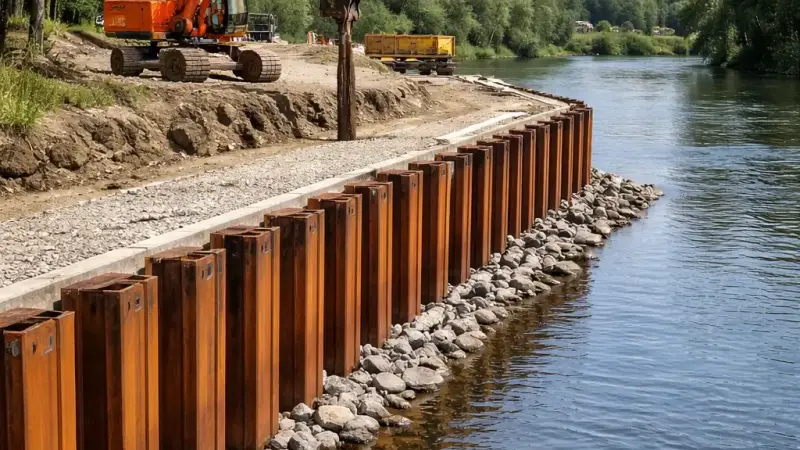
I have seen many riverbanks fail, and the damage is always extensive. Soil erosion, flooding, and landslides can destroy property, roads, and even entire communities. A strong barrier is needed to stop this damage. Steel sheet piles have proven to be one of the most effective solutions.
Steel sheet piles are an ideal solution for riverbank protection because they are strong, quick to install, and offer excellent water tightness. They are used to construct retaining walls that prevent soil erosion and stabilize banks. They are particularly effective in flood defence systems and high-seismic areas due to their flexibility.
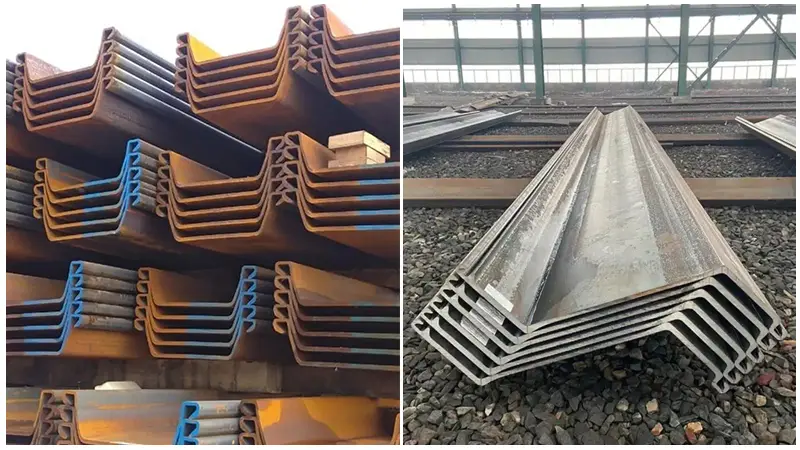
I have worked with steel sheet piles for years. I have supplied them for riverbank protection projects in Southeast Asia and other regions. I have seen how well they perform in stopping erosion and controlling water. Let me walk you through the key aspects of using sheet piles for riverbank protection.
For real-world case studies, see the Sheet Piles Save Riverbank Erosion (SheetPilingUK) and the Permanent Riverbank Flood Defence Sheet Pile Works (Steel Piling Group).
Are sheet piles waterproof?
This is the first question a project manager asks when considering a riverbank wall. The water level is constantly changing, and the wall must hold back the soil and the water. The short answer is yes, but there are technical details to consider.
Steel sheet piles are completely impervious. The steel itself does not let water through. The only potential path for water is through the interlocks between adjacent piles. For most applications, the natural design of the interlock provides high seepage resistance, making additional sealing unnecessary [web:189].
Understanding Water Tightness
Natural Interlock Resistance
The Larssen interlock, which is the standard for U-shaped piles, is designed to provide high seepage resistance just by its shape [web:189]. When the piles are driven into the ground, the natural deposition of soil in the interlocks further enhances the water tightness [web:182]. This is why sheet piles are used for dykes and flood protection barriers [web:182].
When Sealing is Required
For some applications, the water pressure is higher, or the project has stricter requirements. In these cases, you need to improve the water tightness of the interlocks.
| Sealing System | Maximum Water Pressure | Description |
|---|---|---|
| Beltan® Plus | 100 kPa | Bituminous filler [web:189]. |
| Arcoseal™ | 100 kPa | Wax and mineral-oil-based filler [web:189]. |
| ROXAN® Plus | 200 kPa | Water-swelling product [web:189]. |
| AKILA® System | 300 kPa | Advanced sealing system [web:189]. |
| Welding | 100% | Provides complete water blockage [web:189]. |
Real-World Performance
In a recent project in Newport, Wales, 680 tonnes of sheet piles were installed to protect 2,000 homes from high tides [web:197]. The project involved strengthening a 1,350-meter flood embankment [web:197]. The sheet piles are a key part of this flood defence system, and they are designed to be watertight [web:197].
What is the difference between Type 2 and Type 4 sheet piles?
This is a question I hear often. The numbers refer to specific dimensions and capacities of U-shaped steel sheet piles. This classification is based on standards like those from Yamato Steel [web:182]. The difference comes down to the size and strength of the pile.
The main difference is their structural capacity. Type 2 piles are lighter and used for small, shallow projects. Type 4 piles are heavier and have a higher section modulus. This allows them to handle deeper water and heavier loads.
A Direct Comparison
The table below compares the key properties of Type 2 and Type 4 piles. This data is based on the widely used Yamato Steel standard [web:182].
| Property | Type 2 (YASP-Ⅱ) | Type 4 (YASP-Ⅳ) |
|---|---|---|
| Effective Width | 400 mm | 400 mm |
| Effective Height | 100 mm | 170 mm |
| Thickness | 10.5 mm | 15.5 mm |
| Section Modulus (Per Pile) | 152 cm³ | 362 cm³ |
| Unit Mass (Per Pile) | 48 kg/m | 76.1 kg/m |
The section modulus tells you how resistant the pile is to bending. A higher modulus means it is much stronger. The Type 4 pile is more than twice as strong as the Type 2 pile.
Choosing the Right Type
Type 2 Sheet Piles
These are light-duty piles [web:182]. They are recommended for:
- Bottom protection in shallow water [web:182].
- Temporary trench shoring [web:182].
- Light river walls [web:182].
Type 4 Sheet Piles
These are heavy-duty piles [web:182]. They are used for:
- Deep water applications [web:182].
- Construction of primary breakwaters for large sea ports [web:182].
- Large reclamation projects [web:182].
What are the disadvantages of using sheet piles?
I have seen many clients focus only on the advantages. They forget about the potential downsides. It is important to consider these before choosing a solution for your riverbank.
The main disadvantages of sheet piles are their vulnerability to corrosion, the high noise and vibration during installation, and their limited bending capacity for very deep excavations without anchoring. Corrosion protection is essential for a long service life.
The Key Limitations
Corrosion
This is the single biggest threat to steel sheet piles in a river or marine environment [web:190]. Steel can corrode when exposed to water and soil. The corrosion rate depends on the aggressiveness of the environment [web:190]. In some cases, aggressive water and parasite currents in the soil can cause a reduction in thickness [web:190]. For long-term durability, you must plan for corrosion protection [web:190].
Installation Challenges
Driving sheet piles into the ground is not always easy. It can be difficult in dense, bouldery, or very stiff soils [web:190]. The traditional method of driving also creates high noise and vibration [web:190]. This can be disruptive in urban areas and harmful to local wildlife. However, newer vibration-free pressing technology is available to minimize this impact [web:197].
Limitations in Deep Excavations
A simple cantilever sheet pile wall can only hold back so much soil. For very deep riverbanks or high water pressure, the wall may not be strong enough without additional support [web:190]. In these cases, you must use tie-rods and anchors to support the wall.
Cost
Sheet piles are expensive [web:190]. The cost of the material is just one part of the total budget. You also have to pay for transportation, driving equipment, and installation labor.
What is the difference between U type and Z type sheet piles?
This is a crucial design question. The shape of the pile has a direct impact on its performance and cost. The choice depends on the specific needs of your riverbank project.
The main difference is their bending resistance. Z-type piles have their interlocks on the flanges at the outer edges of the section, giving them a much higher section modulus for the same weight. U-type piles have interlocks at the center, which is easier to install but provides lower bending resistance [web:191].
A Detailed Comparison
Let me explain the technical difference in a way that is easy to understand.
U Type (Larssen) Sheet Piles
These have a U-shaped cross-section. The interlocks that connect the piles are located at the neutral axis of the section [web:191].
- Advantage: The shape makes them more convenient to pile [web:193]. They are easier to handle and install.
- Disadvantage: Because the interlocks are at the center, their bending resistance is lower than that of comparable Z-profiles [web:191].
- Best Use: They are suggested for support usage and are the most common type for general applications [web:193].
Z Type Sheet Piles
These have a Z-shaped cross-section. The interlocks are located out on the flanges, at the maximum distance from the center of the section [web:191].
- Advantage: The interlocks are positioned at the maximum distance from the neutral axis, which creates a higher section modulus [web:191]. This makes them the most efficient type of sheet pile available [web:191].
- Best Use: They are commonly used for cantilever and tied-back retaining wall systems [web:191]. They are also most suitable for bad soil conditions [web:193].
A Simple Summary
| Feature | U Type | Z Type |
|---|---|---|
| Cross-Section | U-shaped | Z-shaped |
| Interlock Location | At the center (neutral axis) | At the edges (flanges) [web:191] |
| Bending Resistance | Lower | Higher (most efficient) [web:191] |
| Installation | Easier | Standard |
| Best Use | General support, quay walls [web:193] | Deep walls, cantilever walls [web:191] |
Conclusion
Steel sheet piles offer a durable, watertight solution for riverbank protection. Type 4 piles are for heavy-duty work, while Type 2 piles are for light-duty use. U type piles are easier to install, but Z type piles offer superior bending resistance for deep walls.
For more on sheet pile types and applications, see the Central Steel: U Type vs Z Type Steel Sheet Pile and the ArcelorMittal: Flood Defence and Bank Protection PDF.