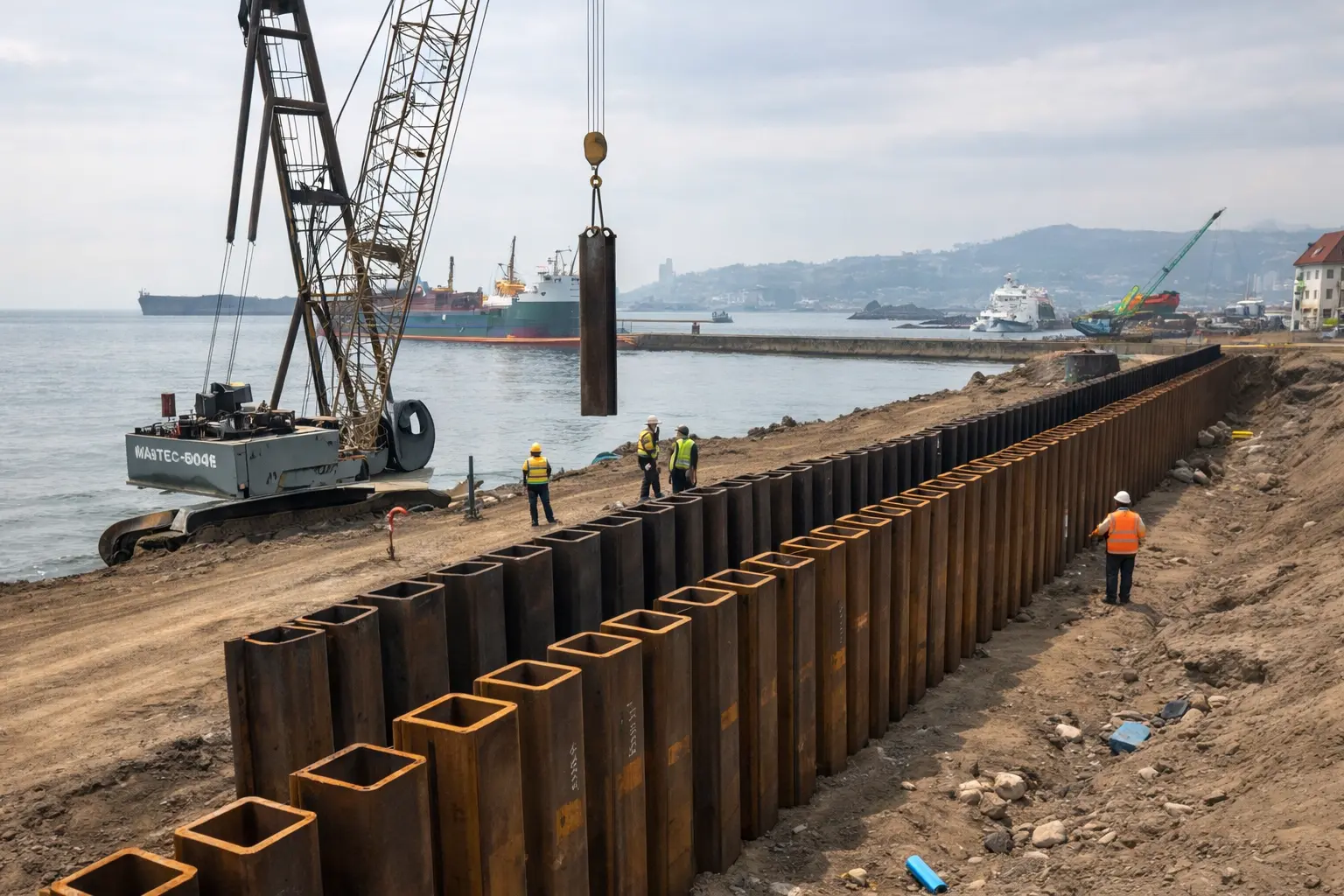
I have seen many port operators struggle with aging infrastructure. The walls are rusting, and the costs keep going up. A steel sheet pile wall is a common solution for these problems, but it is not a simple one. Choosing the right pile for a port is a major decision.
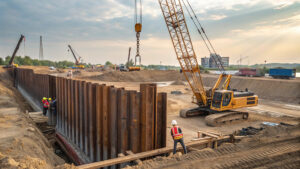
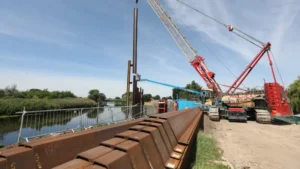
Steel sheet piles are the preferred choice for port and harbor construction because they are strong, quick to install, and suitable for over-water work [web:182]. They are used to create quay walls, retain soil, and protect against erosion. The most common profiles are U-shaped and Z-shaped sections [web:185].
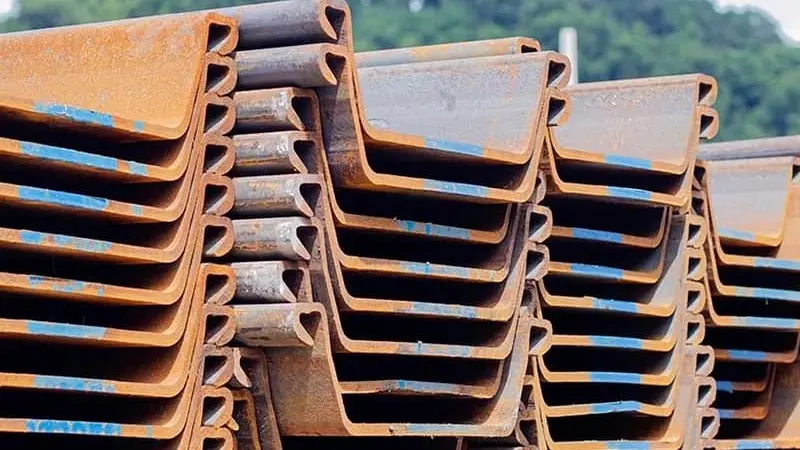
I have worked with steel sheet piles for years. I have supplied them for projects in the Middle East, Southeast Asia, and beyond. I have seen how they perform in the toughest marine environments. Let me walk you through the real-world details of using sheet piles for ports and harbors.
For steel solutions in ports, see the ArcelorMittal: Steel Solutions for Ports, the Aema Steel: Sheet Piles 101, and the PileBuck: Corrosion in Marine Piling.
What are the disadvantages of using sheet piles?
Port operators often ask me about the downsides of steel sheet piles. They hear about the long lifespan but worry about the harsh marine environment. These concerns are valid.
The main disadvantages of steel sheet piles in ports are their vulnerability to corrosion, especially in the tidal and splash zones [web:181]. They also have limited vertical load capacity and are not suitable for deep-draft quays without additional support. Accelerated low water corrosion (ALWC) is a significant risk in ports [web:185].
The Corrosion Challenge
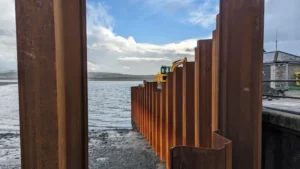
Corrosion is the single biggest threat to steel sheet piles in a port environment [web:64]. I see this every day in my work. The damage is not uniform. It depends on the exposure zone.
The Splash Zone
This is the most aggressive area. The steel is continuously wetted and dried by waves and spray. The corrosion rate in this zone can be as high as 0.006 inches per year [web:181].
The Tidal Zone
The water level goes up and down in this zone. The steel is alternately submerged and exposed to air. This cycling accelerates the formation of rust. The corrosion rate here can be 0.004 to 0.055 mm per year [web:181].
The Submerged Zone
Corrosion is slower in permanently submerged areas. However, marine growth can create pockets where corrosion is more severe. The rate is often measured over decades, with losses of up to 3.50 mm over 100 years in temperate waters [web:181].
The Buried Zone
The part of the pile in the soil faces a different set of risks. The aggressiveness of the soil controls the corrosion rate. Disturbed fills or aggressive soils with low resistivity are highly corrosive [web:181].
Other Limitations
Limited Load Capacity
Steel sheet piles alone are not good at supporting heavy vertical loads. They are not suitable for quays that need to support large gantry cranes without a relieving mechanism [web:182].
Installation Difficulties
Driving piles into hard ground or dense soil is difficult. It requires powerful hammers and can create high noise and vibration levels [web:182].
Interlock Failure
The interlocks between sheet pile sections are a weak point. Corrosion can weaken them. If they fail during a storm or high tide, the wall can collapse [web:64].
How much does steel sheet piling cost?
I get this question from every project manager. The answer is never simple. The total cost of a sheet pile wall is the sum of many parts.
The cost of steel sheet piling varies widely. The material cost is just one part. You also have to pay for installation, transportation, and design. Prices range from $179 to $500 per square meter for the supply and installation of permanent steel sheet piles, depending on the weight and anchoring system [web:185].
Breaking Down the Costs
Material Cost
Steel is a commodity, so the price changes often. The cost of the piles themselves is based on the weight. A heavier pile with a thicker cross-section will cost more.
Installation Cost
This includes the cost of the piling equipment and the labor to drive the piles. Site accessibility and soil conditions have a big impact on installation costs [web:182]. A site with difficult access or hard ground will cost more.
Anchoring System
Most port walls need anchors to support the lateral earth pressure. The cost of the anchor screen and tie rods is significant. For heavier walls, the cost with an anchoring system is much higher than for a simple wall [web:185].
Transportation
Sheet piles are heavy and long. Getting them to the site is a major cost. This is why I always advise clients to source piles from a manufacturer with good logistics.
Cost Estimation
It is hard to give a single price per meter because each project is different. The chart below provides a general guide for the supply and installation of permanent sheet piling [web:185].
| Description | Part | Price per Unit |
|---|---|---|
| Steel Sheet Piling (100-150 kg/m²) | Exclusive of anchor screen | $179 – $263 / m² |
| Steel Sheet Piling (>150 kg/m²) | Inclusive of anchor screen | $348 – $500 / m² |
What is the lifespan of a steel sheet pile?
This is the most important question for a port owner. They need to know how long the wall will last. The answer depends on the environment and how well it is protected.
The typical design life of a steel sheet pile in freshwater is 75-100 years [web:64]. However, in harsh marine environments, the lifespan can drop to 20-30 years without protection [web:64]. In some extreme cases, it can be less than 15 years [web:64].
Expected Lifespans
Inland Freshwater
In non-aggressive inland environments, steel sheet piles can last a very long time. They can reach 75 to 100 years with minimal maintenance [web:64].
Marine Environments
The lifespan in saltwater is much shorter. The exposure zones dramatically affect the rate of corrosion. Without protective measures, the structure may only last 20 to 30 years [web:64].
With Corrosion Protection
Corrosion protection is essential for a long life in marine environments. If you use protective coatings and cathodic protection, you can extend the life by 20 to 30 years [web:181].
Real-World Data
A study in the Port of Durban measured the corrosion rate at two berths. The average corrosion rate was between 0.0466 mm/year and 0.0516 mm/year [web:181]. This data is used to estimate the remaining thickness of the pile walls.
The Human Factor
I have seen many clients extend the life of their sheet pile walls by implementing a good maintenance plan. It is not enough to just install the piles. You need to inspect them and protect them over time.
For corrosion protection in marine environments, see the Nippon Steel: High-durability Corrosion Protection of Marine Steel Structures and the Pile Driving Contractors Association: Corrosion Technical Bulletin.
What is the difference between Type 2 and Type 4 sheet piles?
This is a very common question. The "type" refers to the specific dimensions and structural capacity of a U-shaped sheet pile. The number is not arbitrary. It tells you exactly how strong the pile is.
The main difference between Type 2 and Type 4 sheet piles is their structural capacity. Type 2 piles are lighter and used for small, shallow projects. Type 4 piles are much heavier and have a higher section modulus. This allows them to handle the deep water and heavy loads of large port projects [web:182].
A Direct Comparison
Let me show you the numbers. The table below compares the key properties of Type 2 and Type 4 piles based on the Yamato Steel standard [web:182].
| Property | Type 2 (YASP-Ⅱ) | Type 4 (YASP-Ⅳ) |
|---|---|---|
| Effective Width | 400 mm | 400 mm |
| Effective Height | 100 mm | 170 mm |
| Thickness | 10.5 mm | 15.5 mm |
| Section Modulus (Per Pile) | 152 cm³ | 362 cm³ |
| Unit Mass (Per Pile) | 48 kg/m | 76.1 kg/m |
The Type 4 pile is much thicker, heavier, and has more than double the section modulus of the Type 2 pile. The section modulus is the key number. It tells you how resistant the pile is to bending.
Choosing the Right Type
Type 2 Sheet Piles
These are light-duty piles. They are recommended for:
- Bottom protection in shallow water.
- Temporary trench shoring.
- Light river walls.
Type 3 Sheet Piles
These are the traditional mid-range port solution. They offer a good balance of strength and weight. They are used for:
- Ports and harbors with moderate wave action [web:182].
Type 4 Sheet Piles
These are heavy-duty piles. They are used for:
- Deep water applications [web:182].
- Construction of primary breakwaters for large sea ports [web:182].
- Large reclamation projects [web:182].
Conclusion
Steel sheet piles are essential for port construction but face corrosion challenges. Lifespan varies from 20-100 years based on the environment and protection. Type 2 piles are for light-duty work, while Type 4 piles are heavy-duty for deep water.
For more on steel sheet piling developments and codes, see the Port Technology: Steel Sheet Piling – Recent Developments and Codes of Practice.