You are designing a retaining wall. The engineer gives you a choice between U type and Z type sheet piles1. Which one performs better? Which one is stronger? Which one costs less?
Z type sheet piles1 generally have higher structural performance than U type piles2 for the same weight. The section modulus per kilogram is higher for Z piles because the steel is placed farther from the neutral axis. U piles are better for curved walls and moderate depths. Z piles are preferred for deep, straight walls where high bending strength is required.
](https://cnsteelplant.com/wp-content/uploads/2026/03/Article-application-1-1.webp)
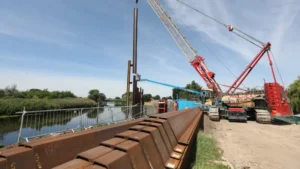
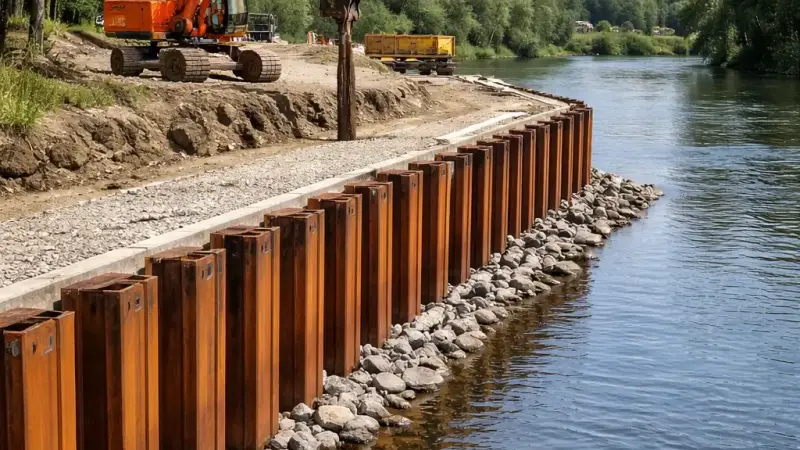
I have supplied both U and Z piles for projects around the world. The riverbank project in Southeast Asia used U piles because the wall was curved. A port project in the Middle East used Z piles because the wall was 18 meters deep and straight. Let me walk you through the structural performance comparison.
What is the difference between Z pile and U pile?
The main difference between Z and U piles is the shape and the position of the interlocks. This affects how the pile resists bending.
U piles have interlocks at the neutral axis and are symmetric. Z piles have interlocks at the outer flanges and are asymmetric. Because the steel in Z piles is spread farther from the neutral axis, they have a higher section modulus per kilogram. This means Z piles are more structurally efficient than U piles for the same weight of steel.
](https://cnsteelplant.com/wp-content/uploads/2026/03/Article-application-6-1.webp)
Structural Efficiency Comparison
Let me compare the structural efficiency1 of U and Z piles.
Section Modulus per Kilogram (Efficiency)
| Pile Type | Section | Weight (kg/m) | S (cm³/m) | Efficiency (S/kg) |
|---|---|---|---|---|
| U Type | U 400 x 125-13 | 60.0 | 1,590 | 26.5 |
| Z Type | AZ 18 | 75.0 | 1,800 | 24.0 |
| U Type | U 400 x 170-15.5 | 76.1 | 2,470 | 32.5 |
| Z Type | AZ 26 | 109.0 | 2,600 | 23.9 |
| U Type | U 600 x 210-18 | 106.2 | 5,730 | 54.0 |
| Z Type | AZ 50 | 211.0 | 5,000 | 23.7 |
Key Observations
- U 600 series has very high efficiency at large sizes
- Z piles have consistent efficiency across all sizes
- For small to medium sections, Z and U are comparable
- For large sections, U 600 series is more efficient
Bending Strength Comparison
| Property | U Type | Z Type |
|---|---|---|
| Interlock position | Neutral axis | Outer flanges |
| Moment of inertia | Lower for same weight | Higher for same weight |
| Bending resistance | Good | Better |
| Water tightness | Excellent (Larssen) | Good (ball-and-socket) |
My Experience
For a 12-meter deep excavation, we compared U 400 x 170 (S=2,470) and AZ 26 (S=2,600). The AZ pile was slightly stronger but 40% heavier. The U pile was more efficient for that application. For deeper walls, Z piles become more efficient.
What is the yield strength of sheet pile1?
The yield strength of sheet pile1 depends on the steel grade. Common grades range from 240 MPa to 430 MPa.
The yield strength of sheet pile1 is 240 MPa (35 ksi) for ASTM A328, 345 MPa (50 ksi) for ASTM A572 Grade 50 and A690, 270 MPa for EN 10248 S270GP, 355 MPa for S355GP, and 430 MPa for S430GP. Higher yield strength allows the pile to resist more bending moment with the same section modulus.
](https://cnsteelplant.com/wp-content/uploads/2026/03/Article-Application-Port-1.webp)
Yield Strength by Standard
Let me provide the yield strength for common sheet pile grades.
ASTM Standards
| Standard | Grade | Yield (MPa) | Yield (ksi) |
|---|---|---|---|
| A328 | — | 240 | 35 |
| A572 | Grade 50 | 345 | 50 |
| A690 | — | 345 | 50 |
EN 10248 Standards
| Grade | Yield (MPa) | Yield (ksi) |
|---|---|---|
| S270GP | 270 | 39 |
| S355GP | 355 | 51 |
| S430GP | 430 | 62 |
How Yield Strength Affects Design
The allowable stress for design is:
σallowable = Yield strength / Factor of safety
For a safety factor of 1.5:
- A328: σallowable = 240 / 1.5 = 160 MPa
- A572/A690: σallowable = 345 / 1.5 = 230 MPa
- S355GP: σallowable = 355 / 1.5 = 237 MPa
- S430GP: σallowable = 430 / 1.5 = 287 MPa
My Experience
For a deep excavation project, we used S430GP piles. The higher yield strength2 (430 MPa) allowed us to use a lighter section than S355GP, saving 15% on steel weight.
What is the difference between a PZ and a PZC sheet pile?
PZ and PZC are both Z-type sheet pile series from Nucor Skyline in North America. The main difference is the interlock design.
PZ sheet piles have hook-and-grip interlocks1. PZC sheet piles have ball-and-socket interlocks2. The ball-and-socket interlock on PZC piles provides better driving performance, tighter water tightness, and is more forgiving during installation. PZC piles are also wider (25-28 inches) compared to PZ piles (16 inches).
](https://cnsteelplant.com/wp-content/uploads/2026/03/Article-Application-River-Embankment-3.webp)
PZ vs PZC Comparison
Let me compare the PZ and PZC series in detail.
PZ Series (Hook-and-Grip Interlock)
| Section | Width (in) | Weight (lb/ft) | S (in³/ft) | Interlock |
|---|---|---|---|---|
| PZ 22 | 16.00 | 22.0 | 5.6 | Hook-and-grip |
| PZ 27 | 16.00 | 27.0 | 8.1 | Hook-and-grip |
| PZ 35 | 16.00 | 35.0 | 12.1 | Hook-and-grip |
| PZ 40 | 16.00 | 40.0 | 15.0 | Hook-and-grip |
PZC Series (Ball-and-Socket Interlock)
| Section | Width (in) | Weight (lb/ft) | S (in³/ft) | Interlock |
|---|---|---|---|---|
| PZC 13 | 27.88 | 50.4 | 14.5 | Ball-and-socket |
| PZC 18 | 25.00 | 50.4 | 19.5 | Ball-and-socket |
| PZC 26 | 27.88 | 73.9 | 28.8 | Ball-and-socket |
| PZC 29 | 27.88 | 84.0 | 36.5 | Ball-and-socket |
Key Differences
| Feature | PZ Series | PZC Series |
|---|---|---|
| Interlock | Hook-and-grip | Ball-and-socket |
| Width | 16 inches | 25-28 inches |
| Driving performance | Good | Better |
| Water tightness | Good with sealants | Better |
| Alignment tolerance | Lower | Higher |
My Experience
For a North American port project, we used PZC 18 piles. The ball-and-socket interlock drove smoothly in the dense sand, and the wider width (25 inches) meant fewer piles to install.
Which is better concrete sheet pile or steel sheet pile?
Concrete sheet piles and steel sheet piles are both used for retaining walls, but they have different performance characteristics.
Steel sheet piles are generally better than concrete sheet piles for most applications because they are stronger per unit weight, can be driven faster, are easier to handle, and can be extracted and reused. Concrete sheet piles are heavier, require more time to install, and cannot be reused. However, concrete piles may be more economical in some regions where steel is expensive.
](https://cnsteelplant.com/wp-content/uploads/2026/03/Article-Application-City-6.webp)
Concrete vs Steel Sheet Pile Comparison
Let me compare the two materials in detail.
| Feature | Performance |
|---|---|
| Strength-to-weight | Very high |
| Installation speed2 | Fast (vibratory hammer) |
| Reusability | Yes, multiple times |
| Water tightness | Good (interlocks) |
| Corrosion resistance3 | Moderate (can be coated) |
| Cost | Moderate to high |
| Best for | Most applications, deep excavations, marine |
| Feature | Performance |
|---|---|
| Strength-to-weight | Lower |
| Installation speed2 | Slower (requires heavy equipment) |
| Reusability | No |
| Water tightness | Fair (tongue-and-groove) |
| Corrosion resistance3 | Good (no corrosion) |
| Cost | Lower in some regions |
| Best for | Shallow walls, regions with low steel availability |
Comparison Table
| Property | Steel Sheet Piles1 | Concrete Sheet Piles4 |
|---|---|---|
| Tensile strength | Excellent | Poor (requires rebar) |
| Bending strength | Excellent | Good |
| Weight per meter | 40-200 kg/m | 200-500 kg/m |
| Maximum length | 30 m+ | 15-20 m |
| Installation time | Fast | Slow |
| Reusable | Yes | No |
| Corrosion | Requires protection | None |
My Experience
For the riverbank project, we used steel sheet piles because the wall was 6 meters high and needed to be installed quickly. Concrete piles would have required a larger crane and taken three times longer to install.
Conclusion
Z type sheet piles1 have higher structural efficiency than U type for deep walls, but U type is better for curves. Yield strength ranges from 240 MPa (A328) to 430 MPa (S430GP). PZC piles2 have ball-and-socket interlocks that outperform PZ hook-and-grip. Steel sheet piles are generally better than concrete for most applications.
-
Explore this link to understand the structural efficiency of Z type sheet piles and their applications in deep walls. ↩ ↩ ↩ ↩ ↩ ↩ ↩ ↩ ↩ ↩
-
Discover why PZC piles are superior to traditional PZ hook-and-grip piles for enhanced performance. ↩ ↩ ↩ ↩ ↩ ↩
-
Discover how corrosion resistance impacts the longevity and maintenance of sheet piles in various environments. ↩ ↩
-
Learn about scenarios where concrete sheet piles may be more cost-effective, especially in regions with high steel prices. ↩ ↩