You are designing a deepwater port or a marine terminal. The water is deep, the waves are strong, and the ships are heavy. You need a retaining wall that can handle these loads without excessive weight.
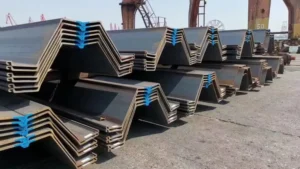
Z type steel sheet piles1 are ideal for port and marine structures because they offer higher structural efficiency than U piles. For the same weight of steel, Z piles provide greater bending strength, making them perfect for deep water applications2 where wall heights exceed 10 meters.
](https://cnsteelplant.com/wp-content/uploads/2026/03/Article-Application-Port-4.webp)
I have supplied Z type sheet piles for ports across the Middle East, Southeast Asia, and Africa. A port project in the Middle East used AZ 26 piles for the main quay wall. The deep water and heavy ship loads demanded the efficiency that Z piles provide. Let me walk you through why Z piles are the preferred choice for marine structures.
Z sheet pile dimensions1
Z sheet piles are designated by their section modulus2 or manufacturer codes. The dimensions vary by section but are optimized for structural efficiency.
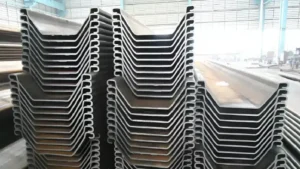
Z sheet pile dimensions1 include width (typically 630-700 mm), height (260-530 mm), and thickness (7-25 mm). The AZ series from ArcelorMittal3 has widths of 630 mm or 670 mm. The PZC series from Nucor4 has widths of 25.00 inches (635 mm) or 27.88 inches (708 mm). The height increases with section modulus2, giving higher bending strength.
](https://cnsteelplant.com/wp-content/uploads/2026/03/Article-Application-Port-2.webp)
Complete Z Type Dimensions Table
AZ Series (ArcelorMittal) – Dimensions
| Section | Width (mm) | Height (mm) | Web Thick (mm) | Flange Thick (mm) | Weight (kg/m) | S (cm³/m) |
|---|---|---|---|---|---|---|
| AZ 12 | 630 | 260 | 7.0 | 7.0 | 57.8 | 1,200 |
| AZ 13 | 670 | 305 | 7.0 | 7.0 | 57.8 | 1,300 |
| AZ 14 | 670 | 308 | 7.5 | 7.5 | 62.0 | 1,400 |
| AZ 16 | 670 | 322 | 8.0 | 8.0 | 66.5 | 1,600 |
| AZ 18 | 670 | 345 | 9.0 | 9.0 | 75.0 | 1,800 |
| AZ 20 | 670 | 358 | 10.0 | 10.0 | 83.5 | 2,000 |
| AZ 22 | 670 | 367 | 11.0 | 11.0 | 92.0 | 2,200 |
| AZ 24 | 670 | 378 | 12.0 | 12.0 | 100.5 | 2,400 |
| AZ 26 | 670 | 396 | 13.0 | 13.0 | 109.0 | 2,600 |
| AZ 28 | 670 | 408 | 14.0 | 14.0 | 117.5 | 2,800 |
| AZ 30 | 670 | 422 | 15.0 | 15.0 | 126.0 | 3,000 |
| AZ 34 | 670 | 444 | 17.0 | 17.0 | 143.0 | 3,400 |
| AZ 38 | 670 | 465 | 19.0 | 19.0 | 160.0 | 3,800 |
| AZ 42 | 670 | 487 | 21.0 | 21.0 | 177.0 | 4,200 |
| AZ 46 | 670 | 508 | 23.0 | 23.0 | 194.0 | 4,600 |
| AZ 50 | 670 | 529 | 25.0 | 25.0 | 211.0 | 5,000 |
PZC Series (Nucor Skyline) – Dimensions
| Section | Width (in) | Width (mm) | Height (in) | Height (mm) | Thick (in) | Weight (lb/ft) | Weight (kg/m) |
|---|---|---|---|---|---|---|---|
| PZC 12 | 27.88 | 708 | 12.52 | 318 | 0.375 | 46.4 | 69.1 |
| PZC 13 | 27.88 | 708 | 12.56 | 319 | 0.375 | 50.4 | 75.0 |
| PZC 14 | 27.88 | 708 | 12.60 | 320 | 0.375 | 55.0 | 81.9 |
| PZC 17 | 25.00 | 635 | 15.21 | 386 | 0.375 | 46.4 | 69.1 |
| PZC 18 | 25.00 | 635 | 15.25 | 387 | 0.375 | 50.4 | 75.0 |
| PZC 19 | 25.00 | 635 | 15.30 | 389 | 0.375 | 55.0 | 81.9 |
| PZC 26 | 27.88 | 708 | 17.70 | 450 | 0.500 | 73.9 | 110.0 |
| PZC 28 | 27.88 | 708 | 18.00 | 457 | 0.500 | 80.4 | 119.7 |
| PZC 29 | 27.88 | 708 | 18.20 | 462 | 0.500 | 84.0 | 125.0 |
How Dimensions Affect Marine Performance
- Width: Wider sections (670-708 mm) mean fewer piles to drive, reducing installation time in marine environments
- Height: Taller sections have higher section modulus2, allowing deeper water walls
- Thickness: Heavier sections provide more corrosion allowance5 for long-term marine service
My Experience
For the port project in the Middle East, we used AZ 26 piles. The dimensions were width 670 mm, height 396 mm, thickness 13 mm. Each pile weighed 109 kg/m. For 18-meter lengths, each pile weighed nearly 2,000 kg.
Steel Sheet pile specifications
Steel sheet pile specifications for marine structures must account for corrosion, driving conditions, and structural loads.
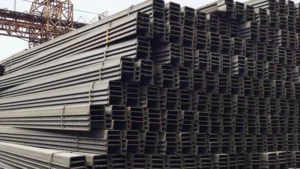
Steel sheet pile specifications for marine projects include the pile type (Z), section designation (e.g., AZ 26, PZC 13), steel grade (ASTM A6901 or EN 10248 S355GP with marine alloying), dimensions, weight per meter, section modulus, and corrosion protection requirements.
](https://cnsteelplant.com/wp-content/uploads/2026/03/Article-Application-Port-3.webp)
Marine Specification Requirements
Let me explain what makes a marine specification different.
1. Steel Grade
Marine environments require enhanced corrosion resistance:
- ASTM A6901: Marine grade with copper, nickel, phosphorus
- EN 10248 S355GP with added alloying elements (copper, nickel)
- Corrosion allowance: Additional thickness for long-term service
2. Interlock Type
Ball-and-socket interlocks2 are preferred for marine use:
- Provide better water tightness
- Handle driving stresses better
- Reduce risk of declutching in waves and currents
3. Section Modulus3
Marine structures require higher section modulus due to:
- Deep water (often 10-20 meters)
- Wave and current loads
- Ship berthing and mooring forces
- Seismic considerations in some regions
4. Corrosion Protection
Specify one or more of:
- ASTM A6901 marine grade steel (50% better corrosion resistance)
- Cathodic protection (sacrificial anodes or impressed current)
- Protective coatings for splash zone
5. Length and Tolerances
Marine piles are often longer than land piles:
- Typical lengths: 15-30 meters
- May require splicing for very deep water
- Tighter tolerances for vertical alignment
My Experience
For the port project, the specification called for AZ 26 to ASTM A6901. The marine grade steel gave 50% better corrosion resistance than standard carbon steel. Combined with cathodic protection, the wall is designed for 50 years of service.
Sheet piles shoring
Sheet pile shoring is the use of sheet piles to support excavations during construction. In marine environments, this often means constructing cofferdams for port structures.
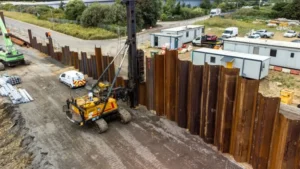
Sheet pile shoring involves driving interlocking sheet piles around the perimeter of an excavation to form a watertight wall. For marine projects, this creates a cofferdam that allows construction in dry conditions. Z type piles1 are often used for deep shoring because of their high structural efficiency.
[^2] system at marine construction site](https://placehold.co/600x400 "Sheet Pile Shoring for Marine Construction")](https://cnsteelplant.com/wp-content/uploads/2026/03/Article-Application-Port-1.webp)
Shoring Methods for Marine Structures
Let me explain the different shoring applications in marine construction.
Cofferdam Shoring
Cofferdams are temporary enclosures that allow construction in water:
- Sheet piles are driven in a circle or rectangle
- The enclosed area is dewatered
- Workers build the permanent structure in dry conditions
- After completion, the cofferdam is removed
Z piles are ideal for cofferdams in deep water because:
- High strength allows deeper excavation
- Ball-and-socket interlocks provide water tightness
- Wider sections reduce installation time
Temporary Excavation Support
For port structures built on land, sheet piles support deep excavations:
- Piles driven before excavation begins
- Bracing or tiebacks installed as excavation proceeds
- Permanent structure built inside
- Piles extracted or left in place
Cellular Cofferdams
For very deep or wide excavations, cellular cofferdams3 use straight web sheet piles:
- Interconnected cells filled with soil
- Provide stability without internal bracing
- Used for deep water construction
Shoring Installation Process
- Drive sheet piles to required depth using vibratory or impact hammers
- Install bracing as excavation progresses
- Dewater the enclosed area (for cofferdams)
- Construct permanent structure
- Remove bracing and extract piles (for temporary work)
My Experience
For a port expansion project, we used Z type sheet piles for a cofferdam that allowed construction of a new berth. The cofferdam was 15 meters deep, and the Z piles handled the water pressure without excessive bracing. After the concrete quay wall was built, we extracted the piles and reused them on another project.
Sheet piling retaining wall
Sheet piling retaining walls are permanent structures that hold back soil and water. In ports, these are called quay walls or bulkheads.
A sheet piling retaining wall1 consists of interlocking steel sheet piles driven into the soil. The wall retains the land behind it while providing a vertical face for ships to berth. For deep water ports, the wall is anchored with tie rods or ground anchors to resist the lateral pressure from soil and water.
[^1] at port with ships](https://placehold.co/600x400 "Sheet Piling Retaining Wall")](https://cnsteelplant.com/wp-content/uploads/2026/03/Article-Application-Port-3-1.webp)
Types of Retaining Walls in Ports
Let me explain the different types of retaining walls used in marine structures.
Cantilever Walls
- No anchors, wall is embedded deep enough to resist rotation
- Used for water depths up to 5-6 meters
- Simpler construction but requires deeper embedment
Anchored Walls
- Tie rods or ground anchors provide additional support
- Used for water depths from 5 to 20 meters
- More economical for deeper water
- Anchors can be driven piles or grouted ground anchors
Combination Walls
- H-piles (king piles) with sheet piles between
- Used for very deep water (over 15-20 meters)
- Highest bending strength
- Often used for major container terminals
Design Considerations for Marine Retaining Walls
| Factor | Consideration |
|---|---|
| Water depth | Determines wall height and required section modulus |
| Soil conditions | Affects embedment depth and anchor design |
| Ship loads | Berthing and mooring forces add lateral loads |
| Wave action | Cyclic loading affects fatigue performance |
| Corrosion | Marine environment requires protection |
| Seismic | Ports in seismic zones require special design |
Z Type for Marine Retaining Walls2
Z type sheet piles are preferred for marine retaining walls because:
- Higher section modulus per kg allows deeper water
- Ball-and-socket interlocks provide water tightness
- Wider sections mean fewer piles to drive
- Available in marine grade steel (ASTM A690)
My Experience
For the port project, we designed an anchored sheet pile retaining wall with Z piles. The wall height was 18 meters. We used AZ 26 piles with tie rods connected to anchor piles driven 25 meters behind the wall. The wall has handled container ships for over a decade with no issues.
Conclusion
Z type steel sheet piles1 are ideal for port and marine structures due to their high structural efficiency. Use marine grade steel (ASTM A690)2 for corrosion resistance. For deep water, specify anchored walls with ball-and-socket interlocks.
-
Discover the advantages of Z type steel sheet piles in marine construction, enhancing durability and efficiency. ↩ ↩ ↩ ↩ ↩ ↩ ↩ ↩ ↩ ↩
-
Learn about the significance of ASTM A690 in preventing corrosion, ensuring longevity in marine environments. ↩ ↩ ↩ ↩ ↩ ↩ ↩
-
Find out how cellular cofferdams provide stability and efficiency for deep water construction projects. ↩ ↩ ↩
-
Discover the PZC series for innovative solutions in marine construction and structural applications. ↩
-
Understanding corrosion allowance is vital for ensuring the longevity of materials in harsh environments. ↩