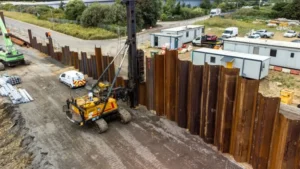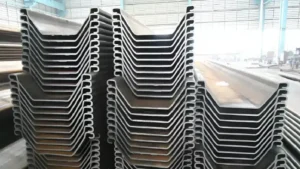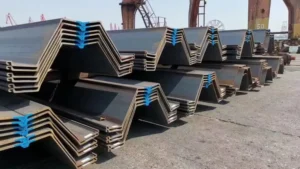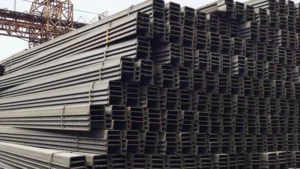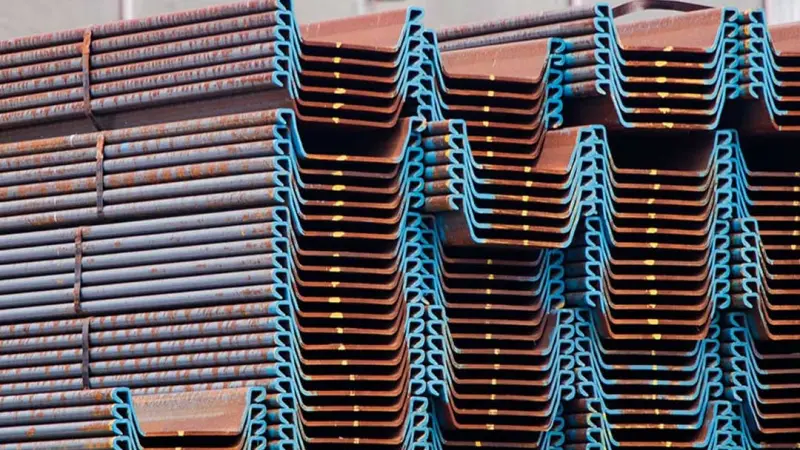
A sheet pile wall may look simple on paper, but if the pile cannot reach the target depth in real soil, the whole retaining plan can fail on site.
There is no single universal driving depth limit for sheet piles. In my experience, the practical depth depends on pile section, soil profile, installation method, equipment power, interlock performance, and project tolerance. Steel sheet piles can often be driven to considerable depth, but the real limit is usually set by drivability, alignment control, and the required embedment for stability rather than by one fixed number.
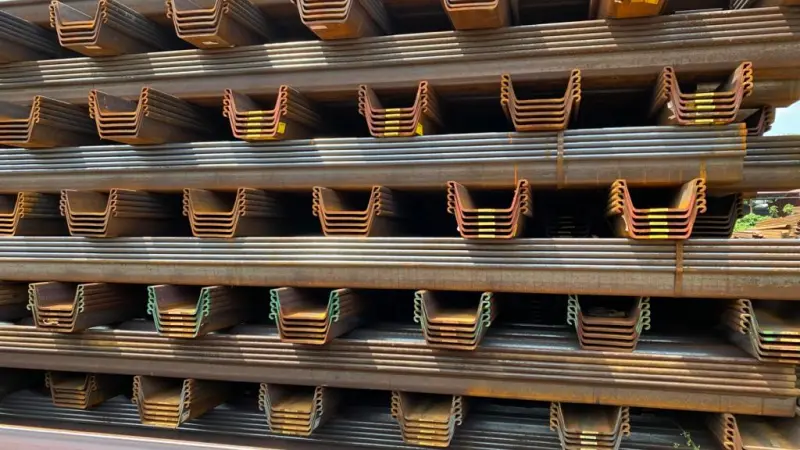
I think “How deep can a sheet pile go?” is one of those questions that sounds simple but is actually asking three different things at once. Some buyers want to know the maximum installation depth a machine can achieve. Some want to know the design embedment depth needed to make the wall stable. Others are really asking about risk: if they buy a certain pile section and length, will the pile actually go into the ground without refusal, damage, or out-of-tolerance driving? I do not like giving a one-line answer to a three-part question, because that is how expensive misunderstandings happen.
From my side, driving depth is never only a steel issue. It is a combination of steel section, soil resistance, groundwater, hammer choice, alignment control, and the wall system itself. A sheet pile can be structurally strong enough on paper and still become the wrong choice if the section is too difficult to drive in the actual geology. I have seen contractors focus on section modulus and bending capacity while paying too little attention to drivability. I think that is a mistake, especially in deep excavation support, waterfront walls, bridge works, and flood control jobs where schedule pressure is high and site conditions are not forgiving.
So in this article, I want to break the topic down in a practical way. I will answer how deep sheet piles can be driven, what the driving tolerances look like, how deep driven piles in general can go, and what I think about the so-called rule of thumb for sheet pile embedment depth. I will also add my own view on a point that gets missed too often: the real driving depth limit is not always the steel. Very often, it is the combination of soil resistance + installation control + the tolerance the project can accept.
How deep can sheet piles be driven?
Sheet piles can be driven to considerable depth, but there is no single universal limit. The achievable depth depends on soil conditions, pile section, pile length, installation equipment, and whether the pile can still be driven accurately without damaging the interlocks or losing alignment.
In practice, steel sheet piles can often be driven from several meters to several tens of meters, and in some projects even deeper with splicing or special installation methods. I do not use one “maximum depth” number. I look at the required embedment, the wall height, the soil profile, and whether the chosen pile section can actually be driven to that depth in the real ground conditions.
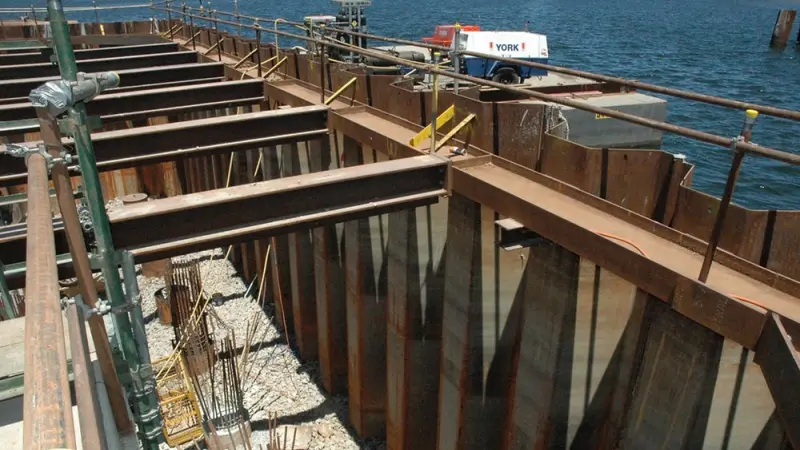
I separate “design depth” from “drivable depth”
When a client asks me how deep sheet piles can be driven, I usually stop and split the question into two parts:
- How deep does the design require the pile to go?
- Can the chosen pile section actually be driven to that depth in this soil with this equipment?
Those are not the same thing. A geotechnical design may say the wall needs 14 m of embedment below dredge level, excavation level, or ground level to control bending, passive resistance, and groundwater. That is the required design depth. But whether the pile can physically be installed to that depth depends on drivability.
The Steel Piling Group makes this point clearly. Steel sheet piles can be driven to considerable depth in a wide range of ground conditions, and even into weathered rock with special measures. But it also notes that where hard driving is encountered, the pile section required for installation may be larger than the section needed for bending resistance. I think that sentence is very important because it captures the real jobsite problem: sometimes the structural design says one section is enough, but the installation reality says you need a stronger or stiffer section just to get it into the ground safely.
There is no fixed “depth limit,” but there are practical ranges
I do not like giving fake precision here. There is no code line that says “all sheet piles stop at X meters.” In real projects, the installed depth can vary a lot:
- short temporary trench sheets may only go a few meters
- deep basement support walls may use sheet piles in the 10–20 m range or more
- marine, quay wall, or flood protection works may go deeper depending on wall height, dredge level, anchor system, and geology
- combined wall systems and spliced piles can go much deeper when the project requires it
Keller’s driven pile guidance notes that driven piles can be installed as a single length or spliced for extremely deep piles. (Keller driven piles) While that page is not only about sheet piles, the principle still matters: steel pile systems are not always limited to the stock length delivered on one truck. If the project needs it, splicing and staged installation can extend the depth range.
What actually controls the depth I can achieve?
1. Soil profile
This is the first thing I look at. A sheet pile that drives smoothly in medium sand may struggle badly in dense gravel, stiff clay with hard layers, demolition fill, cobbles, or weathered rock. ArcelorMittal’s installation guidance says sheet piles can be driven into any type of soil except rock, but the installation is a complex topic that depends heavily on the ground investigation and the equipment choice. I agree with that. “Can be driven” does not mean “can be driven easily, accurately, and economically.”
2. Pile section and stiffness
A deeper wall usually means a longer pile, and a longer pile needs enough stiffness to survive installation without excessive twisting, buckling, or interlock damage. In difficult ground, I often find that the drivable section may need to be heavier than the structurally required section.
3. Installation method
Vibratory hammers are common and fast, especially in granular soils. Impact hammers can finish piles in dense layers or when vibratory driving stalls. Press-in systems are useful where vibration is restricted, but they also have practical length and force limits. Steel Piling Group’s installation methods overview and ArcelorMittal’s equipment guide both show the same lesson: method choice changes the achievable depth and the quality of installation.
4. Alignment and tolerance control
A pile that leans, rotates, or declutches early may lose the chance of reaching the planned depth in good condition. Long piles are more sensitive to alignment problems than short piles. This is why I usually prefer panel driving or good guide systems for longer sheet piles where verticality matters.
5. Driving assistance
Pre-augering, water jetting, or other assistance methods can help a pile reach depth in difficult ground. But these methods also change the soil around the wall and should not be treated as a free bonus. They affect friction, ground movement, and sometimes groundwater flow paths.
My practical view of depth control factors
| Factor | How it affects achievable depth | My view |
|---|---|---|
| Soil type and obstructions | Hard layers, cobbles, or debris may stop or distort the pile | This is usually the first real limit |
| Pile length and section modulus | Longer, stiffer piles are often needed for deep driving | Structural design alone is not enough |
| Hammer type and power | Weak equipment may stall before design depth | Underpowered plant creates false “depth limits” |
| Guide frame and alignment control | Poor control increases lean, rotation, and interlock issues | Long piles need better setup, not just more force |
| Driving assistance methods | Can improve penetration in hard ground | Useful, but should be planned with design awareness |
| Water and groundwater conditions | Can affect friction, stability, and working method | Important in cofferdams and marine work |
My own view: the true depth limit is often economic before it becomes technical
This is the part I think people avoid saying openly. In theory, many sheet pile walls can be made deeper with heavier sections, stronger hammers, pre-drilling, splicing, or combined wall systems. But the question is not only “Can it be done?” The question is “Can it be done with acceptable cost, speed, vibration, tolerance, and risk?”
I have seen cases where a sheet pile wall was technically possible, but once the contractor factored in driving difficulty, hard layers, vibration restrictions, and the need for pre-treatment, another retaining solution started to look more sensible. That does not mean sheet piles were wrong. It means the “depth limit” was no longer a steel limit. It became a project efficiency limit.
What is the driving tolerance for sheet piles?
Driving tolerance for sheet piles is the allowable deviation in position, verticality, and level during installation. The exact tolerance depends on the project and standard used, but sheet pile walls are not expected to land with perfect theoretical accuracy.
Typical sheet pile driving tolerances include limits on lateral position, vertical deviation, and finished top and toe levels. In practical terms, I expect some deviation because driven piles interact with real soil, real equipment, and real obstructions. The key is not zero deviation. The key is staying within a tolerance that still protects wall performance, interlock continuity, and connection details.
I think tolerance is one of the most misunderstood parts of sheet pile work
A lot of non-specialists assume that if the design drawing shows a clean straight wall line, the installed wall should match it almost perfectly. That is not how driven piling works. Sheet piles are long steel elements pushed, vibrated, or hammered into natural ground. The ground is never perfectly uniform. Machines have movement. Interlocks create small rotations. Obstructions appear where nobody expected them. So the wall will always have some tolerance band.
The important question is not “Will the wall be perfect?” It is “What level of inaccuracy can the wall and the structure tolerate without losing performance?”
The Steel Piling Group’s installation tolerance guidance gives very practical reference values based on TESPA and EN 12063. For sheet pile walls, it lists typical tolerances such as:
- lateral deviation at the top of the pile: ±50 mm
- vertical deviation from verticality normal to the wall line: ±1% of driven depth
- vertical deviation along the wall line: about ±0.5% to ±1% of driven depth depending on driving method
- top level deviation: ±20 mm
- toe level deviation: ±120 mm
I like these numbers because they are realistic. They acknowledge that driven piling is a field operation, not a laboratory exercise.
Why tolerance matters more than many buyers think
1. Structural performance
If the wall is significantly out of line or leaning, the bending behavior and anchor geometry can change. In deep excavations, small errors at the top can turn into much larger offsets at the toe because the pile is long.
2. Interlock performance and water control
If piles rotate or declutch, the wall may lose continuity. That matters for structural performance, but it also matters for seepage control. A sheet pile wall that is out of tolerance is not only an alignment problem. It may also become a leakage problem.
3. Connection to walers, caps, slabs, or permanent works
If the sheet pile wall supports a capping beam, a slab edge, a bridge abutment detail, or a permanent basement connection, tolerance becomes much more sensitive. A wall that is “acceptable” for temporary earth support may be unacceptable if it also has to receive structural connections later.
4. Aesthetic and dimensional control in permanent works
For river walls, quay walls, and visible permanent retaining structures, line and level matter not only for engineering but also for finish quality.
The tolerance numbers are only the start
I do not treat published tolerances as a substitute for project judgment. A wall in a temporary excavation can usually accept more installation variation than a wall that supports permanent column loads or interfaces with a finished structure. The Steel Piling Group also notes that tighter tolerances may be needed in basement construction and other constrained sites, and that tighter tolerances usually cost more time and money. I think that is a very honest statement.
My practical tolerance checklist
| Tolerance topic | Why I check it | What can go wrong if ignored |
|---|---|---|
| Top-of-pile line | Affects wall alignment and cap details | Crooked wall line, difficult capping, fit-up issues |
| Verticality | Affects toe position and wall behavior | Toe drift, loss of passive resistance, anchor misfit |
| Rotation about pile axis | Affects interlock integrity and wall face line | Declutching, leakage, poor wall continuity |
| Top and toe level | Affects embedment and final cut level | Reduced embedment or excessive trimming |
| Guide frame quality | Controls installation accuracy from the start | Repeated correction attempts and damaged interlocks |
My own view: tolerance problems often begin with the installation method, not the operator alone
I do not like blaming site crews too quickly when a wall goes out of tolerance. In my experience, tolerance problems often start earlier with the chosen installation method, lack of guide frames, wrong sequencing, or trying to drive long piles one by one without enough control. The ArcelorMittal Piling Handbook makes a useful point here. It explains that panel driving has traditionally been recommended to improve installation accuracy, although modern pitch-and-drive methods have improved with better rigs. I think that is exactly the kind of practical nuance buyers need to hear. Tolerance is not only about being “careful.” It is also about using a setup that gives the crew a realistic chance of success.
How deep can driven piles go?
Driven piles can go very deep when the design, soil conditions, and installation method allow it. But “driven piles” is a much broader category than “sheet piles,” so I do not use the same depth expectations for all pile types.
Driven piles can reach significant depths, often tens of meters, and in some cases more than 80 meters depending on pile type, splicing, and soil conditions. For steel sheet piles, the practical depth is usually governed by retaining wall design and drivability. For bearing piles such as steel H-piles, pipe piles, or precast piles, the depth may be much greater because the pile is designed mainly for axial load transfer rather than wall behavior.
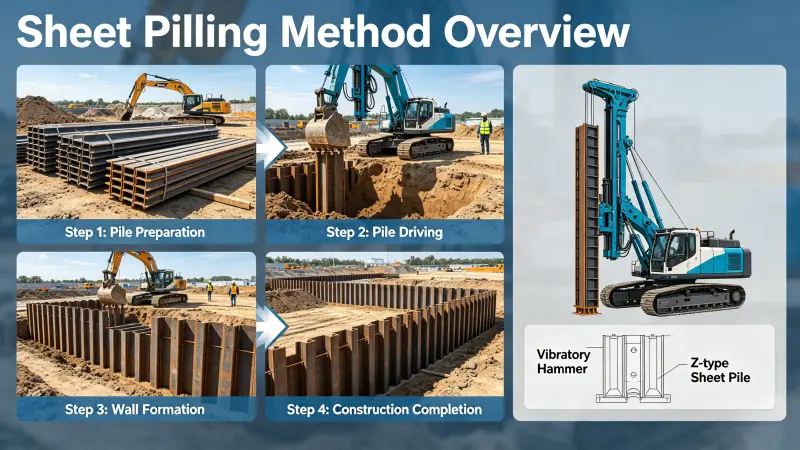
I do not like mixing sheet piles and bearing piles without saying so
This question is important because it is easy to mix up two very different things:
- sheet piles used as retaining elements
- bearing piles used as foundation elements
Both are “driven piles,” but they are not driven for the same purpose. A steel sheet pile wall is usually installed to resist lateral soil pressure, create a cut-off, or form a retaining system. A bearing pile is usually installed to transfer vertical load into deeper competent soil or rock. Because the design goals are different, the depth ranges can be very different too.
Keller’s driven pile guidance says driven piles can be installed in a single length or spliced for extremely deep piles. (Keller driven piles) Keller’s driven precast pile page goes even further and notes that driven piles may be installed to significant depths greater than 80 m. (Keller driven precast piles) I would never quote that number as a normal sheet pile depth, but I do think it is useful context. It reminds buyers that “driven pile depth” as a general concept can be much greater than the depth of a typical retaining wall sheet pile installation.
How I think about driven pile depth by pile type
1. Steel sheet piles
I treat the depth of a sheet pile wall as a retaining wall design + drivability problem. The wall needs enough embedment for stability, but it also needs to be installable with acceptable tolerance and without damaging the interlocks. That makes the practical depth range very project-specific.
2. Steel H-piles and pipe piles
These can go much deeper when used for foundations. The pile may be driven to a target resistance, a set criterion, or a competent bearing layer. Splicing makes very deep installations possible.
3. Precast concrete driven piles
These are also used for deep foundation work and can reach major depths if the joints, hammer system, and soil conditions allow it.
4. Timber piles and short temporary piles
These usually sit at the shallow end of the driven pile spectrum.
What limits the depth of driven piles in general?
Soil resistance
This is the most obvious one. Dense sand, hard clay, gravel, and rock layers all change the achievable depth and the required energy.
Structural capacity during driving
A pile must survive the installation process. If the hammer energy, pile stiffness, cap system, or alignment are wrong, the pile may be damaged before it reaches the target depth.
Splicing strategy
Very deep driven piles are often not a single delivered piece. They are installed in segments and spliced as the work progresses.
Equipment and access
Even if the design allows a deep pile, the site may not have the crane height, rig capacity, or working platform conditions needed to install it efficiently.
My comparison of driven pile depth logic
| Pile type | Main design purpose | Typical depth logic |
|---|---|---|
| Steel sheet pile | Retaining wall / cut-off / lateral support | Governed by wall embedment + drivability |
| Steel H-pile | Bearing / axial load transfer | Governed by depth to competent layer or resistance |
| Pipe pile | Bearing, marine, or heavy foundation | Can be very deep with splicing |
| Precast driven pile | Foundation support | Driven to design resistance or target depth |
| Trench sheet | Temporary shallow support | Usually shallow compared with heavy retaining systems |
My own view: buyers should stop using “driven pile depth” as a shortcut for “sheet pile depth”
I see this confusion often enough that I want to say it directly. If a client reads that driven piles can go 60 m or 80 m deep, that does not mean a standard sheet pile retaining wall should be thought of in the same way. Sheet pile depth is tied to excavation geometry, passive resistance, water control, and installation tolerance. Bearing pile depth is tied to load transfer and geotechnical resistance. Both are driven piles, but the design conversation is different. I think mixing them leads to unrealistic expectations about what a sheet pile wall is supposed to do.
What is the rule of thumb for sheet pile embedment depth?
There is no single rule of thumb that I trust for all sheet pile embedment depths. People sometimes use simple percentages or rough ratios, but I do not think those are reliable enough for real retaining wall decisions without checking soil, water, surcharge, and support conditions.
A common rough idea is that sheet piles need meaningful embedment below excavation or dredge level to mobilize passive resistance and control movement, but I do not recommend relying on a fixed ratio alone. The required embedment depth depends on wall height, soil parameters, groundwater, surcharge, support system, and whether the wall is cantilevered or anchored. For real projects, I always want embedment checked by design rather than by a generic rule of thumb.
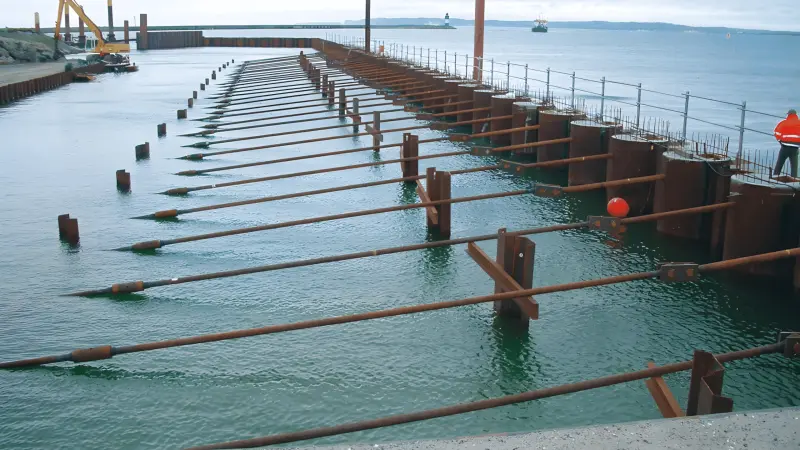
I understand why people want a shortcut, but I do not trust shortcuts here
I understand the attraction of a simple rule. If a contractor is pricing quickly or comparing alternatives, a rule of thumb feels useful. It gives a starting point before the full design is ready. But I think embedment depth is one of the most dangerous places to oversimplify a sheet pile wall.
Why? Because embedment is not only there to “hold the pile up.” It is there to provide passive resistance, reduce bending demand, control wall movement, and sometimes help control groundwater flow under the wall. If the embedment is too shallow, the wall may still stand for a while, but it can move too much, leak too much, or fail under the wrong load combination.
The rough rules people use
In early-stage discussion, people sometimes use broad ideas like:
- embedment as a percentage of retained height
- deeper embedment for cantilever walls than for anchored walls
- deeper embedment in soft soils or high groundwater conditions
- a first-pass check based on similar past projects
I understand the purpose of these shortcuts. They help with early budgeting. But I do not want them to become design rules.
Why a fixed embedment ratio can mislead the buyer
1. Soil strength changes everything
A wall in dense sand does not behave like a wall in soft clay. The passive resistance below excavation level can be completely different even if the visible retained height is the same.
2. Groundwater changes the wall behavior
Water pressure matters. If the wall is near a river, below the water table, or retaining saturated soil, the embedment demand can increase. Underseepage and base stability also become part of the picture.
3. Anchored walls and cantilever walls are not the same
A cantilever wall usually needs more embedment than an anchored wall of similar retained height because the support mechanism is different.
4. Surcharge loads change the pressure distribution
Nearby traffic, stored material, cranes, buildings, or temporary construction loads can increase the earth pressure and change the required embedment.
5. Serviceability matters, not only ultimate stability
A wall can be “safe” in a basic ultimate sense and still move more than the project can tolerate. Embedment often has to satisfy movement limits, not only collapse checks.
A more useful way to think about embedment
Instead of asking for one magic ratio, I prefer to ask four questions:
- What wall system is it? Cantilever, anchored, propped, combi-wall, temporary trench sheet, or permanent waterfront wall?
- What is the retained height and groundwater condition?
- What are the soil layers below excavation level?
- What movement and seepage performance does the project require?
Only after that do I start feeling comfortable about embedment.
My practical embedment checklist
| Question | Why I ask it | What it changes |
|---|---|---|
| Is the wall cantilever or anchored? | Support system changes bending and passive demand | Major effect on embedment depth |
| What is the soil below dredge or excavation level? | Passive resistance comes from this zone | Weak soils often require deeper embedment |
| Is groundwater present? | Water affects pressure and seepage | May require deeper cut-off and stability checks |
| Are there surcharge loads nearby? | Added load increases wall demand | Embedment may need to increase |
| Is movement control critical? | Serviceability can govern | May require more embedment than simple stability alone |
My own view: the best “rule of thumb” is to use rules of thumb only for budgeting, never for final buying decisions
If I am having a very early conversation with a contractor, I do not mind using rough embedment thinking to compare wall options. It helps narrow down section ranges and likely pile lengths. But once the project becomes real, I want the embedment depth checked properly. The cost difference between a slightly shorter pile and a slightly longer pile may look significant in procurement, but the cost of a wall that moves too much, leaks too much, or cannot be driven to the required toe level is much worse.
ArcelorMittal’s installation guideline gives a useful drivability rule of thumb from a different angle: the recommended sheet pile length in centimeters roughly corresponds to the section modulus in cm³/m, subject to soil conditions. (Installation Guideline AZ-800 & AZ-750) I think that is a helpful installation check, but it is not a substitute for embedment design. That difference matters. One rule helps me think about whether the pile can be driven. The other question is whether the wall is actually stable and serviceable.
My practical checklist before I commit to a deep sheet pile wall
If a client asks me to quote a deeper sheet pile solution, these are the questions I want answered before I feel comfortable:
1. Do we have a real soil profile, not only a surface description?
“Clay” or “sand” is not enough for a deep retaining wall. I want the layer sequence, density or consistency, groundwater, and any sign of obstructions or hard layers.
2. Is the wall temporary or permanent?
This changes section selection, corrosion thinking, tolerance expectations, and how much installation risk I am willing to accept.
3. Is the wall cantilever, anchored, or propped?
That changes the embedment logic immediately.
4. Is the chosen section strong enough to drive, not only strong enough to resist bending?
This is where I think many mistakes happen.
5. What installation method is planned?
Vibratory driving, impact hammering, pressing, and assisted driving do not create the same field result.
6. What tolerance does the project really need?
If the wall must tie into a permanent structure, I need to know that before the piles are on the truck.
7. What happens if refusal or hard driving is encountered?
I prefer to discuss contingency early: pre-augering, switching hammer type, splicing, or changing section.
Conclusion
I do not believe in one fixed depth limit for sheet piles. In my view, the real answer comes from design depth, soil resistance, installation method, and the tolerance the project can realistically control.