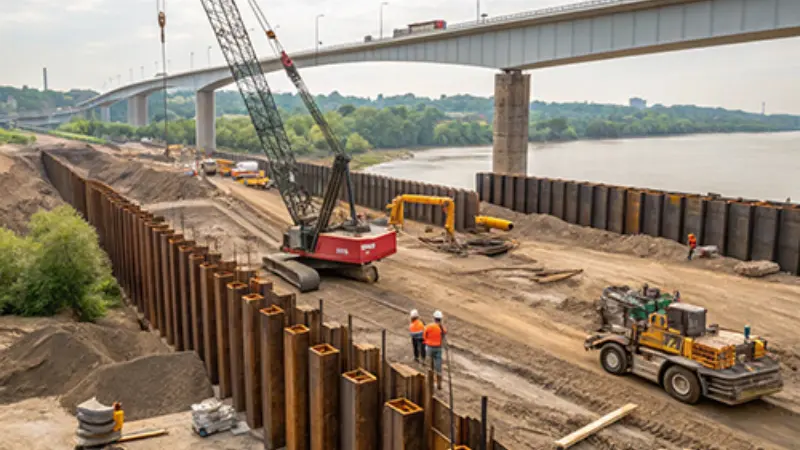
I have seen many contractors and engineers get confused about earth pressure. They know it is important for sheet pile design, but they are not sure about the different types. This confusion can lead to incorrect designs and unsafe walls.
Passive and active earth pressure are the two extreme states of soil pressure on a retaining wall. Active pressure occurs when the wall moves away from the soil, reducing the lateral pressure. Passive pressure occurs when the wall is pushed into the soil, increasing the lateral pressure. These are key concepts for designing sheet pile walls.
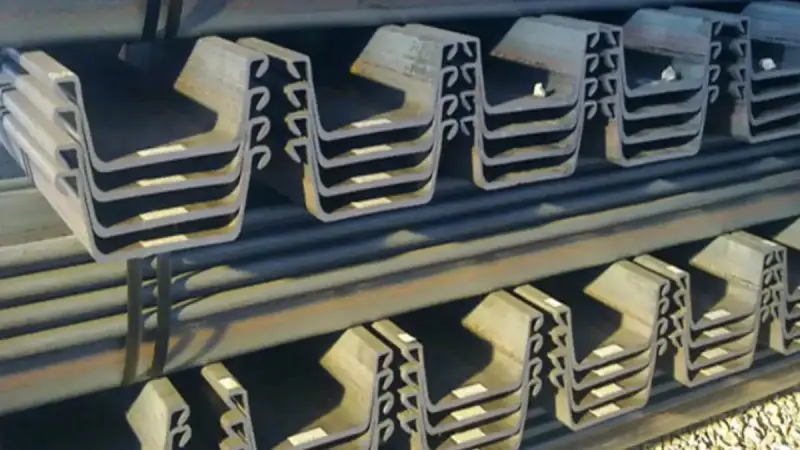
I have worked with steel sheet piles for years. I have supplied them for riverbank protection, port construction, and deep excavation support. Understanding earth pressure is the foundation of good sheet pile design. Let me walk you through what these terms mean and how to calculate them.
What are the three types of earth pressure?
I often get this question from new designers. They hear about active and passive pressure but are not sure about the third type. The answer is simple and important.
The three types of earth pressure are at-rest, active, and passive. At-rest pressure happens when the wall does not move at all. Active pressure happens when the wall moves away from the soil. Passive pressure happens when the wall is pushed into the soil. These three states cover all possible wall movement conditions.
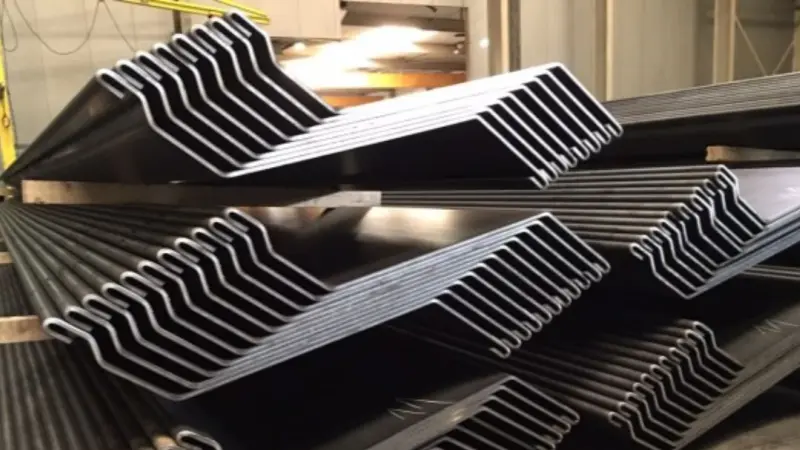
Breaking Down the Three States
Let me explain each type in detail. This will help you understand when to use each one in your design.
1. At-Rest Earth Pressure
This is the pressure when the wall does not move at all. The soil is not pushing the wall, and the wall is not pushing the soil. The lateral pressure is determined by the at-rest earth pressure coefficient, K₀. For normally consolidated soils, K₀ is approximately 1 – sin(φ’). Typical values for K₀ range from 0.4 to 0.6. This condition is used for rigid walls that cannot move, like basement walls.
2. Active Earth Pressure
This happens when the wall moves away from the soil. The soil expands laterally, and the pressure decreases. The wall must move a small amount to reach the active state. For granular soils, the required movement is about 0.1% to 0.4% of the wall height. The active pressure is the minimum lateral pressure. It is calculated using the active earth pressure coefficient, Kₐ.
3. Passive Earth Pressure
This happens when the wall is pushed into the soil. The soil is compressed, and the pressure increases. The passive pressure is the maximum lateral pressure. The wall must move a larger amount to reach the passive state than to reach the active state. The passive pressure is calculated using the passive earth pressure coefficient, Kₚ. Typical values for Kₚ range from 3 to 5 for granular soils.
A Quick Comparison Table
| Type | Wall Movement | Pressure Level | Coefficient | Typical K Value (Granular) |
|---|---|---|---|---|
| At-Rest | None | Medium | K₀ | 0.4 – 0.6 |
| Active | Away from soil | Minimum (Low) | Kₐ | 0.2 – 0.33 |
| Passive | Into soil | Maximum (High) | Kₚ | 3 – 5 |
How do you calculate passive earth pressure?
This is a common question from design engineers. They need to know the passive resistance to check the stability of a sheet pile wall. The calculation is based on the soil properties and the depth.
Passive earth pressure is calculated using the formula p_p = K_p × γ × z + 2c × √K_p. Here, K_p is the passive earth pressure coefficient, γ is the soil unit weight, z is the depth, and c is the cohesion. For granular soils with no cohesion, the formula simplifies to p_p = K_p × γ × z.
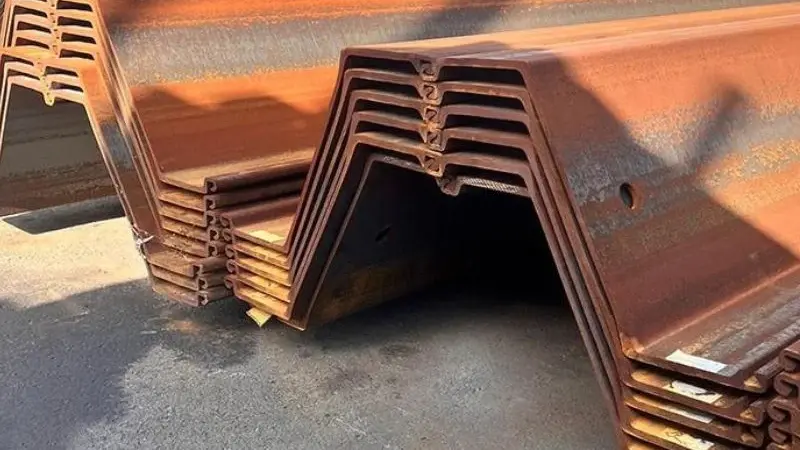
The Passive Earth Pressure Coefficient (Kₚ)
The key to calculating passive pressure is the coefficient Kₚ. This coefficient depends on the soil’s friction angle.
Rankine’s Theory for Kₚ
For a smooth, vertical wall with a horizontal backfill, Rankine’s theory gives a simple formula:
- Kₚ = tan²(45° + φ’/2)
For example, if the soil has a friction angle of 30°, then:
- Kₚ = tan²(45° + 15°) = tan²(60°) = 3.0
Coulomb’s Theory for Kₚ
Coulomb’s theory is more general. It considers wall friction and the wall slope. The formula is more complex, but it gives a more realistic result for many practical cases. For a general explanation of retaining wall pressure theory, see Retaining wall and Lateral earth pressure.
Typical Values for Kₚ
For most granular soils, Kₚ ranges from 3 to 5. Higher friction angles give higher Kₚ values. This means the soil can provide more passive resistance.
A Simple Calculation Example
Imagine a sheet pile wall in dry sand. The soil has a unit weight of 18 kN/m³ and a friction angle of 30°. The wall is smooth and vertical. What is the passive pressure at a depth of 5 meters?
- Kₚ = tan²(45° + 15°) = 3.0
- p_p = Kₚ × γ × z = 3.0 × 18 × 5 = 270 kN/m²
This is the pressure at that depth. The total passive force on the wall is the area of the pressure diagram.
How to calculate active earth pressure?
This is a question I get from many contractors. They need to know the active pressure to design the wall properly. The calculation is similar to passive pressure but uses a different coefficient.
Active earth pressure is calculated using the formula p_a = K_a × γ × z – 2c × √K_a. Here, K_a is the active earth pressure coefficient, γ is the soil unit weight, z is the depth, and c is the cohesion. For granular soils with no cohesion, the formula simplifies to p_a = K_a × γ × z.
The Active Earth Pressure Coefficient (Kₐ)
The active pressure coefficient Kₐ is much smaller than Kₚ. This is because active pressure is the minimum pressure.
Rankine’s Theory for Kₐ
For a smooth, vertical wall with a horizontal backfill:
- Kₐ = tan²(45° – φ’/2)
For a soil with a friction angle of 30°:
- Kₐ = tan²(45° – 15°) = tan²(30°) = 0.333
Coulomb’s Theory for Kₐ
Coulomb’s theory for active pressure gives a more general formula. A useful reference for earth pressure concepts is Lateral earth pressure.
Typical Values for Kₐ
For most granular soils, Kₐ ranges from 0.2 to 0.33. Lower friction angles give higher Kₐ values. This means the soil exerts more active pressure.
The Effect of Cohesion
For cohesive soils, the active pressure is reduced by the cohesion term: -2c × √Kₐ. This means a cohesive soil exerts less active pressure on a wall. It can also create a tensile crack at the top of the wall.
A Simple Calculation Example
Using the same soil as before (γ = 18 kN/m³, φ’ = 30°), what is the active pressure at a depth of 5 meters?
- Kₐ = tan²(45° – 15°) = 0.333
- p_a = Kₐ × γ × z = 0.333 × 18 × 5 = 30 kN/m²
This is much smaller than the passive pressure at the same depth. The active pressure is about 30 kN/m², while the passive pressure is 270 kN/m².
When to use at rest or active earth pressure?
This is a critical question for designers. Using the wrong type of earth pressure can lead to an unsafe design. The choice depends on how much the wall can move.
Use at-rest pressure for rigid walls that cannot move, like basement walls. Use active pressure for walls that can move away from the soil, like cantilever sheet pile walls. Use passive pressure for walls that are pushed into the soil, like the toe of a sheet pile wall.
A Practical Decision Guide
Let me give you a simple guide to help you decide which pressure to use.
Use At-Rest Pressure When:
- The wall is rigid and not allowed to move.
- The wall is a basement wall or a bridge abutment.
- You need to estimate the pressure on a rigid structure.
- There is no expected wall movement.
Use Active Pressure When:
- The wall can move away from the soil.
- You are designing a cantilever sheet pile wall.
- You are designing a retaining wall.
- The wall movement is expected to be small but sufficient to mobilize active pressure.
Use Passive Pressure When:
- The wall is pushed into the soil.
- You are checking the toe of a sheet pile wall.
- You are designing a wall that resists lateral forces.
- The wall movement is large enough to mobilize passive pressure.
The Movement Requirement
The key factor is the amount of wall movement required. Active pressure requires less movement than passive pressure. For granular soils, the active state is reached with a wall movement of about 0.1% to 0.4% of the wall height. The passive state requires a much larger movement.
Conclusion
Active earth pressure occurs when a wall moves away from soil, giving the minimum lateral pressure. Passive pressure occurs when a wall moves into soil, giving the maximum lateral resistance. Use active pressure for sheet pile wall design and passive pressure for toe resistance.